
The Identical

Posted on September 4, 2014 at 5:51 pm

C-
Lowest Recommended Age: Middle School
MPAA Rating: Rated PG for thematic material and smoking
Profanity: Mild language
Alcohol/ Drugs: Drinking, smoking
Violence/ Scariness: Some scuffles
Diversity Issues: None
Date Released to Theaters: September 5, 2014

Copyright 2014 City of Peace Films
“The Identical” is an incompetent mishmash of mawkish sentimentality larded with a few pleasant musical numbers and some random asides about Israel.  I’m not making this up.

It is inspired by an intriguing fact.  Elvis Presley was a twin.  His brother was stillborn.  Screenwriter Howard Klausner (“The Grace Card”) changes the names and imagines what would have happened if the twin had lived but been raised in a different family.  The focus of this story is on Ryan Wade (Elvis impersonator Blake Rayne), the boy who was given up, adopted by a kindhearted Baptist preacher and his wife, played by Ray Liotta and Ashley Judd.  We don’t know much about the child who stayed with his biological parents except that he grew up to be a rock and roll superstar known as “The Dream.” Ryan is a good kid who loves music.  After a stint in the army, he tells his father that he won’t be following him into the clergy.  He works as a mechanic until he wins a Dream impersonation competition and gets hired to perform at state fairs and other venues. We get glimpses of The Dream (also played by Rayne), performing, riding in a limo through a cornfield, flying in a private plane, looking haunted, but we never find out anything about what his life was like, or what music means to him.

The dramatic possibilities in this story surely have to be in the nature/nurture saga that explains the enduring popularity of real-life stories of identical twins separated at birth as well as fictional tales from “The Man in the Iron Mask” to “Big Business.” And there is some potential for pointed satire along the lines of “Walk Hard” or a thoughtful exploration of the racial and cultural divides that melded into the early years of rock and roll. But “The Identical” bypasses all of this for a story that is both lightweight and dreary and a hero who is too good to be true, played by performer who is much more comfortable with the musical numbers than he is with the dialog. I do give him credit for holding his own despite a series of some of the most appalling wigs ever put on screen.

Even supremely talented actors like Liotta and Judd can’t make much of this movie’s dialog, which is stilted and pedestrian. Among the missed opportunities here is the chance to see what Liotta could do delivering a stem-winding sermon to his Baptist congregation. He does deliver some nice thoughts about kindness and tolerance. But all we get from his appearances in church is a watered down commentary on the importance of supporting Israel (with candles burning on a menorah behind him!) during the 6-Day War of 1967. While the film is being marketed as faith-based, there is very little content relating to the role of faith in the lives of any of the Christian or Jewish characters. It is awkwardly written and uncertain in tone, failing as commentary and as story.

Parents should know that this film includes drinking, smoking, difficult family issues, sad deaths, and family conflicts.

Family discussion: Should Reece have told Ryan the truth? Why do audiences like tribute groups that imitate star performers?

If you like this, try: “August Rush” and “The Buddy Holly Story”
Related Tags:


Drama Family Issues Movies -- format Musical

Love is Strange

Posted on August 28, 2014 at 5:59 pm

Love is strange.  As this movie opens, a deeply devoted couple of more than three decades wakes up and prepares for a big, important, emotional, happy occasion.  They bicker a little bit, but it is clear to them and to us that these are reassuringly familiar rhythms for them, almost a contrapuntal love duet in words.  Later in the film, two people who admire and care for each other deeply but are getting on one another’s nerves, converse in terms that are genuinely thoughtful and polite, and yet it is clear to us and to them that they are seconds short of wanting to throttle each other.  One of them will tell his husband in a phone call, “When you live with people, you know them better than you want to.”  That is, unless you share a true, romantic love.  That’s what’s strange — how it is that other people’s quirks that would annoy us if we spent too much time together somehow seem endearing when it is someone you love.  Love is what makes us not strange to the special people who truly understand us.

Copyright 2014 Sony Pictures Classics

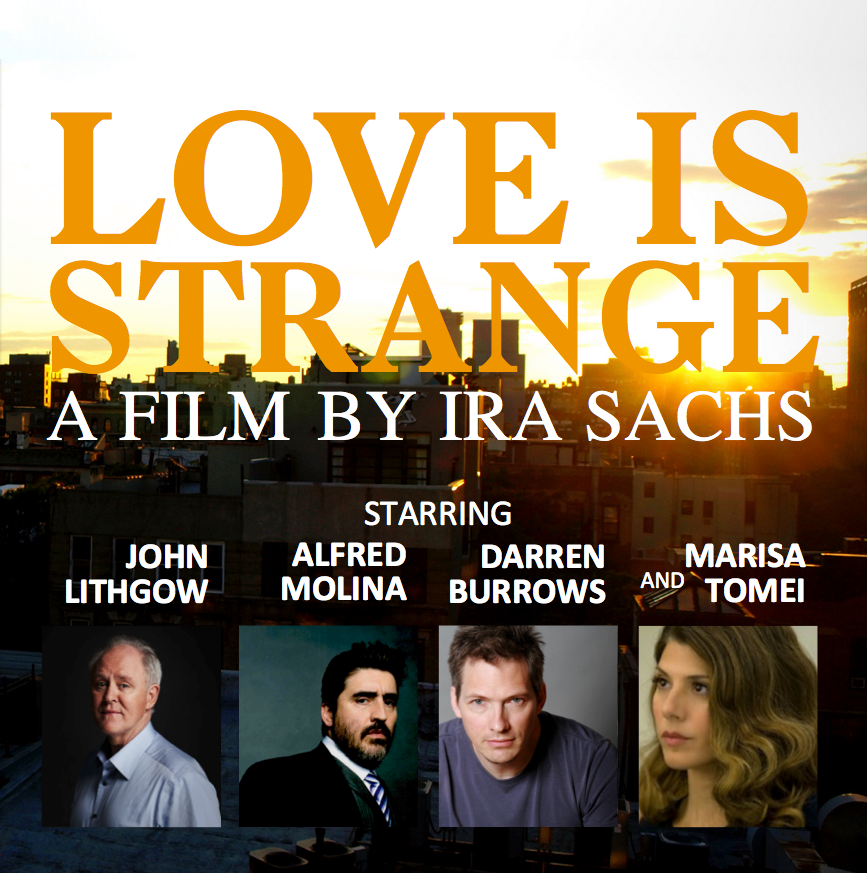
John Lithgow and Alfred Molina play Ben and George, a comfortable but far from wealthy couple who have lived happily together in New York, in a life rich with art, culture, friends, and family.  Ben is an artist.  George is a choir leader in a Catholic school.  As the film opens, it is their wedding day.  Gathered in their apartment afterward, they are toasted by their loved ones, including Ben’s niece-in-law, Kate (Marisa Tomei), a writer, who makes a beautiful speech about how seeing them together, when she was dating their nephew, showed her what a loving partnership could be.

But their marriage is too much for the bishop who oversees George’s school, and he is fired.  Ben and George go into financial free-fall.  They can no longer afford their apartment, and they call on their friends and family to help them while they try to find something less expensive. Everyone wants to help, but this is New York, where space is very limited, and no one can take them both. (A niece who lives in a large house in Poughkeepsie keeps offering, but no one considers that an option.) Ben goes to stay with his nephew, a harried documentary filmmaker, and his wife, Kate, and their teenage son, Joey (Charlie Tahan). He will be sleeping in Joe’s bunk bed. George will be sleeping on the sofa in the small apartment of friends, another gay couple, both cops, who have an active social life.

What “Brokeback Mountain” did to convey that movie romances between gorgeous, glamorous movie stars do not all have to be heterosexual, this film does even better for showing us that the real love story is the one that stretches over decades. Lithgow and Molina exquisitely capture the intimacy and interdependence that only those in very long-term relationships understand. They lightly touch on past disappointments, even betrayals. They tenderly support one another’s vulnerabilities.

The brilliant timing and wit of the scene where Kate is trying to get work done while Ben is cluelessly trying to be a good guest by making social chit-chat is a highlight. Tomei is outstanding, as always. Tahan is marvelously open as a good kid who understandably feels crowded to have a 70-something uncle in his bunk bed. Writer-director Ira Sachs has enough respect for his characters and his audience to allow everyone to be nice. There are no bad guys here (except for the off-screen bishop). But that just makes clear how precious those moments are when we experience the love of those to whom we are never strangers.

Parents should know that this movie is rated R for language only.  There is a sad death.

Family discussion:  What would you advise Ben and George to do?  This movie shows small moments many movies overlook and skips the big moments many movies would include – – why?

If you like this, try: writer/director Ira Sachs’ other films, including “Married Life,” and the classic 1937 film Make Way for Tomorrow.

Related Tags:


Family Issues

The November Man

Posted on August 27, 2014 at 10:57 am

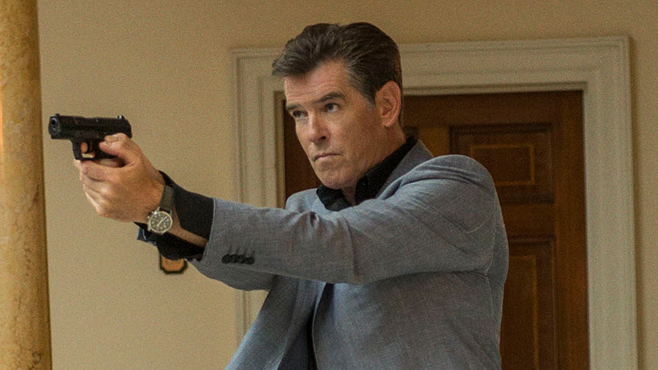
Pierce Brosnan knows what it is like to play a spy in a big-budget, glamorous, blockbuster. He was the most urbane of Bonds in four movies. He knows what it is to play a seedier spy in a prestige, mildly meta movie, the 2001 film “The Tailor of Panama” (with Daniel Radcliffe in a pre-Potter role). So perhaps he thought it was a good idea to produce and star in “The November Man,” a spy story set mostly in Eastern Europe, based on There Are No Spies by Bill Granger. It was not. “The November Man” barely reaches the standard of a generic throw-away thriller, with a sub-par storyline and painfully tiresome dialog.
Copyright 2014 Relativity Media

It begins in 2008 Montenegro, as a venerable CIA operative named Peter Devereaux (Brosnan) sees his young padawan smooching with a pretty girl at an outdoor cafe and harshly explains that personal relationships are out of the question in their line of work. He indicates a guy with a telephoto lens at a nearby table. “Us or them?” the spy-in-training asks. “How the F should I know? Does it really matter?” the world-weary sensei responds. This brief exchange tells you pretty much everything you need to know, or, rather, will find out whether you want to know it or not. Do you think that Devereaux will have some personal entanglement of his own? Do you think the question of who is “us” and who is “them” will provide the twist so unsurprising that even the idiot with the roller bag who wanders out of the hotel elevator without noticing that everyone around him has guns could figure it out? Are the answers to these two rhetorical questions obvious? Well, so is the movie.

Obvious, that is, when it isn’t just being stupid. Throughout the film, shoot-outs, car chases, and explosions occur almost constantly and yet none of the extras ever seem to notice and no one ever calls the police.

The sidekick trainee is David Mason, played by Australian actor Luke Bracey with a blankness that may explain why he was cast as Johnny Utah in the unnecessary upcoming remake of “Point Break.” Bill Smitrovich is, as always, just fine as Dvereaux’s spy boss.  Brosnan, even with all of his movie star charisma, cannot make this tired storyline or pedestrian action scenes hold our interest. It is all as pointless as the explanation for the title — a character explains that was Devereaux’s office nickname because after him, there’s nothing left. Huh? After November is, well, December, and Christmas, and then a whole new year. Pondering the meaning of the nickname, though, was much more entertaining than the film.

Parents should know that this film has extensive spy-style peril and violence including some graphic and disturbing scenes, guns, explosions, chases, torture, with many characters injured and killed, also rape, child prostitution, terrorism, drinking, smoking, drugs, sexual references and situation, and very strong, offensive, and crude language.

Family discussion: How can we balance the need for national security with the need for accountability? How did Mason decide who to trust? What does the reveal about the villain tells us about contemporary geopolitics?

If you like this, try: Pierce Brosnan’s James Bond films and “The Matador”

Related Tags:


Action/Adventure Spies Thriller

If I Stay

Posted on August 21, 2014 at 6:00 pm

B
Lowest Recommended Age: Middle School
MPAA Rating: Rated PG-13 for thematic elements and some sexual material
Profanity: Some strong language
Alcohol/ Drugs: Drinking, including teen drinking
Violence/ Scariness: The film's themes include a tragic accident, characters injured and killed
Diversity Issues: None
Date Released to Theaters: August 22, 2014
Date Released to DVD: November 17, 2014
Amazon.com ASIN: B00NT964VS
Copyright 2014 Warner Brothers Studio

Hamlet asked it best. “To be, or not to be: That is the question.” We struggle through, worrying about whether someone likes us or whether we will be accepted at the school of our choice. Those seem like serious problems. And then something really huge shows us how small those problems are, and forces us to confront the only question that matters: will we continue to “suffer the slings and arrows of outrageous fortune” or will we obliterate ourselves, and everything we can perceive?

That is the question faced by a young cellist named Mia (Chloë Grace Moretz, in one of her first roles as a normal girl).  She has a wonderful family, loving, supportive, understanding and remarkably hip and gorgeous parents (Mireille Enos as Kat and Joshua Leonard as Denny) and a not-too-pesky kid brother named Teddy (Jakob Davies).  She has the kind of kindred spirit best friend who is always vitally interested in every detail and always on her side (“Trust’s” terrific Liana Liberato). And they are a part of a warm, loving community in Portland, Oregon that seems like an endless pot luck dinner party, seamlessly blending from one time and place to another, always filled with laughter and music.

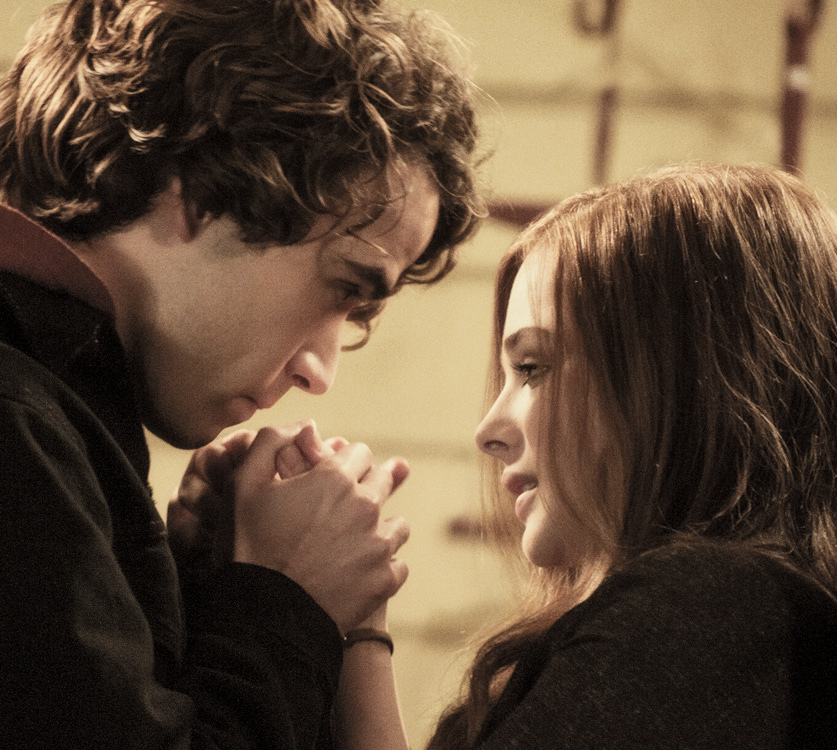
And there is Adam (Jamie Blackley).  He is the perfect combination of untamed/angsty and utterly devoted swain. He is supposedly a punk musician, though his performances are disconcertingly pop-ish with even a bit of emo. And he says swoon-worthy things like, “You can’t hide in that rehearsal room forever. It’s too late. I see you.” Mia feels like an outsider as a classical cellist in a family of rock musicians. And, of course, she attends high school with teenagers who have no interest in orchestral music. “Right on, I love classic rock,” one of them responds when Mia tries to explain the kind of music she plays.

Adam watches Mia rehearse and instantly sees that in the most important way she is just like him. She is someone who is not just moved by music, but saved by it. She says, “I loved the order, the structure, that feeling in my chest. Like my heart is beating with the cello.” The “whole messy live for the moment punk rocker thing” does not feel right to her.

Soon Adam and Mia are a couple. But then his group becomes successful and he starts to tour. And she may have a chance to go to Juilliard, on the other side of the country.

And then there is the accident. Mia’s family takes advantage of a snow day to go off on an excursion together, but a car slips on the ice and there is a very bad crash.  The entire story is told as Mia’s spirit, alone in the limbo between life and death, able to see and hear everyone around her but not able to be seen or heard, is remembering her life, beginning to understand what has happened, and recognizing that it is up to her to decide whether to re-enter her body and fight to stay alive.

Gayle Forman‘s book is thoughtfully adapted by Shauna Cross (“Whip It”), who has a good sense of the inner lives of teenage girls. While Adam and Mia have their struggles, they are thankfully a step above the typical teenage drama (on and off-screen), and almost always respectfully handled and based in character and context and not the usual sitcom-ish miscommunication.  Moritz takes on a tough challenge in playing a character who has to express so much anxiety with so little interaction with other actors, except in flashbacks.  She does well, as does director R.J. Cutler in keeping an internal story visually engaging.  If it doesn’t have the emotional impact of recent YA weepies like “The Spectacular Now” and “The Fault in Our Stars,” it is a touching story about an appealing young couple.

Parents should know that this film has literal life-and-death situations, with a serious accident, and characters injured and killed. It also includes strong language, teen drinking, and non-explicit sexual references and situations.

Family discussion: How did their families influence the different ways Adam and Mia saw their options? Why did Mia’s grandfather tell her she could go? What would you decide and why?

If you like this, try: “The Spectacular Now,” “Save the Last Dance,” and “Bandslam” as well as the book by Gayle Forman and its sequel, told from Adam’s perspective, Where She Went

Related Tags:


Based on a book Drama DVD/Blu-Ray Pick of the Week High School Romance Stories about Teens Teenagers
THE MOVIE MOM® is a registered trademark of Nell Minow. Use of the mark without express consent from Nell Minow constitutes trademark infringement and unfair competition in violation of federal and state laws. All material © Nell Minow 1995-2026, all rights reserved, and no use or republication is permitted without explicit permission. This site hosts Nell Minow’s Movie Mom® archive, with material that originally appeared on Yahoo! Movies, Beliefnet, and other sources. Much of her new material can be found at Rogerebert.com, Huffington Post, and WheretoWatch. Her books include The Movie Mom’s Guide to Family Movies and 101 Must-See Movie Moments, and she can be heard each week on radio stations across the country.

Website Designed by Max LaZebnik