Minions & Monsters

Minions & Monsters

Posted on June 30, 2026 at 2:57 pm

B +
Lowest Recommended Age: Kindergarten - 3rd Grade
Profanity: None
Alcohol/ Drugs: None
Violence/ Scariness: Cartoon mayhem, peril, and violence, with some comic but graphic moments including a beheading, plus scary monsters
Diversity Issues: Deaf character
Date Released to Theaters: July 1, 2026

It was about the time that tourists on a history of Hollywood tour walked past an animated George Lucas in a glass case, speaking with the ACTUAL VOICE OF THE ACTUAL GEORGE LUCAS that I said, “Okay, my critical faculties have been officially shut down and I am just a happy fangirl at this point.” “Minions & Monsters” continues the origin story of the little yellow guys in denim overalls and now adds in the origin story of the movies, plus a robot voiced by Jesse Eisenberg and some love for the fanboys. That’s a quintella of irresistableness and I did not even try to resist.
Minions & Monsters
Copyright 2026 Universal

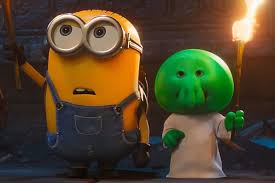
In a present-day prologue, tour guide (Alison Janney) tells a group to take a seat so she can give them the full story of the two minons who changed everything in movies, history, and the world. We go back in time to see them on their quest to find and serve the most evil master in the world. Unfortunately, the minions keep accidentally destroying their “big bosses.” First there is a “scary, burly, and super-mean”gigantic one-eyed ogre, then a wizard with a book of arcane spells, and a despotic king.

Then, they see another promising bad guy, an old West train robber riding a galloping horse. The minions end up taking over the train, which crashes through the city of Los Angeles circa early 1920s (the history dates here are pretty wobbly, but go with it). This gives us a glimpse of iconic silent film characters and settings including Charlie Chaplin in “Modern Times,” Buster Keaton in “Steamboat Bill Jr.,”and Harold Lloyd in “Safety Last.” That train robber? An actor, in a film the minions have just disrupted to the frantic consternation of a dashing monacle-sporting, tweed-knickers-wearing director named Max (Christoph Waltz). But it turns out the brothers who run the movie studio (both voiced by Jeff Bridges) love the chaos of the minions and soon they are big stars, living in an enormous mansion, adored by fans, and selecting what will become their iconic look: denim overalls.

Like many other stars of the silent era and unforgettably depicted in “Singin’ in the Rain,” things change dramatically for the minions when the sound era begins. The minions do not possess the ability to produce intelligable speech. Most of the minions go off in search of another “big boss.” A few, including James, Henry, and Ed, who is Deaf decide that they need to make a monster movie. And so they use the wizard’s book of spells to call up a friendly little green monster (Trey Parker) who promises to bring them to some scary but cooperative monsters.

Meanwhile, a nerdy robot named Dort (Eisenberg) proves unexepectedly adept at fighting bullies at a sci-fi convention and starts seeing a sweet suffragist named Debbie (Zoey Deutch). Dort is a great new character, with a wonderful retro design and a hilarious, slightly unbalanced walk.

It is exciting and very funny and in love with movies. It even begins with the old Universal logos and the Eadweard Muybridge images that led to the very first development of movie technology. Above all, like “Toy Story 5” (and “Toy Story 4”) this film is a tribute to the joy of imagination. The two new minion characters, James and Henry (like the other minions, voiced by director Pierre Coffin) grew up creating stories and characters. The people who made this film did, too, and they want you to see how exciting and fun and important that is.

Parents should know that this film includes a lot of cartoon comic mayhem, peril, and violence including scary monsters and sharks, chases, punching and slapping, a character’s head is cut off, and another dissolves into dust. There is some rude humor including a character who sits on a toy. A new minion is Deaf and his friends quickly adapt to using sign language.

Family discussion: Why do brothers Frank and Ernest have such different responses? Which of the minons are better at adapting to changing circumstances? Which of their “big bosses” is the scariest?

If you like this, try: the classic movies referenced in the film and the other minions and “Despicable Me” movies

Related Tags:


Action/Adventure Comedy IMAX movie review Movies -- format Movies -- Reviews Series/Sequel
Not Okay

Not Okay

Posted on July 27, 2022 at 5:54 pm

B-
Lowest Recommended Age: High School
MPAA Rating: Rated R for language throughout, drug use and some sexual content
Profanity: Very strong language
Alcohol/ Drugs: Alcohol and drugs
Violence/ Scariness: Pervasive references to violence including terrorism and mass shootings
Diversity Issues: Diverse characters
Date Released to Theaters: July 29, 2022

Not Okay
Copyright 2022 Searchlight Pictures
The trigger warning cautions us that this film included flashing lights, themes of trauma, and an unlikeable female protagonist. They’re not kidding. The endlessly likable Zoey Deutch plays Danni and we are shown from the very first minute, a close-up of Danni’s splotchy, teary face, where this is going. Like Danni herself, Deutch deploys her weapons-grade charm to get what she wants. Danni wants to be a social media star. Deutch wants us to see exactly how empty Danni is, how her insecurity has made her more ruthless than she allows herself to see. It’s an excellent performance.

But the character and the script are still too thinly written to sustain an almost-two-hour film, especially one that tells us up front how it is going to end. And it is a story we know already because we live in the world of social media and cancel culture. You’ve heard the expression “live by the sword, die by the sword?” That could have been coined to describe the 21st century world of social media. Have you ever heard of the Milkshake Duck? It’s a description of the lightning-fast online progression from irresistible viral sensation to controversy to catastrophe to canceled.

And yet, like Danni, too many of us still measure ourselves in likes and clicks. Danni explains, “Have you every wanted to be noticed so badly you didn’t care what it was for?” She says she wants to be seen, wants to be important, wants to have some purpose, to matter.

It turns out, she doesn’t really want to be seen. She wants to be seen AS — seen as popular, seen as successful. But not as herself, awkward, insecure, needy. She does not understand that she will be more invisible seen as something other than her real self than she was when she was an overlooked, low-level photo editor and aspiring writer.

And so, she pretends she has been accepted at a writers retreat program in Paris. She takes a few days off from work and fakes a bunch of pictures that make it look like she’s wearing a beret, visiting the Arc de Triomphe, and enjoying a croissant. It works! Lots of clicks and followers! Then she wakes up to discover that there has been a terrorist attack in Paris, at a location she had pretended to visit and everyone thinks she was there. She leans into it, accepting sympathy, writing an article about surviving trauma and encouraging others to use the hashtag #iamnotokay.

She joins a support group for people who have experienced extreme violence. She is disengaged until she realizes one of the members of the group is a young survivor of a school shooting named Rowan (Mia Isaac) who has an impressive social media profile. Danni befriends Rowan to escalate her own profile. But she discovers that some people are not who they pretend to be online. Some are even more authentic and sincere, and Rowen, an activist and poet, is completely genuine, so much so that she assumes Danni must be, too.

This seems to be the year of the fake-it-until-you-make it stories, from fake heiress Anna Delvey and Theranos founder Elizabeth Holmes to WeWork’s Adam Newmann and Uber’s Travis Kalanick. Danni is not based on a real person but she is based on a real phenomenon. But the characters here are just as superficially drawn as the presentational duckface posers on Instagram and TikTok. We do not have to like a character for a movie to be successful, or for the character to have a happy ending, but we do have to see a complete character and here Danni is just an idea.

Parents should know that this film deals with trauma from terrorism and mass shootings. Characters use strong language, drink alcohol and use marijuana, and have unprotected sex in an explicit scene (no nudity).

Family discussion: Who do you follow online and why? How are you different from your online persona?

If you like this, try: “Disconnect” and “The American Meme”

Related Tags:


Drama movie review Movies -- format Movies -- Reviews VOD and Streaming

Trailer: Set it Up

Posted on May 23, 2018 at 3:59 pm

Coming to Netflix June 14, 2018 — “Set it Up,” the story of two assistants to highly demanding bosses who decide to “Parent Trap” them into falling in love so they won’t be so demanding. Cute idea and two stars from one of my favorite films from 2016, “Everybody Wants Some!!” — Zoey Deutsch and Glen Powell.

Related Tags:


Romance Trailers, Previews, and Clips VOD and Streaming
Rebel in the Rye

Rebel in the Rye

Posted on September 14, 2017 at 5:50 pm

B +
Lowest Recommended Age: High School
MPAA Rating: Rated PG-13 for some language including sexual references, brief violence, and smoking
Profanity: A few strong and crude words
Alcohol/ Drugs: Drinking, smoking
Violence/ Scariness: Wartime violence with disturbing images including holocaust images
Diversity Issues: None
Date Released to Theaters: September 15, 2017

Copyright 2017 IFC

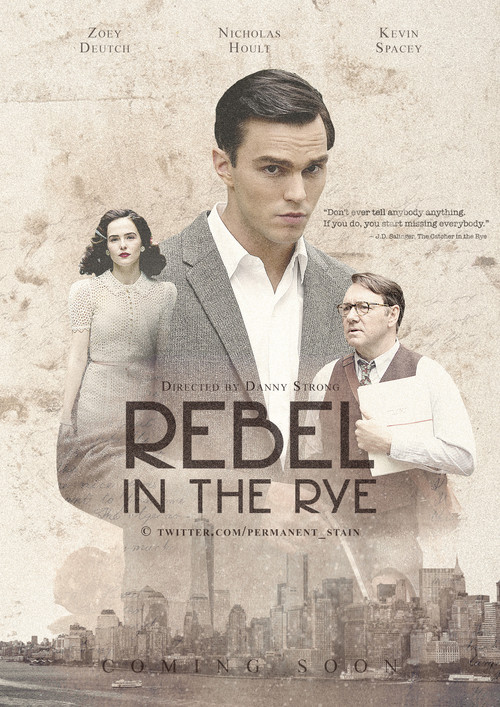
J.D. Salinger had three great losses and three great teachers, and “Rebel in the Rye” is the story of how those all came together to influence the author of one of the most popular and influential novels of the 20th century, The Catcher in the Rye, along with his shorter pieces, a few novellas and stories. Salinger is almost as well known for his decades of seclusion in New Hampshire as he is for his work. Reportedly, after publishing his last story in 1965, he continued to write full-time, but never showed it to anyone or allowed it to be published. It may be that the mystery is a better story than the writing.

Writer/director Danny Strong (co-creator of “Empire,” screenwriter of the “Mockingjay” films and actor in “Gilmore Girls” and “Buffy”) introduces us to Salinger before all of that happened, young, ambitious, and like Catcher in the Rye‘s Holden Caulfield, a smart aleck who has left or been asked to leave a number of top schools. Nicholas Hoult (“About a Boy,” “Mad Max: Fury Road”) shows us the teenage Salinger, arrogant but insecure, especially arrogant when it came to writing and especially insecure when it came to girls. He meets Oona O’Neill (Zoey Deutch), the daughter of playwright Eugene O’Neill, and they begin to date, though what makes her most attractive to him is her lineage and her admiration for his writing. And, after leaving NYU, he enrolls in Columbia, where he takes a class from the editor of Story Magazine, Whit Burnett (Kevin Spacey). “There is nothing more sacred than stories,” Burnett tells the class. And he advises Salinger not to let his voice overwhelm the story, not to let his ego obstruct the emotional experience of the reader.

Burnett will be Salinger’s most important influence on the content of his stories, suggesting that Holden Caulfield deserves a novel. And O’Neill will be an influence, too, the first of the three great losses, when she leaves him to marry Charlie Chaplin.  Just as he is beginning to make progress as a writer, with his first published work in Burnett’s literary journal, Salinger joins the military in WWII, where he endures great peril and hardship and witnesses some of the worst events in world history, including the landing on Normandy beach and the liberation of a concentration camp.  These traumatic experiences caused great distress for Salinger, what would today be called PTSD (as Salinger movingly described in my favorite of his stories, “For Esme, with Love and Squalor.”  But it was these experiences that gave him the depth and scope to write his sole novel.

Burnett teaches Salinger that publication is incidental; what matters is doing the work of writing.  Salinger’s agent (Sarah Paulson, wry but sympathetic) tells him that “publication is everything” and urges him to “soften” his stories according to the “notes (comments) she gets back from editors.  Salinger, initially refusing to make any changes, finally does and even admits that they made the story better.

But the stress of success becomes too much for him.  “I’m shackled by my own creation,” he says as Catcher is seen as an invitation for readers to come see him.  The last loss and the last teacher are combined in a zen master who advises him to let go of his need for approval.  He moves to New Hampshire and never has anything to do with the literary world again. “If I can dedicate my life to writing and get nothing in return,” he says, “I think I might find happiness.”

Hoult is fine in showing us how Salinger changes, especially the effect of the war.  His scenes with his parents (Hope Davis and Victor Garber) and with the women he is trying to impress are especially effective.  Strong, as a writer himself, well understands the struggle to understand which voices to listen to, whether internal or external, in evaluating the work, and the complexity of needing approval even as we try to transcend that need.  The film evokes the mid-century era without being showy or distracting, and, an even more difficult challenge, explores the life of someone who wanted to be left alone without being exploitive.  Salinger insisted that there will never be a film about Holden Caulfield, and he was right as the value of that book is in the voice of its narrator more than in the incidents it portrays.  This is a better version of a story about someone who wants to catch children to keep them safe, at least in his own mind, or in the stories he will never show.

Parents should know that this film includes wartime violence with disturbing images including holocaust footage, drinking and drunkenness, constant smoking, and sexual references.

Family discussion:  Who was right about writing vs. publishing?  What makes Catcher in the Rye so compelling?  How was Salinger’s wartime experience reflected in his writing?

If you like this, try: the books of JD Salinger


Related Tags:


Based on a true story Biography Drama DVD/Blu-Ray movie review Movies -- format Movies -- Reviews
Before I Fall

Before I Fall

Posted on March 2, 2017 at 5:53 pm

B
Lowest Recommended Age: Middle School
MPAA Rating: Rated PG-13 for mature thematic content involving drinking, sexuality, bullying, some violent images, and language - all involving teens
Profanity: Some strong and crude language
Alcohol/ Drugs: Teen drinking
Violence/ Scariness: Fatal accident, suicide
Diversity Issues: None
Date Released to Theaters: March 3, 2017

Copyright 2017 Open Road
Who would not like to go back in time to correct a mistake? Can you correct a mistake without making it worse?

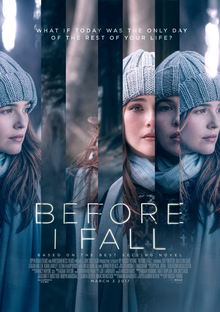
Lauren Oliver’s debut novel Before I Fall is a bittersweet “Groundhog Day” story about a pretty, popular high school senior named Sam (“Everybody Wants Some!!’s” Zoey Deutch) who lives her last day over and over until she figures out why.

Sam wakes up on “Cupid Day” (her school’s version of Valentine’s Day), happy, confident, and looking forward to the day ahead. Her best friend Lindsay (“Paper Towns'” Halston Sage) is picking her up and at school she is expecting her boyfriend Rob to have red roses delivered to her in class. And that evening, she and Rob have planned to have sex for the first time. Everything seems to be coming together just as she wants it.

She barely acknowledges her parents (yes, that is “Flashdance’s” Jennifer Beals as her mother) as she flies out the door. When her little sister runs after Sam with her gloves, instead of thanking her, Sam barks, “Don’t touch my things!” Lindsay picks up their other two friends, and the movie really captures the wild swings between professing total love and devotion and mildly trashing and topping each other that is teengirlspeak.

At school, the lesson is about the Greek myth of Sisyphus, condemned to keep pushing a huge rock up a hill, never getting it over the top before it rolls back down. But no one is really paying attention and the class is interrupted by the delivery of the Cupid’s Day roses. She receives the red roses Rob sent her — after she reminded him — with a note that is more jaunty than romantic. And then there is a special rose from an old friend, who tells her he is having a party that night. She barely acknowledges him. And she does not even notice a sad and angry girl named Juliet (Elena Kampouris) intently working on a charcoal drawing until they are all in the cafeteria, when Lindsay taunts her. “Remind me why we hate Juliet?” Sam asks, but does not really pay attention to the answer. She is more bored by it than ashamed of it.

She does end up at the party, where Rob gets sloppy drunk and Juliet confronts the girls who have been mean to her, including Sam. Later that night, they learn that Juliet has committed suicide. And then Sam wakes up and it is Cupid Day all over again.

At first, she is frustrated and angry at reliving the same day over and over and over. She exploits the freedom from consequences but it is not fun; it is empty. Finally, she begins to pay attention to the people around her and begins to understand what she has to do.

Deutch ably handles her most challenging role so far, showing us Sam’s thoughtfulness, even in her most self-absorbed moments. The small details of her different approaches to each day keep us aware of exactly where she is on her path to greater understanding. Each day may seem the same to Sam, but for us Deutch makes them different as she passes through denial, anger, bargaining, depression, and acceptance. She makes us share her sense of loss, but also her understanding as a reminder of a time she was a hero makes her willing to locate that in herself once more.

Parents should know that this movie includes teen drinking, bullying, strong language including crude sexual references, suicide, and a fatal accident.

Family discussion: If you could live today over again, what would you change? Why didn’t Sam pay attention to Kent and Juliet before? Who is your hero? Whose hero are you?

If you like this, try: “If I Stay,” “About Time,” and “Restless”

Related Tags:


Based on a book Drama Movies -- format Stories about Teens
THE MOVIE MOM® is a registered trademark of Nell Minow. Use of the mark without express consent from Nell Minow constitutes trademark infringement and unfair competition in violation of federal and state laws. All material © Nell Minow 1995-2026, all rights reserved, and no use or republication is permitted without explicit permission. This site hosts Nell Minow’s Movie Mom® archive, with material that originally appeared on Yahoo! Movies, Beliefnet, and other sources. Much of her new material can be found at Rogerebert.com, Huffington Post, and WheretoWatch. Her books include The Movie Mom’s Guide to Family Movies and 101 Must-See Movie Moments, and she can be heard each week on radio stations across the country.

Website Designed by Max LaZebnik