Get ready for Halloween with Scholastic’s “Day of the Dead” DVD, featuring four spooky (but not too scary) tales. In the title story, by Bob Barner and narrated by Rita Moreno, two children celebrate their ancestors on this Latin American holiday. A kitten has a wild adventure in “Kitten’s First Moon,” by Kevin Henkes. “Fletcher and the Falling Leaves,” by Tiphanie Beeke, celebrates autumn. And in “The Little Old Lady Who Was Not Afraid of Anything,” by Linda Williams, some creepy noises give the title character the first scare of her life.
I have one copy to give away! Send me an email at moviemom@moviemom.com with Halloween in the subject line and tell me your favorite thing about this time of year. Don’t forget your address! (US addresses only.) I’ll pick a winner at random on October 21, 2014. Good luck!
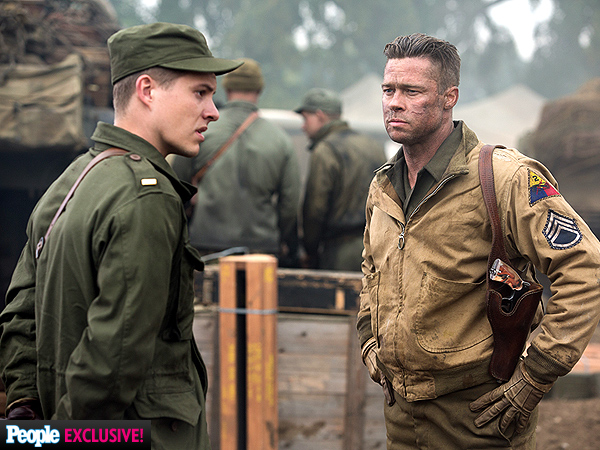
History, Winston Churchill reminds us, is written by the victors. But sometimes those victors have some second thoughts, more complex thoughts, about the nature of heroism, patriotism, and the spoils (in both senses) of war. And sometimes people want to comment on contemporary conflicts but find that it is more compelling in an historical framework. That is how we get “Fury,” a fictional story set in the last days of WWII, with Brad Pitt as “Wardaddy” (everyone gets a “war name”), the leader of a tank team pushing through an increasingly desperate Germany.
“Fury” is what is painted on the gun barrel of the tank. Death, both German and Allied Forces, is everywhere. Our forces, we are told at the beginning, are “outgunned and out-armored,” with “staggering losses.”
The first person we see looks like a cowboy hero, a lone figure on a horse, silhouetted against the sun. He is not a cowboy and he is not a hero. He is about to be killed, and not in a Hollywood, glamorized, bang bang way.
“It will end, soon,” Wardaddy tells Norman (Logan Lerman), his fresh-faced and terrified new driver, a kid fresh from the typing pool who has never been in a tank or fired a gun in combat. “But before it does, a lot more people have to die.”
I’m in favor of movies that show war as brutal, morally compromised, and horrific. Ultimately, though, it has to have more to say than that. It is a movie, a work of drama, and if it is not going to be about something bigger than how terrible war is, it runs the risk of making the very horrors it depicts turn into entertainment and have exactly the opposite impact from the original intention. Steven Spielberg did it with “Saving Private Ryan,” making both the personal story of the individual characters and the larger story about sacrifice and honor compelling and meaningful.
But writer/director David Ayer, whose previous films included the pulpish law-and-order “SWAT,” “Sabotage,” and “End of Watch,” is no Spielberg (though this film borrows a lot from “Saving Private Ryan”). This film tells us very little about history, war, or the human experience.
Parents should know that this film includes very intense and graphic wartime violence with many characters injured and killed, executions, disturbing images, sexual assault, looting, constant very strong and crude language, drinking, smoking
Family discussion: How does this differ from other portrayals of WWII combat? What are the different ways the men in this movie cope with the moral compromises of war? Why did the men choose “war names” and what did they signify?
If you like this, try: WWII dramas “Saving Private Ryan” and “The Big Red One” and the Israeli film “Beaufort”
Rated PG for mild action, rude humor, some thematic elements and brief scary images
Profanity:
Some mild language
Alcohol/ Drugs:
None
Violence/ Scariness:
Themes of death and afterlife with some scary images of skeletons and desolation, peril including bull fights and snake bite, violence including sword fights and outlaws
Diversity Issues:
Diverse characters
Date Released to Theaters:
October 17, 2014
Date Released to DVD:
January 26, 2015
Amazon.com ASIN:
B00Q599952
Copyright 2014 Twentieth Century Fox Animation
Jorge Gutierrez (Nickelodeon’s “El Tigre”) is co-writer and director of a dazzling new animated film that all but explodes off the screen in a kaleidoscope of color and energy and a love of life and storytelling and colorful characters and fantastic adventures. It is filled with the richness of love and passion and life and death and music and bullfighting and courage and family. It is a refreshing new aesthetic, inspired by Mexican folklore, with many of the characters looking as though they were carved from wood — not by trained experts and not recently. It has great songs and stunning images, covers of songs by artists from Elvis to Mumford and Sons, with a sweet new duet from Us the Duo. Plus, there is a sensational and wonderfully varied voice cast that includes Ice Cube (superbly funny and warm-hearted), Cheech Marin, Placido Domingo, and Anjelah Johnson-Reyes (“Bon Qui Qui”).
And it is very funny and a lot of fun.
Even the opening logo for 20th Century Fox has been transformed, letting us know right from the start that we are in another world, or maybe three of them.
A museum guide tells a school group the story, which begins with a wager. The afterlife has two parts: The Land of the Remembered, ruled by La Muerte (Kate del Castillo), where the newly dead are joyfully reunited with their families, and all is celebration, and The Land of the Forgotten, ruled by Xibalba (Ron Perlman of “Sons of Anarchy”), a bleak landscape where souls who are no longer cherished by the living are isolated and afraid. The two rulers make a bet over which of two boys will win the heart of the girl they both love. The winner will get to rule the Land of the Remembered.
The children grow up. Xibalba’s candidate is Joaquin (Channing Tatum), who has become a brave soldier with a chest full of medals. One he never lets anyone see was given to him by Xibalba, who is not above cheating to win the bet. It gives whoever carries it courage and invulnerability.
La Muerte is rooting for Manolo (Diego Luna), who is studying to be a bullfighter like his father and all the other men in their family, but whose real passion is for music. Both are still in love with Maria (Zoe Saldana), just returned from her studies in Spain. Maria’s father favors Joaquin, who can protect the town from the evil, predatory bandit Chacal (Dan Navarro). But Maria’s heart is touched by the romantic Manolo, even after his first attempt to serenade her turns into a disaster (hint: never let your companeros persuade you that the songs of either Biz Markie or Rod Stewart are romantic). When it looks like he will lose the bet, Xibalba cheats again, sending a poisonous snake to bite Maria and Manolo.
Manolo is killed, and finds himself in the Land of the Remembered, where he is happy to see his mother and many other relatives. But to get back to Maria, he will need to cross through the Land of the Forgotten. He meets the candle-maker (a warm and very funny Ice Cube) and a monstrous bull composed of all the bulls Manolo’s family has ever killed, makes a daring wager of his own before he gets back just in time for the arrival of Chacal.
It may seem thickly plotted at times, but that is all part of the Carnivale sensibility. And the cavalcade of incidents and characters, both living and dead, is reassuring in its matter-of-fact approach, reminding us that it is all a part of the book of life, and that we can never lose what or who we truly love.
Parents should know that this film includes Day of the Dead-inspired images with skeletons and afterlife settings, characters in peril and some violence, sad deaths of parents and grandparent (reunited in afterlife), some scary monsters and villains, brief potty humor and some mild language
Family discussion: How can you tell when you follow your parents’ advice and when to do what feels right to you? What is the best way to make sure we remember the people who are no longer with us?
If you like this, try: “The Princess and the Cobbler” and “Rio” and the documentary “Walt and El Groupo,” about the real-life trip Walt Disney and his animators took to South America and how it transformed the look of Disney animation.
Rated PG-13 For mature thematic material including sexual content, alcohol and tobacco use, and for language
Profanity:
Very strong and crude language
Alcohol/ Drugs:
Drinking, smoking, alcohol abuse
Violence/ Scariness:
Car accident, stroke, sad death, bullies, fighting
Diversity Issues:
Diverse characters
Date Released to Theaters:
October 17, 2014
A crude, inconsiderate, bitter slacker — Bill Murray could play that in his sleep. And it would be pretty good. But he doesn’t. Bill Murray gives a beautiful, wise, complex performance as Vincent, an angry old man who drinks too much, smokes too much, gambles too much, pays a pregnant stripper for sex, and seems to get his only enjoyment from trying to make the rest of the world as miserable as he is.
Just as Vincent runs out of money, new neighbors move in next door. It is Maggie (Melissa McCarthy), a single mom, and her son Oliver (Jaeden Lieberher). Maggie, who just left her husband and is working double shifts to pay for Oliver’s private school, is so desperate she is willing to pay Vincent to be Oliver’s babysitter. He is completely inappropriate in every way, taking Oliver to the racetrack and a bar and introducing him to a “lady of the night,” pregnant Russian stripper (Naomi Watts as Daka). And yet, he is able to provide Oliver with support he does not get anywhere else, especially when it comes to dealing with the school bully (Dario Barosso). Vincent’s acerbic take on the world is a bracing change of pace from the chaos and sadness in Oliver’s family and the feeling of being an outsider he gets from being a Jew in a Catholic school, even one with a sympathetic priest for a teacher (Chris O’Dowd) and classmates that include a Buddhist and an atheist. Oliver is in many ways the only real adult in the story, wise and unflappable as the grown-ups around him fail him and each other.
Writer-director Ted Melfi spend the first half of the movie showing us the pressure Vincent is under and his inability to deal with it. He is overdrawn at the bank and he owes money to a bookie (Terrence Howard). His house and car are falling apart and he is, too. He is callous, selfish, and rude. But then we begin to learn that he is capable of great kindness and devotion. He makes regular visits to Sandy (an exquisite performance by Donna Mitchell). She is a beautiful woman with loss of memory who lives in an assisted living facility. He does her laundry and dons a white jacket and stethoscope because she is comfortable thinking he is a doctor. Clearly, he is much more to her, but she does not remember and he does not want to rattle her. He also has a large white cat and seems to be very fond of it.
Meanwhile, Maggie is under a lot of pressure, too. When she gets called into the school after Oliver uses his new lessons from Vincent to hit the bully in the nose, she dissolves into tears. And Oliver’s father is suing her for custody, made much more difficult when he gives the court evidence of Vincent’s poor judgment as a babysitter.
It all comes together a little too sweetly. Even the bully and the grouchy stripper get happy endings. Oliver, while beautifully played by Lieberher, is too good to be true. But Murray’s performance, especially as Vincent recovers from an illness, is never anything less than real, brave, and beautifully observed, and McCarthy, in a largely dramatic role, is outstanding as well. This is a promising debut from Melfi and a quiet little gem.
Parents should know that this film is the story of a man who subjects a child to inappropriate behavior and experiences. It includes very strong and crude language for a PG-13, a stripper and prostitute, an explicit sexual situation, a child exposed to drinking, gambling, and sex work, and a custody battle with references to infidelity.
Family discussion: Who would you pick as your “saint?” Why was Vincent so nice to Sandy and so mean to everyone else?
Before I turn to whitesplaining this film, I will begin by suggesting that you read what Aisha Harris at Slate and what my friends and fellow critics Travis Hopson and Stephen Boone have to say first. If I did not have enough humility before seeing the film about my ability to provide some insight into a movie about racism, the best evidence of the power of the film’s message is that I have more now — and that I recognize it might still not be be enough. I liked the film very much and want to encourage people to see it, so I am going to weigh in with some thoughts and hope that if they come across as disrespectful or ignorant, it will lead to some good conversations and, I hope, to greater understanding.
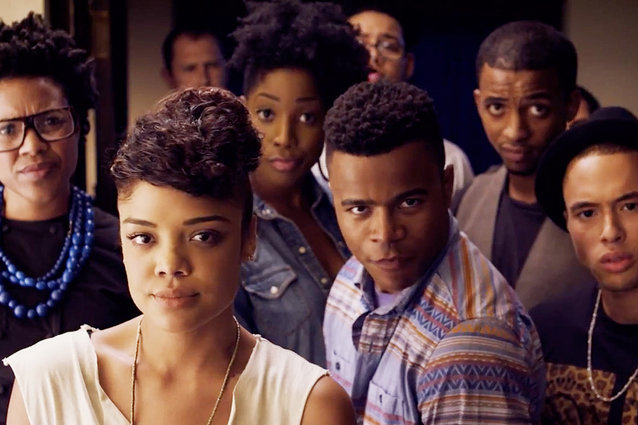
The focus is on four African-American students at an Ivy League school called Winchester University. Sam White (a biting but layered performance by standout Tessa Thompson) is the host of “Dear White People,” a controversial radio program with stinging, provocative commentary along the lines of “Dear white people: The official number of black friends you are required to have has now been raised to two. And your weed man does not count.” Coco (Teyonah Parris) is an ambitious woman who wants to be selected for a new reality TV series, even if that means creating a fabricated backstory and becoming more confrontational. Troy (Brandon P Bell) is the handsome, accomplished BMOC (and son of the dean) who says he has never experienced prejudice and is under a lot of pressure from his father to succeed. And Lionel (Tyler James Williams) is something of a loner because he feels he does not fit in with any of the rigid categories of the campus hierarchical taxonomy. He is invited by the editor of the school newspaper to go undercover to write about race relations at the school.
Each of these characters’ identities and conflicts is represented in their hair. Sam has tight, controlled coils. Coco has long, straight hair. Troy’s hair is cut very close to the bone. And Lionel’s hair is a marvel of untamed frizz that seems to be a character of its own. Each of the characters will face challenges to his or her carefully constructed identity, and all will be reflected in changes of hairstyle.
The dorm that had previously been all-black is now integrated following a race-blind room assignment policy. Sam takes on Troy in an election for head of house, never anticipating that she might win. But she does. This leads to some changes, including a confrontation with the arrogant frat-bro Kurt (Kyle Gallner), son of the white President of the university and leader of the school’s prestigious humor publication. Kurt is the kind of guy who expects to be allowed to eat wherever he likes, even if he is not a member of the house. He also explains that we live in a post-racial world because Obama is President. And he thinks it is a great idea to plan a “ghetto” party, with white students dressing up as gangsta caricatures.
Just to remind us that, while the movie may have a heightened sensibility for satirical purposes, it is not outside the realm of reality, the closing credits feature a sobering series of photos from real “ghetto” parties held on campuses across the country.
It is refreshing, provocative, and powerfully topical, respecting and updating the tradition of “School Daze” and “Higher Learning.” It deals not only with questions of race but with broader questions of gender, class, identity, and the way we construct our personas, especially in our late teens and early 20’s. Writer/director Justin Simien has created a sharp satire with an unexpectedly tender heart.
Parents should know that this film includes very strong language including racial epithets, sexual references and situations, drinking, drug use, and tense confrontations about race, class, and gender.
Family discussion: Where do the people in this movie get their ideas about race, gender, and class? Which character surprised you the most and why? Do you agree with what Sam said about racism?
If you like this, try: “School Daze” and “Higher Learning”