How We Got to Sesame Street

How We Got to Sesame Street

Posted on May 11, 2020 at 8:00 am
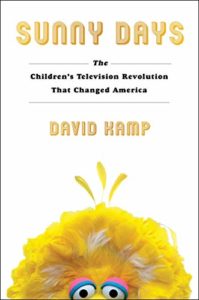
Copyright Simon and Schuster 2020

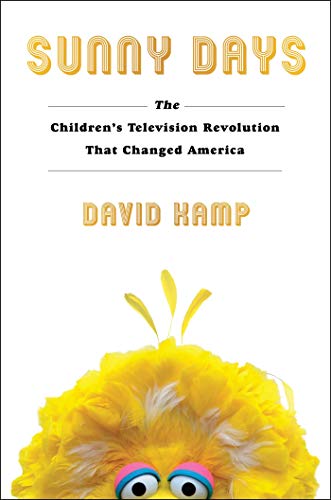
There’s a terrific history of Sesame Street by Jill Lepore in The New Yorker, based in part on a terrific new book called Sunny Days: the Children’s Television Revolution that Changed America by David Kamp. I appreciated the mention of my dad, who, as Kamp’s book reveals, played a critical role in obtaining the first funding for the show. I remember his telling us about it at family dinners, and I was lucky enough to watch the very first episode, which I loved instantly.

Half a century ago, before “Sesame Street,” and long before the age of quarantine, kids under the age of six spent a crazy amount of time indoors, watching television, a bleary-eyed average of fifty-four hours a week. In 1965, the year the Johnson Administration founded Head Start, Lloyd Morrisett, a vice-president of the Carnegie Corporation with a Ph.D. in experimental psychology from Yale, got up one Sunday morning, at about six-thirty, a half hour before the networks began their day’s programming, to find his three-year-old daughter, Sarah, lying on the living-room floor in her pink footie pajamas, watching the test pattern. She’d have watched anything, even “The Itty-Bitty, Farm and City, Witty-Ditty, Nitty-Gritty, Dog and Kitty, Pretty Little Kiddie Show.”

Not much later, Morrisett fell into a dinner-party conversation with Joan Ganz Cooney, a public-affairs producer at New York’s Channel 13. The first time Cooney had seen a television set was in 1952, when she watched Adlai Stevenson accept the Democratic nomination. She’d gone on to champion Democratic causes and had moved from Phoenix to New York to work at Channel 13, where her documentary projects included “A Chance at a Beginning,” about a preschool program in Harlem. As David Kamp reports in “Sunny Days: The Children’s Television Revolution That Changed America” (Simon & Schuster), both Cooney and Morrisett were caught up in Lyndon Johnson’s vision of a Great Society, his War on Poverty, and the promise of the civil-rights movement, and they’d both been stirred by a speech delivered in 1961 by Newton Minow, President Kennedy’s F.C.C. chairman, which called television a “vast wasteland.” Minow, a former law partner of Stevenson’s, had gone on to rescue Channel 13’s public-broadcast mandate during a takeover bid. At that dinner party, Cooney and Morrisett got to talking about whether public-minded television might be able to educate young kids.

Educational television for preschoolers seemed to solve two problems at once: the scarcity of preschools and the abundance of televisions. At the time, half of the nation’s school districts didn’t have kindergartens. To address an achievement gap that had persisted long after Brown v. Board of Education, it would have been better to have universal kindergarten, and universal preschool, but, in the meantime, there was universal television. “More households have televisions than bathtubs, telephones, vacuum cleaners, toasters, or a regular daily newspaper,” Cooney noted in a Carnegie-funded feasibility study, “The Potential Uses of Television in Preschool Education.” With that report in hand, Morrisett arranged for a million-dollar grant that allowed Cooney to begin development of a show with no other title than “Early Childhood Television Program.” In a fifty-five-page 1968 proposal, “Television for Preschool Children,” Cooney reported the results of a national study of the increasingly sophisticated scholarship on child development: she’d travelled the country, interviewing scholars and visiting preschools to find out about what was called, at the time, the “sandbox-to-classroom revolution”—the pressing case for intellectual stimulation for three-, four-, and five-year-olds.

That proposal brought in the eight million dollars in foundation and government funding that made possible the founding of the nonprofit Children’s Television Workshop and the production of the first season of the still unnamed “Early Childhood Television Program.” “Nothing comparable to such a program now exists on television,” Cooney observed. “Captain Kangaroo,” broadcast on CBS beginning in 1955, had educational bits, but it was mainly goofy. (Bob Keeshan, who played the captain, had started out as a Sideshow Bob clown named Clarabell on “Howdy Doody” and then starred as Corny the Clown on ABC’s “Time for Fun.”) “Mister Rogers’ Neighborhood,” a half-hour show produced by WQED, in black-and-white, had gone national in 1968, but reached mainly a middle-class audience. The new show would be broadcast nationally, every weekday, for an hour, in color; it would be aimed at all children, from all socioeconomic backgrounds; it would be explicitly educational, with eight specific learning objectives drawn from a list devised by experts; and its format would be that of a “magazine” made up of “one- to fifteen-minute segments in different styles”—animation, puppetry, games, stories. The “Early Childhood Television Program” would also be an experiment: its outcome would be measured.

Cooney put together a board of academic advisers, chaired by the developmental psychologist Gerald Lesser, and in 1968 she began a series of seminars loosely affiliated with the Harvard School of Education, where Lesser was a professor. To one of those seminars, she later recalled, “this bearded, prophetic figure in sandals walks in and sits way at the back, ram-rod straight, staring ahead with no expression on his face.” She thought that he might be a member of the Weather Underground. She whispered to a colleague, “How do we know that man back there isn’t going to throw a bomb up here or toss a hand grenade?”

“Not likely,” he said. “That’s Jim Henson.”
Related Tags:


Books Television Understanding Media and Pop Culture

Running in Movies — Showing Character as Well as Story

Posted on May 11, 2020 at 8:00 am

Great piece by James Parker in The Atlantic about how actors use running styles to show character in movies. Well, most actors.

Running in movies is always toward danger or away from it. No one in movies is ever just running.

And like ballet dancers, the great runners in movies express character through movement, through the whirling and thumping of their limbs. Matt Damon, as Jason Bourne, is a brain-wiped super-soldier having an identity crisis, so he runs like a frightened washing machine. Carrie-Anne Moss, as Trinity in The Matrix, runs like an equation from the future—which is what she is. Harrison Ford in his prime had a distinctive bowled-over running style: Look at him in The Fugitive, blundering and floundering and grimacing and reeling, an everyman dislodged—as if by an explosion—from the everyday, knocked out of his life, and frowningly, head-buttingly determined to get back in there.

(Tom Cruise is different. Whatever part he’s playing, Jerry Maguire or Jack Reacher, he runs like Tom Cruise, with piston knees and piston elbows and the face of an angry Christ. And that’s okay.)

Bradley Cooper in Silver Linings Playbook, pounding around the burbs with a garbage bag sort of medievally layered over his hoodie, is jogging. People do jog in movies, for fitness—but interiorly, as they jog along, they’re still firmly located on that into-trouble/​out-of-trouble axis. They’re still going one way or the other. Cooper is running—so he hopes—away from madness.

Related Tags:


Understanding Media and Pop Culture
Happy Mother’s Day! Some of My Favorite Movie Mothers

Happy Mother’s Day! Some of My Favorite Movie Mothers

Posted on May 10, 2020 at 11:11 am

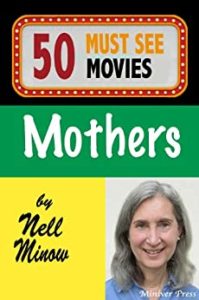
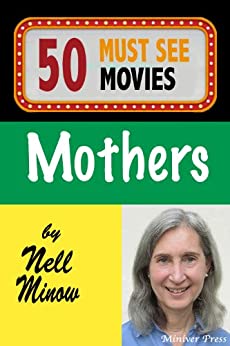
Some of the movies featured in my book, 50 Must-See Movies: Mothers.

Claudia Before they went on to co-star in the luminous romance, “The Enchanted Cottage,” Dorothy McGuire and Robert Young played a young married couple in this sweet neglected gem based on the books by Rose Franken.  Claudia and David love each other very much and he finds her innocence very appealing.  But her immaturity leads to many problems.  A neighbor thinks Claudia is flirting with him and without consulting David she impulsively decides to sell their farm.  And she is very dependent on the loving mother she adores but takes for granted.  Claudia’s is about to face two of life’s most demanding challenges – her mother is dying and Claudia and David are going to become parents themselves.  So Claudia’s mother has to find a way to help Claudia grow up.  Watch for: a rare film appearance by the exquisite Broadway star Ina Claire as Claudia’s mother

Guess Who’s Coming for Dinner There are two great mothers in this talky, dated, but still endearing “issue movie” about inter-racial marriage from 1967.  Katharine Hepburn’s real-life niece Katharine Houghton plays her daughter and what Houghton lacks in screen presence and acting experience is less important than the genuine connection and palpable affection between the two of them.  The question may seem quaint now, but as filming was underway, inter-racial marriage was still illegal in 17 states.  The Supreme Court ruled those laws unconstitutional that same year.  Hepburn is electrifying in what she knew would be her final film with her most frequent co-star and real-life great love, Spencer Tracy.  And the distinguished actress Beah Richards is brilliant as the mother of a son who says his father thinks of himself as a “colored man,” while he just thinks of himself as a man.  Watch for: Hepburn’s expression as her daughter describes falling in love

Claudine Diahann Carroll was nominated for an Oscar for her performance as a single mother in this ground-breaking 1974 film, one of the first to portray a domestic employee as a real person with her own home and family, and one of the first to provide an honest look at the perverse incentives of the “Great Society” welfare programs.  Claudine is the mother of six who has to keep her work as a housekeeper and her relationship with a genial garbage worker (James Earl Jones) a secret from the social worker because they put at risk the payments she needs for her children.  Watch for: the very romantic bathtub scene

Dear Frankie Emily Mortimer plays Lizzie, the divorced mother of a young deaf son in this heartwarming story set in Scotland.  She is devoted and very protective.  She does not want him to know the truth about his abusive father (the source of his deafness), so she tells him that his father is a merchant seaman.  The letters he receives from all the ports of call full of details about all the places he has been are really written by Lizzie. When the ship comes to their town, she has to find someone to pretend to be his father.  Watch for: Lizzie’s explanation of the reason she writes to Frankie —  “because it’s the only way I can hear his voice”

Imitation of Life This melodrama about two single mothers, one white and one black, who join forces has been filmed twice and both are worth seeing.  The best remembered is the glossy, glamorous 1959 version with Lana Turner and Juanita Moore.  Lora (Turner) and Annie (Moore) are brought together by their daughters, who meet at Coney Island.  Lora, a struggling actress, needs someone to help look after her daughter and Annie needs a job and a place to live.  Annie moves in to be the housekeeper/nanny.  She and Lora have a strong, supportive friendship, though Lora and both girls take Annie for granted.  As the girls grow up, Lora’s daughter is resentful of the time her mother spends on her career and Annie’s daughter resents the racism she confronts even though her skin is so light she can pass for white.  Watch for: the most elaborate funeral scene ever put on film, with a sobbing apology from Annie’s daughter (Susan Kohner)

Please Don’t Eat the Daisies Doris Day stars in this film loosely based on Jean Kerr’s hilarious essays about life as Kate, the wife of a theater critic (David Niven) and mother of four rambunctious boys.  While most of the film’s focus is on the marital strains caused by her husband’s new job and the family’s new home, the scenes of Kate’s interactions with her children are among the highlights.  It is clear that while she tries to be understated about her affection and sometimes frustration, she adores them.  Watch for: Kate’s affectionate interactions with her own mother, played by Spring Byington

Related Tags:


Books Film History For Your Netflix Queue Great Characters

59 Years Ago Today: My Father Told TV Executives They Had Produced a Vast Wasteland

Posted on May 9, 2020 at 8:00 am

On May 9, 1961, my father, Newton Minow, delivered a speech that continues to inspire the conversation about media and was recently an answer on Jeopardy!

He was President Kennedy’s new Chairman of the FCC, just 35 years old, and in his first major address he told the National Association of Broadcasters that while there was much to admire on television, too much of it was a “vast wasteland.” His contributions to broadcasting include the launching of the first telecommunications satellite, the creation of PBS, the original funding for Sesame Street (noted in the current issue of the New Yorker) and helping to start the Presidential debates. He continues to serve as Vice Chair of the Commission on Presidential Debates, which he helped to form.

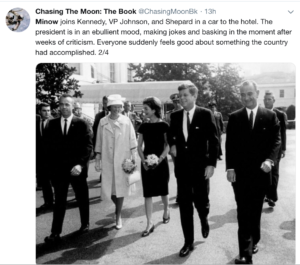
He told the audience about the day before the speech, when President Kennedy brought Commander Alan Shepherd, who had just become the first American in space, and his wife, to the National Association of Broadcasters event Dad would be speaking to the following day.  President Kennedy invited Dad to come upstairs while he changed his shirt, to give him some ideas about what to tell the broadcasters.  Dad suggested that he talk about the difference between the way Americans and the Soviet Union conducted their space program.  In the US, we had all the television cameras there to show the American people, good or bad, what was happening.  The authors of the forthcoming book and documentary Chasing the Moon tweeted about it today:

At the time Dad called on the broadcasters to do better, there were just three national television networks. There was no PBS, just a National Educational Television which was not even available in most of the country, including Washington DC itself. My father told the broadcasters that as long as the airwaves were a scarce resource, they would have to do better to live up to their statutory obligation to serve the public interest, convenience, and necessity, especially with regard to coverage of news and programming for children. He worked over the next half-century to make more choices available, including cable and satellite as well as the creation of a robust public television station. He served as chairman of PBS and of the Chicago affiliate WTTW, served on the board of CBS, is vice-chair of the Presidential Debates Commission (he was the one who proposed its current structure), pushed for closed captioning to make television programming available to hearing-impaired viewers, and argued one of the only cases in history to have a broadcast license rescinded — a station that spewed hatred across the airwaves. And in protest of his critique of television, the sinking ship on “Gilligan’s Island” was named after him, the S.S. Minnow! He is so proud he has a lifesaver from the SS Minnow on his office wall, a gift from his law partners for his 90th birthday.

PBS has a great documentary about him which is free to watch online.  He is also the world’s best dad and we are all so proud of him.

Related Tags:


Television Understanding Media and Pop Culture
Free For Mother’s Day! My Book About the Best Movie Mothers

Free For Mother’s Day! My Book About the Best Movie Mothers

Posted on May 9, 2020 at 12:01 am

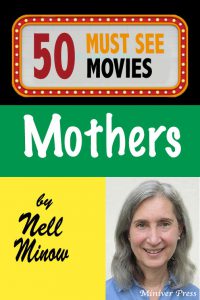
In honor of Mother’s Day, my ebook 50 Must-See Movies: Mothers will be free on Amazon May 9-12, 2020.

No relationship is more primal, more fraught, more influential, more worried over, more nurturing when good and more devastating when bad than our connection to our mothers. The first eyes to look at us with love, the first arms to hold us, Mom is the one who first keeps us fed and warm, who applauds our initial steps, kisses our scrapes, and takes our temperature by kissing our forehead. She’s also the one who keeps people in endless years of psychoanalysis. Mothers inspire movies in every category, from comedy to romance to drama to crime to animation to horror, from the lowest-budget indie to the biggest-budget prestige film.

There are innumerable ways of mothering, and all of them show up in the movies. There are cookie-baking, apron-wearing mothers who always know just the right thing to say. There are stylish, sophisticated, wealthy mothers and mothers who do not have enough money to feed their children. There are mothers with PhDs and mothers who cannot read. There are mothers of every race and religion and many species on earth and in outer space (remember Alien).

There are terrifying mothers who abuse or abandon their children. There are mothers who give good advice and endless support and mothers who push their children to take the wrong jobs or marry the wrong people. There are super-strict mothers and super-lax mothers, mothers who want to know every detail of their children’s lives and mothers who barely remember that they have children at all. There are mothers of children with special needs who fight to make sure they have the fullest and most independent lives they can. There are children who love and support their mothers and children who break their mothers’ hearts.

And there are those very special souls who remind us that motherhood doesn’t require a biological connection. Stepmothers and adoptive mothers are as vitally important on screen as they are in the lives of those lucky enough to be raised by them.

“A boy’s best friend is his mother,” says a character whose mother is central to the story even though she never appears in the film. (Spoiler alert: The quote comes from Norman Bates in “Psycho.”) In “Stop or My Mom Will Shoot,” tough guy Sylvester Stallone plays a cop who mother comes along on his investigation whether he wants her to or not. In “Oedipus Wrecks,” one of three short films that make up the compilation New York Stories, Woody Allen plays a lawyer whose mother finds the ultimate way to embarrass him. And don’t get me started on Jason’s mother in the Friday the 13th movies.

I have selected 50 of my favorite movie mothers, from films as varied as The Sound of Music and Little Women along with forgotten or overlooked films like Stella Dallas, Claudia and David, and Dear Frankie. Actresses like Anne Revere and Spring Byington made careers out of wonderful performances as mothers, and I have included some of their best. I have a special affection for films and performances based on real-life mothers, especially those based on the mothers of the writers who told their stories, like Sally Field’s Oscar-winning performance in Places in the Heart. But each of the mothers in these movies is inspired by the unique joys and frustrations of the woman we love first.

A lot of women have been nominated for Oscars for playing mothers and just about every actress over age 20 has appeared as a mother in at least one movie. From beloved Marmee in “Little Women” and Mrs. Brown in “National Velvet” to mean moms in “Now Voyager” and “Mommie Dearest.”  Oscar-winnng classics and neglected gems, based on real-life like Sally Fields in “Places in the Heart” or fantasy like Dumbo’s lullabye-singing elephant mom, biological mothers like Irene Dunne in “I Remember Mama” or step-mothers like Maria in “The Sound of Music,” these are all must-see movies.

Related Tags:


Books Film History For Your Netflix Queue Great Characters
THE MOVIE MOM® is a registered trademark of Nell Minow. Use of the mark without express consent from Nell Minow constitutes trademark infringement and unfair competition in violation of federal and state laws. All material © Nell Minow 1995-2026, all rights reserved, and no use or republication is permitted without explicit permission. This site hosts Nell Minow’s Movie Mom® archive, with material that originally appeared on Yahoo! Movies, Beliefnet, and other sources. Much of her new material can be found at Rogerebert.com, Huffington Post, and WheretoWatch. Her books include The Movie Mom’s Guide to Family Movies and 101 Must-See Movie Moments, and she can be heard each week on radio stations across the country.

Website Designed by Max LaZebnik