And yet the phrase uses — “Then the problem is you” — feels both wrong and unfair. Because the problem is not just Jeanie. It’s also an entire community who wants to “save Ferris” when he isn’t even in peril and doesn’t notice that Jeanie — and other marginalized kids like her — need attention too. Maybe Hughes wasn’t trying to slyly satirize a society that always gives white guys the advantages and the benefit of the doubt, but man, it really is hard to watch Ferris Bueller’s Day Off 30 years later and not see it that way.
I often say that the single most popular theme in movies is two characters who don’t like each other at first but develop a grudging respect and often a deep affection. Sometimes it’s even a romance, as in “Pride and Prejudice” and most romantic comedies. Writer/director Shane Black, whose films “Lethal Weapon,” “Kiss Kiss Bang Bang,” and “The Nice Guys” are exceptionally entertaining examples, told Screen Crush what intrigues him about mismatched teams.
The mismatch, the two guys who have to use each other as a sounding board and figure out how to get up in the morning when the questions they ask themselves don’t resonate anymore. It’s the notion that I think you sometimes need someone else to believe in you for you, before you have the courage to actually believe in yourself. There’s a real thread of that in a lot of what I do. When you get two great actors to play off each other what you get is good comedy, number one, because they have someone to talk to. But you also get a very heartfelt sense of friendship that hopefully, by the end of the movie when they part, you think, “Wow, these guys have been through an experience together, which had as much to do with friendship as it did kicking ass.”
I’m less drawn to movies where the pairings are buddies like in The Expendables, tossing each other guns, and more when it’s just people who sort of don’t want the other guy in their life, and have to reluctantly admit somebody or some other influence.
Newton Minow and the Vast Wasteland Speech, May 9, 1961
Posted on May 9, 2016 at 8:00 am
Here is my wonderful dad, Newton Minow, on his famous “vast wasteland” speech, delivered when he was the new Kennedy Administration FCC Chairman to the National Association of Broadcasters on May 9, 1961, 55 years ago today.
Although he said many good things about television, producer Sherwood Schwartz was so insulted by Dad’s comments he decided to name the sinking ship on “Gilligan’s Island” after him — the S.S. Minnow. When he was chairman of the FCC his primary goal was giving viewers more choices, through the establishment of what would become PBS, and technological improvements like cable television, UHF channels, and cable TV. He has since worked on many more important projects including the development of the Presidential Debates. He still serves as Vice Chair of the Debates Commission. And he’s the world’s best dad.
There is a a wonderful one-hour documentary about him from Mike Leonard, which is available online. It includes many of our favorite stories: Eleanor Roosevelt’s call to ask Dad to intervene on behalf of Reverend Robert L.T. Smith, a black candidate in Mississippi who was not allowed to buy commercial time, LBJ yelling at him about Vietnam, his now unclassified role during the Cuban missile crisis, and his telling JFK why a communications satellite would be more important than putting a man on the moon. And it has some of our favorite family memories, too.
We had a wonderful 90th birthday party celebration for Dad in January and his colleagues had a very cute children’s book made in his honor about a new and a minnow. I have one to give away. Send me an email at moviemom@moviemom.com with Minnow in the subject line and tell me the worst show you ever saw on television. Don’t forget your address! (US addresses only) I’ll pick a winner at random on May 16, 2016.
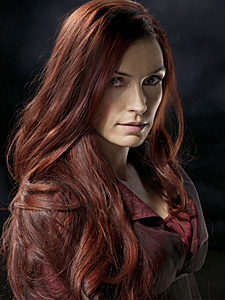
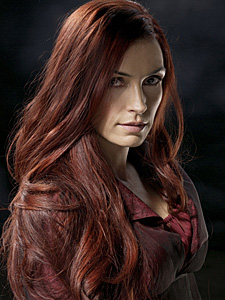
Copyright Marvel 2016It was bad enough when Marisa Tomei was cast as the elderly Aunt May in the next “Spider-Man.” But now the gorgeous Famke Janssen, who has played Jean Gray in the X-Men movies, says she will not be in the next one. As in the last time-spanning film, there will be older and younger actors playing the main characters, except for Gray, who will just be shown as her younger self, played by Game of Thrones actor Sophie Turner, who is 20.
“Women, it’s interesting because they’re replaced, and the older versions are never to be seen again,” Janssen told Entertainment Weekly. “Whereas the men are allowed to be both ages. Sexism. I think that I should be back along with my younger version and the way that we’ve seen it with Magneto and Professor X.”
Janssen, 51, said she had tried to discuss a return for the older Grey with producers but had not received a response.
“I have not heard any feedback on that, other than total radio silence,” she said.
It’s painfully obvious, but I’m still ashamed to admit this: I care about my looks. How else can I explain my trainer, stylist, and Barney’s card? I’ve bleached my teeth, dyed my hair, peeled and lasered my face, and tried a slew of age-defying creams. More than once, I’ve asked the director of photography on a show to soften my laugh lines. Nothing about this suggests I’m aging gracefully.
It’s painfully obvious, but I’m still ashamed to admit this: I care about my looks.
Yet for me, it would be crossing the Rubicon to add Botox and fillers into the mix. I want to look younger (and better), trust me. The only reason I don’t do it is because I’m scared.
I’m afraid one visit to a cosmetic dermatologist would be my gateway drug. I’d go in for a tiny, circumscribed lift and come out looking like a blowfish. Or someone whose face is permanently pressed up against a glass window. Or like I’m standing in the jet stream of a 747. What’s the point of doing it if everyone can tell? I want the thing that makes me look younger, not the thing that makes me look like I did the thing.
As I’ve said before, these “treatments” too often make it impossible for actors to do the very thing we want them to do — show emotion.
It’s no better behind the camera. Variety reports that producer Heather Rae spoke about the problems she faced in getting support for her new film, “Tallulah,” starring Ellen Page.
“At the time this film was deemed not commercially viable, because it was a woman’s story, and it wasn’t about getting the guy,” Rae said at a private screening on “Tallulah” in New York, noting that executives said as much to her face.
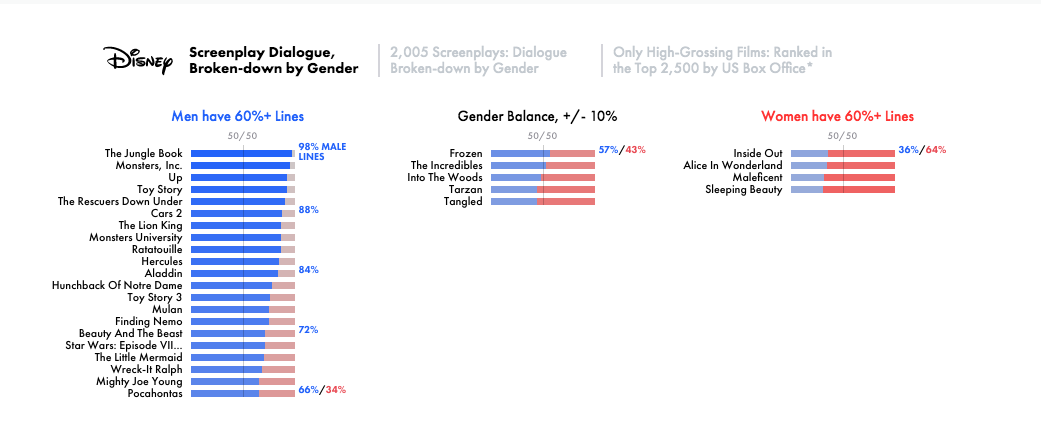
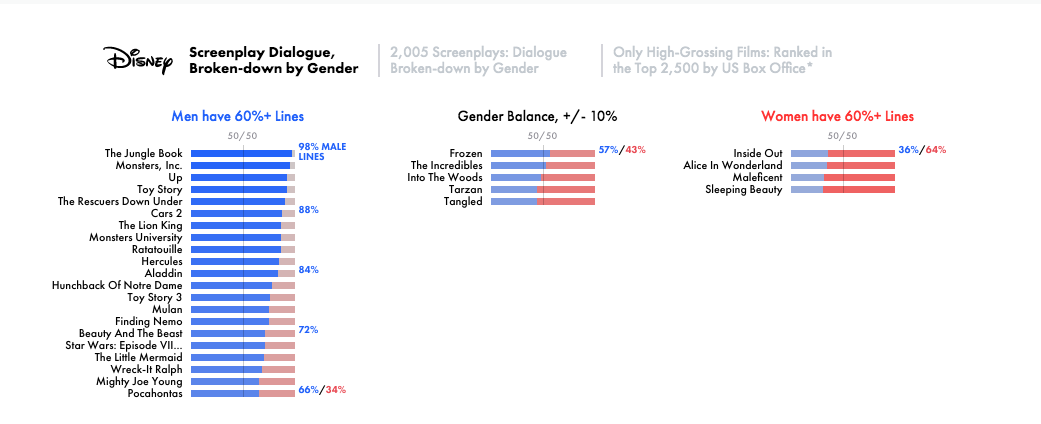
Polygraph has taken 2000 movie scripts and broken them down by gender, showing that in, for example Disney films, men have more than 60% of the lines, even in films like “Mulan,” which has a female lead and is explicitly about a female’s wish to have the opportunities and responsibility of the males. Women had the majority of lines in just 22% of the films. They look at age as well and helpfully make the data available so you can do your own analysis.