Contraband

Posted on January 12, 2012 at 6:00 pm

Oh, not another one last job movie!  This remake of an Icelandic thriller, directed by the actor who played the lead role in the original, is a by-the-numbers heist, chase, and shoot-em-up.  It’s too gritty to be escapist fun and too predictable to work as a thriller.

Mark Wahlberg plays Chris, a one-time smuggler turned legitimate family man with a loving wife Kate (Kate Beckinsale) and two sons.  He is committed to staying on the right side of the law.  But Kate’s young brother gets into trouble with the local drug dealer (Giovanni Ribisi as an oily predator named Briggs) the same way Han Solo got into trouble with Jabba the Hutt, dumping the payload to avoid capture, and Briggs says he will come after the whole family if he doesn’t get paid.  So, Chris has to get the band back together for one more run.  He gets approved by the Department of Homeland Security to work on a ship going to Panama and arranges for trusted associates to be assigned to the crew.  He leaves his closest friend Sebastian (Ben Foster), a recovering alcoholic, to watch over Kate and the boys and takes off for many locations where bad cell reception will add to the tension and frustration.

We’re supposed to be on his side because he keeps saying he won’t smuggle drugs and he loves his highly photogenic family and because the bad guys are so thoroughly loathsome.   And because he such a good smuggler.  But that can’t make up for the increasingly sour taste of the story as Chris and his gang get caught up in some ugly situations, including a detour to meet up with yet another strung-out drug dealer who wants everyone to call him El Jefe, keeps deadly animals in cages, and yes, needs Chris to ride along for just one more last job.  There is one good exchange when the drug dealer says he fed a colleague who disappointed him to the wolves and Wahlberg responds, “Literally?”  And there are scenes that are either commentary on the conundrum of abstract expressionism in a realist world or an ironic statement on valuation models, or perhaps a pearls/swine reference, but most likely just a cheap joke about real guys who know how to fight being smarter than people who pay millions of dollars for paintings no one can understand.  Chris may love and defend his family and even try to protect Briggs’ little girl but his callousness to the carnage and other damage around him and inflicted by him makes it hard to stay on his side.


(more…)

Related Tags:


Action/Adventure Crime Remake
The War Horse

The War Horse

Posted on December 23, 2011 at 12:30 pm

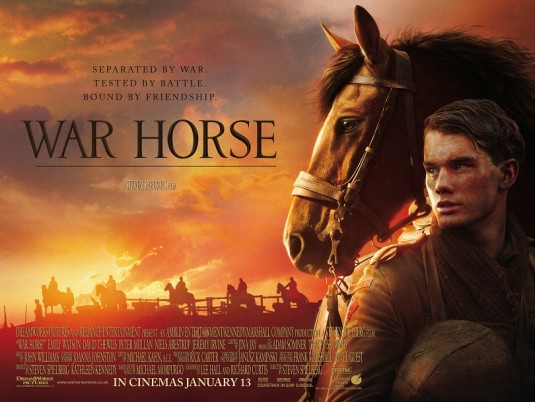
The second Steven Spielberg movie of the week opens on Christmas Day, a grand epic, is big, long, ambitious, and showy.  It is a work by a master, but it is not a masterpiece.  Every detail is carefully considered.  Every leaf on every tree is perfectly aligned so that every sunbeam and shadow fall perfectly across them.  Every equine muscle, every country cottage, every blade of grass, every puff of smoke from a discharged weapon is exquisitely framed and lit, but the visuals outweigh the story.  The result is serviceable but stodgy, stuffy, and static.  The poetry and symbolism of the stage play (with a multi-operator puppet as Joey) is replaced by postcard-picturesque images that are visually rapturous but feel thin in comparison to the movie’s aspirations.

It’s “Black Beauty Goes to War,” the story of a magnificent horse named Joey and Albert (a dull Jeremy Irvine), the boy who loves him.  When World War I begins, Albert’s father sells Joey to a gallant young officer (Tom Hiddleston), who promises Albert he will do everything he can to keep Joey safe and get him back home after the war.  But war has a way of changing everyone’s plans and soon Joey is on his own journey that will take him back and forth between the British and the German forces and, for a short idyllic time, a respite with a frail but brave little French girl and her affectionate Grandfather.  The horse can switch sides in a way that a human cannot, and the movie makes clear the difference between the soldiers who are taken prisoner and shot and the animals who are inherently neutral and thus commoditized.  The brutality of war affects the human characters differently as we see in their responses to the animal.

The sweep and grandeur and tragedy of the film pay homage to majestic WWII-era filmmakers like John Ford, with gorgeous cinematography by  Janusz Kaminski.  One quiet scene of breathtaking power recalling the real-life Christmas truce reminds us of our better angels.  But it also reminds us of Spielberg’s better films.


(more…)

Related Tags:


Action/Adventure Based on a book Based on a play Drama Epic/Historical War
The Adventures of Tintin

The Adventures of Tintin

Posted on December 21, 2011 at 8:00 am

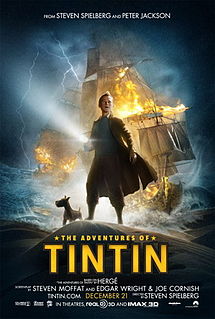
Two box office champion directors and a cult favorite joined forces for a film that was a first for all of them, a 3D motion capture animated story.  It is clear that director Steven Spielberg, producer Peter Jackson (“The Lord of the Rings”) and co-screenwriter Edgar Wright (“Shaun of the Dead”) were thrilled at the total freedom of animation, bringing storyboards to life without any pesky problems posed by weather, local ordinances, camera placement, safety, or the laws of gravity.  And so they have created a film that is non-stop, brilliantly staged action, with every mode of transport and obstacle, half Indiana Jones, half M. Hulot, with a touch of Buster Keaton and Harold Lloyd, turning the entire material world into a giant Rube Goldberg contraption.  Wonderfully cinematic shots and transitions show us how the masters have fun with pure, unleashed movie story-telling.

The comic book stories of the boy reporter Tintin created by an artist/writer known as Hergé  (Georges Remi) are wildly popular in Europe but not well known in the US.  Tintin is brave, capable, inquisitive boy of indeterminate age, probably somewhere around 14.  His excuse for getting involved in all kinds of adventures is that he is a reporter though neither the books nor the movie waste any time on the details of actually writing or filing stories, or, indeed, on any facts about Tintin’s origins or family.  He has a dog, Snowy, who is as intrepid as he is, and their journeys give them many chances to rescue one another in many exotic locations.

Spielberg and Jackson (whose WETA firm did the animation) did not try to copy the iconic linge claire style pioneered by Hergé, though there is a sly nod to it in the delightful opening credits and in a street artist’s sketch of Tintin at the beginning.  Instead it is an intensely detailed motion and performance capture with hyper-real textures and 3D effects that make the vertiginous chase scenes feel very visceral.  Tintin (voice of Jamie Bell) buys a model ship that turns out to be of great interest to a mysterious man named Ivanovich Sakharine (voice of Daniel Craig).  That leads Tintin to an adventure that involves cities, a desert, an opera singer, a potentate, pirates, dim policemen (Simon Pegg and Nick Frost as Thompson and Thomson), as he is drawn into a multi-generational saga involving lost treasure.  Along the way he meets up with Captain Haddock (Andy Serkis), a drunken sailor who is part sidekick, part clue.

It has a lot of alcohol for a PG movie and some parents may be uncomfortable with the repeated references, some intended to be humorous, to drinking and drunkenness.  And some will find the non-stop action overwhelming and just too much to process, even in these frenzied movie-as-video-game days.  Even the exacting eye of Spielberg and the prodigious talent of WETA have not quite mastered the physics of movement with motion capture technology.  The textures are wonderfully vivid and tactile and the angles and velocity are superb and the seas and ships toss convincingly.  But the weight of the bodies when characters leap or fall or objects crash feels strange and somehow off and the faces never find the right spot between the realism of the textures and a more stylized or cartoony look.  This is one element where they should have been more true to the original.


(more…)

Related Tags:


3D Action/Adventure Animation Based on a book Comic book/Comic Strip/Graphic Novel Mystery
The Girl With the Dragon Tattoo

The Girl With the Dragon Tattoo

Posted on December 20, 2011 at 11:21 am

The late Swedish author Steig Larsson created a series of books originally titled “Men Who Hate Women” with a character who was an idealized version of himself — an investigative journalist of impeccable integrity and political correctness who effortlessly appeals to women.  But it was the other lead character in the books who inspired the final titles of the trilogy and who became an international sensation, the dragon-tattooed bisexual computer wizard Lisbeth Salanger, a ward of the state for her violent behavior and anti-social demeanor, with no respect for conventional rules but with a passionate commitment to justice.  “She’s different,” says her employer. “In what way?” “In every way.”

The three books inspired three excellent Swedish films with Noomi Rapace as Lisbeth, and now David Fincher (“Se7en,” “Zodiac,” “The Social Network”) has taken the helm of a big-budget American remake, with Daniel Craig as journalist Mikael Blomkvist and Rooney Mara (briefly glimpsed in “The Social Network” as the girl who breaks up with Mark Zuckerberg in the first scene) as Lisbeth.

Fincher’s version is very true to the book, sharing its strengths and its weaknesses.  Mara’s version is slightly softer than Rapace’s, she still delivers the character’s most intriguing qualities, the combination of blatant punk style with a resolutely inaccessible core, her combination of vulnerability and resilience, her determination, and, above all, her ability to triumph over the most horrifying violations.  As the original title suggests, the weakness of the story is Larsson’s clunky insistence on including every possible form of atrocity, and those who are familiar with the plot may find that there are not enough surprises left.  A superb soundtrack by Atticus Ross and Trent Reznor (who also did “The Social Network”) is interrupted by a jarring version of Led Zeppelin’s “Immigrant Song.”

It begins with a scene that could have come from Raymond Chandler.  Mikael, discredited following a libel suit by a powerful businessman, is invited to meet with an even more powerful figure, Henrik Vanger (Christopher Plummer), the head of one of Sweden’s wealthiest families.  In his huge home in a island that serves as a family compound, Henrik explains that he is haunted by the disappearance of his young granddaughter Harriet  forty years before.  Each year, on his birthday, Vanger received a pressed flower, a symbol of his relationship with Harriet that he believes comes from her killer and is intended to taunt him.  The police and private detectives have tried to find out what happened to Harriet but the mystery is still unsolved.  No body has been found and there seems to have been no way for her to leave the island.  Mikael agrees to see if he can find out what happened.  “You will be investigating thieves, misers, and bullies,” Henrik tells him, “the most detestable collection of people you will ever meet — my family.”

What Mikael does not know is that he has already been investigated by Henrik, whose aide hired a firm to do a background check.  The research was done by Lisbeth Salanger, who hacked into Mikael’s email and has done a very thorough, if not strictly legal, analysis.  The only person Lisbeth trusts, her state-appointed guardian, has a stroke and his replacement is an abusive monster who insists on sexual favors before allowing her to have access to her money.  After some horrifying encounters, Lisbeth extracts some revenge.  Meanwhile, Mikael makes some progress but realizes he needs help.  The aide suggests Lisbeth, and so our two protagonists meet.

Steven Zallian (“Schindler’s List,” co-screenwriter of “Moneyball”) adapted the book well, discarding some distracting subplots.  The soundtrack and production designer Donald Graham Burt superbly convey the frozen remoteness of the setting.  Mikael is not easy to portray because he spends a lot of time watching and listening but Craig makes Mikael thoughtful and lets us see that he recognizes his failures.  Mara’s voice is a little too sweet for Lisbeth but her efficient, straightforward physicality and her watchful but implacable expression are just right for the character who is about to kick the hornet’s nest.

(more…)

Related Tags:


Action/Adventure Based on a book Crime Drama Mystery Remake Series/Sequel Thriller
The Island of Misfit Toys

The Island of Misfit Toys

Posted on December 16, 2011 at 3:49 pm

A classic moment from one of the best-loved holiday treats, Rudolph the Red Nosed Reindeer.  Cheers to all of the misfit toys out there!

http://www.youtube.com/watch?v=5SH1j1luFOw

The very touching story behind the Rudolph song and its creator, Bob May, was told by his friend, my beloved late uncle, Stanley A. Frankel, in a magazine story more than sixty ago.

Rudolph that Amazing Reindeer

by Stanley Frankel

His lovable antics have delighted millions of children; here is the inspiring story of how he was born when a father tried to comfort an unhappy little girl.

On a december night in Chicago ten years ago, a little girl climbed onto her father’s lap and asked a question. It was a simple question, asked in childish curiosity, yet it had a heart-rending effect on Robert May.

‘‘ Daddy, ’’ four-year-old Barbara May asked, ‘‘ why isn’t my Mommy just like everybody else’s mommy? ’’

Bob May stole a glance across his shabby two-room apartment. On a couch lay his young wife, Evelyn, racked with cancer. For two years she had been bedridden; for two years, all Bob’s small income and smaller savings had gone to pay for treatments and medicines.

The terrible ordeal already had shattered two adult lives. Now, May suddenly realized, the happiness of his growing daughter was also in jeopardy. As he ran his fingers through Barbara’s hair, he groped for some satisfactory answer to her question.

For Bob May knew only too well what it meant to be ‘‘different. ’’ As a child he had been weak and delicate. With the innocent cruelty of children, his playmates had continually goaded the stunted, skinny lad to tears. Later at Dartmouth, from which he was graduated in 1926, Bob May was so small that he was always being mistaken for someone’s ‘‘little brother.’’

Nor was his adult life much happier. Unlike many of his classmates who floated from college into plush jobs, Bob became a lowly copy writer for a New York department store. Later, in 1935, he went to work writing copy for Montgomery Ward, the big Chicago mail-order house. Now, at 33, May was deep in debt, depressed and miserable.

Although Bob didn’t know it at the time, the answer he gave the tousle-haired child on his lap was to catapult him to fame and fortune. It was also to bring joy to countless thousands of children like his own Barbara. On that December night in the shabby Chicago apartment, May cradled the little girl’s head against his shoulder and began to tell a story …

Once upon a time there was a reindeer named Rudolph — the only reindeer in the whole world that had a big red nose. Naturally, people called him ‘‘ Rudolph the Red- Nosed Reindeer. ’’ As Bob went on to tell about Rudolph, he tried desperately to communicate to Barbara the knowledge that, even though some creatures of God are strange and different, they often enjoy the miraculous power to make others happy.

Rudolph, Bob explained, was terribly embarrassed by his unique nose. Other reindeer laughed at him; his mother and father and sisters and brothers were mortified too. Even Rudolph wallowed in self- pity.

‘‘Why was I born with such a terrible nose?’’ he cried.

Well, continued Bob, one Christmas Eve, Santa Claus got his team of four husky reindeer– Dasher, Dancer, Prancer and Vixen– ready for their yearly round- the- world trip. The entire reindeer community assembled to cheer these great heroes on their way. But a terrible fog engulfed the earth that evening, and Santa knew that the mist was so thick he wouldn’t be able to find any chimneys.

Suddenly Rudolph appeared– his red nose glowing brighter than ever– and Santa sensed at once that here was the answer to his perplexing problem. He led Rudolph to the front of the sleigh, fastened the harness and climbed in. They were off! Rudolph guided Santa safely to every chimney that night. Rain and fog– snow and sleet– nothing bothered Rudolph, for his bright nose penetrated the mist like a beacon.

And so it was that Rudolph became the most famous and beloved of all reindeer. The huge red nose he once hid in shame was now the envy of every buck and doe in the reindeer world. Santa Claus told everyone that Rudolph had saved the day– and from that Christmas Eve onward, Rudolph has been living serenely and happily

… Little Barbara laughed with glee when her father finished. Every night she begged him to repeat the tale– until finally Bob could rattle it off in his sleep. Then, as Christmas neared, he decided to make the story into a poem like ‘‘ The Night Before Christmas’’– and prepare it in booklet form, illustrated with crude pictures, for Barbara’s personal gift.

Night after night, Bob worked on the verses after Barbara had gone to bed, polishing each phrase and sentence. He was determined his daughter should have a worthwhile gift, even though he could not afford to buy one.

Then, as May was about to put the finishing touches on ‘‘ Rudolph, ’’ tragedy struck. Evelyn May died. Bob, his hopes crushed, turned to Barbara as his chief comfort. Yet despite his grief, he sat at his desk in the quiet, now-lonely apartment, and worked on ‘‘ Rudolph’’ with tears in his eyes.

Shortly after Barbara had cried with joy over his handmade gift on Christmas morning, Bob was asked to an employees’ holiday party at Montgomery Ward’s. He didn’t want to go, but his office associates insisted. When Bob finally agreed, he took with him the poem — and read it to the crowd. At first the noisy throng listened in laughing gaiety. Then they became silent — and at the end, broke into spontaneous applause.

Several Ward executives asked Bob for copies. Then someone suggested: why not put the poem into booklet form as a free gift of Ward customers the following Christmas? Next year, 1939 — a year in which Bob labored to pay his debts and keep Barbara fed and clothed — 2,400,000 copies of the book were printed and given free to youngsters whose parents were customers at the hundreds of Montgomery-Ward stores all over the country.

The story of the reindeer caught on immediately. Psychologists, teachers and parents hailed Rudolph as a perfect gift for children. Newspapers and magazines printed stories about the new hero. Ward’s stores and catalogue offices, placing orders for the following Christmas, asked for 3,000,000 copies.

Meanwhile, May won acclaim — but little else. Montgomery Ward owned the copyright. Yet May was happy in the knowledge that his child — and millions of other children — loved his red-nosed reindeer.

Then the war came, and the giveaway project was shelved. Throughout the war years, however, requests poured in for Rudolph books, toys, games, puzzles, records– all nonexistent. And the demand mounted each Christmas season as parents got out the old Rudolph book and read it to growing families of new Rudolph enthusiasts.

Meanwhile, Rudolph’s success did things to Bob May. He forgot his pessimism, began to laugh again and associate with friends. And among those friends was a pretty brunette, a secretary at Montgomery Ward’s. In 1941, Bob married Virginia Newton. Together they created three new Rudolph fans — Joanna, Christopher and Ginger.

Finally the war was over — and Ward executives planned a new Rudolph book for Christmas, 1946. More than that, a message came from Sewell Avery, president of Ward’s. Touched by the beauty and simplicity of the Rudolph story, he ordered the copyright turned over to Bob — so that May could receive all royalties.

In 1946, 3,600,000 Rudolph booklets had been distributed by Ward’s. Promptly a deluge of demands for Rudolph products swamped Ward’s and Bob May. Businessmen wired, telephoned and called, seeking permission to manufacture toys, puzzles, slippers, skirts, jewelry and lamps.

A special recording of the poem was made by Victor. Maxton Publishers, Inc., bought the rights to produce a bookstore edition in 1947. Parker Brothers brought out a Rudolph game. Even Ringling Brothers-Barnum and Bailey circus proudly exhibited a pony, equipped with antlers and an electrically lighted red nose, called ‘‘Rudolph the Reindeer.’’

Christmas of 1947 was the brightest ever for Bob May, his family and Rudolph. Some 6,000,000 copies of the booklet had been given away or sold — making Rudolph one of the most widely distributed books in the world. The demand for Rudolph-sponsored products increased so much in variety and number that educators and historians predicted Rudolph would come to occupy a permanent niche in the Christmas legend.

Sellouts all over the country inspired merchants to make even more elaborate plans for Christmas, 1948. A special feature is the cartoon in Technicolor directed by Max Fleischer and narrated by Paul Wing which is being run this Christmas season in thousands of film houses. Manufacturers are already blueprinting Rudolph merchandise for 1949-1950-1951– with each item sold returning a royalty to Bob May.

His fortune has now been made, and the years ahead look even brighter. Today, Bob is still a shy, thin, affable man who wants more than anything else to build security for himself and his family. He still works at Ward’s– now as retail copy chief– and tackles the job with the same perseverance which has characterized his whole life.

Through his years of unhappiness, the tragedy of his first wife’s death and his ultimate success with Rudolph, Bob May has captured a sense of serenity. And as each Christmas rolls around, he recalls with thankfulness the night when his daughter Barbara’s question inspired him to write the poem that closes on these lines: But Rudolph was bashful, despite being a hero!

And tired! (His sleep on the trip totaled zero.)

So that’s why his speech was quite short, and not bright — ‘‘ Merry Christmas to all, and to all a good night! ’’

 

Related Tags:


Action/Adventure Holidays
THE MOVIE MOM® is a registered trademark of Nell Minow. Use of the mark without express consent from Nell Minow constitutes trademark infringement and unfair competition in violation of federal and state laws. All material © Nell Minow 1995-2026, all rights reserved, and no use or republication is permitted without explicit permission. This site hosts Nell Minow’s Movie Mom® archive, with material that originally appeared on Yahoo! Movies, Beliefnet, and other sources. Much of her new material can be found at Rogerebert.com, Huffington Post, and WheretoWatch. Her books include The Movie Mom’s Guide to Family Movies and 101 Must-See Movie Moments, and she can be heard each week on radio stations across the country.

Website Designed by Max LaZebnik