Extended fantasy and action violence, scary animals, swords, fire, characters injured and killed
Diversity Issues:
Strong, fierce female characters
Date Released to Theaters:
December 13, 2024
Copyright 2024 New Line Cinema and Warner Brothers Animation
“The Lord of the Rings: The War of the Rohirrim” takes us back to Middle Earth, nearly 200 years before the adventures of the Bagginses and the Fellowship of the Ring. For those whose reaction to this IP brand extension is, “Great! I can’t wait to learn more about the stories behind the story and feel satisfaction when familiar places and characters are name-checked,” this animated story, produced by LOTR director Peter Jackson, will be welcome.
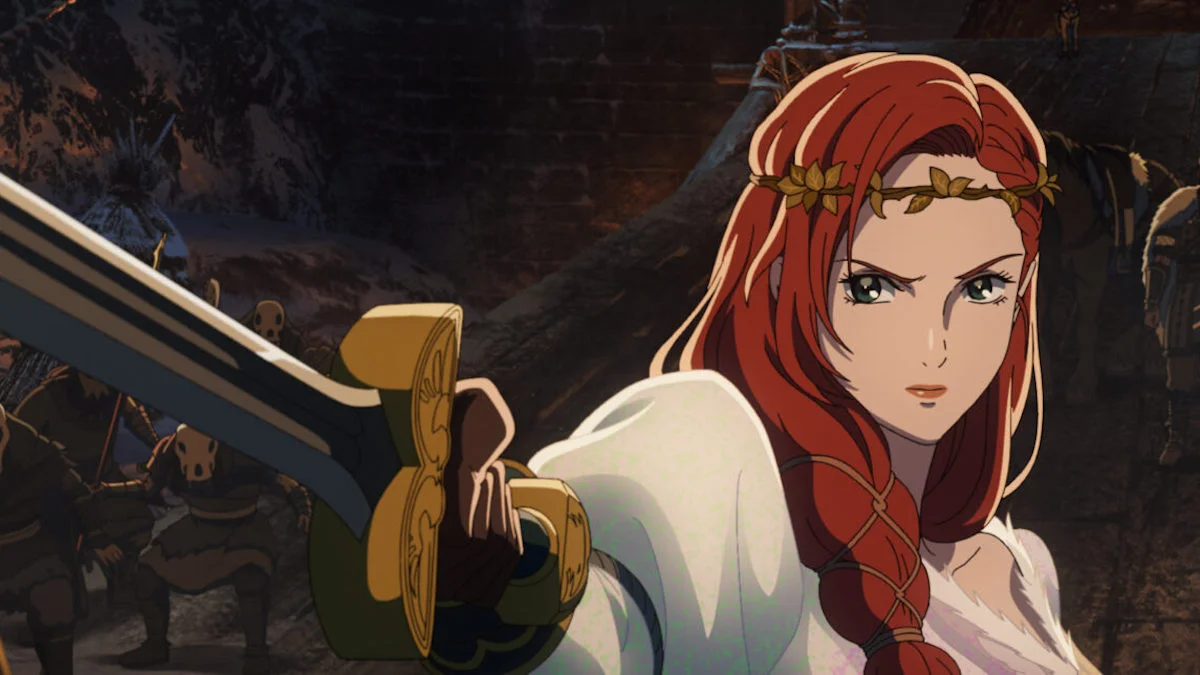
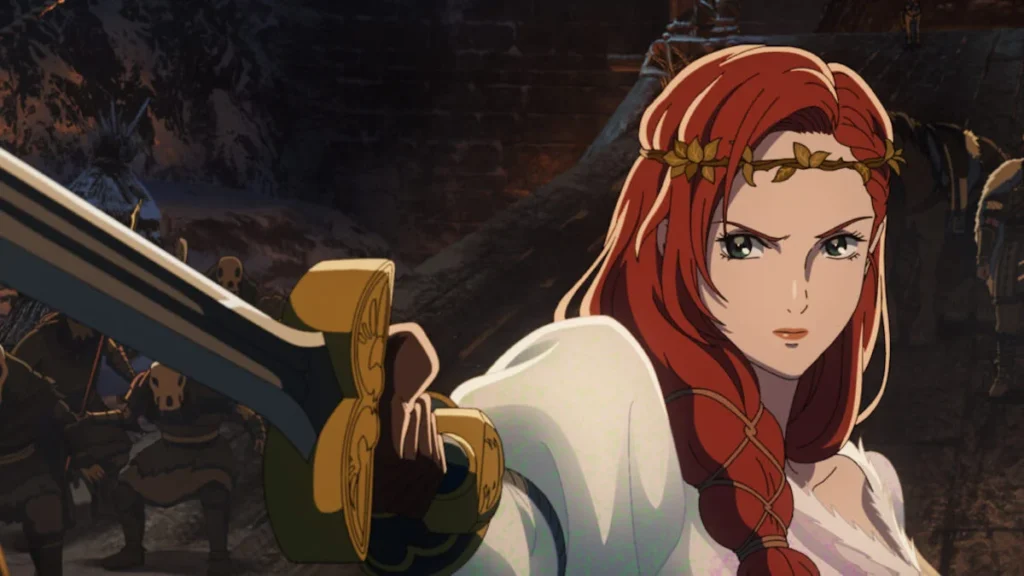
Fans of animation with a taste for anime style, are likely to find this a disappointment. While our heroine, Hèra (Gaia Wise) has big, sometimes expressive anime eyes, the overall style of the animation here is, in a year that included “The Wild Robot,” “Flow,” and “Inside Out 2,” disappointing. Many of the backgrounds are detailed and dimensional, some almost photographic, while the characters and animals are flat and minimalist. Their interactions with the environment seem weightless, any sense of heaviness or the impact of a punch or a fall coming more from the sound effects than the visuals.
Ancillary stories that spring like tree branches from beloved sources have to succeed as independent, stand-alone stories, and this one does not. The Lord of the Rings sagas, books and movies are memorable because of the compelling characters and storylines. The details of the world of hobbits, elves, orcs, ents, and a dragon, not to mention a complete language, are imaginative, but it is the themes of honor, purpose, and loyalty that make them beloved by generations. The characters and storylines here are close to generic.
King Helm Hammerhand of Rohan (Brian Cox of “Succession” and “Manhunter”) is a warrior by nature, physically and politically powerful ruler, generally fair-minded, though he underestimates his “wild, headstrong” daughter, Hèra in favor of his two sons. At a gathering of the noblemen, Freca (Shaun Dooley) barges in, demanding that Hèra marries his son Wulf (Luca Pasqualino) so they can take over the kingdom. Wulf and Hèra played together as children and she still feels warmly toward him. But she insists that she has no interest in marrying anyone. Helm and Freca get into a fistfight, and with one mighty punch Helm knocks Freca down, killing him. Helm banishes Wulf.
Wulf all but disappears and they hear nothing more from him for a few years until he returns, with an army, to capture Hèra and attack Rohan. This means a lot of battles, with just-passable animation and discussions of battle strategy with mostly passable dialogue. This movie never convinces us that there is a reason to make it, and that means there is only reason to watch it for those who will perk up at the mention of familiar places and characters.
Parents should know that this is a very violent film with many battle scenes and a few graphic and disturbing images including dead animals and a severed arm. A young man sees his father killed in a fight and a young woman sees her brother murdered. Characters are killed sacrificing themselves for others.
Family discussion: Why didn’t Helm listen to Hèra? Why were Wulf and Freca so angry and resentful? What was the scariest part?
If you like this, try: the “Lord of the Rings” books and movies
Rated PG for some scary action, brief suggestive material, and thematic material
Profanity:
None
Alcohol/ Drugs:
None
Violence/ Scariness:
Fantasy peril and violence
Diversity Issues:
A theme of the movie
Date Released to Theaters:
November 22, 2024
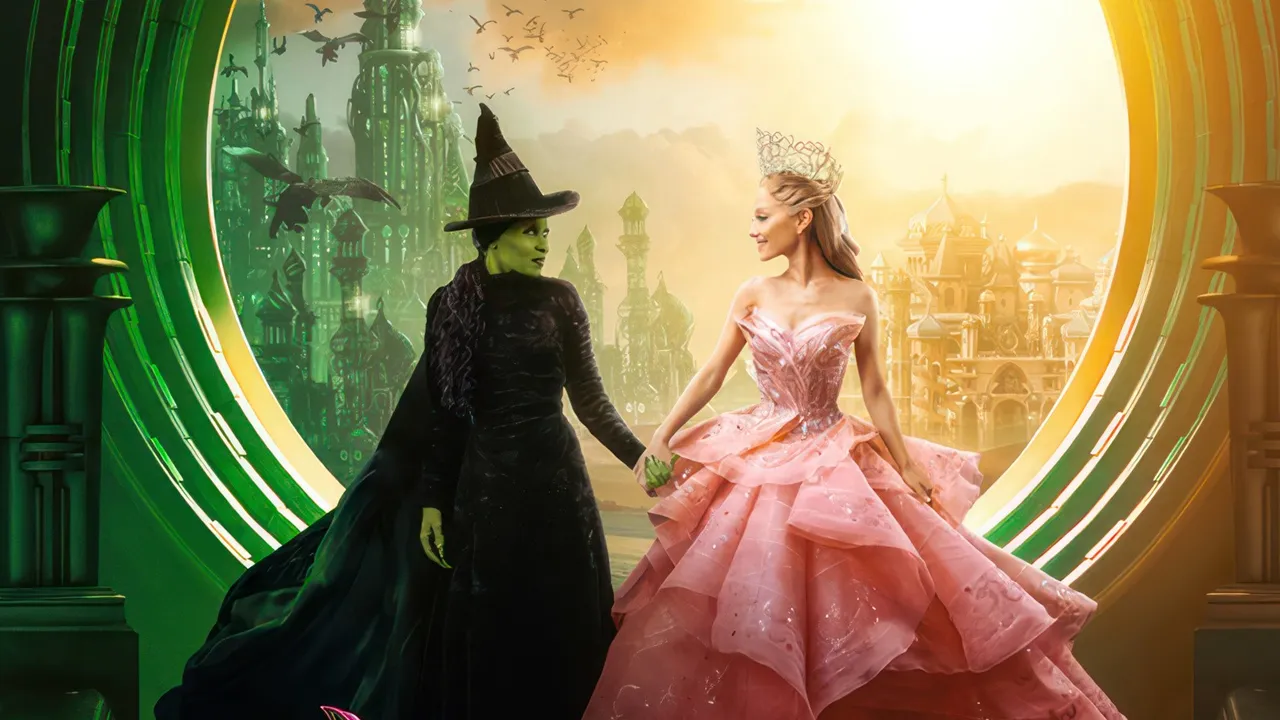
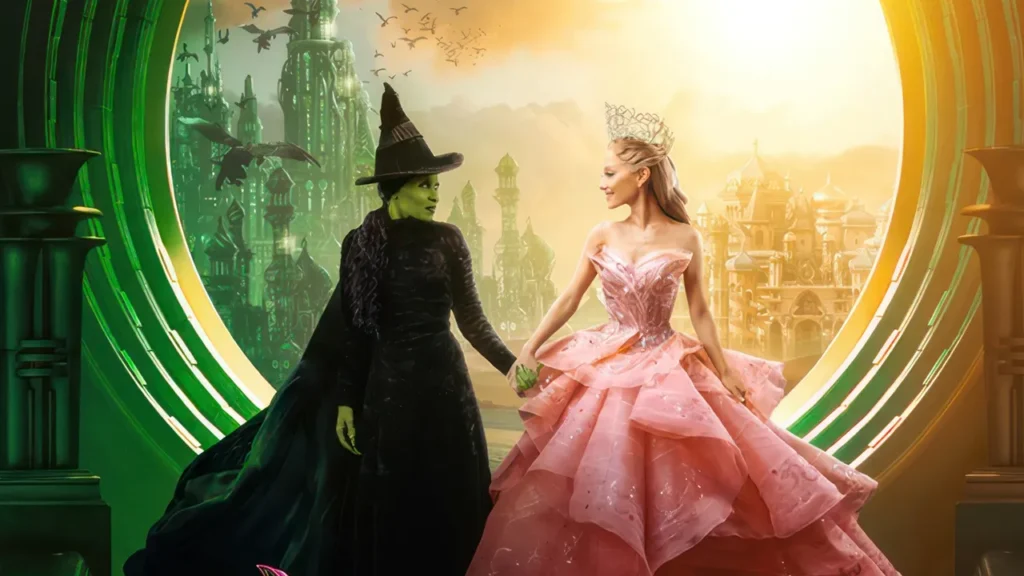
I feel confident that “Wicked,” this movie musical set in Oz is going to be POP-ular. It is, of course, adapted from the long-running, award-winning Broadway play, which was adapted from the book by Gregory Maguire, which was itself inspired by The Wizard of Oz by L. Frank Baum and the family classic MGM movie it inspired, starring Judy Garland, plus the funkified The Wiz, another musical play and movie. But this is not just some IP brand extension; it is as much an exploration of the nature of good and evil as it is a backstory about some of the world’s most iconic characters. It is also a lot–part one is nearly three hours long, with every minute a cornucopia of visuals, music, dancing, and ideas. Some will be overwhelmed, but many will find it dazzling and worth many repeat viewings.
Copyright 2024 Universal
The movie begins with the report that the Wicked Witch of the West has melted due to “a bucket of water thrown by a child.” Glinda the Good Witch arrives via bubble in Munchkin Country to confirm the news. This parallels Judy Garland’s arrival in the MGM film, her tornado-tossed house landing on the Wicked Witch of the East, and then Glinda arrives by bubble to ask Dorothy if she is a good witch or a bad witch. We will glimpse a few other references to the classic film, including a cute animal peeking out of a basket on the back of a bicycle, a shot of the four classic characters, plus Toto, walking through the poppy fields, and the first stop in the Emerald City a makeover musical number in a fantasy beauty salon. We also see the origins of some familiar elements, including the witch’s broom and Glinda’s name. As in the Baum book, the magical slippers are silver, not ruby.
One of the Munchkins asks a questions humans have been pondering since pondering began: Are people born wicked or do they become wicked, and if so, why? That is the theme of this version of the story.
Ariana Grande, appearing under the name on her birth certificate, Ariana Grande-Butera, plays Galinda (yes, that’s her name), a pampered princess who arrives at Oz’s most prestigious institute of higher learning, Shiz University. Think Hogwarts, because though the students are adults, it feels more like a boarding school. It is set in a fabulous compound that feels like a dream project (in both senses of the word) for brilliant production designer Nathan Crowley that is part Victorian, part Edmund Dulac fairy tale, with curves and curlicues everywhere inspired by Art Nouveau, and a sprinkle here and there of steampunk.
Also arriving are two sisters, Elphaba (Cynthia Erivo), with bright green skin, and her sister, Nessarose (played by Marissa Bode, who, like her character, does not have green skin and uses a wheelchair. Galinda is so confident she expects everyone to adore her and is so careless about mistakes that she often uses malapropisms that sort of sound like real words but are not. Elphaba is tentative and shy, but has internal strength of character and a sense of responsibility. She was the result of her late mother’s affair. The only father she has ever known, her mother’s husband, barely acknowledges her, except to order her to take care of Nessarose.
Madame Morrible (Michelle Yeoh) immediately recognizes that Elphaba is gifted with extraordinary magical powers and takes her on for special tutoring. She also decides that the two young women should share a room. At first they dislike and mostly ignore one another, and Galinda pranks Elphaba by giving her an ugly hat to wear to a party. But when the other students laugh at Elphaba, who responds defiantly by dancing by herself, Galinda experiences her first spark of genuine empathy. Instead of claiming to be kind, she shows real kindness by joining Elphaba on the dance floor, and her unquestioned role as the arbiter of status soon has the rest of the crowd joining them in the dance.
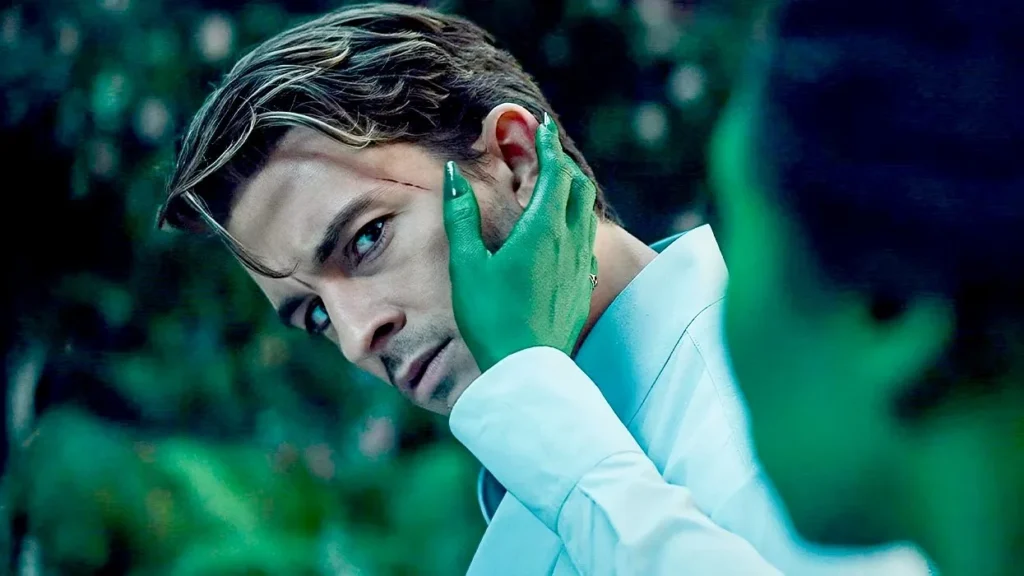
Also at the party are Nessarose with Boq (Ethan Slater), who has a crush on Galinda but invited Nessarose because Galinda told him to, and the extremely handsome and charming Prince Fiyero (“Bridgerton’s” Jonathan Bailey). He was a late arrival at Shiz, after being kick out of other schools. At first he seems to be a perfect match for Galinda (she certainly thinks so). They are both gorgeous but superficial and incurious. Then, in the movie’s most significant scene, Fiyero is the only one who helps Elphaba rescue a caged lion cub, and she is the only one who realizes that his constant pursuit of pleasure is not making him happy.
Jonathan Bailey as Flyero Copyright 2024 Universal
Director Jon M. Chu (“Crazy Rich Asians,”) brings a lot of energy to the movie. Though he does not have the luxury of his “Step Up” and “In the Heights” acting leads’ extensive dance training and skill, the musical numbers, especially the big dance numbers, are creatively and dynamically staged. I especially liked “One Short Day,” as Glinda (she’s changed her name by then) and Elphaba first arrive in the Emerald City. Keep an eye out for the original Broadway Glinda and Elphaba, Kristen Chenoweth and Idina Menzel, in a stage show about Oz history, or rather the Wizard’s preferred version of it.
Bailey has a sinuous charm that conveys Fiyero’s charisma but hints at his feeling lost and struggling with aimlessness beneath the surface. Goldblum’s quirky energy is just right as the Wizard who began as a carny from the midwest. Erivo is the heart of the film, always magnetic and compelling as Elphaba. The bright green makeup does not mask the extraordinary expressiveness of her face, always thoughtful, present, authentic, and grounded, despite the distracting details of the ultra-fantasy world around her. And like Grande, she has a once-to-a generation voice.
The splendor and imagination of the setting and costumes and even the huge musical numbers surround and mostly support real and meaningful questions about bad people doing good things, good people doing bad things, and everyone struggling to find a place somewhere on the continuum between being good and being wicked. Galinda (we learn how she became Glinda) is considered good because she is pretty and smiles a lot. But she is arrogant and selfish. Elphaba is considered if not bad at least weird because she does not smile or conform (note that neither wears the school uniform) but she is devoted to her sister. She is looking for the love she has never received but has no interest in changing anything about herself to try to get it. She knows that would not be real. Other characters surprise us by not being what we expect on the good/wicked scale.
This is a sumptuous and unsubtle treat grounded in Erivo’s graceful and subtle performance. When she defies gravity, she lifts us with her, and we lean forward to the next chapter.
Parents should know that like the MGM movie version, this story features fantasy action and peril with some scary and disturbing images, along with issues of bigotry and cruel treatment. A child is the result of an affair, causing grief and shame.
Family discussion: Why did Elphaba tell Flyero he was not happy? Why did the Wizard want to cage the animals? Are these characters good or wicked or both: Elphaba, Galinda, Madame Morrible? Are any of the characters like someone you know?
If you like this, try: the original Wizard of Oz book and its sequels (great for reading aloud) and the many other versions of the story
ated PG-13 for thematic material, some suggestive material, brief strong language and smoking
Profanity:
Some strong language
Alcohol/ Drugs:
Drinking and alcohol abuse
Violence/ Scariness:
Sad deaths and medical problems, references to wartime injuries and deaths
Diversity Issues:
Treatment of BIOPC characters superficial
Date Released to Theaters:
November 1, 2024
Near the end of the multi-generational saga “Here,” a character mentions that the time he spent caring for his difficult father in his last years helped them have a better, more understanding relationship. This is tell, not show, the opposite of what a movie is supposed to do. In this case, that really important part, the show part, is a lower priority than the movie’s conceptual and technology gimmicks.
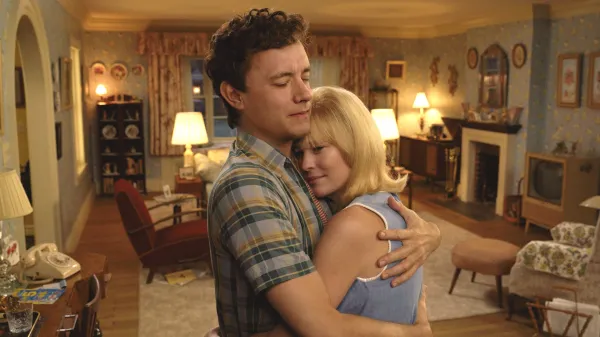
“Here” is based on a graphic novel by Richard McGuire. Its conceit (in both senses of the word) is that the whole story takes place on one spot, going back millions of years, before there was any life on Earth, then with plants, then dinosaurs trampling across, then people, an indigenous couple, a Colonial era man (the royalist son of Ben Franklin) and the enslaved people who resignedly salute him as his carriage passes. A house in what will be the suburbs is built in 1911. Its first owners are a Victorian couple, then an inventor and his devoted wife, much later a Black family in contemporary times, and, in between the central focus, a WWII veteran and his wife, and their three children, one who grows up to be played by Tom Hanks, de-aged by CGI, then looking like he lives now, then aged to show how he may/will look in 20 years. The content of these stories is designed to trigger reactions more based on our own experiences of the big life moments — love, loss, job woes, marriage, family conflict, Thanksgiving, babies, aging parents, more Thanksgivings, a wedding, a funeral — than on any connection to these characters. Our hearts may be tugged at because we are humans who cannot help identifying with these touchstones, but it’s all as synthetic as astroturf.
Copyright 2024 Sony
This film reunites the “Forrest Gump” team, Hanks as Richard and Robin Wright as his wife, Margaret, along with composer Alan Silvestri, cinematographer Don Burgess, screenwriter Eric Roth, and director Robert Zemeckis, who co-wrote the screenplay. Zemeckis, as he does too often, seems far more interested here in the technology than the storyline. The camera placement is static, always the same location in the house’s living room, facing the bay window across from what was once the Colonial plantation. Unlike the images in a graphic novel, movies have to have movement; it;’s in the name. So what we have is a lot of boxes coming in and out of the screen with glimpses of what is happening or did happen that may be contrast or commentary on the cyclicality of events or may just be there to remind us what time we’re in: the Beatles on Ed Sullivan! Jane Fonda’s exercise tapes! And then there are the technology touchstones. Radio, then television. The first cordless phone.
It reminded me of the Carousel of Progress at Disney World, and to be honest, the animatronic characters in that revolving audience show created for the New York World’s Fair in 1964, have more personality than most of the one-attribute characters in “Here.” That is unfortunately even more true of the characters of color in the film. The Black family seems to be there only to show us The Talk with their teenage son about how to behave if he gets pulled over by the police for a traffic violation. Their Latina housekeeper exists only to show us the pandemic. The indigenous people are like the dinosaurs — they exist only to disappear.
Parents should know that this film includes many family ups and downs including conflicts, divorce, serious illness, and death. There is a teenage pregnancy. A WWII veteran with injuries and PTSD self-medicates with alcohol. A young husband and father dies. There are sexual references, scanty attire, references to racism, and some strong language.
Family discussion: What would you want to say to the families who live in this house? Why didn’t Richard want to move? How did the characters decide to compromise on their dreams?
If you like this, try: the book by Richard McGuire, the Thornton Wilder play “The Long Christmas Dinner,” and the 1961 short film “The House”
Sci-ff/cartoon style violence, shooting, off-screen deaths including death of a parent and a mentor
Diversity Issues:
A theme of the movie
Date Released to Theaters:
September 26, 2024
Copyright 2024 Dreamworks
A plane delivering high-tech equipment flies into a storm and a crate falls out, landing on an island inhabited only by animals. Inside the crate is a super-intelligent, ultra-capable robot programmed to complete any task a human might require. The contrast between the natural world of the plants and animals and the metal and programming of the robot is the premise for this story, based on the book series by Peter Brown, told with humor and heart by specialist in “opposites attract” stories director Chris Sanders (“How to Train Your Dragon,” “Lilo & Stitch.”
On one side, fur, feathers, and scales. On the other side, metal and code. The robot, identified by the corporation that created it, is called ROZZUM unit 7134, is a kind of souped-up Swiss Army knife. One of the movie’s greatest pleasures is the way its infinitely adaptable parts and appendages are deployed. Nothing in the robot’s programming has prepared it for the island. But it is capable of learning and adjusting to its environment, so after failure to get a satisfying answer to questions like, “Are you my client?” and “Do you need assistance?” she (we will use that pronoun because the robot has the sweet voice of Oscar-winner Lupita Nyong’o, takes the local next step. She sits down and observes her new environment to learn how to communicate with her fellow inhabitants, which enables us to hear what they have to say, thanks to the brilliant voice work of Pedro Pascal as a fox named Fink, Bill Nighy as a goose named Longneck, Ving Rhames as a falcon named Thunderbolt, Mark Hamill as a bear named Thorn, and Catherine O’Hara, hilarious as always, as Pinktail, a mother opossum covered with her babies.
Roz (as she will ultimately be called) could hardly be more poorly fashioned for this environment. It is funny to see her expect the animals to feel rewarded when she follows her programing by giving them stickers, promotional material for the company that made her, followed by a burst of confetti, even more out of place in the lush natural world than she does. The animals at first consider her a monster.
The early scenes about their unfitness for each other leads organically to interest, understanding, respect, and ultimately a very heartwarming sense of family. A turning point is Roz’s rescue of an orphaned goose egg, left alone after an accident and stolen by Fink for a meal. Roz does not understand what it means to care for the egg, and then, when it hatches and the little gosling imprints on Roz as its mother, she has a task at last: to teach the bird to eat, swim, and fly, so that it can be ready to migrate before it gets too cold. “I do not have the programming to be a mother,” Roz says. “No one does,” Pinktail correctly observes.
Roz develops what can only be described as feelings for the little goose, named Brightbill (Kit Connor). She loses some components and breaks down a bit, from pristine and shiny to scuffed and mossy, with a prosthetic calf made from a log.Is she mirroring what she sees around her? Is she creating the programming necessary to give a child a sense of security and the knowledge he is special to someone? Or is there some way for a machine to develop a soul? Or is it just a reflection of all of the damage to her mechanics? Possibly all of the above. But it is a smaller reach than one might think from being programmed to be of service to placing meaning and purpose on that imperative.
A lot more happens, including some parent-child estrangement (adolescents!) and a lot for Brightbill to learn from his fellow geese, as well as Fink becoming less “fox-y” and all of the animals learning to help each other. The action scenes are dynamic and involving but it is the gentleness of the lessons the characters learn about kindness that will make this film an endearing family favorite.
Parents should know that there is some sci-fi-style shooting. A character is killed off-screen sacrificing himself to save others and a character’s family is discreetly killed in an accident. Another character appears to have been eaten but is not. Characters use some schoolyard language.
Family discussion: What was the most important thing Roz learned and how did she learn it? If you had a Roz, what would you ask her to do? Do you think we will have machines like that?
If you like this, try: the books, and “The Iron Giant” and “Wall-E
Rated PG-13 for adult themes, as well as strong language including racial slurs
Profanity:
Strong and bigoted language
Alcohol/ Drugs:
Drinking and acoholism
Violence/ Scariness:
Peril and violence, characters murdered including a child, very sad deaths, domestic abuse
Diversity Issues:
A theme of the movie
Date Released to Theaters:
August 23, 2024
Melodrama gets a bad rap. It is often associated with exaggerated characters and situations. But life has a tendency to be melodramatic, and a story like “The Supremes at Earl’s All-You-Can Eat” told in an unabashedly heartfelt fashion with a screenplay by (under a pseudonym) Gina Prince-Bythewood and director Tina Mabry, putting the melodrama in the context of enduring, unconditional friendship over the decades. When the character are played by superb performers, seeing how they respond to the direst challenges life can present makes us feel that we are a part of that friendship, at least until the movie ends.
Based on the book by Edward Kelsey Moore, the story goes back and forth in time between the late 1960s and the present. Odette ( Aunjanue Ellis-Taylor of “King Richard” and “The Clark Sisters”) tells us that one connection with her two friends is their unusual origins. Odette was literally born in a sycamore tree. Her mother, past her due date, was told by a woman said to have mystical powers to sit on the branch of a sycamore tree and sing a hymn, and Odette arrived too fast for her to climb back down. She says she was “born off the ground and cursed with a life of fearlessness.” She grew up to be a caretaker who put others’ needs before her own.
Clarice (Uzo Aduba of “Orange is the New Black”) rebelled against her mother, who cared only what other people thought and wanted her to “put on a face and play perfect. She grew up to be a talented pianist with a fierce sense of justice. Barbara Jean (Sanaa Lathan of “Love and Basketball’ and “The Family that Preys”) was born into chaos and abuse, her mother a careless party girl, her father one of many possibles. When teenage Clarice (Abigail Achiri) and Odette (Kyanna Simone) rescue Barbara Jean (Tati Gabrielle) from her abusive stepfather, the three girls form an unbreakable bond. Big Earl (Tony Winters), the wise and generous owner of the diner where the whole community hangs out, says they are as sparkly as The Supremes, and the nickname sticks.
As in films like “Divine Secrets of the Ya Ya Sisterhood” and “Now and Then,” and “Steel Magnolias,” it is the enduring friendship (with a few bumps along the way) that is the focus. The three women have to deal with some of the most devastating setbacks and losses imaginable. Through it all, they rely on the endless, unquestioning support of their friendship (with a few hard truths). Gorgeous performances from the three stars, strong support from Winters, Vondie Curtis-Hall, Russell Hornsby, and Mekhi Phifer as the men in their lives, and thoughtful, sincere work from Mabry and Prince-Bythewood never let the movie get soapy or overdone.
Parents should know that this film includes sad deaths, including murder of a child and an adult, serious illness, alcoholism, adultery, domestic abuse, and violent racism. Characters use some strong language and there are sexual references and situations.
Family discussion: Which friend is most like you and why? Which is your favorite? How was each one’s childhood reflected in their adult lives?