The Woman in Gold

Posted on March 31, 2015 at 5:58 pm

B+
Lowest Recommended Age: Middle School
MPAA Rating: Rated PG-13 for some thematic elements and brief strong language
Profanity: Brief strong language including anti-Semitic epithets
Alcohol/ Drugs: None
Violence/ Scariness: WWII-era peril and violence
Diversity Issues: A theme of the movie
Date Released to Theaters: April 1, 2015
Date Released to DVD: July 6, 2015
Amazon.com ASIN: B00VU4YO7K

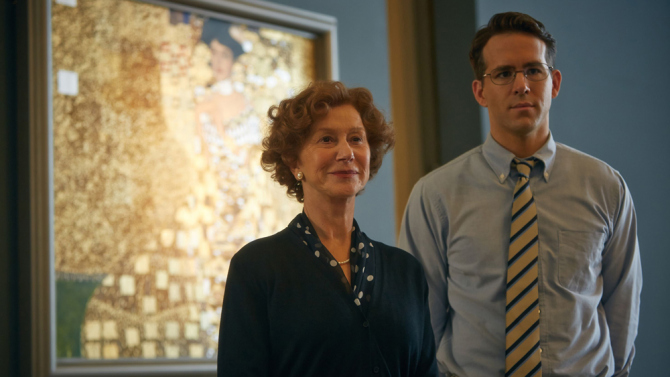
WOMAN IN GOLDThe very title is a form of theft. When Gustav Klimt painted the portrait that gives this film its name, he called it “Portrait of Adele Bloch-Bauer.” She was a warm, vibrant young woman who was a vital part of the extraordinary period of intellectual and cultural life in Vienna known as the Sacred Spring era. Adele Bloch-Bauer died in 1925, and the portrait hung in a place of honor in the apartment her husband shared with his brother, sister-in-law, and two young nieces.

And then the Nazis invaded Germany, their atrocities included stealing the valuables of the Jews they were sending to concentration camps. They took the portrait of Adele Bloch-Bauer and hung it in a place of honor, after they renamed it to remove identity of the subject and the Jewish association of her name. “Portrait of Adele Bloch-Bauer” became the anonymous “The Woman in Gold.” The beautiful choker necklace she wore in the painting was also stolen and given to the wife of Nazi officer Hermann Goering.

More than half a century later, Maria Altmann, the niece of Adele Bloch-Bauer, asked the grandson of her old friend from Vienna if he could help her get the painting back. This film is the story of the painting, the lawsuit, and Maria’s indomitable spirit.

Dame Helen Mirren is radiant as Maria, witty, spirited, an irresistible force who cannot give up. While we never doubt for a moment that she will prevail, Mirren makes us want to watch it all unfold. It is an extremely difficult case, with many arcane legal details, and the real-life story, like all real-life stories, is more complicated and controversial than any movie can convey. Director Simon Curtis (“My Week with Marilyn”) and first-time screenwriter Alexi Kaye Campbell keep the focus on the odd-couple relationship between Maria and the young lawyer (Ryan Reynolds), with flashbacks to show us Maria’s relationship with her Aunt Adele, and then her wedding to a handsome opera singer, just as the Germans are about to invade. Tatiana Maslany (“Orphan Black”) is lovely as the young Maria, and makes us believe she could grow up to become Helen Mirren.

The portrait of Adele Bloch-Bauer now hangs in the Neue Galerie. And now this movie is a part of its story, putting Adele back into the picture and giving us a portrait of the niece who insisted that her story be told.

Parents should know that this film includes WWII-era peril and violence, with references to concentration camps and genocide. There is brief strong language including anti-Semitic epithets.

Family discussion: Why did Maria refuse Ronald Lauder’s offer to get her more experienced lawyers? What was the most important discovery in winning the case?

If you like this, try: the documentary about Nazi art theft, “The Rape of Europa” and learn more about the lawsuit and read up on the real story

Related Tags:


Based on a book Based on a true story Courtroom Drama DVD/Blu-Ray Pick of the Week War

The Sound of Music Celebrates its 50th Anniversary

Posted on March 9, 2015 at 8:00 am

A glorious new 50th anniversary Blu-Ray edition of Sound of Music is out this week, featuring commentary, behind the scenes footage, and all kinds of extras — sure to be one of your “favorite things.”  
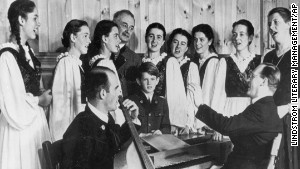
This box-office champ is one of the all-time great family musicals, a Rodgers and Hammerstein triumph based on the true story of the Von Trapp family’s escape from Austria.  

140223073354-von-trapp-family-1946-story-bodyMuch of the story is true.  Maria was a postulant, sent by the convent to become a tutor for one of the ten (not seven) children of nobleman and Naval officer Georg Von Trapp. They got married, but it was seven years before the Nazis took over Austria.  Maria always insisted, though, that Georg was not at all like the stern, humorless character of the early scenes.  And they escaped by train, not by the mountains.  A new book about the real story behind the family and the film is a lot of fun: The Sound of Music Story: How A Beguiling Young Novice, A Handsome Austrian Captain, and Ten Singing Von Trapp Children Inspired the Most Beloved Film of All Time.

The movie musical is still one of the all-time greats.  And you can visit the Von Trapp grandchildren and great-grandchildren at their resort in Stowe, Vermont, where they are still singing.

Their home in Austria is also now a hotel.

A&E Biography did an episode about the Von Trapps.

Here’s a glimpse of the children from the Broadway cast on the game show, “What’s My Line?” (They’re at the end of the show.)

Julie Andrews performed a duet with Maria Von Trapp.

And here is one of my favorite songs from the movie.

Related Tags:


Based on a play Based on a true story Classic Family Issues For the Whole Family Movie Mom’s Top Picks for Families Musical Romance

McFarland USA

Posted on February 19, 2015 at 5:58 pm

B+
Lowest Recommended Age: Middle School
MPAA Rating: Rated PG for thematic material, some violence and language
Profanity: Some strong language
Alcohol/ Drugs: Drinking
Violence/ Scariness: Some gang-style violence, mostly off-screen, characters injured
Diversity Issues: A theme of the movie
Date Released to Theaters: February 20, 2015
Date Released to DVD: June 1, 2015
Amazon.com ASIN: B00UI5CUSM
Copyright Disney 2015

In 1987, Coach Jim White (Kevin Costner), who had never coached or even run cross country, took a team of kids from one of the poorest communities in California to a state championship. Of course that would have to become a Disney movie. But in 2015, it is near-impossible to make a movie about a white coach and his all-Latino team without falling into one of two equally fatal traps. We are no longer in an era when it is acceptable to have a “mighty whitey” movie has a white savior teaching people of color a better way to live. We are also no longer in an era where it is acceptable to have a “magical Negro” plotline, with a person of color teaching a white person a better way to live. We all have people in our lives who teach us important lessons, but presenting these stories in a sensitive way is an almost insurmountable challenge.

“McFarland USA” comes as close as it can to surmounting that challenge by wisely — and honestly — showing what everyone in the story learns from the experience. That comes from warm, sensitive performances by all involved and by telling details. The best is after the team comes in last in their first meet because the coach failed to check out the terrain. The team had never practiced on an incline and the course of the raise included some steep passages. So, for their next practice, Coach White brings them to a place where he and the audience see enormous piles of something under tarps. White knows only that this is a good place to practice running uphill. The team knows what is under the tarps — millions of discarded almond shells, removed by field workers, so supermarkets across the country can stock shelled nuts in little plastic pouches. The symbolism, and White’s growing understanding not just of the challenges faced by his team but of their dedication, perseverance, and strength is un-sappy and touching.

It begins with White getting fired for an outburst at an arrogant high school football captain, and taking a job as an assistant football coach in the small farm town of McFarland in central California. The entire population is Latino and most of them work in the fields as “pickers,” starting at age 10. The kids and teenagers work before and after school. White is quickly relieved of his responsibilities as assistant coach when he takes a player out of the game because he has been injured. He decides to start a cross-country team, even though the principal tells him ‘That’s a private school sport.  They breathe different air.”  White has no experience.  Also, because this is 1987, it would be about a decade before he could just Google how to do it. No one at the school has the time — or the shoes — for distance running. But he can see that they can run, and he gets them to agree to try to compete.  At first, he does not even have a stopwatch to time their runs.  He uses a kitchen timer.

It is a poor community.  No one in the boys’ families has more than a 9th grade education.  The high school is next door to the prison, with a barbed-wire fence.  The families see sports as “not essential,” a distraction that keeps the boys away from paying work on the fields.  “Every hour with you is food off my table,” says one father.  But White and the community learn to trust each other, even after a scary encounter.

Director Niki Caro (“Whale Rider”) has a sensitive touch and a trust in her story and characters that gives them space to breathe.  The running scenes are vivid and exciting.  By the time we get to the end credit sequence, showing the team now in their 40’s and still running every day in McFarland, we see that more than the state championship has been won.

Parents should know that there are a few bad words, some drinking, and some gang-style violence. It is mostly off-screen, but characters are injured and there are brief disturbing images.

Family discussion: Which teachers have made you see that you were capable of more than you thought? How did White and the team demonstrate that to each other?  When did the team start calling him “coach” and why?

If you like this, try: “Spare Parts,” “Chariots of Fire,” and “Hoosiers” and this interview with Carlos Pratts

Related Tags:


Based on a true story DVD/Blu-Ray Pick of the Week Sports Stories about Teens
THE MOVIE MOM® is a registered trademark of Nell Minow. Use of the mark without express consent from Nell Minow constitutes trademark infringement and unfair competition in violation of federal and state laws. All material © Nell Minow 1995-2025, all rights reserved, and no use or republication is permitted without explicit permission. This site hosts Nell Minow’s Movie Mom® archive, with material that originally appeared on Yahoo! Movies, Beliefnet, and other sources. Much of her new material can be found at Rogerebert.com, Huffington Post, and WheretoWatch. Her books include The Movie Mom’s Guide to Family Movies and 101 Must-See Movie Moments, and she can be heard each week on radio stations across the country.

Website Designed by Max LaZebnik