Rush

Posted on September 26, 2013 at 6:00 pm
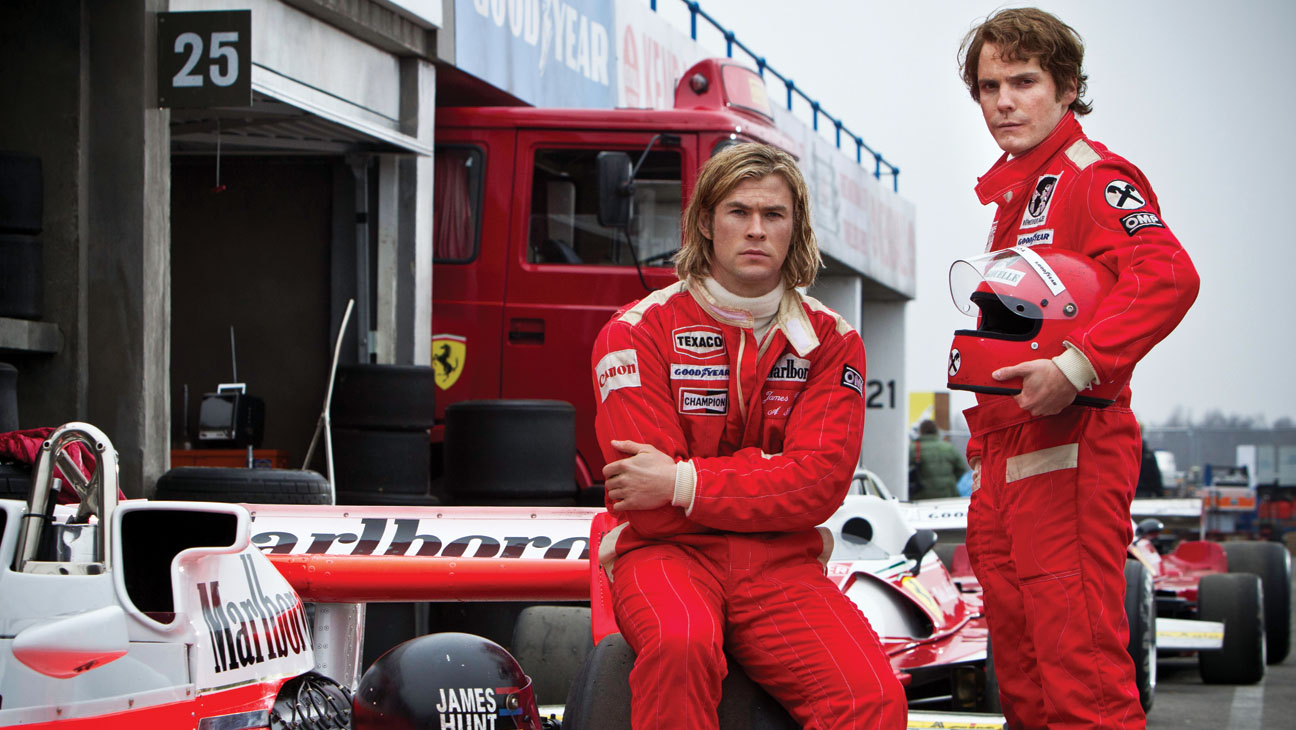
RUSHThe immensely gifted screenwriter Peter Morgan reunites with his “Frost/Nixon” director Ron Howard and returns to his favorite theme, a real-life drama about the clash between two brilliantly talented but flawed figures. This time it is the bitter rivalry between Formula One race car drivers James Hunt (“Thor’s” Chris Hemsworth) and Niki Lauda (“Inglourious Basterds'” Daniel Brühl).  The British Hunt is Maverick to the Austrian Lauda’s Iceman, the Michael to his Sonny, the id to Lauda’s superego.

Both were the rebellious sons of wealthy fathers.  Hunt is handsome, careless, and catnip to the ladies.  “He will have you pulling your hair out nine days out of ten,” a character says, but on the tenth day, when you need him, he will deliver.  Lauda is methodical and analytical.  He calculates the odds.  But they both know that they are among the very few who know what it feels like to get into a car that is essentially a bomb on wheels and speed it around a racetrack.  They both do it not because they like driving in circles but because they like to test themselves.  They both like to win, even need to win.  And, as they remind us perhaps one or two times too many in this film, they both know that the best way to do that is to compete against one another.  “The only people  I can get along with are those who can drive fast,” Hunt says.  He does not really get along with them, either.

Hemsworth, 30 pounds lighter than his Thor/Avengers muscled-up Norse god look, is able to make Hunt magnetic even in 70’s hair.  We meet him as he walks into an emergency room with a bashed nose, not from a racing accident, from a jealous husband.  The pretty nurse (Natalie Dormer) asks what he did to anger the husband and he rakishly offers to show her.  The curtain rings squeal against the rod as it is quickly swung around and soon he is introducing her to his pit crew as “Nursie.”  No time to learn her name, and no need.

Hunt was the James Bond of race car drivers, sexy, sophisticated, and fearless.  But I don’t think James Bond ever threw up before a confrontation.  “Rebels, lunatics, dreamers,” he tells us about race car drivers. “People who are desperate to make a mark and willing to die for it.”  Formula One averaged two deaths a year.  But, he adds, “The closer you are to death, the more alive you feel.”

Lauda says his brain is not that strong but his ass is very smart.  He can tell from a car’s vibrations under the seat that a fan belt will be in trouble and which tire needs air.  He negotiates his driving deals the way he drives, calmly but ruthlessly.   He gets up early to walk the track.  He calculates risk constantly and accurately.  When he explains that one race should be called off because the heavy rainstorm has made conditions unsafe, Hunt, behind on points, persuades the other drivers to vote to continue.  Lauda is very badly injured, including burns on his face and severe lung damage.  In one of the most extraordinary comebacks in the history of sports, Lauda was back on the track 42 days later, against doctor’s orders but able to compete.  In what passed for cheerfulness from the dour Austrian, he told the press that there was one advantage to the skin grafts on his forehead.  They don’t sweat, so he would no longer be bothered by sweat dripping in his eyes.  And, has his wife told him, you drive with your foot, not your face.

Howard conveys the pressure and the thrill of Formula One racing, giving us the view from inside the helmet, and showing us that Hunt’s air of casual mastery is accompanied by a nervous habit of playing with the cap on his cigarette lighter.   He shows us how Hunt and Lauda are always racing, whether it is Hunt visualizing the track or Lauda walking it, competing for the best cars and sponsors, or exchanging barbed comments about whether it is more important to be feared than loved.  The action is electrifying, on and off the track.

Parents should know that this movie includes some disturbing images of crashes and injuries, very strong language, sexual references and situations with nudity, drinking, smoking, and drug use, as well as a great deal of reckless behavior.

Family discussion: What were the most important ways in which Hunt and Lauda were alike?  If you were a sponsor, which would you hire and why?

If you like this, try: “Winning” with Paul Newman, “Grand Prix” with James Garner, and “Le Mans” with Steve McQueen, and Peter Morgan’s “The Damned United” about another real-life sports rivalry.
Related Tags:


Based on a true story Drama Sports

New on DVD: The Life of Muhammad

Posted on August 24, 2013 at 8:00 am

PBS distribution this week released “THE LIFE OF MUHAMMAD” on DVD, Blu-ray and digital download. It is a three-part program, presented by acclaimed journalist and author Rageh Omaar, charting the extraordinary story of a man who, in little more than 20 years, included humble beginnings in Mecca, to his struggles with accepting his prophetic role, his flight to Medina, the founding of the first Islamic constitution and his subsequent military and political successes and failures.  It also explores his legacy as a religious and historic leader, with chapters called: “The Seeker,” “Holy Wars,” and “Holy Peace.”

Filmed on location in Saudi Arabia, Jerusalem, Turkey, Syria, the U.S., the United Kingdom and Jordan, the series also draws on the expertise of some of the world’s leading academics and commentators on Islam, including Tariq Ramadan (academic and fellow of St. Anthony’s College, Oxford), Ziauddin Sardar (London-based scholar and writer specializing in Muslim thought), Tom Holland (British novelist and historian), HRH Princess Badiya El Hassan of the Jordanian Royal Family, Dr. Amira K Bennison (senior lecturer in Middle Eastern and Islamic Studies, Cambridge University), Sajjad Rizvi (associate professor of Islamic Intellectual History, Exeter University), Bishop Nazir-Ali (author of “Islam: A Christian Perspective”) and John L Esposito (professor of Religion and International Affairs and Islamic Studies, Georgetown University).

Any documentary about a religious figure is guaranteed to be controversial.  Some people will object that the series is biased; others will object that it strives too hard for objectivity.  It is a work of history and anthropology, not a hymn. Along with the historical narrative, the film addresses Islam’s role in the world today and explores interpretations of Islamic attitudes toward money, charity, women, social equality, religious tolerance, war and conflict, well worth watching by anyone who wants to learn more about one of history’s most influential and inspirational leaders and the followers who continue to practice his faith and spread his word.


Related Tags:


Based on a true story Biography Spiritual films

Lee Daniels’ The Butler

Posted on August 15, 2013 at 6:00 pm

B+
Lowest Recommended Age: Middle School
MPAA Rating: Rated PG-13 for some violence and disturbing images, language, sexual material, thematic elements and smoking
Profanity: Some strong language, n-word and other racist epithets
Alcohol/ Drugs: Drinking and alcohol abuse, smoking
Violence/ Scariness: Peril and violence including police brutality, lynching, murder, rape (off-camera), sad deaths
Diversity Issues: A theme of the movie
Date Released to Theaters: August 16, 2013
Date Released to DVD: January 13, 2014
Amazon.com ASIN: B00EV4EUT8

the-butler-poster

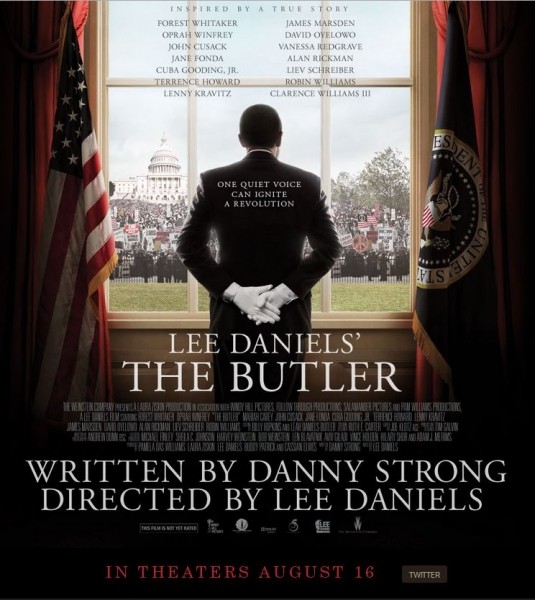
Washington Post reporter Wil Haygood was covering the 2008 Obama campaign when some young black women told him that they were going to vote for America’s first major party Presidential candidate who was African-American, even though their fathers told them not to.  The generational chasm that separated the fathers who were not ready to see one of their heritage in the White House and the daughters who were inspired him to check to see whether there might be someone in the White House itself who was of that older generation.  He found one, Eugene Allen, who had been a butler in the White House from the Truman administration to the Reagan administration, and who was planning to vote for Barack Obama, and Haygood  wrote an article telling his story.

That story inspired this film, with Forest Whitaker as Cecil Gaines, born on a plantation in the Jim Crow south and serving eight Presidents while raising two sons.  Like the young women Haygood met, the next generation had very different ideas and aspirations.  The conflict between a man whose job was to serve by being “invisible in the room” had sons who wanted to be anything but invisible. As Sidney Poitier said to Roy Glenn in “Guess Who’s Coming to Dinner” in 1967, “Dad, you think of yourself as a colored man.  I think of myself as a man.”

There are some awkward moments in trying to get through so much material so quickly, with just brief glimpses of some of the Presidents and some of the events.  By the time we figure out that it is Robin Williams playing President Eisenhower, painting a landscape as Cecil serves him from a silver tray, his appearance is over. John Cusack has two juicy scenes as Richard Nixon.  As the eager, if socially clumsy Vice President, he visits the kitchen to hand out buttons and ask the staff what issues are important to them.  “As members of the Negro race,” he intones, as though they do not know who they are, “what are your biggest concerns?”

Later, Cecil sees the President unraveling under the impeachment proceedings.  James Marsden has some of President Kennedy’s charisma, and Minka Kelly is lovely and utterly heartbreaking as Jackie, sobbing in the pink suit covered with blood that she could not bring herself to remove.  Liev Schreiber shows us President Johnson’s swagger, leaving the bathroom door open so he can talk to his aides while he is on the toilet.  Presidents Carter and Ford are seen only in brief archival footage, but Alan Rickman and Jane Fonda are both excellent as the Reagans, shown with more warmth and humanity than the caricatures we might expect.

This cavalcade of star power is just the frame.  Director Lee Daniels and screenwriter Danny Strong (Danny Siegel on “Mad Men”) put the human story at the center of the tumultuous historic changes from the late 1950’s to the first decade of the 21st century.  That gets a little didactic and clumsy.  Cecil Gaines is given two sons, Louis (David Oyelowo of “Red Tails”) and  Charlie (Elijah Kelley of “Hairspray”), so that Louis can become involved in the Civil Rights movement, from sit-ins to freedom rides, and then the Black Panthers and anti-apartheid, while Charlie goes to fight in Vietnam.   But sensitive and heartfelt performances and the ultimate recognition by the characters that despite their estrangement, the connection between Cecil and Louis is powerful and unbreakable makes their reconciliation hit home.  There is a distracting and unnecessary detour into the relationship between Cecil’s wife, Gloria (Oprah Winfrey) and a neighbor (Terrence Howard).  And the cameos by big stars as the Presidents are distracting — and a grim reminder that even powerhouses like Winfrey, Whitaker, and Daniels and a relatively modest budget were not enough to get a Hollywood greenlight without some white stars.  Some of the best scenes are when we see the African-American characters away from the “other face” they have to show whites, relaxed and joking in the White House locker room (Cuba Gooding, Jr. Lenny Kravitz) and  or at neighborhood parties.

Ultimately, this is Cecil’s story.  When he was a child, service was a chance to get out of the cotton field.  In his first job away from the plantation, he learns to present a pleasant, respectful, and helpful face to the customers, to “make them feel not threatened,” to look at them only to “see what they need.”  And he learns to stop using the n-word about himself or anyone else.  When he comes to the White House, he is told,  “You hear nothing.  You see nothing.  You only serve.”  As for the issues, when it comes to the staff, “We have no tolerance for politics at the White House.”

While Louis and his friends are staging a sit-in at a segregated lunch counter, his father is serving dignitaries, wearing white gloves and a tuxedo.  But all the courage and determination Louis shows in his passionate commitment to equality don’t reach the power of the moments when Cecil challenges the long-standing tradition of paying the African-American staff of the White House 40 percent less than the white staff, and not allowing them the opportunity for promotion.

“Darkness cannot drive out darkness,” the movie’s opening epigraph from the Reverend Dr. Martin Luther King tells us.  “Only light can do that.”

Parents should know that this film includes strong language, drinking, drunkenness, and alcohol abuse, sad deaths, peril and violence including police brutality, rape, murder, lynching, racial epithets, sexual references and non-explicit situations.

Family discussion: Talk to members of your family about their own experiences before and during the Civil Rights era and read about some of the people and incidents mentioned in this movie, including Emmett Till, Pablo Casals, and James Lawson.

If you like this, try:  The Autobiography of Miss Jane Pittman, “Eyes on the Prize,” and “The Remains of the Day” and the books The Butler: A Witness to History and White House Butlers: A History of White House Chief Ushers and Butlers

Related Tags:


Based on a book Based on a true story Biography Drama DVD/Blu-Ray Pick of the Week Epic/Historical Family Issues

Jobs

Posted on August 15, 2013 at 6:00 pm

Lowest Recommended Age: High School
MPAA Rating: Rated PG-13 for some drug content and brief strong language
Profanity: Some strong language
Alcohol/ Drugs: Drinking, smoking, drug use including hallucinogens
Violence/ Scariness: Tense and angry confrontations
Diversity Issues: None
Date Released to Theaters: August 16, 2013
Date Released to DVD: November 26, 2013
Amazon.com ASIN: B00BEIYLAW

ashton-kutcher-as-steve-jobs

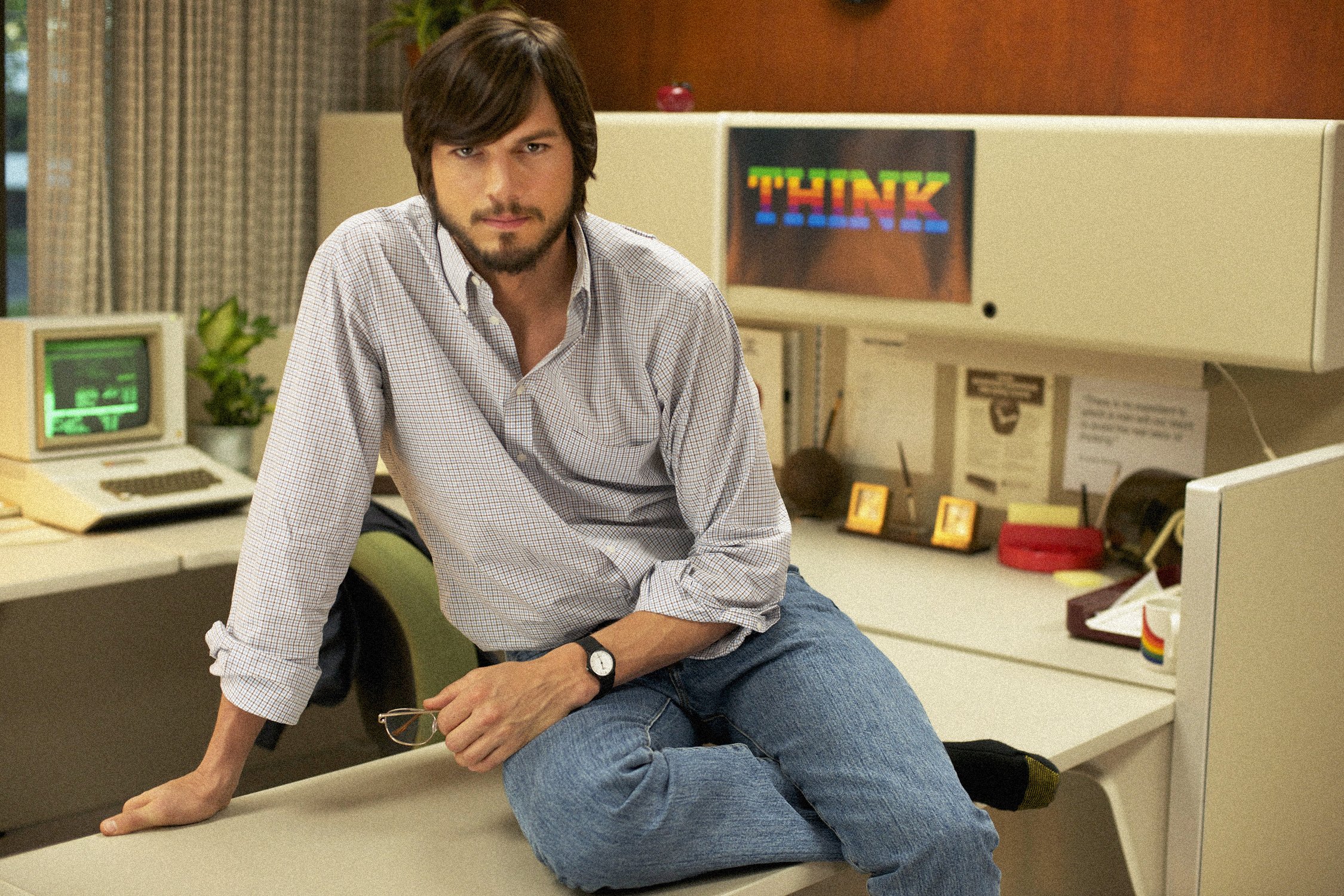
Even the most fascinating character, a true visionary with a transformative impact on the world and a story with one of the most wallopingly vindicating comebacks in business history, cannot always translate into a great movie.  A straight-on biopic cannot help but feel formulaic and clichéd, with the inevitable cinematic ports of call: our hero meets his then-unknown, now-legendary posse, there is a start-up montage of hard work with no resources, and when things get going our hero is accused by the people around him of neglecting them and/or abandoning the principles he once stood for. Everyone will tell him he is wrong.  He will be proven to be right.  Everyone will tell him he is arrogant.  He is, but he is also right.  There are setbacks.  There is triumph.  There are “Stars: They’re Just Like Us”-style peeks into his messy private life.  There is hero worship.  As we learned from “The Social Network,” these stories work better when they do not try to show us why someone was great or how he or she became great but instead tell us a story about a limited set of incidents that illuminate not only the life of this real person but tell us something about our own.

The good news is that just that movie about Steve Jobs is in the works, from “The Social Network’s” Aaron Sorkin. It will show us just three different moments in Jobs’ life, as three products are about to be launched.  And it will have lots of very smart dialog.  I can’t wait to see it.  In the meantime, we have this version, with Ashton Kutcher giving a very respectable performance as Steve Jobs, from his days as a college dropout still attending courses at Reed, in between sleeping around and dropping acid, to his triumphant return to Apple, eleven years after he was thrown out by the board of directors and the CEO he hired. Is it ironic or at least inconsistent that a movie about a man who insisted on “insanely great” innovation and joyfully disruptive, even seismic product development would be the subject of such an old-fashioned, traditionally structured storytelling?  Sure.  It’s like the problem of the computers and other equipment in the movie.  Though it is crucial to the storyline that we see how innovative they are; a couple of decades later they all look as old-fashioned as the rotary phones.  It is not a great or even a very good movie.  It is reporting rather than illuminating.  But it is watchable and modestly entertaining.

We learn very quickly, if clumsily, that (1) Jobs is so brilliant that a benign professor played by James Woods says he is welcome to keep going to class even though he has dropped out, (2) he is something of a user (he picks up a girl, sleeps with her, and then, when she offers him a tab of acid, tells her he is taking a second one for his girlfriend), (3) he is sad and rootless (as he and his friend and girlfriend are tripping as they lie on a blanket in the Oregon countryside, a tear slips out of his eye when he talks about being abandoned by his birth parents).  And while we’re on the subject of tears, there are a lot of damp eyes in this movie.  There may be no crying in baseball, but apparently there are a lot of tears in computers.  And (4) he does not play well with others.  He goes to work as a programmer for Atari, where he alienates everyone by being arrogant and smelling bad.

And then one day his pal Steve Wozniak (Josh Gad, in full nerd mode but with heart) shows him something cool.  He has hooked up his processor to a TV screen so that he can see the code.  Big time light bulb moment for the other Steve.  After an awkward and unimpressive demo for the Home Brew computer club, which led to his first business opportunity.  Jobs realized that there was a market for personal computers beyond the hobbyists and gearheads.  The fact that this seems stunningly obvious now is a tribute in part to his vision.  The clunkiness of the landline phones throughout the movie is another one.  Soon he created Apple with Wozniak and some friends.  Jobs set up a production facility in his parents’ garage and everyone got out their soldering irons and whatever the 1980’s equivalent of Red Bull was and went to work.

We see him rise and fall and rise again, with boardroom battles as vicious and bloodlessly violent as any scene to hit theaters this year.  Jobs is portrayed as a callous but visionary leader who tells his staff that “when you can touch the human heart, it’s limitless,” but parks in the handicapped space and tells his pregnant girlfriend, “I’m sorry you have a problem, but it’s not happening to me.”  He ferociously insists on loyalty from those around him but shows them none in return.

All of the performances are solid, despite the considerable handicap of 70’s hair.  As one of the early Apple employees he cuts out of the IPO gains, Lukas Haas is still making good use of those puppy dog eyes that go way back to “Witness.” Matthew Modine and J.K. Simmons are nicely slick as corporate bad guys.  But so much of both the personal and business story is left out that it feels empty.  The Jobs we see seems more focused on the details of the financing than the details of the product.  The man who felt abandoned by his birth parents (and later refused to see his birth father, even as Jobs was dying) disputed paternity and refused to see his daughter Lisa, but nevertheless named his biggest project after her?  He ran up huge development costs but refused to raise the price of the products to cover them and this made the shareholders the bad guy?  Why was he so ruthless in refusing stock options for the guys who were there at the beginning?  And why doesn’t the movie show that Wozniak gave them a piece of his own share?  Most important, why doesn’t the movie give us more than platitudes in showing us how Jobs got to “insanely great?”

Parents should know that this film includes smoking, drinking, marijuana and hallucinogens, strong language, a paternity dispute, and many tense confrontations.

Family discussion: What were Steve Jobs’ greatest strengths and faults? How can you work toward something that is “insanely great?”  What does it mean to say that “the system can only produce the system” and how can we transcend that?

If you like this, try: Steve Jobs by Walter Isaacson and Steve Wozniak’s iWoz: Computer Geek to Cult Icon: How I Invented the Personal Computer, Co-Founded Apple, and Had Fun Doing It

Related Tags:


Based on a true story Biography Drama DVD/Blu-Ray Pick of the Week
THE MOVIE MOM® is a registered trademark of Nell Minow. Use of the mark without express consent from Nell Minow constitutes trademark infringement and unfair competition in violation of federal and state laws. All material © Nell Minow 1995-2026, all rights reserved, and no use or republication is permitted without explicit permission. This site hosts Nell Minow’s Movie Mom® archive, with material that originally appeared on Yahoo! Movies, Beliefnet, and other sources. Much of her new material can be found at Rogerebert.com, Huffington Post, and WheretoWatch. Her books include The Movie Mom’s Guide to Family Movies and 101 Must-See Movie Moments, and she can be heard each week on radio stations across the country.

Website Designed by Max LaZebnik