
My Law School Moment — University of Chicago
Posted on November 27, 2017 at 2:34 pm
Many thanks to my alma mater, the University of Chicago Law School, for talking to me about my career and the way the school continues to influence and inspire me.
Posted on November 27, 2017 at 2:34 pm
Many thanks to my alma mater, the University of Chicago Law School, for talking to me about my career and the way the school continues to influence and inspire me.
Posted on November 26, 2017 at 4:54 pm
This very cute trailer for the 2018 animated feature “Smallfoot” reminds us that what may seem normal to us may be scary to others, which means that what seems scary to us just might not be that scary.
Posted on November 23, 2017 at 7:33 am
I love this film, about four families celebrating Thanksgiving with all of the secrets, drama, longing for approval, and, yes, gratitude and love. The cast includes Julianna Margulies, Dennis Haysbert, Kyra Sedgwick, Alfre Woodard, Mercedes Ruehl, and Joyce Chen.
Posted on November 21, 2017 at 8:42 pm
A-| Lowest Recommended Age: | Kindergarten - 3rd Grade |
| MPAA Rating: | Rated PG for thematic elements |
| Profanity: | Mild language |
| Alcohol/ Drugs: | None |
| Violence/ Scariness: | Themes of death and loss, some peril |
| Diversity Issues: | None |
| Date Released to Theaters: | November 22, 2017 |
| Date Released to DVD: | February 27, 2018 |

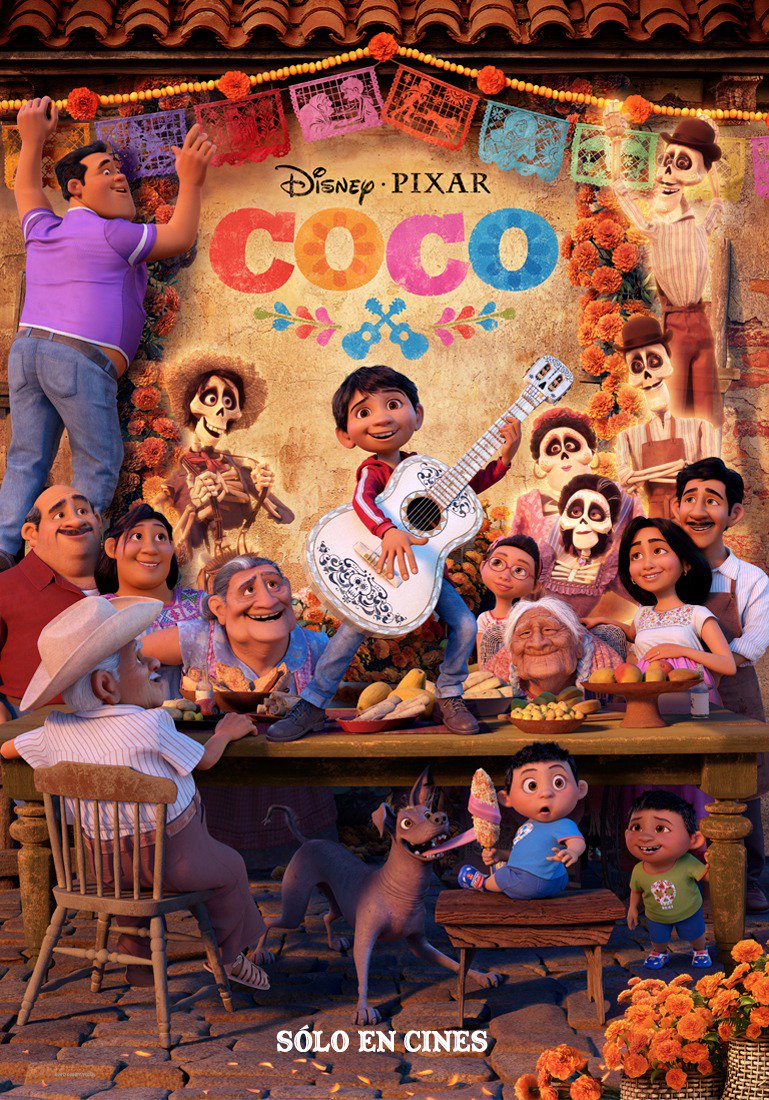
Those of us who remember the 1995 release of Pixar’s first feature film, “Toy Story,” feel that we’ve all grown up together. It isn’t just the astonishing progress in the technology (the reason the first film’s characters were toys was that all they could animate were shiny smooth surfaces). It is the progression of the themes of the films, the first one literally about a child’s playthings, through stories that deal with increasingly adult concerns about aging, loss, and meaning. “Coco” is the story of a Mexican 12-year-old named Miguel, but the title reminds us that the central character is his great-grandmother Coco, struggling with dementia but beloved by her family. It has the dazzling visuals, expert tone and pacing, and the smiling-through-tears moments we have come to rely on from Pixar.
Miguel (Anthony Gonzalez) is the youngest in a big, close family that lives together and works together in the family shoemaking business. He tells us the story of the family through beautifully animated papel picado, the lacy paper cutouts that are a Mexican tradition. His great-great grandfather abandoned his wife and daughter, the then toddler Coco, to pursue a musical career and since then the family has banned any member from playing or even listening to music. But Miguel loves music and has a secret room where he watches old clips of the community’s biggest music and movie star, Ernesto de la Cruz (Benjamin Bratt) and plays his homemade guitar, painted to look like de la Cruz’s.
Miguel hopes to play in a talent show but his grandmother, Coco’s daughter, finds out and smashes his guitar. When Miguel tries to borrow de la Cruz’s guitar from his crypt, he is somehow transported to the Land of the Dead, just as the residents are making their annual pilgrimage over the marigold-strewn bridge to visit the families who have invited them with photographs and memories. There he recognizes his ancestors from the family ofrenda (shrine with photos, candles, food, and mementos). Like Dorothy in Oz and Alice in Wonderland, he has many adventures on a journey in an enchantingly imaginative world but wants to go home. If he does not return by sunrise, he will have to stay there forever.
The Land of the Dead is gorgeously imagined, filled with thousands of lights and the kind of fascinating details that are made for the pause button. The — I’m going to call them people, but they look like skeletons with eyeballs — live in a stratified world, where those who have extended families and are best and most lovingly remembered have beautiful clothes and homes while those who are alone and nearly forgotten live in a (still-picturesque) slum and call each other “cousin” and “uncle” to pretend that they are still connected to someone. Once they are no longer remembered, they just dissolve into dust. Miguel meets Hector (Gael Garcia Bernal), a loose-limbed, poorly dressed skeleton who is close to dissolving as he is being forgotten in the land of the living. Hector agrees to take Miguel to Ernesto de la Cruz, for help in going home, if Miguel will bring back Hector’s photo, so he can be remembered.
It is good to see Mexican culture portrayed in such a straightforward manner, not exotica-sized or othered. There are some exciting adventures and some very funny moments along the way, involving Miguel’s sidekick, a Xolo street dog named Dante, a wild talent show/concert, a still-pushing-the-edge-of-the-artistic-envelope Frida Kahlo, and a psychedelic-colored flying lion-headed creature, one of the alebrije who guide the dead to where they are supposed to be. The skeletons are brilliantly animated, each with a very individual personality and a lot of fun with bones that, without tissue, do not always hold together. Moments of warm humor keep the story from getting maudlin, and moments of true-heartedness make us feel as connected to the Land of the Dead as Miguel is.
Parents should know that much of the film takes place in the Land of the Dead (heaven) filled with skeletons, and it has themes of loss including memory loss, and murder and alcohol.
Family discussion: When is the right time to seize the moment? Ask your family for some stories of your ancestors. What stories do you want people to remember about you?
If you like this, try: “Finding Nemo,” “Inside Out,” and “The Book of Life” — and learn about Frida Kahlo and about the real-life Day of the Dead celebrations
Posted on November 21, 2017 at 5:24 pm
B +| Lowest Recommended Age: | Middle School |
| Profanity: | Mild language |
| Alcohol/ Drugs: | Drinking, drunkenness |
| Violence/ Scariness: | Ghosts, some scary surprises, child labor and abuse |
| Diversity Issues: | None |
| Date Released to Theaters: | November 22, 2017 |
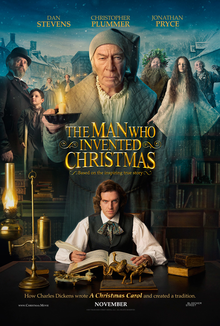
The story is so deeply embedded in our culture that it is difficult to recognize how revolutionary it is. The idea of time travel was considered an enormous innovation in Mark Twain’s A Connecticut Yankee in King Arthur’s Court, published more than 40 years later, but Dickens had Scrooge go back in time to see his past. It is based on the idea that a man could change and would want to change based on an honest look at his childhood trauma and choices made over the years, half a century before Freud. “The Man Who Invented Christmas” gives us a sometimes light-hearted but always warm-hearted look at the man who created Ebenezer Scrooge and the Ghosts of Christmas Past, Present, and Future. We see how the story came together based on what Dickens saw and felt and how writing the story helped him to understand and reconcile his own past.
Dickens (Dan Stevens of “Downton Abbey” and “Beauty and the Beast”) is one of the most critically acclaimed and popular authors in the world, touring America to cheering audiences. Or he was, until he had three flops in a row, just as bills are mounting for renovations on his house, his wife tells him their fifth child is on the way, and his charming but feckless and irresponsible parents arrive for a visit. He desperately needs money, but worries that he is completely out of ideas. His hand remains poised over the paper, its only mark a blob of ink that drops from the feather pen to reproach him because no words are appearing.
It is always difficult to portray the work of a writer because it is all internal and you run the risk of boring the audience with scenes of someone sitting at a desk. Director Bharat Nalluri, working from a script by Susan Coyne, wisely takes our hero out into the world and we have the pleasure of seeing the hyper-alertness artists bring to the world. Whether it is jotting down the name of the waiter (Marley), eavesdropping on the new maid telling ghost stories to his children, watching his young nephew, whose leg is in a brace, or listening to complaints about the poor from a wealthy man exiting the theater, Dickens is constantly creating his characters from life. And when he conjures them up, he makes them real for himself before he makes them real to the reader. Christopher Plummer first appears as a lone mourner at a burial, sharply reminding the clergyman that he isn’t paying by the hour so there’s no reason to drag out his remarks. And then he reappears in Dickens’ wonderfully vivid imagination as Scrooge.
This is not the gritty, grimy Victorian world we have seen in many films, including those based on Dickens’ books. Nalluri echoes the magic lantern shows Dickens’ father enchanted him with as a child in the glowing colors of wintry London. As he did in “Miss Pettigrew Lives for a Day,” he shows a deft skill in moving a large, colorful cast in and out of the story, maintaining a slightly heightened, romantic, but still grounded tone. Stevens holds the center together ably, often on the edge of being frantic but with a joy in storytelling. One especially sweet scene has him delighting his children with the same imagination that continues to thrill audiences and makes this lightly fictionalized peek at him filled with charm and delight.
Parents should know that this movie includes some mild language, mention of pregnancy, drinking and drunkenness, and some child labor and abuse and bullying.
Family discussion: What people and situations around you can inspire your stories? Why did he change his mind about his father? Whose burden can you lighten?
If you like this, try: the many films of the story, especially the Muppet, Mr. Magoo, Alastair Sim, and MGM versions.