One of my favorite directors (Stephen Frears of “The Queen”) and two of my favorite actors, Ben Foster and Chris O’Dowd star in the story Lance Armstrong, who was a worldwide symbol of determination and resilience until he was disgraced by revelations about doping. It is based on the book Seven Deadly Sins: My Pursuit of Lance Armstrong by David Walsh.
Interview: Dayton Duncan on “The National Parks: America’s Best Idea”
Posted on March 11, 2016 at 3:36 pm
In honor of the 100th anniversary of the National Parks Service, PBS and all affiliate stations will rebroadcast The National Parks: America’s Best Idea April 25-30. 2016. The six-episode series was produced by Ken Burns and Dayton Duncan and written by Dayton Duncan. It was filmed over the course of more than six years at some of nature’s most spectacular places, from Acadia to Yosemite, Yellowstone to the Grand Canyon, the Everglades of Florida to the Gates of the Arctic in Alaska. Mr. Duncan is the author of twelve books, including Out West: A Journey Through Lewis & Clark’s America and Grass Roots: One Year in the Life of the New Hampshire Presidential Primary. SSeed of the Future: Yosemite and the Evolution of the National Park Idea is being released with the Yosemite Conservancy to commemorate the 150th anniversary of the park’s initial creation as a federal grant to the state of California. Mr. Duncan generously took time for an interview.
He told me about his unforgettable first trip to a national park.
I was not quite nine and it was the only real vacation my family ever took, back in the late 50s. I grew up in a little town in Iowa. Both of my parents worked so we didn’t really take vacations except that one summer. So it’s such a vivid memory. I can almost give you a day by day rundown of the places we went but they included the Badlands in South Dakota, Devils Tower, which is a national monument in Wyoming, the Little Bighorn Battlefield which is a national historic site in Montana and then we went to Yellowstone to the Grand Teton National Park, both of them in Wyoming, to Dinosaur National Monument. It was a great experience. My mom sort of lead me to believe that I was going to be instrumental in the planning of the trip and had me get out maps and write away write to different states for brochures and stuff and help to map out where we were going to go.
Basically we borrowed my grandmother’s car and some camping equipment from some family friends. We stayed in national parks because they were beautiful, because my mom thought they were important and also because they were affordable. I didn’t come back from that trip saying, “My life has been changed forever,” but as I look back on my life now as someone who has spent much of his adult life traveling the United States in pursuit of getting to know more about it, and someone who has written a lot about the history of United States but particularly the western part of United States, I can say it has. You know I can look back and think that that actually did change my life because at the time I didn’t say, I will end up being a writer, a filmmaker and one of those things that I’m fascinated in now is the land that we call the United States and our history and its interplay with that land. So I can’t help but think that that probably had something to do with it.
My mom wanted to broaden my sisters and my horizons and there is no question that I saw places that I hadn’t conceived of. It was 1959 and our car had broken down in the Black Hills, South Dakota which delayed us for two days otherwise we would have been in Yellowstone in the disastrous earthquake of 1959. In fact we would have been in the campsite outside of the park with the big flood when the dam broke. But while we were in Yellowstone there were still a number of aftershocks and not only did I see these geysers going off but felt the earthquake aftershocks two or three times. I saw my first moose, my first buffalo, all those kind of things. And 40 years later as a parent I took my children to those places and got to watch them see their first bison, their first moose.
The idea of national parks is original to the United States. Duncan says that the tension between those who want to preserve the parks and those who want to sell them over to private interests is not a new one.
The subtitle of our film says it is the best idea we ever had. We are quouting Wallace Stegner, the great writer and historian. At the core of that are two things that come from us as a people as a democracy. We are the first nation to have set aside the most extraordinary magnificent, some would say sacred parts of our landscape not for the exclusive use of kings and royalty or the rich and the well-connected but for everyone and forever.
The Declaration of Independence created our country as a nation. The creation of the national parks which no nation prior to us had ever done is in my belief a direct extension of the Declaration of Independence to the land, that is to say those things, every person is equal, that is what national parks does, too. That we all are owners and have equal access to these extraordinary places for our pursuit of happiness, however you want to define what pursuit of happiness might be. So that’s the thing that should be saved for everyone in the second part is in for all time. And in doing that that obviously like the idea of liberty itself, it’s always being contested, it’s always evolving and so far in our history has broadened. The Declaration of Independence said that all men are created equal, but if you ask the people who wrote that in 1776 they would’ve said, “Well, we mean all white men who owned property and had no debts are created equal.” Fortunately they didn’t write it in this way and our nation’s journey has been to redefine and broaden what that meant so that not just on men white men with property and no debts but then all white men were created equal, then we included African-American men and we included women and we still on that journey of expanding that and bringing true meaning to those inspiring words.
And in the national parks at first we were setting aside these sorts of logical oddities, the tallest waterfalls in North America the biggest trees on earth and the greatest collection of geysers on earth, those sort of things and we continue to broaden that to include important places in our history, both those places that we traced because they speak to the best of us and places now in our history that reminds us of mistakes that we have made. We’ve expanded the state parks not just for the scenery but that there to preserve nature itself. When Yellowstone was created in the 1872 as the world’s first national park, they had no concern about buffalo at the time, well as it turned out it became a refuge for the bison when they were nearly exterminated in our continent, the most magnificent animal that we have ever had I believe was down to about 24 in the national park and even there it took legislation and action by people to fully protect them and it saved them from going to extinction and now there are 7 million bison in the United States.
Slowly we came understand that these places served lots of different roles. The first director of the National Park Service 100 years ago. Stephen Mandel, called them “vast schoolrooms of Americanism,” by which he meant that when people go there they become prouder of their country and therefore better citizens. But what we have also learned in the last hundred years is they are best schoolrooms, period. They are great teaching places. They teach us about nature, they teach us about our interaction as human beings with nature, they teach us about our history and remind us of things that we need to be reminded of at different times. Alexis de Tocqueville said that Americans prefer the useful to the beautiful and we will always demand that the beautiful be made useful. And as John Muir said, “Nothing dollarable is safe.”
Americans are commercial and believe in individualism and all those things to sometimes an excessive degree. But at the same time what the parks remind us is that we are capable of something else, that we were capable in the 19th century which when as a nation we were in a mad dash across the continent trying to privatize everything that we could. In 1864, in the midst of the Civil War, Congress’s main duty for 100 years had been to give away or sell away the public domain but in Yosemite in 1864 they said, “No, we’re not going to do that here,” and they entrusted it to the state of California to protect it forever. And then in 1872 when the reports came about Yellowstone they said we’re going to do the same thing that we did in the Yosemite but wait a minute there is no state to give it to as Wyoming was still territory, so they created the world’s first national park and then discovered that that was a better model than the state and then eventually Yosemite became a national park like Yellowstone.
So the Grand Canyon was first proposed as a national park in 1880-something. Had Congress agreed to the proposal it would have been the world’s second national Park. But local interests in Arizona territory didn’t want it to be. They wanted it for commercial use, so they fought and stopped it and so it was proposed again and again turned down again and again. Theodore Roosevelt visited there as a president 1903 and on his very first visit there he said, “My advice of the people of Arizona is leave it as it is. The ages had been at work on it and man can only mar it.” They paid no attention to him.
Then with the tools of the thing called the Antiquities Act in 1908 he was able to set it aside as a national monument against the howls of protest of commercial and private, political interest in Arizona. It wasn’t until 1919 that the Grand Canyon was finally after very long and political fight was finally made into a national park. It’s about the most self-evident place that should be preserved as a national park as you could ever imagine but it took 30 plus years to make it so. So that’s part of the tension that is within us and within society. It has always been that way and it sometimes rises to a higher pitch and sometimes recedes a little bit. Right now we are in one of those higher moments when there seem to be a greater interest and political push to privatize what’s left of the public domain versus both protecting places like parks but also protecting places that might become national parks in the future. That’s just the political situation that we find ourselves in. Luckily and what I feel very profoundly is that that kind of impulse will kind of always be with us. There is always going to be somebody who is going to look down at Grand Canyon and see a river down there and say, “Boy, what a great place for a dam.” There’s going to always be somebody who is going to be looking at a beautiful valley like Yosemite and say, “Boy, what a great place for trophy homes,” and there’s always going to be somebody who will look at the mountainside and wonder if there are minerals inside of there, and see a grove of trees and try to figure out how many board feet of lumber could be gotten out there. That will always be with us.
The challenge for us as Americans is to recognize that we have to inspire each generation to be responsible for taking care of this legacy. Once it’s been ruined, it’s been ruined. So just because you created a national park doesn’t mean that you don’t have to always be vigilant and always be trying to bring forth the next generation who understand that and will treasure it and will have the political will to fight those other impulses that are part of the American character that might just spoil it. The imperative is to reach both young people and diverse populations and say,”This place belongs to you too. You are an equal co-owner of the most jaw-dropping Canyon on earth, you are a co-owner of these ancient and magnificent trees, you are co-owners of these geysers and custodians of these bison. Nothing converts you more to being a park advocate than actually visiting one.
Military violence including terrorism, bombs, explosions, characters injured and killed, some disturbing images
Diversity Issues:
Diverse characters
Date Released to Theaters:
March 11, 2016
Date Released to DVD:
June 27, 2016
Amazon.com ASIN:
B01CUMHBJS
Copyright Bleeker Street 2016
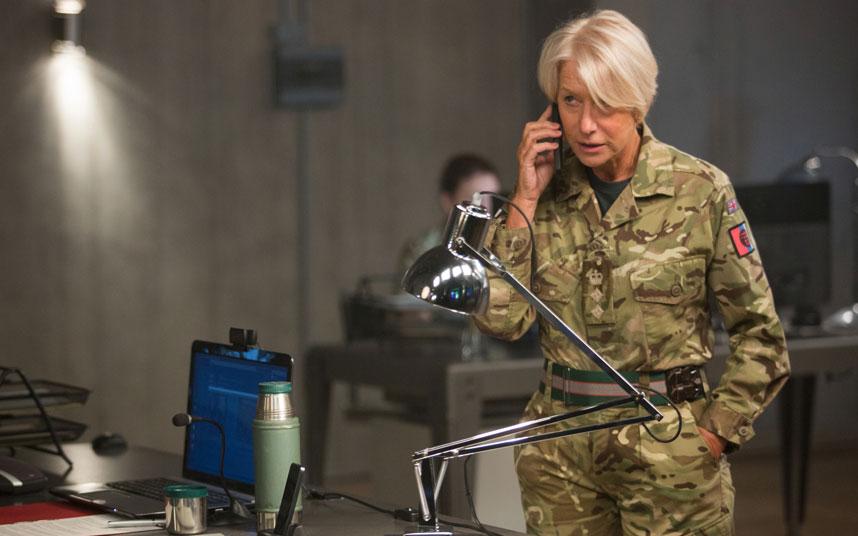
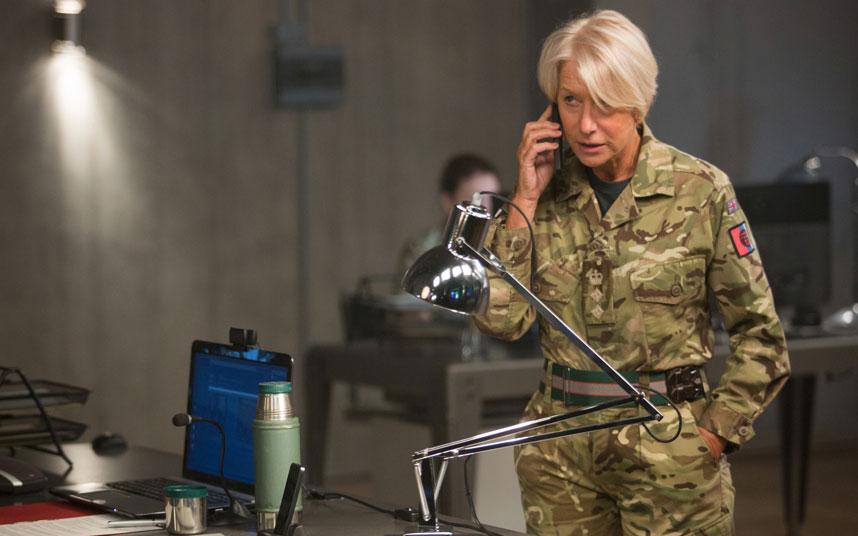
“Eye in the Sky” is a rare thriller that grips the mind and heart equally. Drones take our military closer than we have ever been before to the people and the activities of the enemy as they remove us further than we have ever been before from the visceral reality of the actions we take based on what we have learned. This film takes us inside the tactical, political, legal, and moral choices faced by the international governments and military in combating terrorism. Director Gavin Hood and screenwriter Guy Hibbert show us the stakes rising and the options shrinking with each passing second, so we in the audience must constantly ask ourselves not just what the characters should do but what we would do.
Colonel Katherine Powell of the British Army (Helen Mirren) is awakened by her phone. Intelligence received via drone indicates that three from the top ten international most wanted list of terrorists may possibly be together at a home in Kenya. The British and the US are especially interested in one couple they have been trying to find for six years. The wife is British and the husband is American. Both countries want them captured and tried at home.
If her team can positively identify the couple and the man they are meeting with, the mission will turn from reconnaissance to capture. But then the drone camera reveals that the danger is far more dire and imminent than they thought. The house is not just a meeting place. They are arming suicide bombers, taping their last statements, and presumably getting ready to send them into densely populated areas for maximum carnage. The people working on this are all over the world, with a military unit in Hawaii that analyzes images from a drone in Kenya, flown by a pilot in Las Vegas, commanded by military personnel in England, under the direction of elected officials who are both away from their countries on business.
The military has the capacity to prevent the suicide bombers from inflicting damage on civilians by blowing them up before they leave. But they are in the middle of a residential area. Is this warfare or an execution? Does it matter that two of the targets are British and US citizens? Does it matter that a little girl is selling bread just outside the house?
The international scope of the mission and the bureaucratic/political decision-making is fascinating. Information inside the house comes from a tiny mini-drone that looks like an insect, flown into the house by an operative nearby who is pretending to be both selling buckets in the open market and playing a video game on a phone. The operative is played by “Captain Phillips” star Barkhad Abdi, a very different and equally impressive performance of great intelligence and thoughtfulness. Information from the outside, including the biometric identification of the suspected terrorists, comes from drones monitored by Americans half a world away. Sitting at screens are Aaron Paul and Phoebe Fox as US military who are diligent and dedicated but not really prepared to blow up the people they’ve been spying on, especially that little girl.
There is a literal ticking time bomb in that house. We can see it. What should we do about it? Should we risk that child’s life to keep the suicide bombers from taking more lives? For the military, including Colonel Powell and her boss, Lieutenant General Frank Benson (the late Alan Rickman, making us miss him even more sharply), it is a mathematical calculus; not simple, but clear. They know they must consult the lawyers, who remind them of the criteria, almost a formula, they are required to apply. But the bureaucrats get nervous, and bump it up to the politicians. Calls must be made all over the world as the officials are participating in various diplomatic events; at one point it is even suggested that the question be put to the President of the United States.
But the film shows us that these questions have already been asked and answered. There is a calculus that is reassuringly quantitative and comprehensive but disturbingly clinical. As we see the people all over the world watching the people inside the house, trying to figure out how to apply those algorithms expressed in acronyms and percentages, the film forces us along with the characters to try to apply formulas to a world that will always confound them.
Parents should know that this movie features military violence including drones, guns, explosions, terrorism, suicide bombers, with some grisly and disturbing images, and very strong language. An extended part of the film focuses on potential “collateral damage” to civilians, including a child, from military action.
Family discussion: How would you improve the decision that was ultimately made? How would you improve the process for making it? Who should decide?
Copyright 2016 FocusWe have a very clear picture of Jesus’s birth, and it is endlessly re-enacted and depicted each year at Christmas time. But we know almost nothing about His childhood, other than his astonishing the elders with his depth of knowledge.
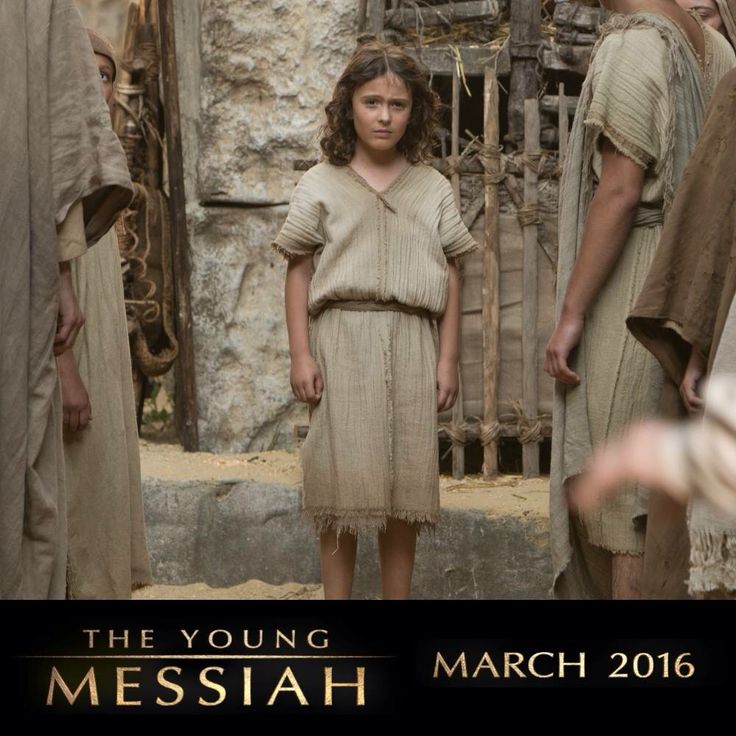
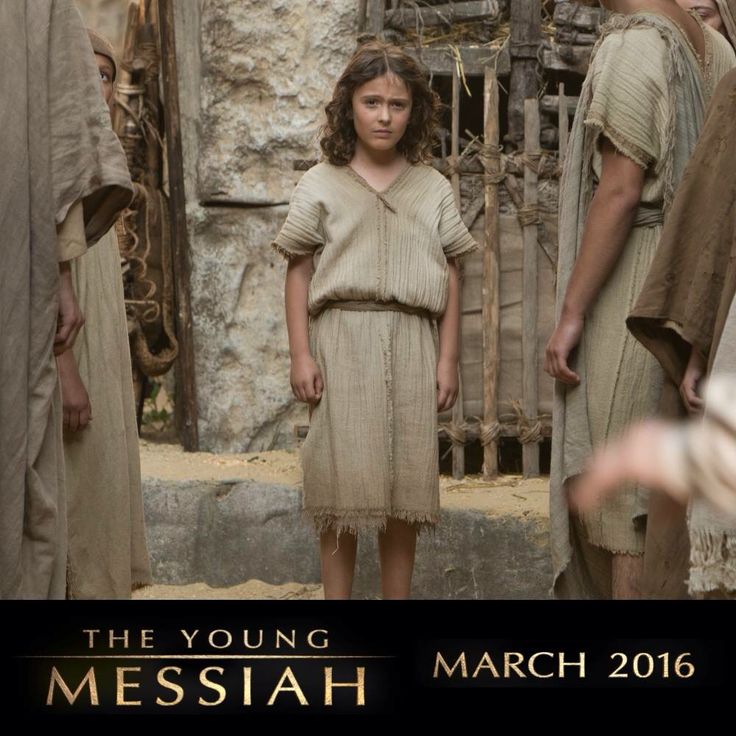
“The Young Messiah,” “inspired by scripture and rooted in history,” shows us His early years. It is a reverential, respectful portrayal of Jesus at age 7, as the Romans were trying to find and kill Him, and as He was just beginning to understand His power and purpose. It is based on the book by Anne Rice.
Jesus is played by sweet-faced Adam Greaves-Neal. We first see Him listening to a young girl who is teaching him to draw a camel. When a bully gives her a hard time, Jesus steps in to defend her and the bully starts attacking Him. A mysterious hooded figure tosses an apple core to trip up the bully, who falls, hits his head on a rock, and dies. No one else could see the man in the hood, and Jesus is blamed for the boy’s death.
The young Messiah insists on visiting the body, and it is there He performs His first miracle, bringing the boy back to life. This is an extraordinary moment because no one, even Jesus himself, knew such a thing was possible or that He was capable of it. And yet Jesus is so young, and his compassion so deep, that it seems completely natural for him. It confirms the greatest hopes but also the greatest fears of Mary and Joseph as it makes him a target for the Romans. And, like all parents, they have to find a way to protect their child and to answer His questions, though both are difficult and both at the same time seem impossible. “How do we explain God to His own son?” Even more difficult, how can they explain to Him a world in which the road is lined with crucified Jews and babies were murdered because the Romans were so afraid of Him? And how should they guide Him in using a power no one really understands? Mary can only say, “Keep your power inside you until your Father in Heaven shows you the time to use it.”
As Jesus and his family travel from Egypt to Jerusalem, Herod sends a soldier named Severus (Sean Bean) to find the boy and kill Him. Severus is not worried about reports that the boy can perform miracles. “There’s only one miracle,” he says, brandishing his sword. “Roman steel.”
Greaves-Neal is not really an actor, but his performance has an appealing dignity and tenderness. “Am I dangerous?” he asks, not “Am I in danger?”
It is especially good to see the young Jesus portrayed as compassionate but also intensely curious about the world. That thirst for knowledge and understanding is as inspiring to those around Him as His miracles.
Parents should know that this film include Biblical violence including crucifixion, bullying, and characters are injured and killed.
Family discussion: What do we learn about Jesus from his reaction to the bully? How did his curiosity about the world and scripture help him understand his purpose?



 is being released with the Yosemite Conservancy to commemorate the 150th anniversary of the park’s initial creation as a federal grant to the state of California. Mr. Duncan generously took time for an interview.