AFI Docs: Three Great Documentaries About Failures of Law Enforcement

Posted on June 20, 2014 at 8:34 am

We had a great first day at AFI Docs, the most important documentary film festival in the country. I am very proud to be a sponsor. Yesterday, we saw three of the films featuring one of this year’s key themes, failure, abuse, and over-intrusiveness of law enforcement, all followed by panel discussions with the filmmakers and those featured in the film.

“1971” is the story of a group of young anti-war protesters who broke into a field office of the FBI in Media, Pennsylvania and stole all of the documents filed there. Before Daniel Ellsberg, Julian Assange, Chelsea Manning, and Edward Snowden, these eight people, anonymous until they came forward four decades later, sent files to newspapers that revealed shocking and illegal activity at the FBI. What they uncovered led to the first-ever oversight hearings and guidelines for FBI activities. Reporter Betty Medsger, who covered the story for the Washington Post, wrote a book about it last year: The Burglary: The Discovery of J. Edgar Hoover’s Secret FBI.

“The Newburgh Sting” is the story of four men who were arrested for planning a terrorist attack on a plane and two synagogues. But the movie reveals that the man who planned and financed the operation was an FBI informant.

“The Internet’s Own Boy” is about Aaron Swartz, a brilliant, passionate young man, the co-founder of Reddit and one of the leaders of the anti-SOPA campaign, who killed himself at age 26 because he was being prosecuted for downloading scholarly journals. He was facing a 13-count indictment with the prospect of a 35 year sentence.

Related Tags:


Documentary Festivals

Jersey Boys

Posted on June 19, 2014 at 6:00 pm

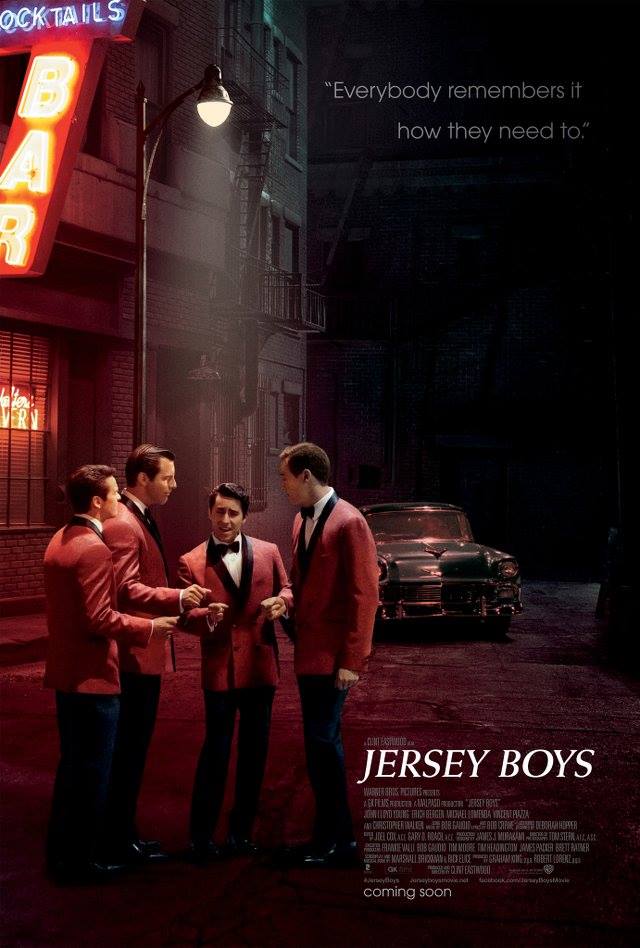
Winston Churchill famously said that history is written by the victors.  In movie terms, that means that when you see the names of just two of the original Four Seasons listed as the film’s producers, it is clear we are going to get their side of the story.jersey boys

This film, like the Tony Award-winning musical, is the “VH1 Behind the Music”-style story of four guys from the scrappy streets of New Jersey who grow up with only three possible career paths: the military, the mob, and somehow achieving fame.  The first two have a high risk of getting killed.  The last seems unobtainable.  But the four guys, brought together in part by a fifth guy who took the fame option, Oscar-winner Joe Pesci (played in the film by Joseph Russo), became one of the most successful pop acts of all time, with number one hits through the 60’s-70’s.

Clint Eastwood, a composer himself, who made a fine musical biopic about Charlie Parker (“Bird”), has taken on this story, beautifully performed, but too focused on the lives of the group’s members, with very little about what it was that made them stars, or even what the music meant to them aside from a way to get out of New Jersey and support their families.

Tony Award-winner John Lloyd Young plays the undisputed star of The Four Seasons, Frankie Valli, whose pure-toned, remarkably elastic three-octave range was the pure aural joy amidst the sweet harmonies of the Four Seasons sound.  It was that voice that persuaded 15-year-old Bob Gaudio (Erich Bergen), already the composer of a hit single (“Who Wears Short Shorts”), to join the group.  A handshake deal between Gaudio and Valli continues to this day.

Eastwood and cinematographer Tom Stern give the movie a bleached-out look that gives the skin tones of the cast the consistency of putty.  This is intended to express the grittiness of the New Jersey community, but it just looks drab.  And it undermines the points that Eastwood and the Jersey boys themselves try to make about their rough-and-tumble environment when the kindly cop knows everyone in the community so well he remembers Frankie’s curfew.  Even the mob boss (a deliciously droll performance by Christopher Walken) is so cute and cuddly that he cries openly when Frankie sings a sentimental number.  And he’s there to step in when another mob guy is less understanding.

The predictable temptations and stresses of life on the road are predictably laid before us.  Some day, I hope someone will make a movie about a famous guy that won’t have the screaming fight with the wife about how he’s never home.  This is not that film.  And there are the struggles for leadership, the poor judgment with money, also resolved the Jersey way.  We briefly see decisions that led to iconic details.  After several other names, the group picked “The Four Seasons” from a sign at a bowling alley that would not hire them to perform.  “Big Girls Don’t Cry” came from a Billy Wilder movie they saw on television.  But we never get a real sense of the era, of how they fit into the culture musically, how they interacted with the fans, how they were affected by experiencing the world outside of New Jersey.

It is absorbing, largely because of excellent performances by all four of the Jersey Boys, but uneven, largely because the script assumes that we will be as fascinated with the relationships of the four men as they are themselves.  At the end, Frankie says that for him the high point was finding their sound, just four guys harmonizing under a street light.  That’s a moment we never get to experience.  The only time we feel their pleasure in performing is in what has to be seen as the curtain call number, an odd piece of theatricality that, after two and a half hours of running time, finally shows us what made the Four Seasons so thrilling to experience.

Parents should know that this film has very strong language including crude sexual references, a non-explicit sexual situation, smoking, drinking, off-screen drug abuse, and references to mob activity.

Family discussion: Why does Frankie take responsibility for what Tony did? Why did he leave his daughter with her mother? What do you think was their high point and why did Frankie pick the one he did?

If you like this, try: other musician biopics like “Ray” and “Walk the Line” and the music of the Four Seasons.  And to get a glimpse of Frankie Valli today, look for him in a small role in Rob Reiner’s “And So It Goes” with Michael Douglas and Diane Keaton.

Related Tags:


Based on a play Based on a true story Biography Crime Drama Musical

Think Like a Man Too

Posted on June 19, 2014 at 6:00 pm

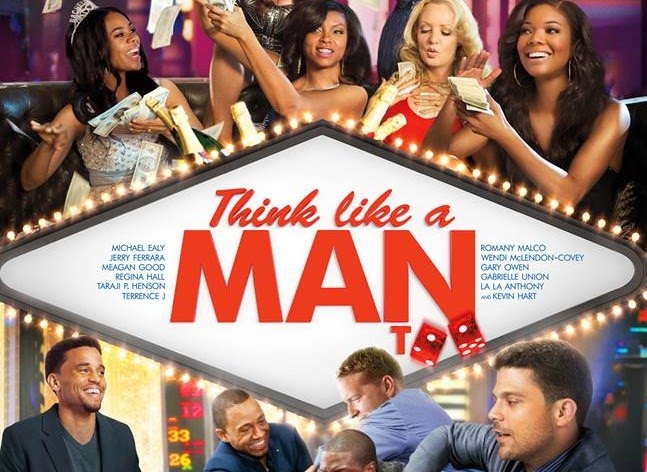
Think-Like-a-Man-Too-Poster-647x472A romantic comedy based on Steve Harvey’s book of advice for women about relationships has now led to a sequel based on finding the slightest possible premise for getting the gang back together to see if they can create some more box office magic.

Not that there’s anything wrong with that.  After all, seeing pretty people do silly things so they can kiss and make up is always a good reason to go to a movie.  And these are some of Hollywood’s most appealing performers.

In the first film, a group of buddies with a regular basketball game find themselves flummoxed by a bevy of beauties who read Steve Harvey’s book for tips on dealing with players, mama’s boys, and perpetual adolescents.  The happily ever after ending has now led to a proposal and the whole group is going to Las Vegas for separate wild pre-nuptial parties followed by the wedding itself.  When the groom-to-be assures his bride that everything will be perfect and nothing can possibly go wrong, we know that nothing will be perfect and everything will go wrong in the most humiliating way possible until we find our way to another happy ending with a possible opening for #3, which I hereby predict will involve a baby or two.

Would-be chef Dom (Michael Ealy) and corporate powerhouse Lauren (Taraji P. Henson) are deeply in love but struggling with job opportunities in different cities that they are afraid to tell one another.  Mya (Meagan Good) is not happy to run into stories about the wild past of “Zeke the Freak” (Romany Malco). Kristen (Gabrielle Union) wants to get pregnant as quickly as possible and that puts a lot of pressure on Jeremy (Jerry Ferrara).

But the development that has the biggest impact on the film is the one that happened off-screen.  Since the first one was released, Kevin Hart has become a box office powerhouse with a concert film in 2013 and two enormously successful comedies already in 2014 (About Last Night and Ride Along).  This is most likely the reason that he takes up so much more of “Too” than he did in the first one.  And since is a very loud guy, he seems to take up even more than he does, too often with all the appeal of a buzzing mosquito.

The entire premise of the first film is jettisoned, along with any aspirations beyond silly fun.  It takes Cedric (Hart) far too long to figure out that he has mistakenly booked himself into a room that costs ten times what he thinks, because every time there is any possibility to mitigate the damages of whatever he has gotten himself into, he blusters like a bantam rooster to block any kind of reality check from the other characters.  And this is close to the movie’s most plausible plotline.  Even Lucy and Ethel could not make us believe that anyone cares whether the boys or the girls have a wilder pre-nuptial party.  Director Tim Story throws in every possible signifier of movie fun, from a makeover (“Bridesmaids'” Wendy McLendon-Covey) to a dance number (okay, the girls’ dancing to Bell Biv DeVoe’s irresistible “Poison” is a treat) and the ever-popular night in the pokey plus the completely superfluous addition of a couple of cute white guys (Adam Brody and “About a Boy’s” David Walton.

The cast is clearly just here to have a good time, and the audience will, too.

Parents should know that this film includes some strong language including crude sexual references and humor, sexual situations, strippers, drinking and drunkenness, and drug use, along with a lot of foolish Las Vegas behavior.

Family discussion:  What were the groups trying to accomplish in their pre-nuptial parties?  Which couple has the strongest relationship?

If you like this, try: the first film and “About Last Night” (rated R), also featuring Hart, Ealy, and Hall.

Related Tags:


Based on a book Comedy Date movie Romance Series/Sequel

Coherence

Posted on June 19, 2014 at 5:47 pm

A-
Lowest Recommended Age: High School
MPAA Rating: Not rated
Profanity: Strong language
Alcohol/ Drugs: Drinking, drugs
Violence/ Scariness: Pervasive psychological horror and some violence
Diversity Issues: None
Date Released to Theaters: June 20, 2014

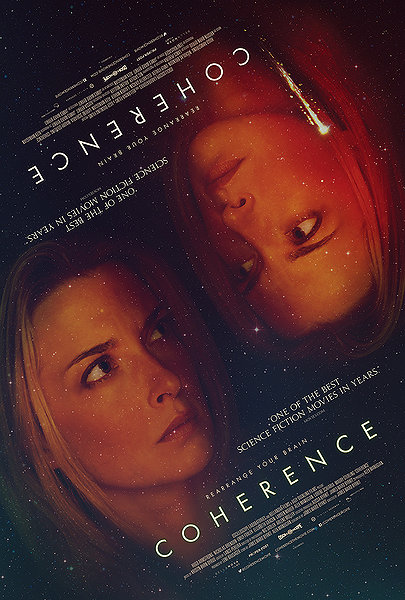
coherenceSeriously, don’t read this review until after you’ve seen the movie. The less you know, the more you will enjoy this nifty thriller, which craftily makes the most of its micro-budget to maximize a deliciously mind-bending story. As in all great thrillers, the scary stuff is not what’s on the outside, but what the stuff on the outside does to the stuff in the inside, meaning not just the inside of the characters but the inside of the audience.

James Ward Byrkit, who wrote “Rango” and created the visual design for the “Pirates of the Caribbean” movies (all with Gore Verbinski), wanted to take some time away from seven-figure-budget blockbusters and create something small and intimate. He literally shot it in his living room, with a cast of vaguely familiar looking but under the radar actors. As the movie begins, eight friends are getting together for a dinner party. We get some sense of the relationships and some tensions as they gather. They engage in routine dinner party chat, mentioning in passing some news about a comet due to pass overhead along with the usual updates and gossip.  And then the phones stop working.  And then the lights stop working.  And then someone says he’d better go outside to find out what is happening.  And we’ve all seen enough movies to know that this is probably not a great idea.

What happens next is not a plot twist but a plot Rubik’s Cube, an ingeniously plotted infinite regression of meta-realities. To say any more would be to spoil the movie’s best surprises.

Parents should know that this is a psychological thriller with a pervasive sense of dread and some violence.  Characters drink and use drugs and there is strong language.

Family discussion: What decision do you wish you could go back and do over?

If you like this, try: “Identity”

Related Tags:


Movies -- format Thriller VOD and Streaming

Interview: Dean DeBlois of “How to Train Your Dragon 2”

Posted on June 13, 2014 at 7:00 am

Writer/director Dean DeBlois is one of my favorite people to interview and it was delightful to talk to him about the wonderful “How to Train Your Dragon 2.”

Just give me the basics just to set the stage. Tell me how much time has gone by since the first film and where we start off.

This is the second installment of a planned of trilogy. It has our characters now 20 years old instead of 15 year olds that were in our first movie. We wanted to introduce Hiccup and the gang at a different crossroads in their life where they are now stepping into adulthood with some uncertainty and a sense that Hiccup isn’t quite cut out to take over his father’s mantle as chief. So instead he is expressing his restlessness by being out there on the edge of the Viking map and charting new lands and finding new dragons. That’s where he comes across the conflict that actually threatens the peace back home. He discovers that there is a group of dragon trappers that are trapping dragons for an ambitious conqueror named Drago Bludvist who on plans on amassing a dragon army. And there is also a vigilante who is out there rescuing dragons and whisking them away to safety.how-to-train-your-dragon-2-poster2-408x600

Now tell me a little bit about what has happened in the technology side since you made the first one and how that has affected making the movie. Were there things you were able to do this time that you couldn’t do last time?

Sure, absolutely! This film is actually the first to roll out a brand new generation of software that has been in development for over five years. And it just reinvents the way that we approach our work and makes it very intuitive and real time so that we don’t have to wait for renders which always impairs creativity. The big improvement is that the software is much faster so you can work with lots of characters on screen but the results are immediate and so animators now work with their hands again. They get to use the stylus and they can manipulate characters instead of using spreadsheets, numeric entries and pull-down menus.

It seems to me that there is a lot more capacity for many, many characters to interact with each other.

That’s exactly it! There are so many shots in this movie that increase the scope and scale which is perfect for our ambition for the film. There were shots that couldn’t have been done before, like where we have thousands of characters on screen rushing the beach and the epic battle of the second act or so many different characters riding their dragons even in the opening during the dragon races. It allows us to be really rich and complex and also allows for incredible subtlety with the animation as well because there is so much going on under the skin with every one of our character.

With every year it seems like technology makes our lives a little bit easier and makes things look a lot better. Five years ago it seems like clouds in particular were very difficult or water, or anything interacting with water was difficult, like ice for example. We have a lot of that in our movie and it was really difficult to light that but now they look spectacular and you can imagine actually what it going to be five years from now. I believe that what we’re doing now which feels very cutting edge five years from is going to look primitive in ten years.

There is a guy name Dave Walvoord who was our head of visual effects who spent a lot of time actually developing the look of that ice. And it really was incredible. They worked really hard, it was difficult but they figured out a formula that seems to allow just the right amount of light to reflect through it and it has just the right opacity and luminosity to it that just makes it jump off the screen. That’s hats off to our effects department, breathing so much life into what lurks beneath the waves has add a really great quality to it

how-to-train-your-dragon-2-hiccupI’m going to try to do this so that we avoid spoilers but we lose an important character in this movie, so what can you say about that?

It was painful but it was a rite of passage and I think that we all knew that Hiccup had a place to go narratively and so long as he had a crutch he wouldn’t step into the role that he needed to step into. So as somebody who suffered a very similar loss as a boy it has a great heroism to it and a nobility to it but also narratively in terms of tracking Hiccup’s coming of age it was a rite of passage that I thought we needed to go through in order to really commit to the person he needed to become.

That was sad but what totally got me was that beautiful song. I cried.  So tell me about the choreography and where the song came from.

I’m really happy to hear that because that was the moment I was most afraid of in the movie and as a result I’m maybe most proud of. The risk for a cringe-worthy experience was high I knew I wanted to have this old Viking ballad that would have been passed down through the generations and something that would have been sung at her wedding to bring her back from this place of regret and remorse and feeling overwhelmed by the realization that people can change and she made the wrong decision and all this time her son who probably needed her feeling like a square peg back in Berk, left to feel like he was the only one that was sympathetic to dragons.

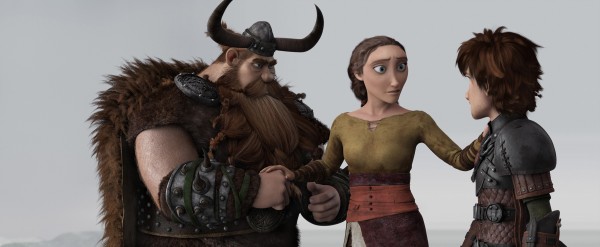
So she is carrying a lot of that burden at the beginning of the scene and Hiccup is so enthusiastic, he’s unaware that he is only overwhelming her more but Stoick realizes that there is another approach and so he uses this song that was a duet to remind her of the person she used to be and who they used to be together. So it was made to be carried out in a very clumsy kind of charming way that used music minimally in order to feel authentic and raw and not a burst into song musical moment. And it sounds like we pulled it off if it made you cry.

I should tell you the song was actually written by Jónsi who was the frontman of an Icelandic band call Sigur Rós and he did our incredible song at the end of our first film. He’s a good friend and I made a concert film for them a few years ago. He joined forces with John Powell to write two pieces for this movie and that’s Hiccup’s introduction song and this song.  Lyrically I had something very specific in mind. Shane McGowan from the Pogues has always written these really heartfelt tender beautiful moments and beautiful lyrics and so we approached him about it.  He jumped at the chance so the lyrics are lyrics are actually from Shane McGowan, John Powell and Jónsi. We even brought in a choreographer to help us with the movements.

The choreography was pretty intricate.

Yes, we used a choreographer from Once, the stage production and America Idiot.   I asked him to make it feel like your parents, sort of bumbling parents dancing around the kitchen instead of Dancing with the Stars. And he incorporated a few fumbles as well in the middle of the choreography to make it feel really authentic and unrehearsed.

I thought that was great. Now I want to go back to the beginning  for a minute because that dragon race was an incredible way to get you very immediately into the film and with the characters.  How do you orchestrate that to keep us on top of so many different things that are happening?

Narratively we had a lot of ground to cover just in terms of recapping it for the audience and helping out the audience who had not seen the first film. So we decided to do it this very kinetic visceral way. Now that the Vikings and dragons are no longer at each other’s throats they needed something to do with all that energy. so they created this obstacle race of sorts that involves finding marked sheep that are all over the island and then returning them to these baskets that contain them. And you have the whole populous of Berk crammed into these stands cheering them on.  This way we could see all of our auxiliary cast aged five years later but also reintroduce them in a fun kinetic way paired with their dragons and seeing how they have become symbiotic flyers in these five years that has passed.

And then another thing is we fly be a lot of the updates that have been installed since the first movie so in places of catapults, and battle stations we now have feeding stations, water reservoir, and aqueducts.  You can really see the ways that the dragons have been integrated into the Vikings’ daily lives and how it’s become a dragon utopia, which also helps to set up the stakes for the movie.  This is what could be lost if Drago Bludvist has his way and conquers their land as well.

Drago is played by Djimon Hounsou.  Tell me about selecting him for the cast and what you saw for that character.

One of my favourite movies is Blood Diamond and I thought Djimon was so powerful in that movie, in particular the scene where he is talking to his son who has been brainwashed by the warlords and has a gun pointed at his father.  It’s this beautiful scene where he is saying, “This is who you are and these are your sisters and this is your mother” and remind him of sort of the daily life of who he used to be and the tears were running down his face.  I thought that  was a great reference for the moment where Hiccup was trying to reconnect with Toothless in the  third act of the movie. So he was high on my list and I also love the fact that Djimon was born in Africa but raised in France and he has a very non specific accent which is what I wanted for this character.  He was from a distant land, a strange land of unknown origin and so it added to his mystique that he is journeyed this long way for this goal of amassing a dragon army.  He’s got a great character to his voice that’s really powerful and intimidating but also textured to indicate that there’s more going on than just the arch villain.  He has limited screen time in this movie but I think there is a sense of wanting to know more about what makes him tick.

And I also really enjoyed the new character that you added, Eret played by Kit Harington.

I started watching Game of Thrones as I was setting up the movie and John Snow quickly became one of my favorite characters. And I loved that sense of youth in his voice, and there’s a nobility there.  Eret is from a completely different land but also in a way a contemporary of Hiccup’s, roughly in that age range. There was a youth and a charm but also playfulness to the voice that Kit brings. And I actually think he did a great job of rising to the occasion because we pushed the character to be much more of an arrogant, cocksure, cowboy of a dragon trapper who loves the sound of his own voice and Kit immediately took to that and packed more accent  to it to make it seem even more amplified. I think he had a lot of fun with the role.

What’s next?

I’m about to start writing that script after I take a little break.  I have an existing outline already that was part of mapping the trilogy was kind of knowing what threads we would be drawing out of the first film and playing out in the second installment but then also what are we setting up for the third? I love the idea that something that Cressida Cowell had mentioned when she was visiting the studio and she is the author of the books from which the first movie was based. She said, “I plan by the end to explain what happens to dragons and why they are no more.” That was so compelling and I thought “Wow, it is such a powerful idea.”  Of course it’s bittersweet but I think it is  so emotionally powerful and fitting to be able to close a chapter on this trilogy with history returning to somewhat as we know it and what happened to the dragons and where did they go and could they come back. These are all mysteries that will be unveiled. But I loved that Hiccup learned stand on his own and made the toughest decisions of all for the betterment of mankind and dragons.

 

Related Tags:


Animation Directors Interview Writers
THE MOVIE MOM® is a registered trademark of Nell Minow. Use of the mark without express consent from Nell Minow constitutes trademark infringement and unfair competition in violation of federal and state laws. All material © Nell Minow 1995-2026, all rights reserved, and no use or republication is permitted without explicit permission. This site hosts Nell Minow’s Movie Mom® archive, with material that originally appeared on Yahoo! Movies, Beliefnet, and other sources. Much of her new material can be found at Rogerebert.com, Huffington Post, and WheretoWatch. Her books include The Movie Mom’s Guide to Family Movies and 101 Must-See Movie Moments, and she can be heard each week on radio stations across the country.

Website Designed by Max LaZebnik