This time of year always makes me think of “Windy Day,” one of my favorite short films. John and Faith Hubley created this wonderfully impressionistic animation using a recording of their daughters playing together as a soundtrack.
Stripped: Amazing New Documentary on Comics Now Available on iTunes
Posted on April 1, 2014 at 7:00 am
I’m a big fan of comic strips and a proud Kickstarter contributor to the new documentary “Stripped,” out today on iTunes.
There is no better way to celebrate April 1st, spring, or just the joy of laughter than this look at luminaries like:
Bill Griffith (Zippy the Pinhead)
Brendan Burford (King Features Syndicate)
Chris Hastings (Dr. McNinja)
Anthony Clark (Nedroid)
Dan Piraro (Bizarro)
Danielle Corsetto (Girls With Slingshots)
Darrin Bell (Candorville, Rudy Park)
David Duncan (Savannah College of Art & Design: SeqArt Department)
Brian Ralph (Savannah College of Art & Design: SeqArt Department)
David Malki (Wondermark)
David Reddick (Legend of Bill)
Dylan Meconis (Family Man)
Emily Horne (A Softer World)
Kate Beaton (Hark, A Vagrant!)
Gary Tyrrell (Fleen)
Jon Rosenberg (Scenes from a Multiverse)
Gene Ambaum and Bill Barnes (Unshelved)
Greg Evans (Luann)
Rodd Perry and Guy Endore-Kaiser (Brevity)
Hilary Price (Rhymes with Orange)
Holly Post (Topatoco)
Howard Tayler (Schlock Mercenary)
James Strum (Center for Cartoon Studies)
Jeff Keane (The Family Circus)
Jeff Smith (Bone, RASL)
Jenny Robb (Ohio State Billy Ireland Cartoon Library & Museum)
John Lowe (Savannah College of Art & Design: SeqArt Department)
Jim Davis (Garfield)
Karl Kerschl (The Abominable Charles Christopher)
Kazu Kibuishi (Amulet, Flight)
Scott Kurtz (PvP, Table Titans)
Kris Straub (Chainsawsuit, Broodhollow)
Brad Guigar (Evil, Inc.)
Meredith Gran (Octopus Pie)
Michael Jantze (The Norm)
Phil & Kaja Foglio (Girl Genius)
R.C. Harvey (Meanwhile… A Biography of Milton Caniff)
Ray Goto (Savannah College of Art & Design: SeqArt Department)
Dove McHargue (Savannah College of Art & Design: SeqArt Department)
Richard Thompson (Cul de Sac)
Roz Chast (The New Yorker)
Ryan North (Dinosaur Comics)
Scott McCloud (Understanding Comics)
Sherry Stern (LA Times)
Stephan Pastis (Pearls Before Swine)
Steve Hamaker (Fish N Chips, Bone)
Tom Gammil (The Doozies, The Simpsons)
Zach Weiner (SMBC)
Jeannie Schulz (Peanuts, Schulz Museum)
Andrew Farago (Cartoon Art Museum)
Shaenon K. Garrity (Skin Horse)
Jessica Ruskin (Schulz Museum)
Lalo Alcaraz (La Cucaracha)
Keith Knight (K Chronicles)
Mell Lazarus (Momma)
Bill Amend (Foxtrot)
John Glynn (Universal Press Syndicate)
Lee Salem (Universal Press Syndicate)
Robert Khoo (Penny Arcade)
Matt Inman (The Oatmeal)
Mike Krahulik and Jerry Holkins (Penny Arcade)
Lynn Johnston (FBoFW)
Cathy Guisewite (Cathy)
Patrick McDonnell (Mutts)
Mort Walker (Beetle Bailey, Hi & Lois)
Jeph Jacques (Questionable Content)
John Geddes (USA Today)
Brian Walker (Hi & Lois)
Interview: Rachel Boynton of Oil Business Documentary “Big Men”
Posted on March 30, 2014 at 7:39 am
Documentarian Rachel Boynton (Our Brand Is Crisis) spent seven years filming “Big Men,” a documentary about what happens when the American oil business meets a previously unknown oil reserve in Ghana. Is it possible for American business, with its obligations to generate returns for shareholders, to develop operations in a poor country without leading to corruption and abuse? Boynton takes an even-handed approach, showing us the story — and the conflicts — as they develop.
The film’s central story follows a small group of American explorers at Dallas-based oil company Kosmos Energy. Between 2007 and 2011, with unprecedented, independent access, Big Men’s two-person crew filmed inside the oil company as Kosmos and its partners discovered and developed the first commercial oil field in Ghana’s history.
Simultaneously the crew filmed in the swamps of Nigeria’s Niger Delta, following the exploits of a militant gang to reveal another side of the economy of oil: people trying to profit in any way possible, because they’ve given up on waiting for the money to trickle down.
So what happens when a group of hungry people discover a massive and exquisitely rare pot of gold in one of the poorest places on earth?
Scott Foundas wrote in “Variety”
“Like a number of recent hot-button docus, from ‘Crude’ to ‘Inside Job,’ Rachel Boynton’s extraordinary ‘Big Men’ should come tagged with a warning: The side effects of global capitalism may include dizziness, nausea and seething outrage. Using razor-sharp journalistic skill to untangle the knotty saga of an American petroleum company’s entrance into the West African republic of Ghana, Boynton’s film also poses a series of troubling philosophical questions: Is unchecked greed an intrinsic part of the human character? Is ‘the greater good’ ever more than a convenient euphemism where big business and big government are concerned? Wide fest exposure and ancillary sales seem assured for this Tribeca world premiere, which also richly deserves a theatrical pickup.”
Boynton talked to me about making the film and the challenges of telling a complicated story.
As is said by several different people over the course of the movie, we all are human beings with the same impulses. So why is it that there are such different outcomes?
Well, in Ghana we don’t know what the outcome is going to be, right? That was sort of one of the conundrums of the film. I knew that watching the film anyone would want to know, are the people in Ghana are going to benefit from this? And I was never going to be able to stick around for twenty years to find out. I needed a way to contemplate that question, if not to find an answer at least to give them another question.
You show a representative from Norway who provides a counterexample, a very credible, fair system in which all of the citizens of the country share in the benefits from the oil extraction. And then you show Nigeria as another option, where corruption has been a terrible problem. What makes the difference?
Norway is a pretty homogeneous society, you know, a lot of unity there. There are 250 different languages spoken in Nigeria, not to mention the dialect. So you’re in one town and you go five km down the road and they don’t speak the same language. And it’s literally like the tower of Babel, very difficult for people to communicate with each other let alone come to some kind of consensus as a nation. And I think that kind of diversity is both of something of beauty and strength and at the same time something that is incredibly difficult to overcome when you’re trying to come to some sort of national unifying consensus. Or if you are trying to have leaders, this notion of everyone looking out for themselves is something that unifies everyone in the movie. And there’s a line in the film from someone who works for the Ghanaian national Petroleum company on the board and he says that he doesn’t believe that self interest is an intrinsic part of human nature, that what unites us needs to be greater than what divides us. And I love that sentiment, I love the idea but it’s much more difficult to achieve than it is to say and it’s much harder to achieve in a place as diverse as Nigeria.
How did you become interested in this story?
I made Our Brand Is Crisis and it was very well received on the festival circuit. It did well for itself and I was very pleased and excited about how it was done. It was my first film as a director and I felt kind of empowered coming out of that film to do something more ambitious. I was at a point in my life where I wanted to do something really epic and big and difficult. And at the time oil was all over the news. I’d turn on CNN and literally every five minutes there would be a segment about the price of oil and fears over a hundred dollars a barrel. It was just on everyone’s lips and I thought, “This is interesting. Everyone’s talking about oil and yet I’m not seeing anything about this most important resource from inside the industry. Wouldn’t it be interesting to get in that industry?” I could do that and then I started fishing around. Where would I go first? What I was gonna do?
And as I was doing some research I discovered that the Gulf of Guinea off the Coast of West Africa was this region that the Bush Administration and all of the oil majors were paying enormous attention to as this new frontier for oil exploration. They were all talking about how there was a lot of underexplored territory there. And that new technology was allowing them to look for oil there. So I said, “Oh well, that’s kind of interesting, that could be an interesting place to go look at,” and then at the same time I was really thinking about this militancy popping up in Nigeria and all these stories about militants attacking pipelines and kidnapping oil workers started appearing in the news. And I said there has to be a movie there, that’s conflict, drama, and that equals movie, right? So I bought a plane ticket to Lagos and I went to Nigeria and that’s how I started.
My original idea was that I was going to get access to an American oil company operating in Nigeria and the whole thing was going to be set there. And I spent basically a year and a half traveling back and forth between Nigeria and America like a crazy person, sort of trying to find the movie, trying to get access to people, trying to get to know people so that I could guarantee our security, trying to get the right permissions to put together a movie, right? But I didn’t start by knowing exactly what the movie was.
So in 2007 I had written several emails to guys at Kosmos Energy. They had this reputation as being guys who could find oil where no one else could and they had all worked together at a company called Triton Energy in the early 90s to discover oil off the coast of Equatorial Guinea. So a lot of people were interested in what they were going to do next. They managed to raise a ton of money from Blackstone before they had drawn their first well as a company. And so I knew who they were and I filmed at this thing called the Offshore Technology Conference and I happen to find someone from Kosmos on a panel there talking about Nigerian oil. I asked him out to lunch, and I pitched him on the idea of making a film. When I first filmed with them at the Offshore Technology Conference, that was in April, May of 2007, just after that they drilled their first well as a company in June, July 2007. And with that well they discovered the Jubilee field and I basically said, “You know there’s a potentially great film here and it would be great to do something about you guys,” and he said, “Why don’t you come and pitch the guys who started the company?” So I went to Dallas and I did a PowerPoint presentation. And it was a really lame PowerPoint presentation but they said yes to me and that’s how I got access to the company.
The film has a pointed contrast between between what the Wall Street guy said about reputation and how important reputation is and other participants, who in their own ways talk about how they are perceived. Even the masked gang who destroy the oil drilling equipment talk about being in the film because they want to be famous.
Yes, everyone talks about reputation.
Everyone is very, I guess I’d say, media-savvy. How do you as a filmmaker get past the way the people you are filming try to spin you?
I’ve made two movies now about people who don’t exactly wear their heart. I would say the people in my last film were much more conscious than the people in this film because that’s what they did for a living. These guys, when I did my little PowerPoint presentation, one of the things that was at the top of our PowerPoint presentation was something like, “movies are good for your reputation” and we all know that. It’s about wanting to be big and so of course one of the reasons why they are talking to me is that they want to be big and being big is two things; It’s having a lot of money and it’s having a big reputation, a good positive big reputation. And certainly being in a film is linked to that… Of course.
I don’t feel like I had the wool pulled over my eyes as a filmmaker.
I think anyone talking… Me talking to you okay; listen, I’m not going to tell you my deep dark secrets that I don’t want anyone to know. I’m not going to tell you that because I don’t know you and you are going to publish the interview. There’s certain things that one just doesn’t do and I think that’s kind of human. And I think certainly, one of the things I believe is a filmmaker is that you have to be respectful of people’s limits. And, you have to understand that people are only going to go so far in what they are willing to reveal and you have to accept that about them and embrace that about them and work with what you have. And frequently I would say, nine times out of ten, people will give you more than they think they will because they feel comfortable and they feel not judged and when people are not being judged they are more willing to be open. And openness is what makes someone in a film interesting, in a documentary right? The capacity to get someone being open.
That interview with Jim in the film I think is a phenomenal interview. It’s just that one of the best interviews I’ve ever done in my life. An amazing interview! Because we just had each other. At the time we did that interview, we trusted each other. I didn’t film him and then show it to people the next day. He felt he could trust me. And he could trust me. I was trustworthy and so he trusted me. As a filmmaker, I am not interested really in “gotcha” filmmaking, like trying to do something behind someone’s back. I really don’t think I am naïve. And I don’t think the movie feels naïve. I saw this documentary about Nigeria once and the filmmaker says in the documentary; “I decided I just was going to come in and film whatever I saw.” And thought to myself, “what the heck are you talking about?! How can you possibly do that?! It’s Nigeria! Everyone’s lying to you! How in the world could you possibly be coming in and showing what you see?”
So, one of the reasons the film is so layered and incredibly dense and there is so much going on in this movie, is because the truth is incredibly complicated. And one of the ways of getting at that is to contrast and comparison. It’s not just through showing what one person says.
That opening of the wasp on the huge and deteriorating oil equipment is so striking. Tell me why you chose that as a way into the story?
Well, Jonathan Furmanski and I talked about about insects. I was very interested in insects, I kept asking him to film insects. He knew I wanted him to film insects. That said, he found that image. Like, I was busy, I can’t remember what I was doing and he was getting shots; just beautiful shots at the well and things around the well. And he saw this little wasp’s nest being built underneath the oil, the ancient oil well and he got this great image. It’s my little “hats off to Darwin’” scenario I guess, a little bit. I’m very interested in the connections between things and I’m interested in this notion of self interest, and of building things and tearing things apart. And the wasps, for me it was really more about the feeling of the thing, the tone that it sets, that sort of smell of potential threat, the buzz in the background and the thing that strikes that’s got this thing around the end of it that’s going to watch out for itself, don’t step on it, building its nest under this well. For me, it was really about that tone because that’s the tone of the film.
Rated PG-13 for violence, disturbing images and brief suggestive content
Profanity:
None
Alcohol/ Drugs:
Drinking and drunkenness
Violence/ Scariness:
Disturbing images, peril, chaos, characters injured and killed, dead bodies, violence, attacks, sexual assaults, girls sold into slavery
Diversity Issues:
None
Date Released to Theaters:
March 28, 2014
Date Released to DVD:
July 28, 2014
Amazon.com ASIN:
B00JBGWP3Y
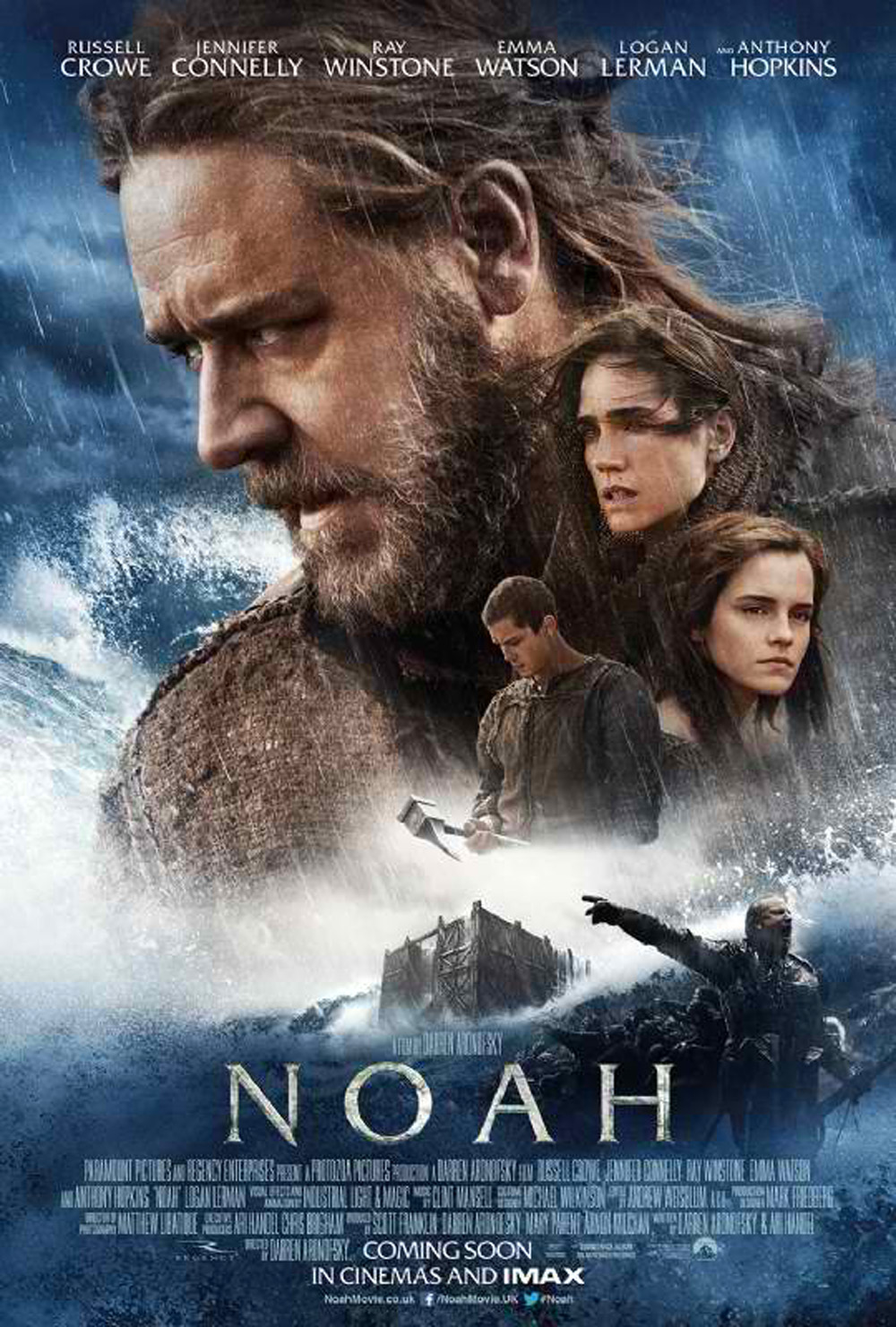
“Noah” is a serious, thoughtful, reverent movie that, like its title character, wrestles with the big issues of morality, survivor guilt, and strengthening a connection to the divine. It is also a big, grand adventure with drama and special effects. It should satisfy believers, seekers, and those who just want an exciting story, well told.
Writer/director Darren Aronofsky (“Black Swan”) shows us a Noah (Russell Crowe) who struggles to be a good man and do as God wants. Only ten generations from Adam and Eve, he is haunted by the stories of the Fall and Cain’s murder of his brother. When he was a boy, he witnessed the murder of his own father at the hand of the brutal leader of the descendants of Cain (Ray Winstone as Tubal-Cain). Now, he tries to protect his wife, Naameh (Jennifer Connelly), and three sons from the marauders.
Noah lives lightly on the earth, gently chiding his son for picking a flower because that interfere with its work of spreading seeds. He and his family do not eat animals; they respect the innocence of all creatures, unlike Tubal-Cain who defines himself as someone who takes without regard for anything but his own urges and lust for power.
Noah is filled with an ominous sense that he is receiving omens and seeks the advice of his mystic of a grandfather, Methuselah (Sir Anthony Hopkins). He begins to understand that he is commanded by The Creator to build an ark and collect the animals of the earth and to preserve them in the coming storm that will wipe out all of life on Earth. He will be helped in this by The Watchers, fallen angels who were once pure light but are now punished for their mistakes by being imprisoned in enormous bodies of mud and rock.
As Auden reminds us, the grand, sweeping events of the world do not happen purely. They occur in the midst of human lives that are messy and imperfect. While Noah struggles to follow the will of The Creator, he has to deal with problems at home. Ila (Emma Watson), a girl Noah and his family rescued after her entire community was slaughtered by Tubal-Cain, is loved by Noah’s son, Shem (“Romeo & Juliet’s” Douglas Booth), who loves her, too. But due to her injuries, she cannot have children, and she does not want to keep him from being a father and creating a new generation. Ham (Logan Lerman of “Percy Jackson”) is furious that there is no prospect of a wife and family for him.
And then there is Tubal-Cain, used to taking whatever he wants. He will do anything to stay alive through the flood and become king of whatever the world will be afterward. And he senses that Ham may be susceptible to joining him.
We rarely see Bible stories told with such artistry and power. The acting is superb and the special effects are well done. The big moments, the flood, the omens, the Watchers, the thousands of animals moving inexorably toward the ark, are all handled with meaning and import. When Noah tells his family one of the few stories that they have in this still-new human world, the story of creation, we feel the nothingness that was before. Story-telling itself becomes a way to shape the world and form an understanding of patterns, purpose, and meaning.
Men wind a snakeskin around their arms in the earliest of rituals and prayers and we see the flicker of what would become a daily observance for Orthodox Jews over the millennia through the present, the phylactery leather strips that men use in their morning prayers. We are reminded that this is a time before Jesus and before Abraham, when there was no organized religion and no established set of beliefs and practices. There is not even the word “God.” It is just “Creator.”
The innocence and the impulse to reach out toward the heavens are very moving. So is the way that Noah grapples with what today we might call survivor guilt or PTSD. And he struggles to find his better angels. Tubal-Cain is not just a man who wants to fight him; he is that part of Noah himself that is all lower urges toward flesh and power, the impulse to trap and smash and to break laws even in a world where laws have not been established.
While some viewers and some who have not even seen the film have objected to this portrayal (or, in the case of strictly Muslim groups, any portrayal of a religious figure), most should see this film as an eternal story well told in a manner that is itself a form of worship in prompting us to think more profoundly about our own choices and connections.
Parents should know that this film includes epic/Biblical violence including murder, battles, flood, some disturbing images, parent killed in front of child, character trampled to death, discussion of infanticide, some disturbing images, non-explicit sexual situation, and childbirth.
Family discussion: Why did the two groups of humans develop so differently? What should Noah have done about Na’el? Why did he separate from the family after the flood?
If you like this, try: “The Fountain” and “Pi” by the same director and Biblical-era classics like “Ben-Hur” and “The Ten Commandments”

 ) spent seven years filming “