The Odyssey

The Odyssey

Posted on July 15, 2026 at 12:00 pm

B +
Lowest Recommended Age: High School
Profanity: Some strong language
Alcohol/ Drugs: Memory-erasing flowers, wine
Violence/ Scariness: Extenseive war-time peril and violence, monsters, many characters injured and killed, graphic and disturbing images
Diversity Issues: None
Date Released to Theaters: July 17, 2026
Copyright 2026 Universal

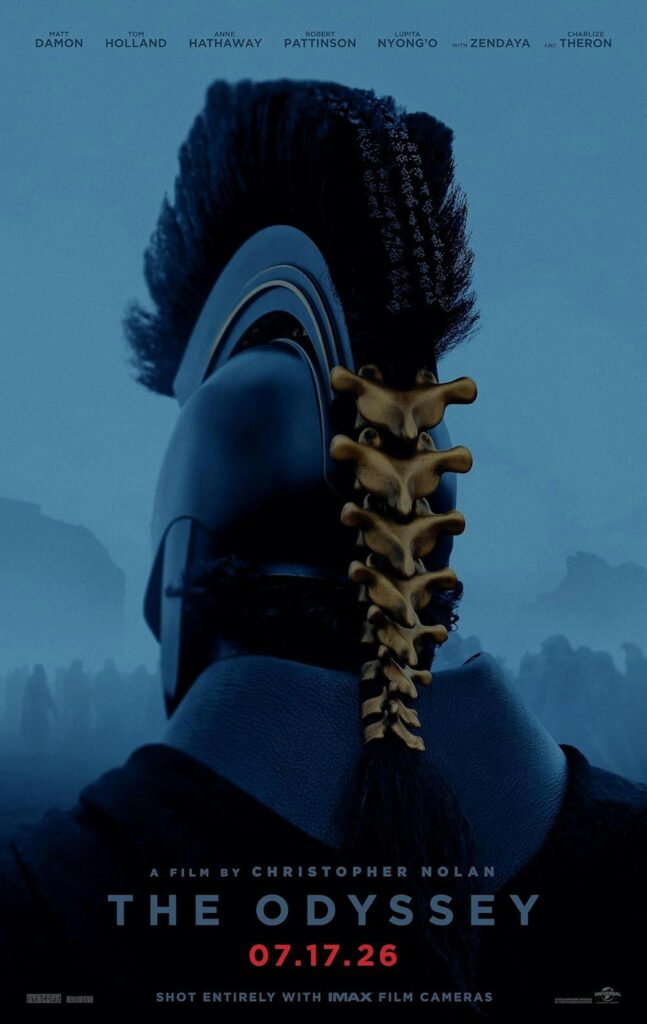
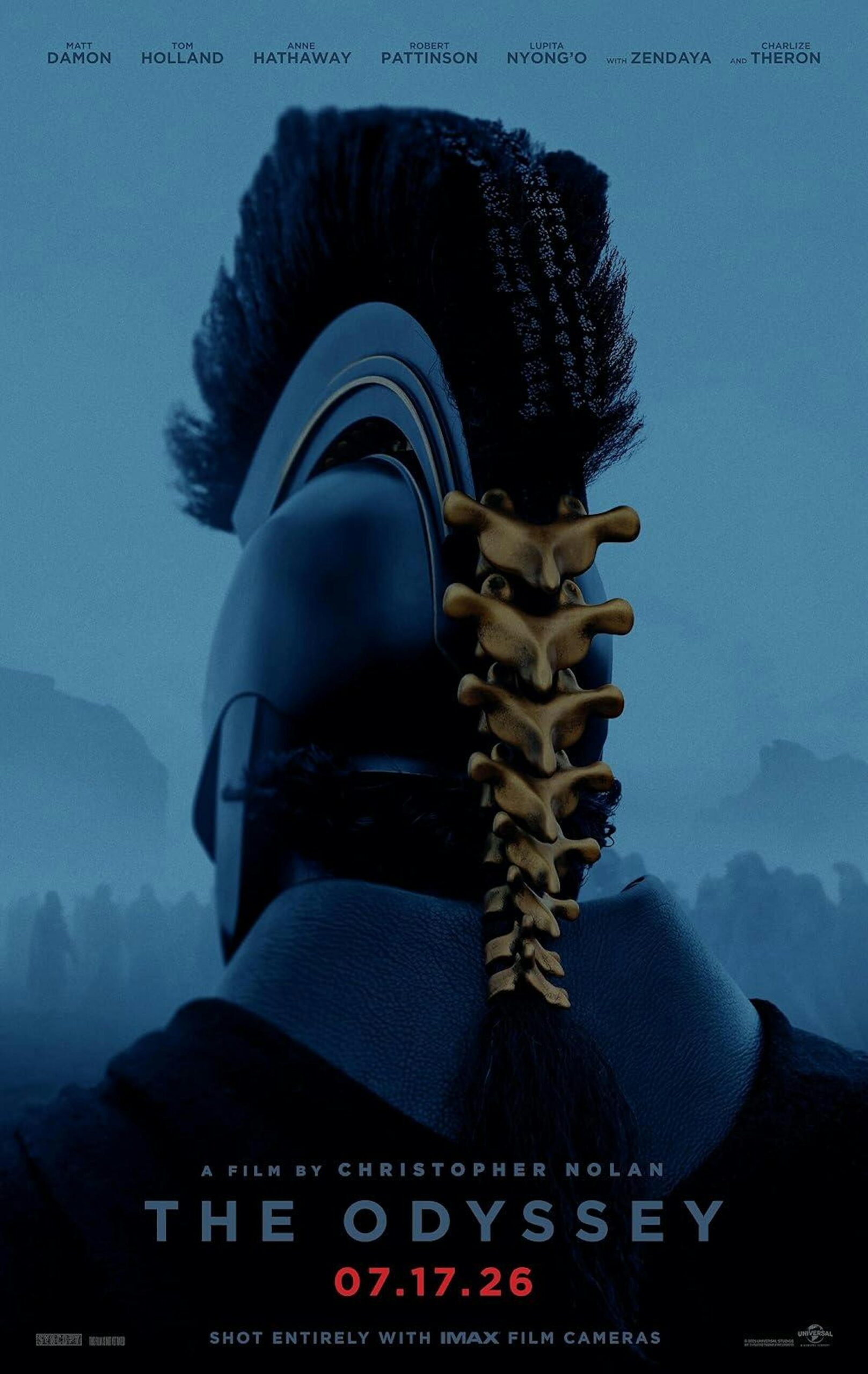
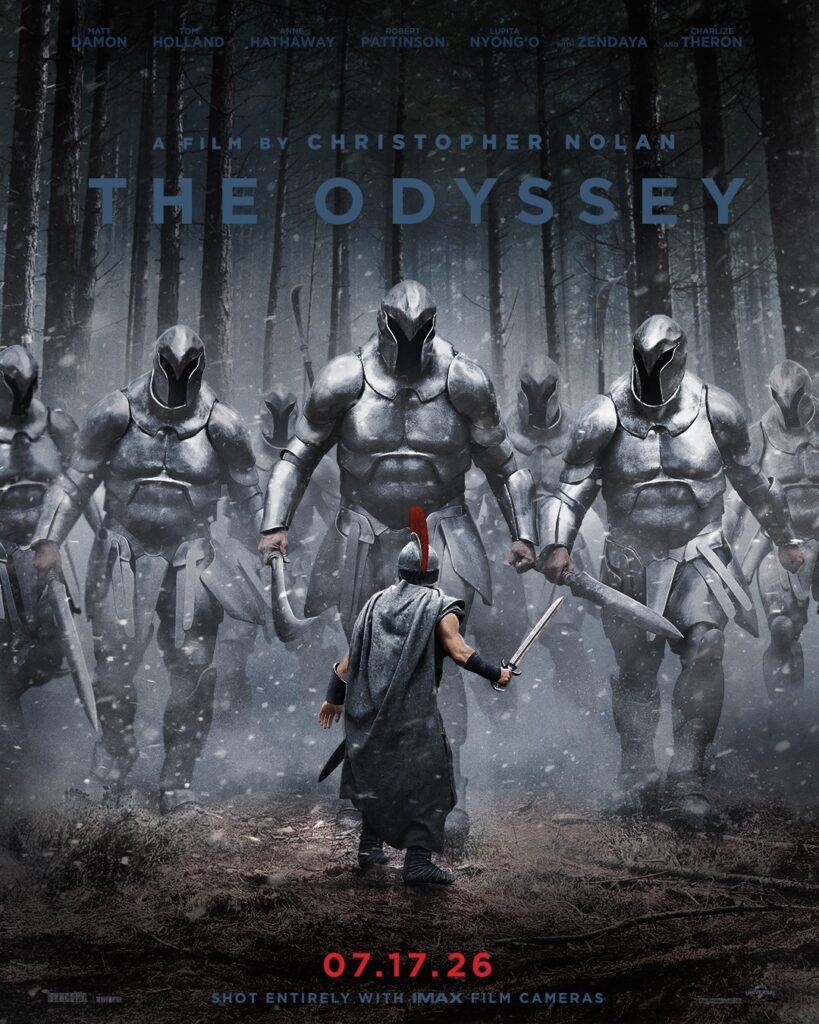
One of the foundational stories of the Western canon has a grand, sweeping, meticulously diligent new version in writer/director Christopher Nolan’s epic film, bristling with Oscar-winning talent and impressive seriousness of purpose. It is, with a few significant exceptions, true to Homer’s story dating back to 700-800 BC. But there are also vestigial reflections of Nolan’s previous film, “Oppenheimer,” both stories of men who must grapple with the consquences of their destructive, even ruthless, acts during wartime.

Matt Damon plays one of history’s most complex heroes, Odysseus, whose name and story still define journeys of adventure thousands of years later. The Odyssey follows Odysseus on his long voyage home after the victory of the Greeks, led by Agamemnon, with Achilles, Ajax, and Odysseus, in the Trojan War. Paris, a Trojan prince, had been asked to decide which of three goddesses was the most beautiful. Aphrodite, the goddess of love, bribed him by saying that if he picked her, she would give him the most beautiful human woman in the world. That woman was Helen (Lupita Nyong’o). She was the wife of the Greek king, Menelaus of Sparta (Jon Bernthal). But she is known throughout history as Helen of Troy, because she was kidnapped (or ran away with) Paris, leading to the war that made her known as “the face that launched a thousand ships.”

That war lasted ten years. It was Odysseus, known for his trickery, who came up with the idea of getting the soliders inside the Trojan’s impenetrable city by hiding in a gigantic statue of a horse, with a soldier named Sinon (Elliot Page) left behind to lie that the Greeks had retreated, leaving the horse as a tribute to the goddess Athena (Zendaya). When the Trojans drag it into the city, the Greek soldiers come out to win a decisive battle and end the war. This story is told in Virgil’s Anead, and in Nolan’s film we see parts of it more than once in flashbacks, part of elliptical, non-linear story-telling that may be confusing to those not familiar with Homer’s tale. (To refresh your memory or just get a quick recap, try this.)

But really, all you need to know is that Odysseus is on his way home, leading his men in (to start with) three boats, hoping to make it back before Agamemnon reaches his home just to be competitive. (Agamemnon will get home first but then be murdered by his wife, Helen’s sister (also Nyong’o).

It will take Odysseus a decade, with many stops along the way as the crew tries to replenish their provisions. The most well-known of their adventures are all brought to screen in unprecedented splendor by Nolan, and his “Oppenheimer” team, editor Jennifer Lame, production designer Ruth De Jong, and Oscar-winning cinematographer Hoyte van Hoytema, filming in Greece, Italy, Iceland, Morocco, and Scotland. This is the first-ever feature movie filmed entirely with IMAX cameras (in tribute, you can even get an IMAX camera popcorn bucket) and shown in 70 mm. The visuals are never less than spectacular. Odysseus and his men are traveling by boat and the sky and “the wine-dark sea” Homer described is filmed with a power and grandeur of a true epic. We get a visceral feeling of just how alone these men are, not just before GPS but before maps and navigation, entrusting to the gods to guide them home but knowing that the gods may be even more devious tricksters than Odysseus himself.

Odysseus tries to follow the “laws of Zeus,” particularly with regard to hospitable treatment of strangers, and killing even animals with honor, plucking his bow string to give them a chance to escape. When lives are at stake, though, he will do what is expedient. On their first stop, he leads his men onto an island where a cave is set up as a home, with a cozy fire. According to his beliefs about what the laws of Zeus require and assuming that the inhabitant of the cave will believe the same, he orders his men to stoke the fire to welcome their host. But the inhabitant is not a man. He is a gigantic cyclops, and in a genuinely terrifying moment, as soon as he enters the cave, he grabs one of the men and bites his head off. It is hard to understand why Nolan chose to omit one of the key elements of the story, Odysseus refusing to give the cyclops his name, instead saying he was called “Noman.” This is a very significant part of the story that is parallel to his not using his own name when he returns home, both relating to his sense of himself and his identity.

After a few more deaths, Odysseus is able to lead his men to an escape. But he violates his obligation to give the murdered men a decent burial. The conflict between his obligations under the law of Zeus and the choices to save as many lives as possible are a theme.
Copyright 2026 Universal

This conflict is presented in the immediate consequences of killing the cyclops. Odysseus learns that the monster was the son of the god Poseiden, who will now express his grief and anger by keeping them from reaching home. As in Homer’s original story, it explores the theme of human agency and the interference of the gods. We often see Odysseus near the goddess Athena.

Other adventures include two enchantresses. Calypso ( Charlize Theron) feeds Odysseus lotus flowers that make him forget the PTSD of his agonizing choices but also the fact that he has a family. Circe (Samatha Morton) turns his famished men into pigs (an extraordinary scene of transformation and body horror), and we see how clever Odysseus is in figuring out what she has done and forcing her to reverse the spell and help him get home. He travels to Hades where he meets the ghost of Sinon. He straps himself to the mast of his ship while his men have their ears blocked with wax to pass through the jagged rocks where the sirens sing men to their deaths.

Meanwhile, his wife, Penelope (Anne Hathaway) and son Telemachus (Tom Holland) are back in Ithaca, with dozens of suitors eating their food, drinking their wine, and trying to get Penelope to marry one of them so he can take over the kingdom. The most odious of the suitors is Antinous (Robert Pattinson), a maniuplative schemer who got Sinon to take his place in the war. Telemachus leaves Ithaca to see if he can find any news of his father from Menelaus.

It will take all of Odysseus’ craftiness and strength to defeat the suitors and reunite with his wife and son. Damon’s performance shows us all of the complexity that makes Odysseus an eternally enthralling hero. Pattinson continues to impress as he subverts his considerable looks and charisma to create a despicable, cowardly character. John Leguizamo is superb as the loyal Eumaeus. Even the three-hour run time cannot find enough time for Theron, Zendaya, and Morton, but each of those encounters could be an entire movie.

Nolan’s screenplay veers into colloquialisms that take us out of the movie now and then. But he has an unsurpassed gift for the language of cinema. The scenes of exploration, combat, and in Penelope’s castle in Ithaca are striking and narratively clear. Penelope fends off the suitors by telling them she cannot move forward until she finishes weaving a burial shroud for her late father-in-law. She weaves during the day and then unravels it at night. She appears modestly behind a screen as the suitors crowd the dining hall.

Nolan’s style is chilly and cerebral, with the female characters thinly sketched and too often just creating problems for or taking power away from men. That may be one reason that draws him to a story where a military hero has encounters with literal enchantresses who impede his progress. His exploration here of the conflicts even successful warriors feel about what they have done and what they have seen is moving. He made very significant changes to Homer’s concluding scenes (admittedly, contested by some scholars as added by others later). But the ending he chose has the same problems as the disputed version and it undermines the weight of what he has presented so compellingly throughout the story.

Parents should know that this film is extremely violence with many characters injured and killed, many with throats slit, monsters, ghosts, and graphic and disturbing images. Odysseus is drugged and characters drink wine. There is some strong language.

Family discussion: Why is this one of the most enduring stories in history? What does Odysseus regret the most? What decisions did he make that you think were wrong?

If you like this, try: the book (Fagles or Wilson translation) and a modern re-imagining from the Coen brothers, “O Brother Where Art Thou.”

Related Tags:


Based on a book Epic/Historical IMAX movie review Movies -- format Movies -- Reviews Remake Road Trip War
A Big Bold Beautiful Journey

A Big Bold Beautiful Journey

Posted on September 16, 2025 at 3:35 pm

B +
Lowest Recommended Age: High School
MPAA Rating: Rated R for language
Profanity: F word used many times
Alcohol/ Drugs: Alcohol
Violence/ Scariness: Sad off-screen death of a parent, medical issue for an infant
Diversity Issues: None
Date Released to Theaters: September 19, 2025

Two strangers meet at a wedding, and the next day find themselves — in both senses of the term — on a car trip, guided by a mysterious GPS, through apparently endless unoccupied rural landscapes, stopping at doors that appear unconnected to any structure but turn out to be portals to the past. The journey, with a script by “The Menu’s” Seth Reiss and directed by Kogonada is romantic in the dictionary meaning of the term, “characterized by themes of love, emotion, imagination, and nature.”

Copyright 2025 Columbia

Margot Robbie plays Sarah, and Colin Farrell, who starred in Kogonada’s “After Yang,” plays David. They both arrive at the wedding unaccompanied. And, as we will learn, they both arrive in vehicles provided by a very quirky firm simply called The Car Rental Agency, “specializing in emergencies.” The agency, which operates in a gigantic warehouse with just two cars, 1990s Saturns. Its two proprietors (Kevin Kline and Phoebe Waller-Bridge) sit behind a table and, when David shows up having found his car with a boot for unpaid tickets, a flier for the rental company conveniently nearby, they have a file on him. He initially turns down their GPS, insisting that he can just use his phone. But they warn him that phones can fail, and it is clear they won’t let him go without the GPS, so he takes it.

The GPS works normally on the way to the wedding, where David and Sarah meet, drawn to one another but hesitant. It seems like a missed connection. The next morning, the GPS (voiced by Jodie Turner-Smith, Farrell’s co-star in “After Yang”) invites David on an adventure and then directs him to get a “fast food cheeseburger.” Sarah is there, also eating a cheeseburger. As they leave, her car won’t start and the GPS tells him to give her a ride. The big, bold, beautiful journey begins.

The first doorway is mostly to get them used to the idea, and then each successive doorway takes them to more complicated and painful memories. Two of particular impact show us separate past encounters that intersect in meaningful ways. Others allow David and Sarah to understand their parents (sensitive performances by real-life couple Lily Rabe as Sarah’s mother and Hamish Linklater as David’s father). They get to glimpse how their time at the wedding could have been different. The one audience may respond to the most viscerally, because it’s high school, takes David back to his performance at age 15 in the lead role of “How to Succeed in Business Without Really Trying.” The details of these encounters are wisely chosen and performed with the delicacy and authenticity of Kogonada’s previous films. The affection for theater kids (notice the posters in Sarah’s high school bedroom and the song David sings in the car) underscores the importance of finding the truth in stories.

Cinematographer Benjamin Loeb (also of “After Yang”) brings a poetic sensibility to the images, enhancing the fantasy element of the story but grounding it (literally) in the landscape. The shape and bright primary colors of the umbrellas are striking, and overhead shots evoke a heroic adventure. The story’s encouragement for those who have the courage to take a risk and change old patterns has a quiet optimism that may send some of us to open a few bold and beautiful doors ourselves.

Parents should know that this movie includes many uses of the f-word, some sexual references, and a brief, non-explicit sexual situation, a sad death of a parent, and a medical issue involving an infant.

Family discussion: How are Sarah and David alike? How are they different? How did what they learn about themselves change the way they thought about each other? What moment in your life would you want to go back to in order to learn from it?

If you like this, try: “9 Days” and “All of Us Strangers”

Related Tags:


Drama Family Issues Fantasy movie review Movies -- format Movies -- Reviews Road Trip Romance
Drive-Away Dolls

Drive-Away Dolls

Posted on February 22, 2024 at 6:39 pm

B +
Lowest Recommended Age: Mature High Schooler
MPAA Rating: Rated R for crude sexual content, full nudity, language and some violent content
Profanity: Very strong language
Alcohol/ Drugs: Alcohol
Violence/ Scariness: Extended peril and very intense violence including beheading, guns, fire, torture, some graphic and disturbing images
Diversity Issues: Diverse characters
Date Released to Theaters: February 23, 2024
Date Released to DVD: April 23, 2024

Once there was a vibrant category of trashy, low-budget films for the cheap theaters and drive-ins. Sometimes called grindhouse films or exploitation films because they were designed to be shocking, they are so beloved by Quentin Tarantino and Robert Rodriguez that they made a tribute film called “Grindhouse” that was a high-budget version of the kind of 50s double features that inspired them when they were growing up. “Drive-Away Dolls,” from Ethan Coen and Tricia Cooke, is another tribute to the Grindhouse-era films. While the sex and violence that was so shocking in the 1950s that audiences did not care about the shabby the production values are no longer shocking today, “Drive-Away Dolls” captures the transgressive spirit of those films, with no air quotes or irony, just engaging and very sincere joy in the genre. Top-level actors, camerawork, music, and wipes (we’ll get to them later) are just a bonus. Coen and Cooke (an un-credited co-director) say this is the first installment of their planned “lesbian b-movie trilogy.” Cooke is queer and they have spoken about their non-traditional marriage, which they have said is reflected in the relationships in the film.

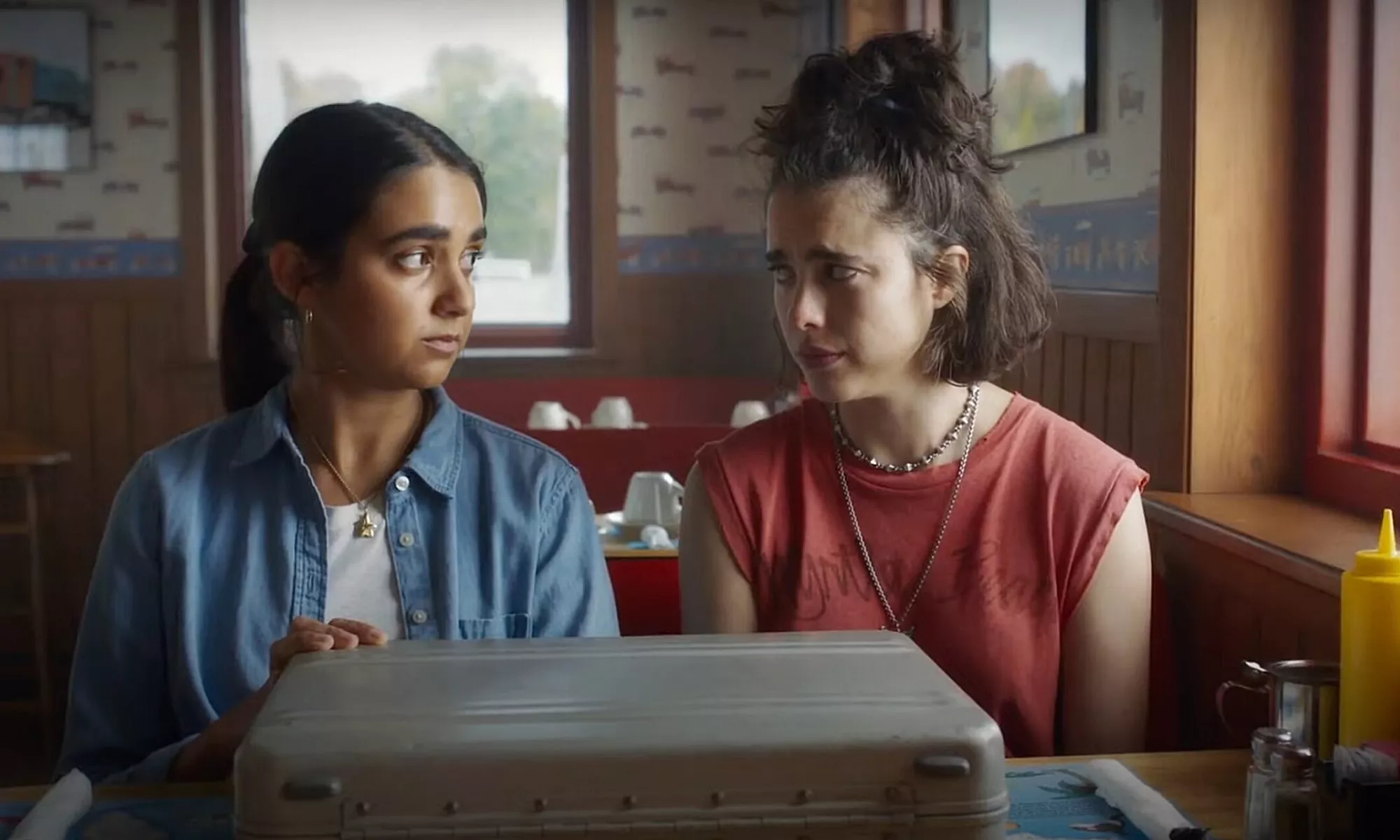
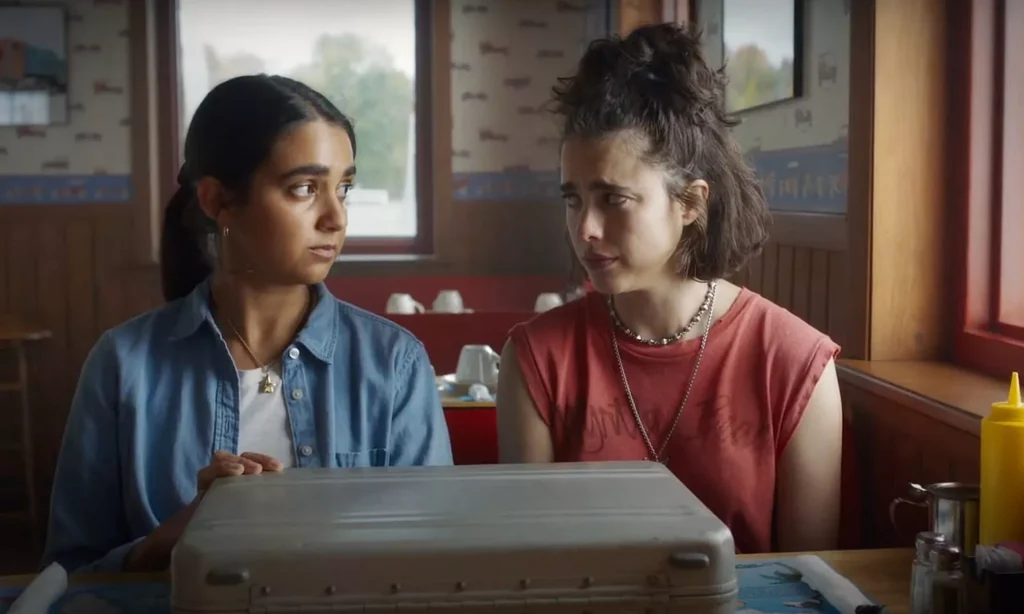
The foundation for the story is one of the oldest and most beloved in the history of human stories: two people who are very different take a journey with many adventures along the way that expand their understanding of themselves and their world. Those people are the very free-spirited, impulsive Jamie (Margaret Qualley) and the very conventional, wear a suit to the office and correct people’s grammar Marian (Geraldine Viswanathan). It is 1999, and they are queer women living in Philadelphia. Jamie’s girlfriend Sukie (Beanie Feldstein) has just kicked her out for cheating, and she has no place to stay. Her friend Marian is feeling stressed and wants to go to Tallahassee for a break. So, Jamie decides to come along, and suggests they get a drive-away car, through a service that matches up drivers with people who want their cars to be driven to another city. As it happens, Jamie and Marian show up at the drive-away company run by Curlie (a wonderfully dry Bill Camp) just as a car going to Tallahassee has been dropped off. Curlie, who has been told to expect a pick-up and assumes that they are the ones. We, on the other hand, know that they are not.

Jamie paints “Love is a sleigh ride to hell” on the trunk of the car, and the adventure begins. The car they are driving to Tallahassee is of great interest to some very bad people. We have already seen that they are prepared to kill and inflict all kinds of mayhem and that it relates somehow to, perhaps a nod to Tarantino and “Pulp Fiction” here, an aluminum briefcase with contents that, unlike “Pulp Fiction,” will eventually be revealed and, trust me on this, you are not going to guess correctly.

The film is stylized but stylish with wipes — the transitions from one shot to the next — that are amusingly old-school and surprising guest star cameos I will not spoil here. Jamie and Marian have a lot of adventures along the way, including a make-out party with a female soccer team that is skillfully filmed in a manner that is empowering rather than explotative. The goons (as they are credited) sent to get back the briefcase have their own adventures in between bickering with each other about whether finesse or brutality is the best way to get what they want. The film includes the characteristic Coen twisty-funny dialogue, and makes good use of the settings, including statues of William Penn and Ponce de Leon gazing down on the wild adventures below. Qualley and Viswanathan are two of Hollywood’s most engaging young stars and their performances are joyful and captivating, their imperishable freshness and high spirits making it impossible for the outrageous elements to seem tawdry. It’s not for everyone, but it will be an instant favorite for fans of the Coens.

Parents should know that this movie has nudity and explicit sexual references and situations, a lot of peril and violence including a beheading, guns, knives, and fire, and very strong language.

Family discussion: Where would Jamie and Marian be today and what would most surprise them about what has and has not changed since 1999? How did they see each other differently over the course of the trip?

If you like this, try: “Grindhouse” and “Bottoms”

Related Tags:


Action/Adventure Comedy Crime DVD/Blu-Ray movie review Movies -- format Road Trip Romance
THE MOVIE MOM® is a registered trademark of Nell Minow. Use of the mark without express consent from Nell Minow constitutes trademark infringement and unfair competition in violation of federal and state laws. All material © Nell Minow 1995-2026, all rights reserved, and no use or republication is permitted without explicit permission. This site hosts Nell Minow’s Movie Mom® archive, with material that originally appeared on Yahoo! Movies, Beliefnet, and other sources. Much of her new material can be found at Rogerebert.com, Huffington Post, and WheretoWatch. Her books include The Movie Mom’s Guide to Family Movies and 101 Must-See Movie Moments, and she can be heard each week on radio stations across the country.

Website Designed by Max LaZebnik