Dolphin Tale 2

Posted on September 11, 2014 at 5:59 pm

Copyright Warner Brothers 2014

The warmest, wisest, most pleasurable live-action family film of the year is “Dolphin Tale 2,” even better than the 2011 original. This really is that rare movie for the whole family.

The first film was inspired by the true story of Winter, a rescued dolphin who was able to thrive in Florida’s Clearwater Marine Aquarium after an innovative new prosthetic tail helped to protect her spine and allow her to swim. She has been an inspiration to millions of visitors in person and via webcam, especially to wounded veterans and other adults and children with disabilities. In the original, directed by Charles Martin Smith (Terry the Toad in “American Graffiti” and Farley Mowat in Never Cry Wolf, a sensitive loner named Sawyer (Nathan Gamble) bonds first with the wounded dolphin and then with the staff who care for the marine animals, especially aquarium head Clay (Harry Connick, Jr.) and his pretty daughter Hazel (Cozi Zuehlsdorff). Ashley Judd played Sawyer’s mother, Kris Kristofferson played Clay’s houseboat-dwelling dad, and Morgan Freeman played crusty Dr. McCarthy, who figures out how to make the prosthetic comfortable and stable.

Everyone returns for this follow-up, and this time Charles Martin Smith does triple duty as writer, director, and actor, appearing as a strict but not unsympathetic USDA official responsible for making sure the facility meets federal standards in caring for the animals.   He may refer to Winter at CMA1108, but he is trying to do what is best for her.

The kids have gone from middle school to high school. They are now experienced marine animal specialists, and spend most of their time at the aquarium, much of that in the water. We see how capable and knowledgeable they are when they assist in the rescue of an injured dolphin they name Mandy and a sea turtle ensnared in fishing line they dub Mavis. And we see how deeply they care for the animals when the veteran of their dolphin population, a 40-year-old deaf dolphin who is “paired” with Winter, dies suddenly. This is more than a sad loss. Dolphins are deeply social creatures. If Winter cannot or is not willing to be be paired with another dolphin, she will die.  The USDA inspector says that if they cannot find a friend for Winter in 30 days, she will have to be moved.

Mandy’s arrival seems providential. But then the best thing happens, which is also the worst thing. They are able to restore Mandy to health.  But that means that she can no longer remain in captivity, which is just for animals who can no longer take care of themselves.  The motto of the facility is three words: rescue, rehabilitate, release.  “You didn’t build this place to keep animals,” Clay’s father reminds him.  “You built it to heal them and let them go.”  The wrenching task of weighing those competing considerations is sensitively presented as a moral issue, an economic issue, and as a part of growing up that Hazel and Sawyer must understand.  It is an issue of more complexity than we normally get to see in family films, and it is presented with exceptional insight.  A scene where Hazel follows Sawyer’s mother’s advice to speak to Clay the way she would like to be spoken to is a small gem that got some appreciative laughs of recognition from the audience. Smith knows his audience, though, and expertly seasons the storyline with cute animals, especially Rufus the pelican, who is back for more comic relief. Even with Rufus, though, the slapstick moments are just part of the story.  His protective concern for Mavis is genuinely touching.

A storyline about whether Sawyer will accept an opportunity to take a special semester at sea is less intriguing.  But Gamble’s quietly sincere and thoughtful performance grounds the film, with Zuehlsdorff (who provides a sweet song over the closing credits) more ebullient, but never less than completely real and in the moment. The completely natural performances of the two leads perfectly matches the sun-drenched naturalism of the setting, utterly at home in the water, interacting with the dolphins, or struggling to grow up. When Dr. McCarthy sits down next to the conflicted Sawyer to hand him a family heirloom, Sawyer says knowingly, “I’m about to get a lesson here, aren’t I?” He is, and we are, too, but it is a good lesson and it goes down easy. So does the film, ambitious in scope but light in presentation. And it is no disrespect to the movie to say that the best part is the closing credits, where we see Wounded Warriors and other people with disabilities coming to visit Winter and Hope for inspiration and, somehow, a sense that they are being understood and cared for.

Parents should know that this film includes mild peril, some scenes of animal and human injuries and a sad animal death.

Family discussion: What was the lesson of the watch? What were the best reasons for releasing Mandy? For keeping her? Did they make the right decision?

If you like this, try: The original film — and watch Hope and Winter online

Related Tags:


Animals and Nature Environment/Green For the Whole Family Inspired by a true story Scene After the Credits Series/Sequel Stories About Kids

The Expendables 3

Posted on August 14, 2014 at 6:00 pm

Copyright 2014 Lionsgate

Everything I said about the last two “Expendables” movies, blah blah, with some new additions from the AARP branch of the action heroes club: Harrison Ford, Antonio Banderas, Wesley Snipes, and Mel Gibson, plus a couple of Expendable interns to bring down the median age a bit.

Sylvester Stallone got the gang back together for one more Over-the-Hill gang run-with-a-gun-fest. Once again, he plays Barney Ross, as one of those guys who is most comfortable when he is least comfortable. One of these guys, given a chance to sleep in a bed, puts the bedspread down on the floor and settles in for the night. Barney and the gang are the guys you call when you need the impossible and off the books. I need to point out, however, that it isn’t too hush-hush as Barney’s first meeting with Drummer (ah, the machismo of these names), the CIA big shot played by Ford, replacing Bruce Willis as Church. (There are a couple of cracks about Church, directed at Willis, who reportedly asked for too much money to be in this film.)  Barney and Drummer have a nice chat about all the black ops stuff in a hospital parking lot.

Who cares whether it makes sense? We’re here for the stunts and explosions and they are fine. It’s the winks to the camera and the manly quips that are hard to take.  Note to the hard-core fans of hard core, however: while the first two films were rated R, this one is PG-13. Which means, basically, just one f-word and less blood.

Despite their name, of course each and every one of the team is vitally important to Barney, and he has a collection of dog tags from those who didn’t make it hanging in the plane like sad little wind chimes. Barney hates to put people in danger, which is something of an occupational hazard when you are in the tough guy business.  When one of his team is hit hard, he fires everyone else and brings in new recruits, which (1) gives us a chance to see him hopping around the world with Kelsey Grammer as his talent scout, for one of those “Magnificent Seven,” “Oceans 11” let’s see what these guys can do episodes, and (2) gives them a chance to cast some people audiences under age 25 might recognize, including boxer Victor Ortiz of “Dancing With the Stars,” Kellan Lutz of “Twilight,” and  MMA champion Ronda Rousey.  Conveniently, each of them can do two things: fight and hack computers, fight and Parkour, fight and rock a mini-skirt, etc.

They’re going after a bad guy played with way too much relish by Mel Gibson, as though he is saying, “You want to hate me?  Bring it on!”  Of course he is impossible to find and surrounded by armies of security.  And Drummer wants him brought back alive.  But this is what Barney does.  So, he takes his padawans and pretty soon they’re jumping out of plans and exchanging manly quips.  And they’re showing old Pops a thing or two about using computers and being in the 21st century.  It works out just fine until it doesn’t, and it’s time for the old folks to come in and save the day.

It’s fun to see these old guys in action, and it gives you a lot of bang-bang for the buck.

Parents should know that this movie includes some strong language and crude insults, extensive and graphic violence with knives, guns, fights, explosions, and many characters are injured or killed.

Family discussion: How did the two generations of Expendables differ? Why did Drummer and Galgo care so much about getting into the fight? Why did Barney take off his protective gear?

If you like this, try: the earlier “Expendables” movies and the 1980’s action films featuring these stars

Related Tags:


Action/Adventure Series/Sequel

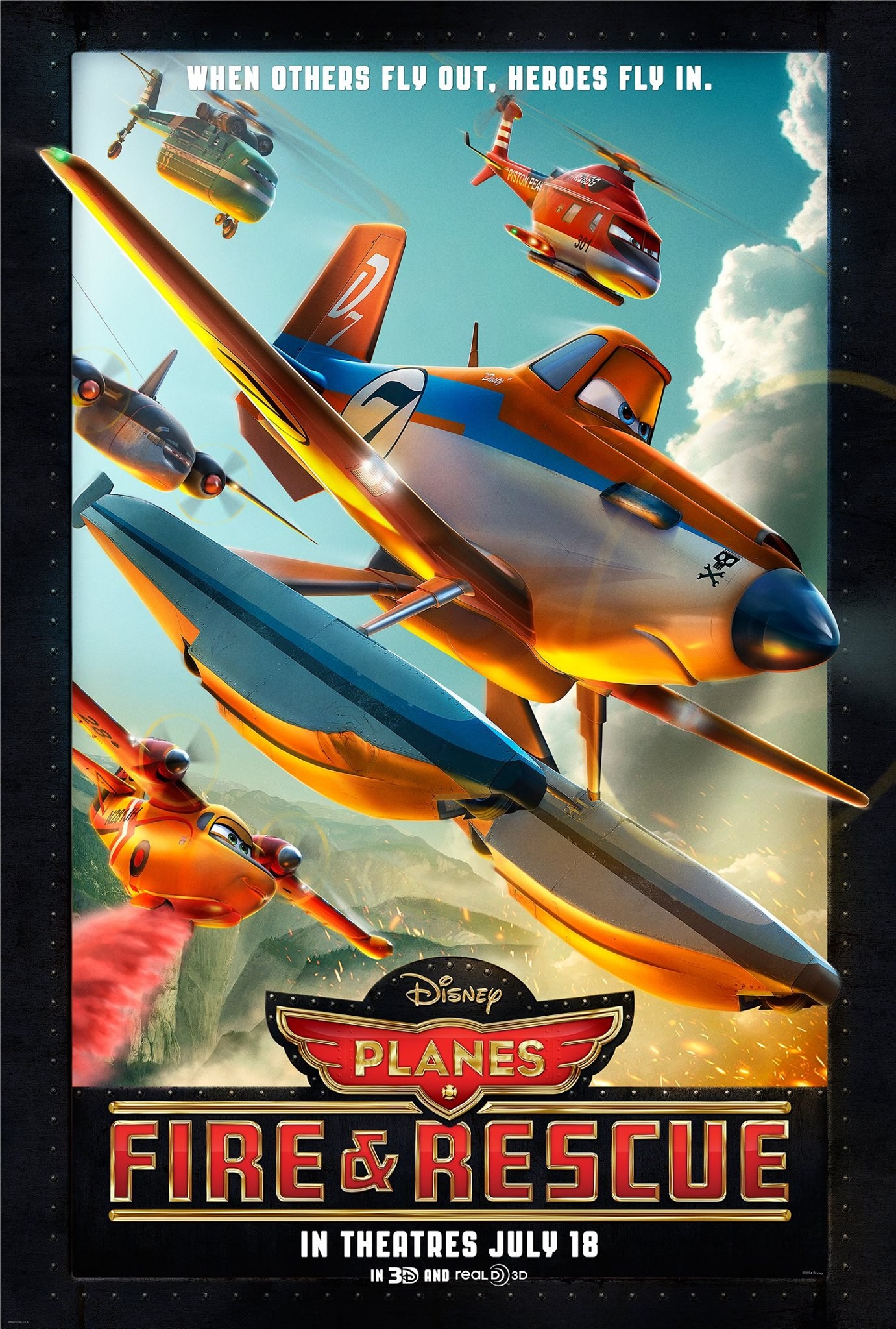
Planes: Fire & Rescue

Posted on July 17, 2014 at 5:59 pm

Planes_fire_rescue_poster

The visuals are stunning, the details are witty, the 3D effects are splendid,  the songs are lively, the voice actors are top-notch, but the storyline feels like an episode of “Thomas the Tank Engine.”  That’s when it was still analog and old-school and before it went to animation, but still — especially as the gender politics of this film are uncomfortably old-school as well.

Last year’s Planes added another mode of transportation to the charmingly retro world of Cars. A plucky crop-duster named Dusty (Dane Cook) learned to race and became a champion. As this movie begins, he is an international superstar. But his vintage gearbox has been worn down by the races, and no replacement is available. Dusty is going to have to find something that is as meaningful to him as racing.

When he accidentally starts a fire at Piston Peak National Park, Dusty sees that old Mayday (Hal Holbrook), the fire and rescue truck is not quite up to the task.  More important, he is not up to code.  The stern Transportation Management Safety Team inspector informs them that they need more capacity if they are going to stay in business.  That means some upgrades for Mayday and it also means a second firefighter.  Dusty feels responsible. And if he cannot race, he has to find something new to do, to help make up for his mistake. So he agrees to take the training to become a certified fire fighter.

Dusty is welcomed by the team, including the flirtatious Lil Dipper (“Modern Family’s” Julie Bowen), the heavy-lift helicopter Windlifter (Wes Studi), ex-military transport Cabbie (Captain Dale Dye) and The Smokejumpers, a brave collection of all-terrain vehicles who leap out of the planes and parachute down to the fire.  But he stern Blade Ranger (Ed Harris), who is in charge of the training facility, is not at all sure Dusty is up to the task.

The action sequences are very well staged and the effects, especially the water and sky images, are truly astonishing. The usual pun-studded, meta humor for the series shows up throughout, from the show business trade news magazine titled “Cariety” to a female vehicle dismissing a lame come-on with a cool, “Pick-up trucks!” The choicest surprise is a videotape with a car-ified version of a classic television series, with that very recognizable series star contributing a character voice.  Of course the television show appeared in the late 70’s-early 80’s, so it is likely to be over the heads of today’s children and their parents, too.

The real villain here is the fire, of course, but there is also a comic villain, a pompous administrator voiced by John Michael Higgins.  But the movie never works up much interest in him or his schemes, and the post-credits stinger barely stings.

More troubling is the poor treatment of the female characters, despite being called out for that same problem in the first one.   At least in the original, the female characters were capable and independent.  Poor Bowen is relegated here to a role that recalls the man-chasing stereotypes of television in the 1960’s, often played by Rose Marie or Ann B. Davis.  She is constantly trying to tell Dusty that they are on a date and, when he politely says they will be going as a group, dementedly agrees that it is a good thing for her to meet his friends until he reminds her that the firefighting team members are her friends.  And a major plot twist occurs when the previously ultra-capable mechanic voiced by Teri Hatcher is casually outdone by a male character.  It’s completely unnecessary, it subverts the primary premise of the storyline, and it demeans the female mechanic for no reason.  It isn’t Dusty who’s got filings in his gearbox.  It’s the script.

Parents should know that this film includes peril, including fire, collapsing bridge, rapids, engine failure, action and some violence (no one irreparably hurt, but a reference to a sad death), and some bathroom humor.

Family discussion: Who in this movie has to decide how to handle it when their plans do not work out? How do you think about your own back-up plans?  What does “better than new” mean?

If you like this, try: “Cars” and “Planes”

Related Tags:


3D Animation Fantasy Series/Sequel

Dawn of the Planet of the Apes

Posted on July 10, 2014 at 6:00 pm

dawnoftheplanetoftheapesceasarAll hail Caesar!

The intelligence-enhanced ape from Rise of the Planet of the Apes takes center stage in this sequel, which begins ten years after the last film. The virus we saw infecting the human population has now wiped out almost all human life. The assorted apes, led by Caesar, have asserted their primacy over other animals. In the opening scene, we see them hunting with spears they have crafted, killing a bear, and riding on horses. They live in homes they have constructed from logs, communicate — mostly via sign language — teach their children the alphabet in school, and have an organized society, with Caesar as their leader. They demonstrate loyalty and tenderness.  They adorn themselves; Caesar’s mate wears a small crown.

Ceasar is played by the brilliant motion-capture actor/artist Andy Serkis and the CGI work of the geniuses at Weta Digital.  The seamless integration of the CGI characters and the human characters and the subtlety of the apes’ eyes and facial expressions brings us straight into the story, underscored by the immersive 3D.  It is dramatic, not stuntish, with the possible exception of some spear-throwing toward the screen.

The film recalls old-school cowboys-and-Indians westerns, with the apes riding into battle on horses and the humans and their armory holed up in the ruins of San Francisco like it is Fort Apache.  Then the apes get the guns, and everything escalates fast.  The film wisely gives both groups of primates a range of characters, some wise and trustworthy, some bigoted and angry.  Both species have to learn that respect has to be based on character and actions, not on genetics.  The division is not between man and ape but between those who can envision a future with cooperation and trust and those who cannot.

There are some thoughtful details.  The destroyed city tells the story of a decade of unthinkable loss and also of great courage.  A dropped sketchbook conveys information that in a world without mass communications is revelatory.  A long-unheard CD plays The Band and we see the humans react, thinking of where they were the last time they heard it and what access to electricity could mean for them now.  The humans have the advantage of knowing how to create and use power; they also have the disadvantage of needing it.

In the midst of the battle, there is a quiet moment when a small mixed group hides out together in a location with a lot of resonance from the previous film.  It lends a solemnity to the story, even a majesty, that gives it weight.  Even those who seem from our perspective to be making decisions that are disastrously wrong do so for reasons we can understand.  The action is compelling but it is the ideas behind them that hold us.

Parents should know that this film includes constant peril and violence, post-apocalyptic themes and images, many characters injured and killed, guns, fire, drinking, smoking, and some strong language.

Family discussion: Why were there so many different opinions within both the ape and the human communities? How did they choose their governing structure? Why didn’t Carver want to listen to Ellie’s explanation of the source of the virus?

If you like this, try: the original “Apes” movies to compare not just the stories but the technology used by the filmmakers

Related Tags:


3D Action/Adventure Based on a book Drama Fantasy Romance Science-Fiction Series/Sequel Talking animals

Transformers: Age of Extinction

Posted on June 26, 2014 at 5:59 pm

transformers-age-of-extinction-poster-dinobots-411x600

The script for the new Transformers movie is basically: Noise.  Explosions. Chases. Guy-on-guy fighting.  Transformer-on-Transformer fighting.  Brief pauses for father-teenage daughter conflict, father-boyfriend of the teenage daughter conflict, paranoia-inducing rogue government operatives, paranoia-inducing megalomaniacal one-percenter, and a flicker of a robot existential crisis.  Then back to the noise, explosions, and massive PG-13 destruction, meaning more damage to buildings than people or giant robots, though one of the human characters does get incinerated early on.  Repeat. Repeat again.

Yes, this movie is nearly three hours long.  That’s a lot of robots.  It is long, and it is loud.  The primary focus is the special effects, including the use of the first-ever IMAX 3D camera (though the credits reveal some post-production 3D work as well).  The depth of the frame is impressive.

That’s expected and it is fine.  The special effects are better than the non-special effects moments, which come down to 1. Exposition, which makes very little sense, 2. Banter, which is weak, and 3. In-jokes about sequels and product placement.

The special effects are excellent.  And I can’t help it, I still love to see cars turn into robots and robots turn into cars. This time there are even Transformer dinosaurs!

Somewhere among the robots, there’s an all-new human cast in this fourth Transformers movie, again inspired by the Hasbro toys and the animated television series.  Mark Wahlberg takes over the lead as Cade Yeager, broke inventor and overprotective widowed dad of a 17-year-old daughter (Nicola Peltz as Tessa).  His specialty is “making junk into different junk,” and he has a barn that serves as his lab/repair shop.  He buys a beat-up old truck that turns out to be none other than alpha-bot Optimus Prime (again with the deep and resonant voice of Peter Cullen).  The problem is that since the massive destruction of Chicago in the last movie, which we recall as Cade drives by billboards that say “Remember Chicago,” the consensus in the human population is that all Transformers have to be eliminated.

A government operative named Harold Attinger (Kelsey Grammer) is leading a black ops program to rid the planet of all Transformers, regardless of whether they are autobots or decepticons.  He refuses to give any information to a clueless and ineffectual White House Chief of Staff (Thomas Lennon).  And he plots with one-percenter Joshua Joyce (Stanley Tucci), an inventor/multi-billionaire sort of cross between Tony Stark and Donald Trump.

So the injured Optimus Prime and his friends are the target of attacks by a business mogul, a government agency, a sort of bounty hunter, and the decepticons, including a sort of re-animator version of Megatron.  That means a lot of collateral damage back in Chicago and in China as well, though the cities are not as well differentiated as the robots and that is not saying much.  While there seem to be references to current debates about immigration and terrorism, the themes are less overtly political (or dramatic) than a random assortment of words selected for their emotional charge.

Notoriously unreconstructed Michael Bay directs as though it is the first iteration of the Transformers, back in the 1980’s.  The racial and gender stereotyping is only slightly less clunky than in earlier installments, which means that the autobots represent various ethnic caricatures for no particular reason and Cade calls his daughter’s Irish boyfriend “Lucky Charms.”  It also means that despite the almost infinite budget for the film, apparently there was not enough to pay for enough material to clothe teenage Tessa.  No matter what she wears, for some reason there is always a lot of skin showing.  There are various sexist comments (jellyfish are compared to women because they are “erotic and dangerous”) and an ooky discussion of why it is not statutory rape when a 20 year old has sex with a 17 year old (the 20 year old in question helpfully carries a copy of the Texas “Romeo and Juliet” law in his wallet, along, I hope, with other protection as well).  The politics of the movie are as incoherent as the fight scenes; in both, it is not always clear who the good guys are supposed to be.  Basically, everyone is bad except the autobots and their human friends.  And the movie is bad except for the robots.

Parents should know that this film includes strong language (s-words, b-words, one f-word), suggestive discussion of teen sex and teen pregnancy, extensive sci-fi action-style violence, constant peril and chases, some characters injured and killed (one burned to a crisp) and widespread destruction and explosions, references to genocide, some disturbing images and scary creatures, some ethnic stereotyping and alcohol (intrusive, if self-mocking, product placement).

Family discussion: What mistakes have turned out well for you? Why was it important to Cade to turn junk into something useful? Why did Attinger insist that all Transformers were bad?

If you like this, try: the other “Transformers” movies and the television series, and “The Iron Giant”

Related Tags:


Action/Adventure Based on a television show Fantasy Science-Fiction Series/Sequel
THE MOVIE MOM® is a registered trademark of Nell Minow. Use of the mark without express consent from Nell Minow constitutes trademark infringement and unfair competition in violation of federal and state laws. All material © Nell Minow 1995-2026, all rights reserved, and no use or republication is permitted without explicit permission. This site hosts Nell Minow’s Movie Mom® archive, with material that originally appeared on Yahoo! Movies, Beliefnet, and other sources. Much of her new material can be found at Rogerebert.com, Huffington Post, and WheretoWatch. Her books include The Movie Mom’s Guide to Family Movies and 101 Must-See Movie Moments, and she can be heard each week on radio stations across the country.

Website Designed by Max LaZebnik