BlacKkKlansman

BlacKkKlansman

Posted on August 9, 2018 at 5:24 pm

A-
Lowest Recommended Age: High School
MPAA Rating: Not rated
Profanity: Very strong and racist language
Alcohol/ Drugs: Alcohol
Violence/ Scariness: Peril and violence
Diversity Issues: A theme of the movie
Date Released to Theaters: August 10, 2018
Date Released to DVD: November 5, 2018

Copyright 2018 Focus Features
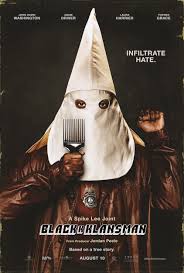
Ron Stallworth (John David Washington) is undercover through most of “BlacKkKlansman,” and not just on the job, but in the job and outside of it, too. The real-life Stallworth was the first black police officer, and later the first black detective in Colorado Springs, back in the 1970’s and he really did go undercover to infiltrate the Klu Klux Klan — over the phone. Spike Lee’s film, based on Stallworth’s book, tells how Stallworth saw a classified ad, called the Klan, and, with the help of a white partner who was “Stallworth” for the in-person meetings, ended up a member in good standing, having phone conversations with the head of the organization, Grand Wizard David Duke (Topher Grace). (All of this really happened.)

Stallworth also really went undercover at a lecture by black activist Stokely Charmichael, who had just changed his name to Kwame Ture, and who is played here by Corey Hawkins, conveying Ture’s magnetism and fiery brilliance and making an impression so strong in his brief scene that it resonates throughout the rest of the film. This rally is really the pivotal, as Washington shows us as close unguarded as Stallworth gets, which opens him up to pursuing Patrice (Laura Harrier), a pretty activist he meets there. But of course he has to stay undercover with her, too — personally, not professionally — because she has strong political feelings about working within the system in general and about the police in particular. (This character and their relationship are fictional.) Adam Driver, as Stallworth’s white partner, has his own double-undercover moments. He thinks it does not matter that he is Jewish, but as Stallworth tells him, he has skin in the game, too. Near the end of the film, Stallworth is undercover at least two levels when he is assigned to Duke’s security detail and must stand close to the man who does not know Stallworth is the man he spoke to in confidence over the phone.

Law enforcement might have been an unusual choice for a black man of that era, but in every other respect Stallworth seems born to be in law enforcement, happy to accept the offer, and clearly aware of the challenges he will face, from the superiors who assign him safe but boring jobs to racist comments from some of the other officers. Washington (a former pro football player and regular on “Ballers”) projects an easy physical confidence, nerves of steel, and a personal meticulousness, from his perfectly shaped Afro to his neatly ironed shirt and shined shoes. Lee, working with production designer Curt Beech, costume designer Marci Rodgers, and director of photography Chayse Irvin, bring a light touch to a 70’s vibe that owes as much to the movies and pop culture of the era as to what ordinary people and settings looked like. There’s a nice nod to 70’s movies as well in the graphics and sinuous, jazzy camerawork and the way the handsome, athletic Washington is lit like Shaft or Superfly.

There could be no better depiction of what Hannah Arendt called “the banality of evil” than the Klansmen and women in this film, who chat casually about hatred and terrorism the way other small groups of like-minded communities might talk about an upcoming bake sale. We can almost sympathize with a 1970’s wife who just wants a chance to do something important like the men do or the men who get a sense of fellowship in a shared interest. Topher Grace shows us Duke’s silky, ingratiating manner, and Lee shows us that complacent hatred may be the most insidious.

It may seem to some viewers that an opening montage of racist imagery, including D.W. Griffith’s “Birth of a Nation” and a scene of Alec Baldwin as a racist businessman are over the top, until we see the footage from 2017’s white supremacist rally Charlottesville one year before the release of this film. Lee is one of my favorite directors, but he sometimes has more ideas than story or characters in his films. Here, with Stallworth’s remarkable true and timely story, a star-making performance by Washington, whose resemblance to his double Oscar-winning father is more in his voice than his face, he has made one of his all-time best, most purely entertaining, and most important films.

Parents should know that this film includes depictions of terrorist activities with peril and violence and very strong and offensive language. Characters drink alcohol.

Family discussion: How did Ron and Patrice differ in their ideas about the best way to solve problems and make things better? What has changed and what has not since the 1970’s?

If you like this, try: the book by Ron Stallworth and Lee’s films “Inside Man,” “School Daze,” and “Chi-Raq”

Recommended reviews: Odie Henderson on rogerebert.com, Travis Hopson on Punch Drunk Critics
Related Tags:


Based on a true story Drama DVD/Blu-Ray movie review Movies -- format Race and Diversity
Christopher Robin

Christopher Robin

Posted on August 2, 2018 at 5:50 pm

B +
Lowest Recommended Age: Kindergarten - 3rd Grade
MPAA Rating: Rated PG for some action
Profanity: None
Alcohol/ Drugs: None
Violence/ Scariness: Comic peril and mayhem, reference to sad death of a parent, brief wartime battle scenes
Diversity Issues: None
Date Released to Theaters: August 3, 2018
Date Released to DVD: November 5, 2018
Copyright Disney 2018

You can’t become a child again. But you can reconnect to the child who still lives within you, and when you do, it means even more because you know how precious it is. That is not just the theme of “Christopher Robin.” It is the experience of watching it. Enchanting production design from Jennifer Williams and cinematography from Matthias Koenigswieser make the 100 Acre Wood the place anyone would love to do nothing in.

Last year year we had the very disappointing “Goodbye, Christopher Robin,” a sour and unfocused film about the Milne family, the traumatized father, the distant mother, and the unhappy child who inspired the classic Winnie the Pooh books. This fantasy is far truer to the spirit of those books, and a most welcome late-summer pleasure. Those who know and love the books will be happy with the fidelity to the stories and characters. Those who do not know them will enjoy the film and, I hope, be inspired to read the books as well, and check out the Disney animated stories.

For those new to A.A. Milne: there are four books, two chapter books and two of poetry, about the life of young Christopher Robin (Orton O’Brien), and his stuffed toys, especially his best friend, a “bear of little brain” and unquenchable thirst for honey, Winnie the (or ther) Pooh, known affectionately just as Pooh. With his friends, the anxious Piglet, the gloomy donkey Eeyore, the devoted kangaroo mother Kanga and the baby she carries in her pocket, Roo, the bossy Rabbit and the occasionally wise Owl, he lives in the Edenic Hundred Acre Wood, where there is always time to pleasantly do nothing at all.

But the sad fact is that children grow up. “The day finally comes as it does to all children, to say good-gye.”  Christopher Robin is being sent to boarding school. He has one last tea in the woods with his friends, and then he’s gone.

We follow his story with Ernest Shepard-like illustrations that match those in the books, but it is idyllic no more. Christopher Robin’s father dies. He grows up (now played by Ewan McGregor) and falls in love with Evelyn (Hayley Atwell), but he is at war when their daughter Madeline is born.

And then he is home, working as an efficiency expert in a luggage company that is feeling a post-war pinch, and he is under enormous pressure to cut costs. He is affectionate but distracted and neglectful. When Madeline (Bronte Carmichael) asks for a bedtime story he picks up the nearest book and ends up reading to her about the industrial revolution. Then he lets Evelyn and Madeline down again by telling them he cannot join them on a weekend in the country because he has to work.

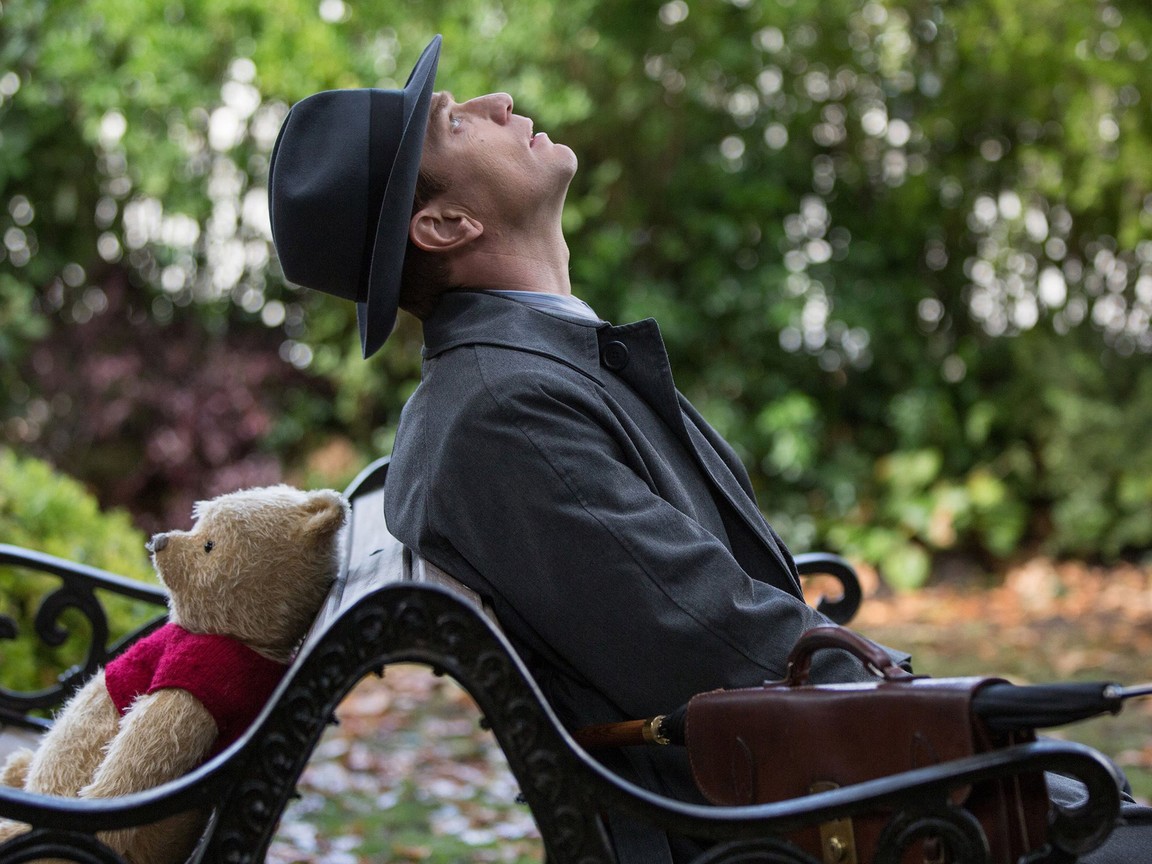
And then Pooh shows up in London (voiced by Jim Cummings, who also provided the endearing slightly husky voice for the Disney animated Pooh). He needs to be taken back home to find his friends. Christopher Robin (called Christopher by his wife and Robin at work) packs his paperwork in his briefcase (and his brolly, of course), and takes the train, shushing Pooh and trying to find a way to cut twenty percent out of the company’s expenses.

But then he cannot help being beguiled by the charms of his old friends and their enchanted world.  Children will enjoy Pooh’s simple questions as a classic comic ploy of having a character whose innocence makes them feel superior. Adults will realize that Pooh’s questions and comments may sound ignorant of adult life, as a bear of very little brain whose only concern has been finding honey might be, but in fact the very simplicity of them is what makes them profound.  Christopher Robin tells his daughter that “nothing comes from nothing.” But “Doing nothing,” Pooh says, “often leads to the very best kind of something.” He asks Christopher Robin, “Is a briefcase more important than a balloon?”

Christopher Robin is split in two, like his name. He has lost touch with himself.  He tells his boss that nothing matters more to him than his work and he tells his daughter she means the world to him, but he does not act as though either is true.  He has delivered the message of efficiency so thoroughly that when Evelyn tells Madeline to go play, she solemnly assures her mother “I’m going to play better and harder than any child has before.”

Christopher Robin has to rediscover the pleasures of, well, pleasure before he can share it with his daughter, and it is pure pleasure to see McGregor’s face shine with the joy of remembering how to play.  For all of his worry about taking care of everyone at the office and at home, he was doing poorly at both. His stuffed friends teach him how to take care of those you love with patience, by listening to them to understand what they really need. If his solution at the office is half “Mary Poppins” and half slightly skewed Keynesian economics, by then we are so sweetly beguiled, that seems just right.

Parents should know that this film includes comic peril and mayhem, reference to death of a parent, and brief wartime battle scenes.

Family discussion: Which questions from Pooh made Christopher Robin change his mind? Ask everyone in the family to describe a toy that they loved.  What comes from nothing?  Try playing “Say What You See” and see how different people’s answers are.

If you like this, try: the books by A.A. Milne and the Disney animated Pooh films

Related Tags:


Based on a book DVD/Blu-Ray Family Issues Fantasy For the Whole Family movie review Movies -- format
Teen Titans Go! to the Movies

Teen Titans Go! to the Movies

Posted on July 26, 2018 at 5:15 pm

B +
Lowest Recommended Age: Kindergarten - 3rd Grade
MPAA Rating: Rated PG for action and rude humor
Profanity: Some schoolyard language
Alcohol/ Drugs: None
Violence/ Scariness: Action/comic book-style peril and violence
Diversity Issues: None
Date Released to Theaters: July 27, 2018
Date Released to DVD: October 29, 2018
Copyright 2018 Warner Bros. Pictures

Not another superhero movie, you say? And how far down the list of comic book characters do we have to go? The Teen Titans are way ahead of you. Silly, surreal, super-snarky, self-aware to a fault and smashing the fourth wall into smithereens, the “Teen Titans Go! to the Movies” movie is a superhero movie about a third-tier superhero who only wants to fight the bad guy because that’s how he’ll get to be in a superhero movie. Got it?

It’s got plenty of inside humor for the fanboys who will know why it’s especially apt to have Nicolas Cage providing the voice for Superman, why it’s funny to have a Stan Lee cameo in a DC movie, who the Challengers of the Unknown are, and why the arch-villain Slade (producer Will Arnett) keeps being mistaken for Deadpool. And it has action, heartwarming friendships, and plenty of potty jokes for those who have no idea who the Teen Titans are, and, believe me, will not know much more about them when the movie is over.

The Teen Titans as they are currently portrayed are Robin (Batman’s sidekick, voiced by Scott Menville), Beast Boy (Greg Cipes), who can turn himself into any animal, alien princess Starfire (Hynden Walch), who signifies her other-worldliness by inserting “the” randomly in front of other words, the gothy Ravan (Tyra Strong), who can create portals from anywhere to anywhere, and Cyborg (Khary Payton), who can adapt his metal shell to create any machine. Insulted that they are not even invited to the premiere of the new Batman movie, Robin is even more horrified to see that upcoming sequels include movies about Batman’s butler, Alfred, and even one about his utility belt, but nothing about Robin. He appeals to the director, Jade Wilson (Kristen Bell), but she says she cannot make a movie about him unless he has an arch-nemesis.

Enter Slade, “an archenemy whose name is fun to say in a dramatic way.”

There are songs. There are action scenes. There are many, many jokes about the world of comics, from the ultra-obscure (stay all the way to the end) to the widely accessible (yes, there are a lot of superhero movies and Green Lantern is still embarrassed about his). It makes fun of itself and then it makes fun of itself for making fun of itself, and then it makes fun of us for watching so many superhero movies. It is unpretentious, the look harking back to low-budget Saturday morning cartoon shows. And that makes it refreshing and delightful.

NOTE: The movie is preceded by a very cute DC superhero girls short called “The Late Batsby,” with Batgirl racing to catch up with her super-friends to fight Mr. Freeze.

Parents should know that this film includes extended cartoon-style action/superhero peril and violence, explosions, chases, fire, some characters briefly injured, potty humor, and schoolyard language.

Family discussion: If you made a movie about one of your friends, what would you include? Why did Robin want a movie so badly?

If you like this, try: the Teen Titans television series, “Incredibles 2″ and “The LEGO Movie” and “LEGO Batman”

Related Tags:


Animation Based on a television show Comic book/Comic Strip/Graphic Novel DVD/Blu-Ray Fantasy movie review Movies -- format Stories about Teens Superhero
Puzzle

Puzzle

Posted on July 26, 2018 at 5:08 pm

B +
Lowest Recommended Age: Middle School
MPAA Rating: Rated R for language
Profanity: Some strong language
Alcohol/ Drugs: Alcohol, drug references
Violence/ Scariness: Tense family confrontations
Diversity Issues: Diverse characters
Date Released to Theaters: July 27, 2018
Date Released to DVD: November 12, 2018

Copyright 2018 Sony PIctures Classics
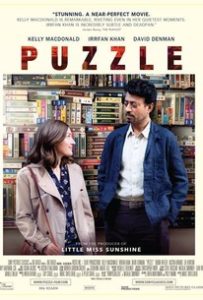
Sometimes in life and often in movies, one object, one moment, one connection can make all the difference and take a character on a journey of purpose and self-discovery. In “Puzzle,” a woman who lives in a very small world discovers that she likes doing jigsaw puzzles because she is very, very good at it. As lovely a metaphor as puzzles are, it is not fitting the pieces together that changes her life. It is learning that she is good at something that has nothing to do with her family. Doing the puzzles and seeing the patterns makes her curious to learn more about the world and it makes her brave enough to find out.

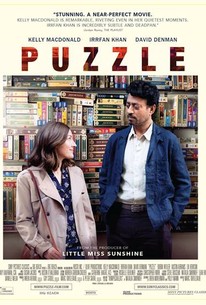
Kelly McDonald is exquisite as Agnes, a Catholic woman who lives with her husband and their two sons in the house she grew up in. We first see her preparing for a party, and then we learn it is her own birthday party. She may be the guest of honor, but she is still doing all of the cooking, decorating, and serving. Her husband and sons love her without paying much attention to her.

One of her birthday gifts is a crossword puzzle. She completes it, and somehow, it completes her. And then it shows her how incomplete her life has been. She has spent decades in the same small, Catholic community. The puzzle inspires her to do something daring — take the train into Manhattan to buy another. And when she sees a notice that someone is looking for a “puzzle partner,” she does something even more daring. She lies to her family so she can find out more.

Screenwriter Oren Moverman (“Love and Mercy,” “The Dinner”) adapted the screenplay from Argentine director Natalia Smirnoff’s “Rompecabezas.” Director Marc Turtletaub gives the film a timeless quality. From the look of her home and her clothes, Agnes seems to be living a generation ago. It is a shock when one of her other birthday presents is an iPhone. She looks at it as though it was delivered by a messenger from the future. “I have a radio and a window,” she tells her son. “I know when it is going to rain.” She calls the iPhone an “alien robot.”

We see that this is a choice Agnes has made, to live in a cocoon of the past, to avoid questioning her choices because she does not want to think about the answers. Why is it puzzles, as her husband says, something for children, that inspire her to think for the first time that maybe she should look outside her home? Or make her speak up for herself and for her son? It could have been cooking difficult recipes like “Julie & Julia” or learning to drive as in “Driving Lessons” or gardening as in “Greenfingers.” It does not matter what it is that pulls characters out of themselves to take risks and learn more; what matters is whether it does and whether the story about how it does inspires that in us.

And what matters here is McDonald. Much of the movie is just her face, luminous, open, a little bit fearful, a little bit joyful. The film is wise in its exploration of the things we do to quiet our minds, even when the result is to hide from ourselves, not peace but numbness. It understands that people and even movies themselves are puzzles that, if we put the pieces together thoughtfully, give us connection, meaning, and purpose.

Parents should know that this film has some strong language, family tension, references to drug use, smoking, drinking, and a non-explicit sexual situation.

Family discussion: Why did Agnes suddenly want to learn about the news? What will she do next?

If you like this, try: “Driving Lessons”

Related Tags:


Drama DVD/Blu-Ray movie review Movies -- format Remake
Mamma Mia! Here We Go Again

Mamma Mia! Here We Go Again

Posted on July 19, 2018 at 5:40 pm

B
Lowest Recommended Age: Middle School
MPAA Rating: Rated PG-13 for some suggestive material
Profanity: Some mild language
Alcohol/ Drugs: Drinking and drunkenness
Violence/ Scariness: None
Diversity Issues: None
Date Released to Theaters: July 20, 2018
Date Released to DVD: October 22, 2018

Copyright 2018 Universal
Pretty music, pretty scenery, pretty people – here they go again, my my, and how can we resist them? Lesser songs, better singers, higher platform shoes, more romance, a horse, a goat, a boat, a romantic last-minute wedding interruption, returning cast members and a whole new group to play younger versions of the older characters.

Mamma Mia! Here We Go Again” finds the young woman with three fathers (Amanda Seyfried as Sophie) about to realize her mother’s dream of a luxury hotel on the idyllic island of Kalokairi (the Greek island of Skopelos in the original, in this one the Croatian island of Vis, which gave the production tax breaks).

It is bittersweet because her mother (Meryl Streep as Donna) has died. She and her step- and one of three possible biological fathers (Pierce Brosnan), conveniently an architect, miss her dearly. “It will get better,” she reassures him. “Yes, just not quite yet,” he answers. Working on the grand opening party makes her feel closer to her mother. But she also misses Sky (Dominic Cooper), who is getting training in hotel management and has been offered a dream job half a world away. She also wishes her other two fathers could be there for the opening, straight-laced British lawyer Harry (Colin Firth), who is negotiating a big merger in Japan, and Bill (Stellan Skarsgård), who is getting an award for being Sweden’s greatest person because this movie does not really care enough about minor details to Google an actual award or invent a plausible one. And why should it? This is a movie that asks us to believe Cher is Meryl Streep’s mother. And that someone could have a daughter in 1980 who would still be in her early 20’s.

While Sophie is planning “the most incredible party of all time,” the primary focus of the film is on filling in the dot, dot, dots of Donna’s origin story, from her college graduation in 1979 (the math does not really add up here, either), her friendship (and performances) with Tanya (Jessica Keenan Wynn as the deliciously acerbic younger version of the character played by Christine Baranski) and Rosie (Alexa Davies as the younger version of the tender-hearted character played by Julie Walter), and her encounters with Bill, Harry, and Sam (younger versions played by Josh Dylan, Hugh Skinner, and Jeremy Irvine).

Lily James (“Baby Driver,” “Cinderella”) plays the young Donna, wearing gold platform boots under her graduation gown as she strides to the podium to give the graduation speech, then tosses off the gown to reveal a wild mash-up of a costume that could only be found in an ABBA performance or perhaps on display at the Bad Taste Museum in the Hall of What Were They Thinking. Her friends join her on stage for a jubilant performance of “I Kissed a Teacher,” and then bid her farewell as she embarks on her adventure. In France, she meets a shy Englishman. It is Harry. In one of the movie’s highlights, they sing and dance to a rousing “Waterloo” in a restaurant. She next meets Bill, who gives her a ride on his boat

And then she meets Sam, who wins her heart and then breaks it. By then she is pregnant, and by then she knows that this island is where she wants to make her home.

There is more skill in the crystalline harmonies, rock star poses, screen saver vistas, and segues between time and space than in the storyline, which is both too sad and too silly. Pierce Brosnan still can’t sing. The script often sounds like it was badly translated from the original Swedish. But it’s a cool treat on a hot summer evening, and let’s face it — you couldn’t escape if you wanted to.

NOTE: Wynn is the latest in five generations of one of the most luminary of show business families, including actors Ed Wynn (“Mary Poppins”) and Kennan Wynn (“Dr. Strangelove”) and writer Tracy Kennan Wynn (“The Longest Yard”). And of course, be sure to stay through the end credits for a final musical number!

Parents should know that this film includes sexual references and non-explicit situations, questions of paternity, some sexual humor, childbirth scene, some mild language, and some alcohol.

Family discussion: How do you bolster your friends and family? What makes your soul shine? How do you make a complicated problem simple?

If you like this, try: the first “Mamma Mia” and “Walking on Sunshine” and read Susan Wloszczyna’s interview with Judy Craymer, who came up with the idea of turning ABBA’s songs into a play.

Related Tags:


DVD/Blu-Ray movie review Musical Romance Series/Sequel
THE MOVIE MOM® is a registered trademark of Nell Minow. Use of the mark without express consent from Nell Minow constitutes trademark infringement and unfair competition in violation of federal and state laws. All material © Nell Minow 1995-2026, all rights reserved, and no use or republication is permitted without explicit permission. This site hosts Nell Minow’s Movie Mom® archive, with material that originally appeared on Yahoo! Movies, Beliefnet, and other sources. Much of her new material can be found at Rogerebert.com, Huffington Post, and WheretoWatch. Her books include The Movie Mom’s Guide to Family Movies and 101 Must-See Movie Moments, and she can be heard each week on radio stations across the country.

Website Designed by Max LaZebnik