Late Night

Late Night

Posted on June 6, 2019 at 5:01 pm

B +
Lowest Recommended Age: High School
MPAA Rating: Rated R for language throughout and some sexual references
Profanity: Very strong language
Alcohol/ Drugs: Smoking, social drinking
Violence/ Scariness: Reference to deaths of parent and co-worker, tense confrontations
Diversity Issues: A theme of the movie
Date Released to Theaters: June 7, 2019

Copyright 2019 Amazon Studios
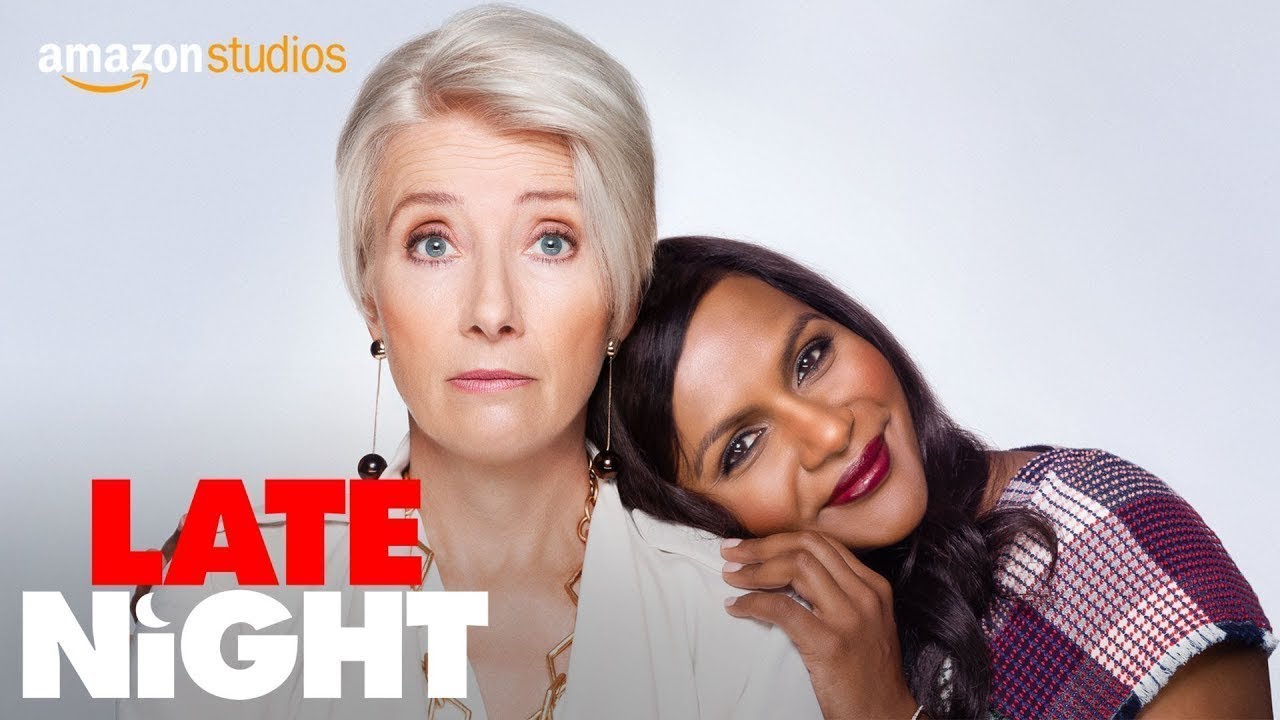
“Late Night” is a festival favorite written by and starring Mindy Kaling, who created just the right role for herself as an Indian-American woman who gets her dream job as a comedy writer, working for a tyrannical late night talk show host played by Emma Thompson. Kaling, who has often talked about her love for romantic comedies played a character in her television series who imagined herself as the heroine of one (understanding them only on the most superficial and self-involved level), has created what is in essence a rom-com about a work relationship between two women, one hopelessly optimistic, one relentlessly cynical.

Kaling plays Molly, a quality control specialist in a chemical plant who gets a one in a million shot at the job by winning an essay competition. Katherine (Thompson) has just imperiously ordered her long-suffering producer (Denis O’Hare) to add a woman to the all-male, all-white writing staff, so he gives Molly a chance. What the writers do not know is that the new head of the network (Amy Ryan), who likes to talk about “four-quadrant” audiences (males and females over and under 25 years old) and ROI (return on investment), thinks Katherine, despite her multiple Emmys and other awards, has become out of date and out of touch with her audience. Ratings are down, and Katherine is unlikely to boost them as long as she insists on having guests like Senator Diane Feinstein and historian Doris Kearns Goodwin.

Katherine demands “excellence” from everyone around her, and that means total dedication. Her manner is abrupt and imperious and she fires staff like she’s the Queen of Hearts calling “Off with their heads!” She refuses to capitulate to what she considers the dumbing down of the media (and the world). When her producer persuades her to have a viral YouTube star who makes videos of her sniffing her dog’s butt on the show, the withering contempt she cannot hide alienates her shrinking audience further. She is pushed onto social media, but her first joke about Twitter bombs, perhaps because she calls it “Twittah” but also because she has not taken the time to understand what it is.

There are just two things she cares about, her husband (John Lithgow), who is in the early stages of Parkinson’s Disease, and her show. Both are being taken from her, and she does not have the resources to respond.

Katherine literally does not know the names of her writers, many of whom have never even met her. She has no interest in learning their names, and when she finally sits down in the writers’ room, she assigns them all numbers.

Kaling, who was both writer and actress on the US version of “The Office,” has a good feeling for the “He Man Women Haters”-Our Gang-style dynamics of the all-male writer’s room. They are so used to having no women around that they use the ladies’ room. And her being there doesn’t stop them. At first, she brings her quality control perspective, analyzing what’s missing from the show, until one of the writers gives her some good advice: write something.

Kaling has said that (until “Wrinkle in Time”) every part she has had is one she has had to create for herself. Her strength as a writer is giving us characters who are three-dimensional, vivid, and smart. Both Molly and Katherine filter Kaling’s experiences and perspective in writing for television, the relentlessness of sifting through jokes to put together a polished monologue of perfectly crafted comedy only to have to start over again the next day, the treacherous balancing act between giving enough of yourself to connect with the audience while keeping enough private to keep your sanity and sustain relationships, the even more treacherous challenge of staying on top while people who are every bit as ambitious try to topple you.

She shortchanges Molly a bit here, particularly when she lets herself get hurt by someone her character would be instantly wary of. We get the sense that it is the Katherine character who interests her more, and it gives Thompson one of her all-time best roles. In the first half, she effortlessly tosses off Katherine’s most devastating take-downs, a woman who insists on excellence in a world that does not seem to want it. But in the second half, when Katherine has to be unsure and vulnerable, Thompson gives a performance of exquisite depth and precision. “I hope I have earned the privilege of your time,” Katherine tells her audience. Kaling and Thompson make the privilege ours.

Parents should know that this film includes substantial strong language, sexual references, some potty humor, smoking, and infidelity.

Family discussion: Would you have hired Molly? Why didn’t Katherine change sooner? What was Katherine’s funniest joke?

If you like this, try: “Dancing in September” and “The Mindy Project” and “Larry Sanders Show” television series


Related Tags:


AWFJ Movie of the Week Comedy Drama Gender and Diversity movie review Movies -- format Movies -- Reviews Race and Diversity
Dark Phoenix

Dark Phoenix

Posted on June 6, 2019 at 4:42 pm

C
Lowest Recommended Age: Middle School
MPAA Rating: Rated PG-13 for intense sequences of sci-fi violence and action including some gunplay, disturbing images, and brief strong language
Profanity: Some strong language, one f-word
Alcohol/ Drugs: None
Violence/ Scariness: Extended comic-book action peril and violence with some disturbing graphic images, guns, explosions, superhero fights, characters injured and killed
Diversity Issues: A theme of the movie
Date Released to Theaters: June 7, 2019
Date Released to DVD: September 16, 2019

Copyright Disney 2019
The Marvel Avengers movies showed surprising range for very different characters operating in a single universe, from the outright comedy of “Thor Ragnarok” and “Guardians of the Galaxy” to the “Captain America: Winter Soldier” hark back to the political paranoia films of the 1970’s, the grappling with historical divides and cultural identity in “Black Panther” and the existential issues of “The Hulk.” But “Dark Phoenix,” this latest entry in the not (yet) integrated X-Men franchise, also based on Marvel comics, veers unwisely into a genre best left out of the superhero category: soap opera.

In this version of the X-Men universe (don’t try to tie it too closely to the original series or we would have to try to understand how Professor X and Magneto could age several decades in seven years, not to mention several other major disconnects), Jean Gray is brought by Professor X (James McAvoy) to his school, a sort of Hogwarts for mutants, when she is a child. Devastated by the loss of her parents in a car accident and terrified by powers she does not understand or control, she at first refuses. Professor X assures her that he can fix whatever she breaks, and that she herself is not broken. Note that just before the car flips over and crashes, which Jean survives without a scratch, the radio plays two significant songs: “By the Time I Get to Phoenix” and “Werewolves of London.” The first is a reference to the regenerating mythical bird that will give Jean her new nom de superhero/persona. The second is likely a nod to Jean’s relationship with Wolverine, otherwise not referred to in this film.

By the time Jean grows up (played by “Game of Thrones'” Sophie Turner), she is in a strong romantic relationship with Cyclops (Tye Sheridan) and very much a part of the group of young adult X-Men. (Raven/Mystique, played by Jennifer Lawrence, points out that the women have been saving the men so often they should consider changing the name to X-Women). The team goes on their first mission to outer space, to rescue a crew of American astronauts. Jean is almost killed, but is exposed to and possibly saved by some mysterious cosmic radiation. She says she is fine and nothing shows up in a quick medical examination, but later that day she faints, and when she is tested again, her powers are literally off the charts. As in, so far past anyone else they need to build a new machine to measure.

Whatever she has learned from the trust, guidance, and support of Professor X dissolves as the new powers bring back the same feelings of guilt, shame, defiance, and being out of control that we saw in her just before her parents’ car flipped over. She will try to find answers from her past, including a visit to the secret place where Magneto (Michael Fassbender) and his team are hanging out, a hidden safe zone that is off the grid.

As in all X-Men movies (and in last week’s “Godzilla” except with monsters), the core tension is between those who want to find a way for humans and mutants to live together in peace and mutual support (astronaut rescue!) and those who want to wipe each other out. This war seems to be going on inside of Jean, as she discovers that her real and substitute fathers lied to her and as she fears she will not be able to control her new powers.

Meanwhile, some aliens have landed and taken over human bodies. Their leader (Jessica Chastain) is searching for Jean to help them take over the planet. It is a shame to see this versatile, classically trained actor relegated to one of those roles where all of her lines are recited in the same languid but threatening monotone and her superpowers is primarily striding around in stilettos without mussing her impeccably shaped blonde hair.

The action scenes are capably staged, but the non-action scenes are close to inert and some of the special effects look cheap and insubstantial. Can we just all agree never to ask an alien character to say that emotions make humans weak? This is a disappointing placeholder that suffers by comparison with the vastly more dynamic and imaginative superhero movies we’ve already seen this year.

Parents should know that this film has extended fantasy/comic-book peril and violence with characters injured and killed and some disturbing and graphic images including characters being impaled, shot, and dissolved, and some strong language including one f-word.

Family discussion: Why did Professor X lie to Jean? Did he “fix” her? Would you like to have Jean’s powers and what would you do if you had them?

If you like this, try: the “X-Men” movies and comics and “Captain Marvel”

Related Tags:


Action/Adventure Comic book/Comic Strip/Graphic Novel DVD/Blu-Ray Fantasy movie review Movies -- format Series/Sequel Superhero
Rocketman

Rocketman

Posted on May 30, 2019 at 5:42 pm

B +
Lowest Recommended Age: Mature High Schooler
MPAA Rating: Rated R for language throughout, some drug use and sexual content
Profanity: Very strong language
Alcohol/ Drugs: Extended substance abuse including drugs and alcohol
Violence/ Scariness: Suicide attempt, family issues
Diversity Issues: A theme of the movie
Date Released to Theaters: May 31, 2019
Date Released to DVD: August 26, 2019
Copyright 2019 Paramount

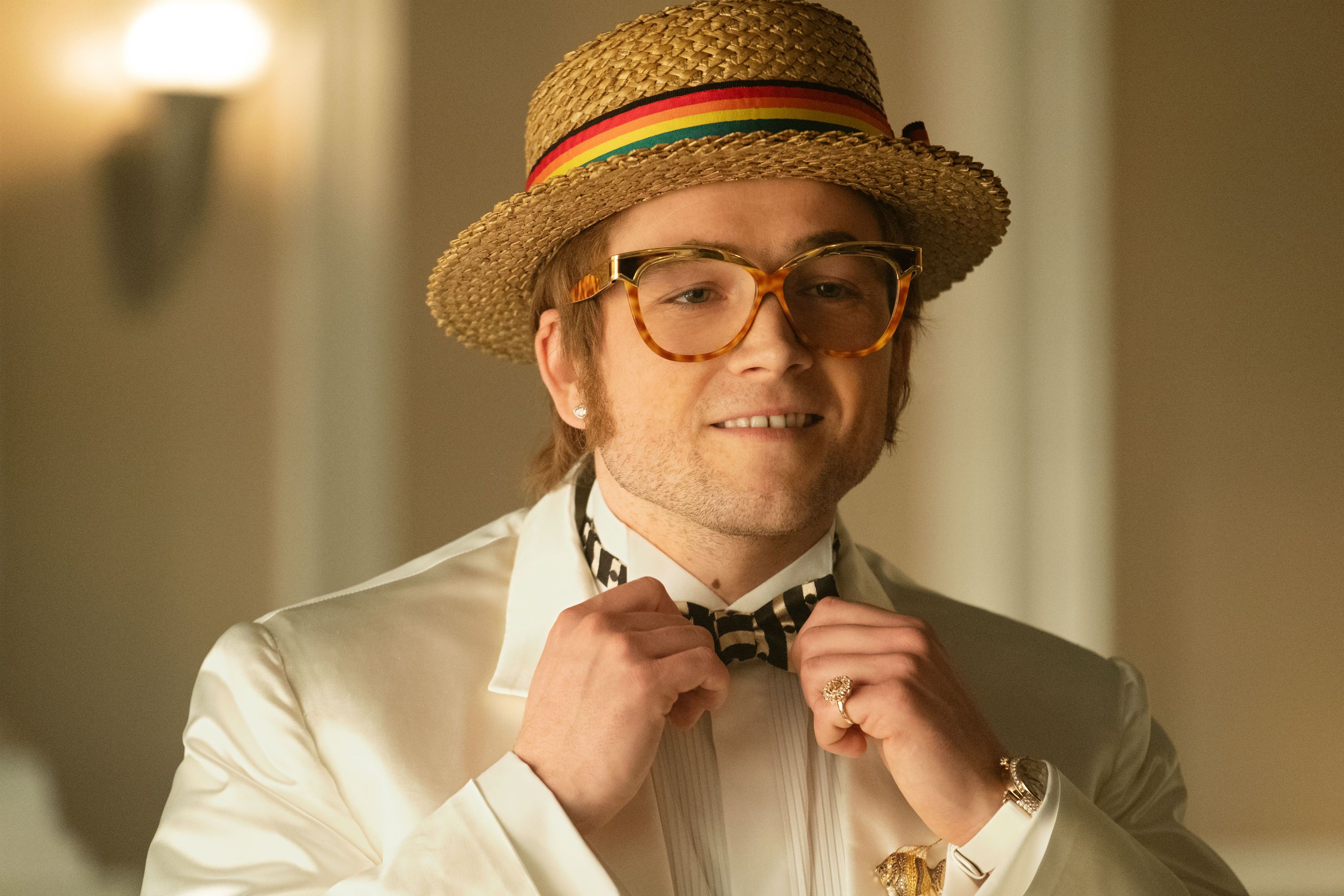
Elton John strides purposively down a corridor dressed in what looks like devil costume for Liberace’s Halloween party. But he is not moving toward a stage or recording studio. He is not going to sing or compose. He is going to tell his story to a different kind of audience, a support group in a drug rehab facility. And to us.

Rocketman,” produced by Sir Elton himself, is a sometimes-impressionistic retelling of the classic VH1 “Behind the Music” story of sex, drugs, and rock and roll. Instead of “and then I wrote” with a chronological rehash of hits, celebrity encounters, romantic ups and downs, and AA-style amends, it is a dramatic version of a jukebox musical, with full-on dance numbers and songs that match the mood of the moment. Director Dexter Fletcher, who also finished up “Bohemian Rhapsody” after the original director was fired, wisely uses the more flamboyant elements of the story as a backdrop and keeps the camera focus on Taron Egerton (the “Kingsman” movies and “Eddie the Eagle,” also directed by Fletcher). He makes us see the energy and magnetism of Sir Elton as a performer, but it is in the most intimate close-ups that we see Sir Elton the person, vulnerable, scared, and longing to be truly accepted.

As Sir Elton tells his story to the support group, he removes the costume, a piece at a time (the horns come off first), and he reveals his own layers as well, starting with the child then known as Reg Dwight (an impressive Matthew Illesley), who lives with his distant father (when Reg asks for a hug, his father says, “Don’t be soft.”) and his self-involved mother (Bryce Dallas Howard), and his kind-hearted grandmother (Gemma Jones). Reg’s musical gifts are evident immediately; he can play anything he hears. He gets a scholarship to the Royal Academy of Music (his grandmother takes him there when his mother can’t be bothered).

And then he hears Elvis, and it’s all about rock and roll. His band plays back-up for touring American acts, and he changes his name (“Elton” was nicked from a bandmate; in the movie John comes from John Lennon but in real life it was from his mentor, “Long John” Baldry). And then he answers an ad for singers and songwriters and, when he says he composes and does not write lyrics, an unopened envelope is handed to him and it turns out to be from Bernie Taupin (Jamie Bell of Billy Elliot and Film Stars Don’t Die In Liverpool). They form a close working and personal relationship.

And then there is the breakthrough performance at LA’s legendary Troubadour club. The future Sir Elton at first refuses to leave the bathroom when he hears that musical legends are in the audience: some of the Beach Boys, Leon Russell, Neil Young. But then he comes on stage and it is magical. We see him, and then the audience literally float up into the air, an exquisitely lovely moment that perfectly translates the euphoria of the performance.

Then there is a troubled romantic and professional relationship with a new manager (smoldering Richard Madden as John Reid) and unimaginable excess as he still struggles for acceptance from his parents. In a particularly wrenching scene Sir Elton sees his father, who will not see him perform, warmly affectionate with the children of his second wife. As we return to the scene at rehab, we see him finally able to accept the love he so desperately wants.

Egerton showed us in the “Kingsman” movies that he has what it takes for the performative side of this story, but this is the first time we have had a chance to see just how sensitive and subtle an actor he is. There are moments when we can see three or four different emotions on his face at once, as in his phone call to his mother to tell her he is gay or when he is mesmerized, terrified, and flickering back and forth between being open and hiding his feelings with Reid.  In one split second he goes from drugged-out, depressed, and anxious back stage to full-on rock star as he walks out toward the audience.  It is hard to imagine there will be a better performance on screen this year.

Sir Elton wanted the focus of this story to be on his personal life and his feelings, interpreted by the music, rather than his story as a composer and performing artist. For that, of course, we have Sir Elton himself, his music videos and recordings of his live performances, and the songs which over decades have said so much.

Parents should know that this movie includes extensive substance abuse, a suicide attempt, family dysfunction, addiction issues, sexual references and situation, and very strong language.

Family discussion: What person did he want to be? Which is your favorite Elton John song? How do you like this more subjective form of storytelling?

If you like this, try: the music of Elton John and other real-life stories of musicians including “Bohemian Rhapsody,” “Coal Miner’s Daughter,” and “Walk the Line”

Related Tags:


Based on a true story Biography DVD/Blu-Ray movie review Movies -- format Musical
Godzilla: King of the Monsters

Godzilla: King of the Monsters

Posted on May 30, 2019 at 5:32 pm

B
Lowest Recommended Age: Middle School
MPAA Rating: Rated PG-13 for sequences of monster action violence and destruction, and for some language
Profanity: Strong language
Alcohol/ Drugs: None
Violence/ Scariness: Extended fantasy/sci-fi action, peril, and violence, massive destruction
Diversity Issues: None
Date Released to Theaters: May 31, 2019
Date Released to DVD: August 26, 2019

Copyright Warner Brothers 2019
There are a lot of monsters in and around this movie. “Monster” in its most literal meaning refers to san imaginary creature that is typically large, ugly, and frightening, basically, something that falls outside of what we consider “normal.” But we use the term “monster” to describe people whose behavior is extremely cruel, violent, or hateful. Note: the Latin root of the word can mean “warn.”

All of that is on display in “Godzilla: King of the Monsters,” an Avengers-style roundup of the classic kaiju (“strange beast”) monsters from post-WWII movies about enormous creatures who cause massive destruction as white-coated scientists make frantic calculations, the military deploys its most powerful weapons, skyscrapers are knocked down, politicians debate, and ordinary people run and scream. And so we have our title character, Godzilla, who has been a, well, monster hit at the box office, with the longest continuously running movie franchise, from 1954 to the present day, 35 films so far. Then there are the flying reptile Rodan, the gigantic insect-like Mothra, and the three-headed, dragon-like King Ghidorah.

And then there are the people. It would be a stretch to call them “characters” because they mostly exist to represent different sides in the movie’s key divide, metaphor for metaphor for a range of geopolitical issues ranging from refugees and immigration to environmental destruction to the role of public and private entities in national security and that oldest of themes, hubris, as reflected by the age of atomic weapons.

These issues are literally brought home in the way that a formerly married couple, Emma (Vera Farmiga) and Mark (Kyle Chandler) Russell, and their daughter Madison (“Stranger Things'” Millie Bobbie Brown). They were so traumatized by the death of their son in the last monster attack that they split up. Mark is now off in the wilderness studying wolves. Emma is still studying kaiju and working on a special thingamagig that can be used to control the monsters and prevent further destruction.

Only Madison knows about how Emma plans to use it. And when the monsters who had been dormant re-appear Emma brings Madison along in what appears to be a very poorly timed take your daughter to work day. As Emma’s colleagues are mowed down by an “eco-terrorist” (Charles Dance) Emma and Madison are captured.

Meanwhile, there is a debate in the outside world about how to deal with monsters. Should we kill them all? Should we acknowledge that they are the next stage of evolution and live with them? As one character says, when asked if they could just be our skyscraper-sized pets, “No, we would be theirs.” And the question of who really are the monsters is raised with just enough heft to add some interest without ever getting in the way of the reason for the movie, which is big things fighting with other big things.

I know, I know, you want me to get to the good stuff. And you can relax; I just spent more time on exposition than the film does. Co-writer/director Michael Dougherty knows why we’re here and boy, does he deliver, with the help of outstanding special effects and design crew. It is possible, I suppose, that you may have a chance to catch your breath at some point, in which case you might consider what the people behind that first Godzilla movie 65 years ago, with production values that might have seemed a bit crude even then, might think if they saw these never-less-than-spectacular kaiju, never less than majestic, every battle powerfully staged.

Even if they had worked on the characters and dialogue with as much imagination as they did with the creatures, it would just be a distraction. The international cast gives it what they can, but the only use for lines like “It’s an existential challenge to our world!” and “The earth unleashed a fever to fight the infection,” “You are messing with forces beyond your comprehension!” plus references to “playing God” and saving the world is to stay out of the way of the action. Happy summer — the popcorn pleasures have arrived.

Parents should know that this is a monster movie with extended sci-fi/fantasy peril, action, violence, mayhem, and destruction. Characters use strong language and there are issues of betrayal and family tensions.

Family discussion: What is the significance of the comment about the difference between the way Eastern and Western cultures see the stories about dragons? How would humans find a way to co-exist with monsters? Which humans behave like monsters?

If you like this, try: the kaiju movies, “Rampage,” and “Pacific Rim” and its sequel

Related Tags:


Action/Adventure DVD/Blu-Ray Fantasy IMAX movie review Movies -- format Remake Series/Sequel
Aladdin

Aladdin

Posted on May 23, 2019 at 5:17 pm

B-
Lowest Recommended Age: Kindergarten - 3rd Grade
MPAA Rating: Rated PG for some action/peril
Profanity: Mild language
Alcohol/ Drugs: Brief alcohol
Violence/ Scariness: Extended fantasy/action peril and violence, attempted murder, near-drowning, discussion of sad deaths of parents
Diversity Issues: Issue of female autonomy and power
Date Released to Theaters: May 24, 2019
Date Released to DVD: September 16, 2019

Copyright Disney 2019
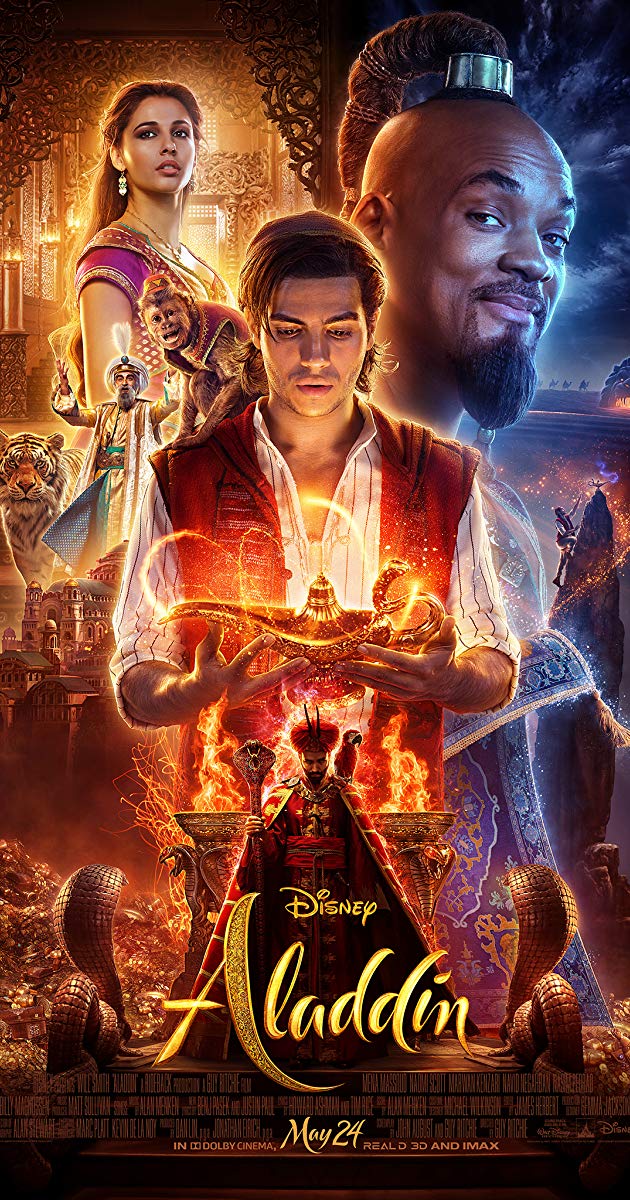
It is a bit of a puzzle that a director known for dynamic action doing a live action remake of a musical animated film that was exceptionally lively has somehow produced a movie that seems bogged down, even static. The new “Aladdin” from co-writer/director Guy Ritchie (“Lock, Stock, and Two Smoking Barrels,” “Sherlock Holmes”) is colorful and tuneful, but for much of its just over two hours running time it lumbers along, despite its best efforts to entertain.

The original Disney animated version of “Aladdin” is one of the studio’s all-time best thanks to a wonderfully melodic score, with songs by Alan Mencken and Howard Ashman and possibly the all-time greatest animated movie voice performance in history, Robin Williams as the Genie. The mercurial Williams found his ultimate mode of presentation with the help of Disney’s top animators as the magical, infinitely malleable, cartoon character, instantly creating characters ranging from Ed Sullivan, William F. Buckley, and Jack Nicholson to Peter Lorre and a bunch of zombies, always retaining the essential heart and humor that made a fantasy come alive. (The closest Williams ever came to replicating avalanche of portrayals might be his innumerable improvisations with a shawl on “Inside the Actor’s Studio.”) No live action version, even with the help of the latest CGI technology and the powerhouse charisma of Will Smith, can match the kaleidoscopic imagination of the 1992 Genie.

This version does make some substantial improvements in the story of the “street rat” who loves a princess and then, with the help of the genie in a magical lamp, pretends to be a prince so he can court her. Disney says it has the most diverse cast in the studio’s history, and it is great to see all of the lead roles performed by people whose ethnicity matches their characters, with Egyptian-born Mena Massoud as Aladdin and Naomi Scott, of British and Indian heritage, as Jasmine. The locations are authentic as well. Filmed in Jordan, and with the always-outstanding work of the Disney production designers, the settings are splendid, and the classic songs still sound fresh and hummable, especially “Prince Ali” and “A Whole New World.” The film should really be called “Aladdin and Jasmine” because it gives the princess a full, meaningful role in the story, respecting her agency, ability, and dedication to her people. It gives her father, the Sultan (Navid Negahban) more agency, as well, unlike the animated character, who spends much of the story in an enchanted fog. And it’s nice to see Genie get a bit more of a story, too, thanks to the handmaiden to the princess, played by “SNL’s” Nasim Pedrad.

But the story-telling itself is foggy in this version. Jafar (Marwan Kenzari), the story’s villain, does not have the menace of the original. He seems young and angry, more petulant than ominous. There is a hint of an intriguing backstory for him that gets lost in the busy, “look at me”-ness of the film. A storyline about whether the Sultan should approve invasion of another country does not work well and a dance number with the Genie controlling Aladdin has too many cuts to deliver on the humor of the situation. The “Step Up” movies do these moments much better, and Jasmine’s new song from “La La Land’s” Benj Pasek and Justin Paul is outshone by the originals. A wink at the map of Disneyland as Jasmine does the ancient equivalent of Googling “Prince Ali” is out of place.

If there had been no animated version, this one would have served as an entertaining family movie. But as has happened too often with Disney’s live action remakes of its best animated films, it is just an unnecessary reminder of how much we loved the original.

Parents should know that this film includes fantasy peril and violence including near-drowning, attempted murder and references to killing and to sad death of parents, action, brief alcohol, and a kiss.

Family discussion: What would your three wishes be? Remember to be careful with your words! Why was Aladdin so awkward when he becomes Ali? Why was Jafar so angry? What does it mean to be a diamond in the rough, and what made Aladdin one?

If you like this, try: the original Disney animated version and the stories of the 1001 Nights

Related Tags:


Action/Adventure Based on a book DVD/Blu-Ray Epic/Historical Fantasy Movies -- Reviews Musical Remake Romance
THE MOVIE MOM® is a registered trademark of Nell Minow. Use of the mark without express consent from Nell Minow constitutes trademark infringement and unfair competition in violation of federal and state laws. All material © Nell Minow 1995-2026, all rights reserved, and no use or republication is permitted without explicit permission. This site hosts Nell Minow’s Movie Mom® archive, with material that originally appeared on Yahoo! Movies, Beliefnet, and other sources. Much of her new material can be found at Rogerebert.com, Huffington Post, and WheretoWatch. Her books include The Movie Mom’s Guide to Family Movies and 101 Must-See Movie Moments, and she can be heard each week on radio stations across the country.

Website Designed by Max LaZebnik