The Broken Hearts Gallery

The Broken Hearts Gallery

Posted on September 10, 2020 at 1:00 pm

B +
Lowest Recommended Age: Mature High Schooler
MPAA Rating: Rated PG-13 for sexual content throughout and some crude references, strong language and drug references
Profanity: Some strong and explicit language
Alcohol/ Drugs: Alcohol, drug references
Violence/ Scariness: Emotional confrontations, reference to a sad offscreen death
Diversity Issues: Exceptionally inclusive
Date Released to Theaters: September 11, 2020

Copyright 2020 TriStar Pictures
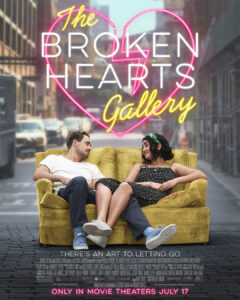
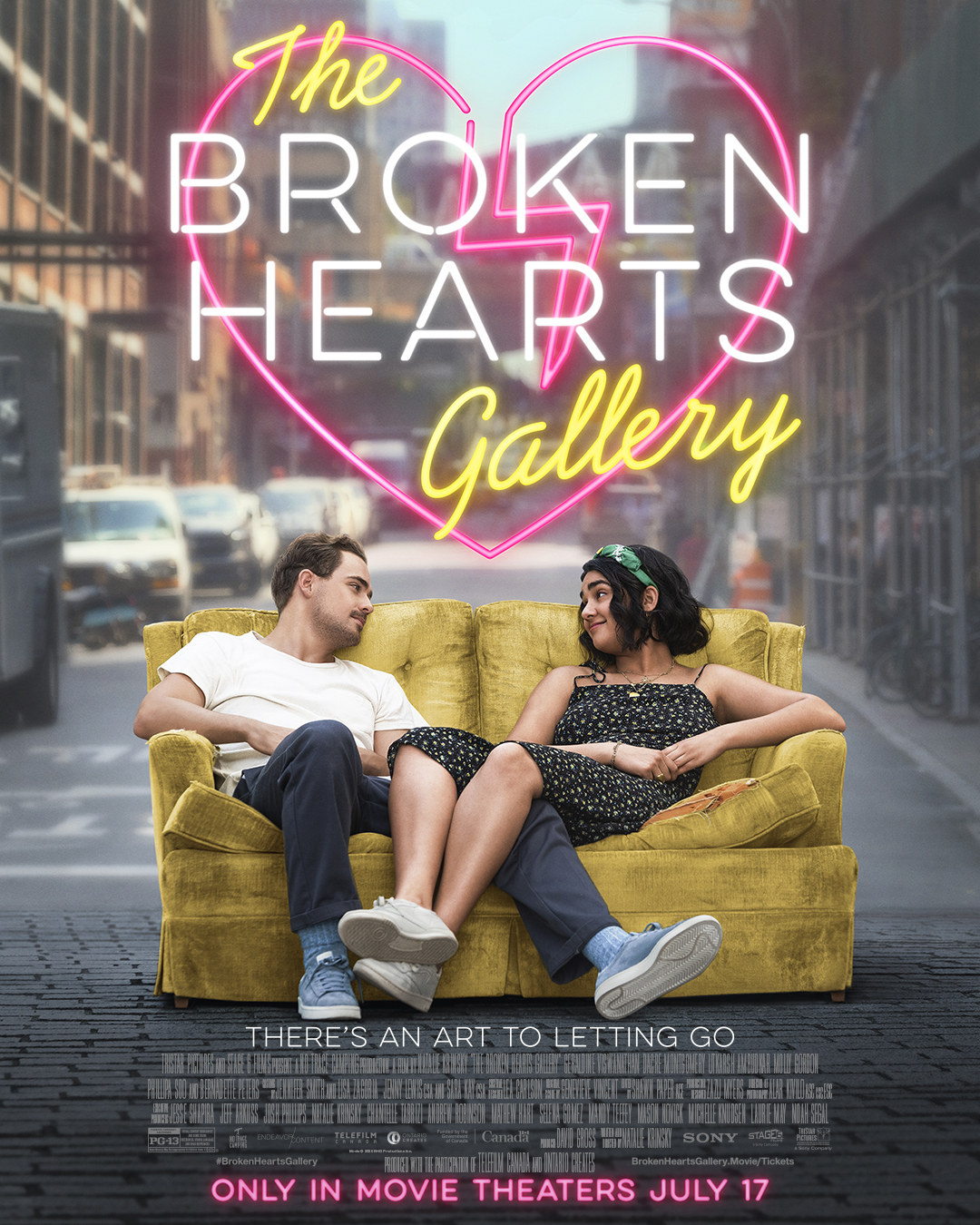
Maybe it’s my pandemic brain, but I found “The Broken Hearts Gallery” the most delightful romantic comedy in a long time, and I can’t wait to see it again. For all those who have been decrying the end of the romantic comedy because it is just too hard to come up with reasons to keep the lovers apart, let me make this Exhibit A for the defense. It turns out to be very simple. All you need is actors with enormous magnetism and chemistry, some banter that goes snap, crackle, and pop, a couple of misunderstandings and miscommunications, the all-important apology, and of course, spoiler alert, the happy ending. “The Broken Hearts Gallery,” written and directed by “Gossip Girl’s” Natalie Krinsky, is as refreshing and delicious as an ice cream cone on a hot day.

All credit to Krinsky, but the heart of this movie in every way is the adorable Geraldine Viswanathan (“Blockers,” “Bad Education”) as Lucy, who is every bit as endearing as any of the queens of romantic comedies from Doris Day to Meg Ryan and all of the various Jennifers and Jessicas with quippy best friends usually played by Judy Greer. Speaking of the essential role of the quippy best friends, A+ for the two in this film, played by powerhouses-who-deserve-their-own romantic comedies, “Hamilton’s” Phillipa Soo and “Booksmart’s” Molly Gordon as Lucy’s BFFs, support system, and Greek chorus.

Lucy has two passions. The first is art, especially the not-yet-discovered artists with something new to bring to the world. She has a low-level job in a high-level art gallery owned by a “Devil Wears Prada”-style terrifying boss lady, the film’s only under-written character and her name is too-on-the-nose Eva Woolf for goodness sakes. On the considerable other hand, she is played by Broadway legend Bernadette Peters. Lucy’s other passion is holding on to mementos and artifacts of failed relationships, which are more important to her than the relationships themselves. When she loses her current boyfriend, a colleague in the gallery (Utkarsh Ambudkar as Max) and her job in the same #epicfail, she tipsily climbs into a car she mistakes for a Lyft, the handsome guy who owns the car (Dacre Montgomery as Nick) decides to drive her home, and we can check off “meet cute” on our romantic comedy bingo card. Other boxes are checked off nicely, too as the couple bicker, develop grudging respect and then affection as they accomplish something together, get close, get less close, and then, well you know. Plus karaoke, exes, and, of course, wandering through an open market.

Here is what is not on the bingo card but should be from now on: like “The Personal History of David Copperfield,” this movie is casually, un-self-consciously, and joyfully inclusive in a way that feels bountiful, generous, and heart-warming. Krinsky does not waste time worrying about whether related characters look like they share DNA or have names to match their ethnicity, or whether a romantic comedy lead should be blonde and blue-eyed and size 00, and that allows us the luxury of freedom not to worry about it either. Romantic comedies may be aspirational with a dream of perfect understanding and intimacy and witty dialogue, but this one is understatedly aspirational on a whole other level.

Just as revolutionary, this movie gives us a romantic comedy heroine who is not insecure and clutzy. Lucy has issues but she also has confidence and a sense of where she is going. She is coping with loss in some ways that are more constructive than others, like everyone else, but understanding that is what life and movies are all about.

Nick is trying to open a boutique hotel, still under construction and running out of money. He impulsively hangs one of Lucy’s mementos, Max’s tie, on a nail and that inspires her to create the title art installation, which becomes hugely popular, and hugely cathartic for the broken-hearted people who come by to share their stories. The loss of a love is, Lucy says, the loneliest feeling. Sharing the story makes it less lonely. So does a charming romantic comedy that opens up all kinds of new possibilities, including looking for more from its talented writer/director and cast.

Parents should know that this film has some strong language and explicit sexual references that might earn an R if it were not a comedy. Characters drink and get tipsy and there is a drug reference.

Family discussion: What mementos are meaningful to you and why? What art installation can you create?

If you like this, try: “The Personal History of David Copperfield”
Related Tags:


Comedy movie review Movies -- format Movies -- Reviews Race and Diversity Romance
New Oscar Diversity Qualifications Announced

New Oscar Diversity Qualifications Announced

Posted on September 8, 2020 at 8:28 pm

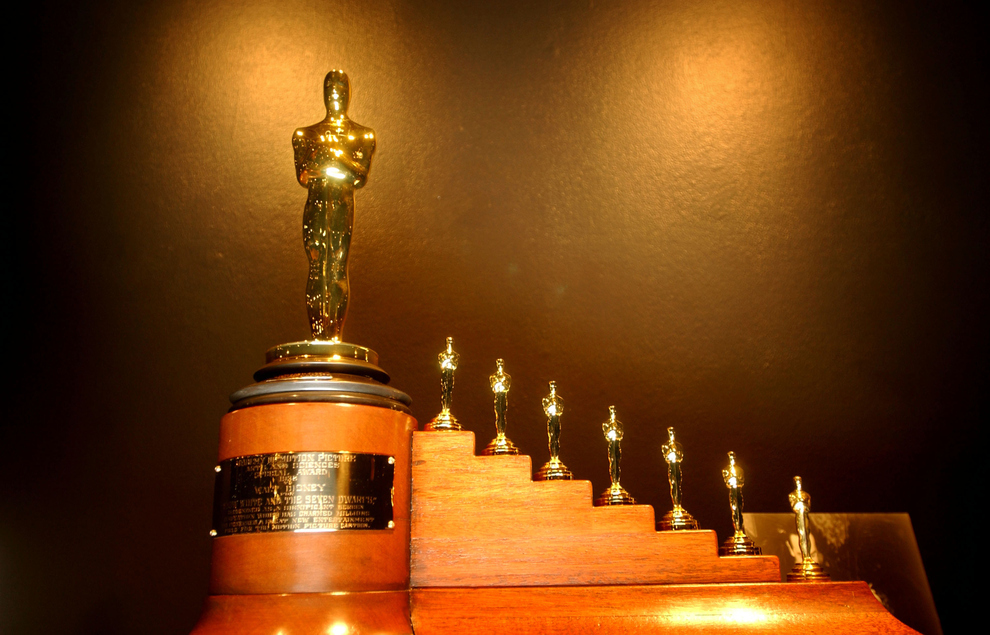
The Academy of Motion Picture Arts and Sciences has announced new diversity requirements for films that want to be eligible for Oscar awards.

Oscar hopefuls will have to meet a new set of inclusive hiring standards in order to qualify for Best Picture, an effort the Academy of Motion Picture Arts and Sciences hopes will lead to greater diversity and representation both onscreen and behind the scenes.

It’s part of the Academy Awards’ ongoing response to criticism over its lingering lack of diverse nominees. The outcry became particularly intense five years ago when the hashtag #OscarsSoWhite forced a reckoning within the organization. Since that time, leadership of the Academy has tried to improve diversity within its voting body and encourage positive discussions within the industry, but this new set of guidelines is aimed at making it mandatory for contenders to be more inclusive of those who have traditionally been marginalized in Hollywood.

The policies will only become mandatory for the 96th Academy Awards in 2024, which will give would-be contenders three years to make sure they meet at least two of the four categories below that are designated A, B, C, and D.

STANDARD A: ON-SCREEN REPRESENTATION, THEMES AND NARRATIVES
To achieve Standard A, the film must meet one of the following criteria:

A1. Lead or significant supporting actors — At least one of the lead actors or significant supporting actors is from an underrepresented racial or ethnic group.

• Asian
• Hispanic/Latinx
• Black/African American
• Indigenous/Native American/Alaskan Native
• Middle Eastern/North African
• Native Hawaiian or other Pacific Islander
• Other underrepresented race or ethnicity

A2. General ensemble cast — At least 30% of all actors in secondary and more minor roles are from at least two of the following underrepresented groups:

• Women
• Racial or ethnic group
• LGBTQ+
• People with cognitive or physical disabilities, or who are deaf or hard of hearing

A3. Main storyline/subject matter — The main storyline(s), theme or narrative of the film is centered on an underrepresented group(s).

• Women
• Racial or ethnic group
• LGBTQ+
• People with cognitive or physical disabilities, or who are deaf or hard of hearing

STANDARD B: CREATIVE LEADERSHIP AND PROJECT TEAM
To achieve Standard B, the film must meet one of the criteria below:

B1. Creative leadership and department heads — At least two of the following creative leadership positions and department heads—Casting Director, Cinematographer, Composer, Costume Designer, Director, Editor, Hairstylist, Makeup Artist, Producer, Production Designer, Set Decorator, Sound, VFX Supervisor, Writer—are from the following underrepresented groups:

• Women
• Racial or ethnic group
• LGBTQ+
• People with cognitive or physical disabilities, or who are deaf or hard of hearing

WATCH

Archaeologist Reviews Archaeology in Movies, from ‘Indiana Jones’ to ‘Lara Croft: Tomb Raider’
More Vanity Fair Videos
MOST POPULAR
Image may contain: Human, Person, Suit, Coat, Clothing, Overcoat, Apparel, Face, and Meghan Markle
Prince Harry and Meghan Markle Are “Relieved and Pleased” to Pay Off the Frogmore Cottage Renovations
BY KATIE NICHOLL
Image may contain: Water, Outdoors, Nature, Sport, Sports, Human, Swimming, Person, and Underwater
On Witness and Respair: A Personal Tragedy Followed by Pandemic
BY JESMYN WARD

The Trump Campaign Is Spending Money Like a Guy Who Bankrupted a Casino (And Five Other Businesses)
BY BESS LEVIN
At least one of those positions must belong to the following underrepresented racial or ethnic group:

• Asian
• Hispanic/Latinx
• Black/African American
• Indigenous/Native American/Alaskan Native
• Middle Eastern/North African
• Native Hawaiian or other Pacific Islander
• Other underrepresented race or ethnicity

B2. Other key roles — At least six other crew/team and technical positions (excluding Production Assistants) are from an underrepresented racial or ethnic group. These positions include but are not limited to First AD, Gaffer, Script Supervisor, etc.

B3. Overall crew composition — At least 30% of the film’s crew is from the following underrepresented groups:

• Women
• Racial or ethnic group
• LGBTQ+
• People with cognitive or physical disabilities, or who are deaf or hard of hearing

STANDARD C: INDUSTRY ACCESS AND OPPORTUNITIES
To achieve Standard C, the film must meet both criteria below:

C1. Paid apprenticeship and internship opportunities — The film’s distribution or financing company has paid apprenticeships or internships that are from the following underrepresented groups and satisfy the criteria below:

• Women
• Racial or ethnic group
• LGBTQ+
• People with cognitive or physical disabilities, or who are deaf or hard of hearing

The major studios/distributors are required to have substantive, ongoing paid apprenticeships/internships inclusive of underrepresented groups (must also include racial or ethnic groups) in most of the following departments: production/development, physical production, post-production, music, VFX, acquisitions, business affairs, distribution, marketing and publicity.

The mini-major or independent studios/distributors must have a minimum of two apprentices/interns from the above underrepresented groups (at least one from an underrepresented racial or ethnic group) in at least one of the following departments: production/development, physical production, post-production, music, VFX, acquisitions, business affairs, distribution, marketing and publicity.

C2. Training opportunities and skills development (crew) — The film’s production, distribution and/or financing company offers training and/or work opportunities for below-the-line skill development to people from the following underrepresented groups:

• Women
• Racial or ethnic group
• LGBTQ+
• People with cognitive or physical disabilities, or who are deaf or hard of hearing

STANDARD D: AUDIENCE DEVELOPMENT
To achieve Standard D, the film must meet the criterion below:

D1. Representation in marketing, publicity, and distribution

The studio and/or film company has multiple in-house senior executives from among the following underrepresented groups (must include individuals from underrepresented racial or ethnic groups) on their marketing, publicity, and/or distribution teams.

Related Tags:


Awards Disabilities and Different Abilities Gender and Diversity Race and Diversity

Labor Day 2020: Thanks to Those Who Work

Posted on September 7, 2020 at 8:00 am

Today we pay tribute to workers, especially those who worked for better conditions for everyone.

Sally Field won an Oscar for “Norma Rae,” a real-life story about a courageous woman who helped mill workers form a union. It was inspired by Crystal Lee Sutton, a courageous advocate for workers’ rights.

Doris Day plays a union worker who falls for a new guy in management but doesn’t lose sight of the seven and a half cent raise the workers are bargaining for in the rollicking musical, “The Pajama Game.”

John Sayles’ “Matewan” tells the story of mine workers fighting for safer conditions.

https://www.youtube.com/watch?v=qwEMIvDEFy4

“Harlan County USA” is a documentary about a strike by mine workers.

“Bread and Roses” is based on the real-life story of a strike by undocumented janitorial workers, with Adrian Brody as their lawyer.

https://www.youtube.com/watch?v=IrDpd4sCswY

“Salt of the Earth” was inspired by an actual miners’ strike against the Empire Zinc Co. and the cast includes real-life miners who were involved in the strike

Related Tags:


For Your Netflix Queue Holidays Lists
Mulan, Tenet, Antebellum: Critical Insights

Mulan, Tenet, Antebellum: Critical Insights

Posted on September 6, 2020 at 12:00 pm

Some of the best writing about film I’ve read this week:

Copyright Warner Brothers 2020

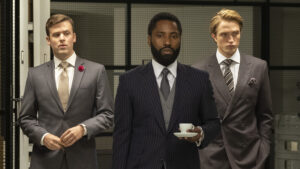
Jackson McHenry on Vulture discovers that The Best Parts of Christopher Nolan Movies Are All the Dainty Snacks and Drinks.

His films are full of immaculately manicured and coiffed heroes who tend to sport expensive suits, nice watches, and a level of deep sadness about women who’ve died in their proximity. They rarely sit down for a full meal, but they often pause for a quick cup of a tea and maybe half a sandwich, often while delivering some bit of exposition to another character. Once you start noticing the number of conversations that take place over dainty drinks and appetizers in Christopher Nolan movies, you simply cannot stop. He loves a small, civilized repast, especially if it involves a silver serving tray, and his universe is full of angsty men having a cup of a tea and a little something to tide them over till later.

On Slate, Sam Adams explains “Tenet” as thoroughly and clearly as it is humanly possible. Here’s a sample:

The word tenet reads the same backward and forward, one of several references to reversibility embedded in the film. Andrei Sator’s surname comes from the Sator Square, a five-by-five grid of interlocking letters that reads the same in every direction. It was first discovered in the ruins of Pompeii, which is a location that Andrei’s wife, Katherine (Elizabeth Debicki), and their son seem especially keen on visiting.

The other five words in the Sator Square all turn up in the movie at some point: There’s Rotas, the name of the security company that guards Andrei’s warehouse in the Oslo airport; Opera, the location of the movie’s first set piece; Arepo, the name of the art forger whose bogus Goya Katherine, who works at a high-priced auction house, arranged to have sold to her husband, and which he’s now using as leverage to keep her from leaving him. And there’s the central word in the Sator Square, the axis on which it turns: tenet.

Tenet is also the word ten backward and forward, which becomes key to the movie’s climactic sequence, in which synchronized attack teams move through time in opposite directions on a 10-minute countdown, performing what the movie calls a “temporal pincer.”

“Mulan” director Nikki Caro talks about filming the battle scene in the New York Times. At Polygon, Petrana Radulovic writes about one big change from the Disney animated version. The scene where Mulan dramatically cuts her hair off with her sword does not occur in the live-action remake and the larger implications of the Eastern vs. Western ideas about characters.

Copyright Disney 2020

From an East Asian perspective, it’s pretty apparent why an independent Mulan wasn’t working well with the story. The idea of pursuing an individual destiny has been romanticized for male protagonists throughout Western canon. In adapting fairy tales like Beauty and the Beast and The Little Mermaid, where female protagonists passively waited around and suffered, Disney found it empowering to reinvent them as active heroines taking control of their own destinies. But Mulan doesn’t draw from a history of male heroes embarking on journeys. The idea of striking out against family goes against the Confucian notions of the original ballad.

My friend and one of my favorite critics, Roxana Hadadi writes about “Mulan” for Pajiba. She calls the film “visually resplendent but narratively stifled.”

On paper, the representation politics of the film hold up—but they act in service of a story that is so adamant about traditional masculinity and nationalist loyalty that there’s literally no other plot. Niki Caro’s Mulan is grandly rendered but narrowly minded, and the film’s self-seriousness will make you long for the 1998 animated version’s subversive gender politics and sense of fun.

And Robert Daniels says that “Antebellum” is the worst movie of the year. His review may be one of the best of the year. “‘Antebellum’ is an unrepentantly violent film, and this entire sequence shows how it falsely equates shock value with empathy.”

In Antebellum, Bush and Renz desperately prod around in the dark, trying to discover the gravity of prestige slave movies like 12 Years a Slave. Slaves whistle “Lift Every Voice and Sing” in the cotton fields; one Confederate soldier calls another “snowflake”; grey-coats chant the Nazi refrain “blood and soil”; a statue of Robert E. Lee materializes on a foggy battlefield. The directors evoke these images as symbols, but don’t have the next-level horror-film ability to match symbolism with meaning. The narrative’s metaphorical thud resounds as loudly as the rolling sea.

In one of the movie’s few satisfying moments — and in a lyrically beautiful image — Eden rides a horse while wearing a Union coat and brandishing a battleaxe. She careens through Confederate lines, mouth bloodied and agape. But her uplifting revolution can’t redeem Antebellum’s grotesque wallowing and jangly script.

Related Tags:


Critics Understanding Media and Pop Culture
Hitchcock in Hitchcock Movies

Hitchcock in Hitchcock Movies

Posted on September 5, 2020 at 8:00 am

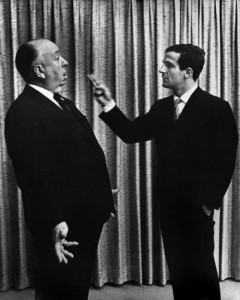
Alfred Hitchcock fans loved to spot his cameos, which added a touch of whimsy to his thrillers. As time went on, he made sure they occurred early in the films to avoid distracting the audience. The biggest challenge he faced was in the movie “Lifeboat.” Unless he was going to play one of the characters in the title craft, how could he find a way to appear? The answer is delightful. He was on a diet at the time, and had lost a lot of weight. So, he created a fake ad for a diet medicine and had it in a newspaper that appeared in the film. People actually wrote and asked him where they could get some as it was so effective!

Here’s a compilation of Hitchcock’s cameos.

Related Tags:


Film History Movie History Supercuts and Mashups Trailers, Previews, and Clips Understanding Media and Pop Culture
THE MOVIE MOM® is a registered trademark of Nell Minow. Use of the mark without express consent from Nell Minow constitutes trademark infringement and unfair competition in violation of federal and state laws. All material © Nell Minow 1995-2026, all rights reserved, and no use or republication is permitted without explicit permission. This site hosts Nell Minow’s Movie Mom® archive, with material that originally appeared on Yahoo! Movies, Beliefnet, and other sources. Much of her new material can be found at Rogerebert.com, Huffington Post, and WheretoWatch. Her books include The Movie Mom’s Guide to Family Movies and 101 Must-See Movie Moments, and she can be heard each week on radio stations across the country.

Website Designed by Max LaZebnik