White Chicks

White Chicks

Posted on June 23, 2004 at 4:58 am

C
Lowest Recommended Age: High School
MPAA Rating: Rated PG-13 for crude and sexual humor, language and some drug content
Profanity: Very strong language for a PG-13
Alcohol/ Drugs: Drug humor, drinking, smoking
Violence/ Scariness: Comic violence including guns, characters shot but no one badly hurt
Diversity Issues: A theme of the movie
Date Released to Theaters: June 23, 2004
Date Released to DVD: October 26, 2004

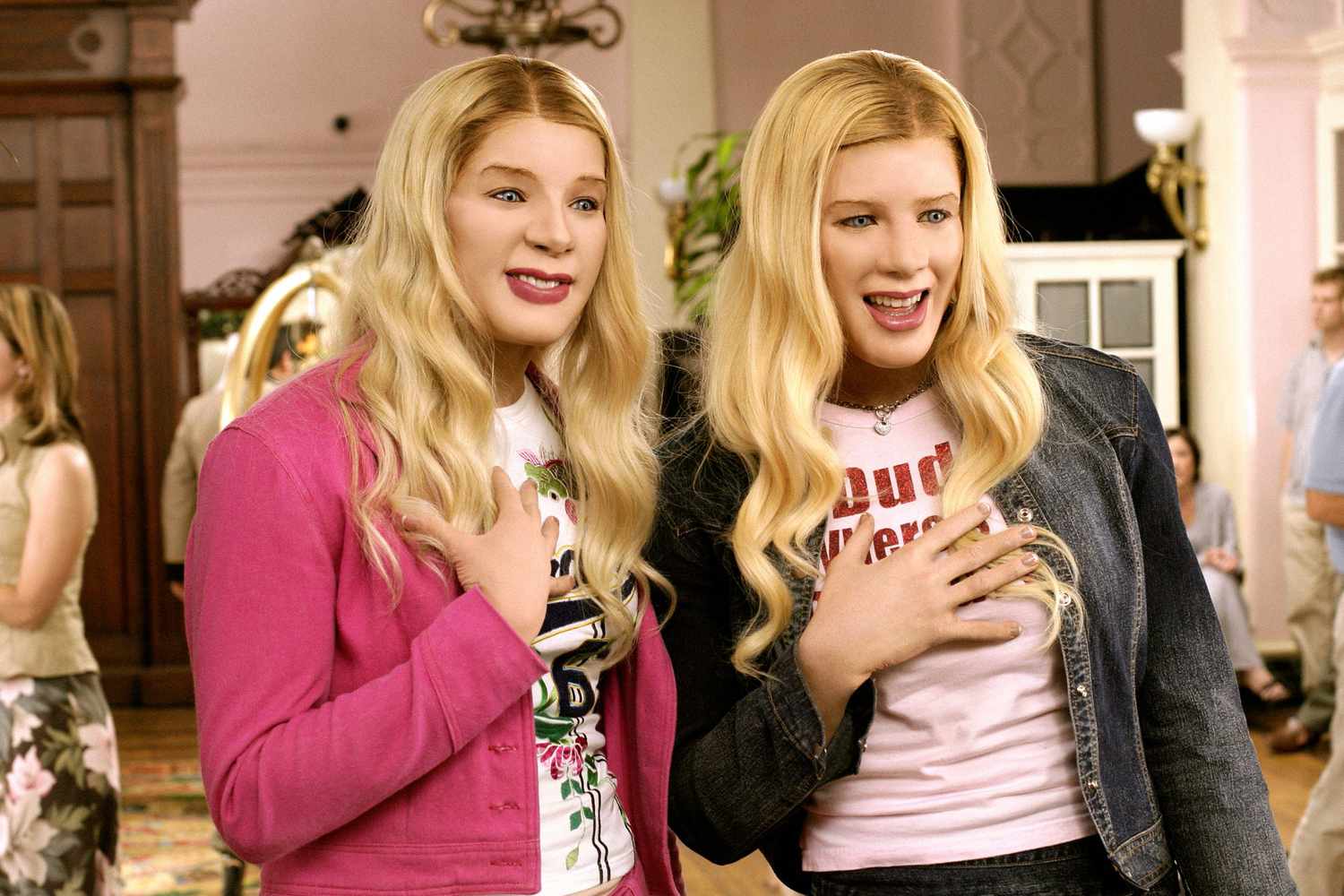
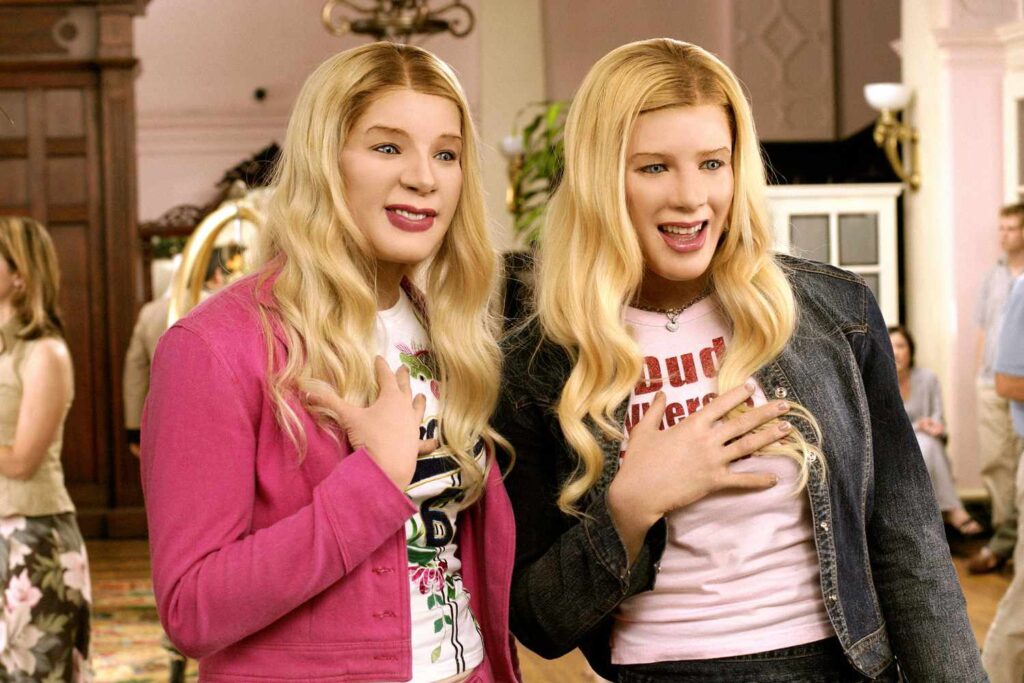
Appealing performers and a couple of very funny moments don’t make up for a lazy and generic script in this predictable farce about two black male FBI agents who go undercover as spoiled rich white girls. I knew we were in trouble when there was a “Hammer Time” joke in the first few minutes, a reference way past its sell-by date. And a Bjork swan-dress joke? In white chick terms, that’s so yesterday.
Copyright Columbia Pictures 2004

In rap music terms, this movie samples characters and plots from many other movies, including the already vastly over-used (attractive and principled but do-things-their-own-creative-way law enforcement types always getting chewed out by choleric superiors until one of their wacky schemes pays off and they get to be heroes) and the already done so brilliantly and distinctively that no one should ever try them again (whoever thought of appropriating the “Junior” plot twist from Some Like it Hot should be sent to the screenwriter equivalent of solitary confinement).

Even the movie doesn’t even appear to paying attention to its plot. Movies don’t have to be logical; they don’t even have to make sense. But sloppy inconsistencies like the ones here become a distraction that interferes with the ability of the audience to enjoy even the jokes that work.

Shawn and Marlon Wayans, apparently both the Zeppo Marxes of the talented Wayans family, play FBI agents Kevin and Marcus Copeland. It is typical of this movie’s problems that no one had the energy to give these characters anything resembling a personality. They are almost indistinguishable from each other except that one has a hysterically jealous wife and the other has a goatee and is single.

After they bungle a drug bust, they are assigned to escort the Wilson sisters (think Paris and Nicky Hilton), who may be targets for a kidnapper. They are on their way to a weekend at the Hamptons where they hope to be photographed for the cover of a magazine. A minor car accident on the way there leaves them with scratches on their faces and they refuse to be seen that way. So, the Copelands call in the FBI’s crackerjack undercover make-up team to transform them into the Wilsons. Conveniently, they both already have earrings.

Despite the fact that they are taller than the girls and the latex masks applied to their faces make them look like victims of Botox overkill, no one in the Hamptons seems to notice anything significantly different about “the girls” (one friend guesses that they’ve had collegen treatments to turn their lips from “Cameron Diaz to Jay-Z”). The Copelands squeal and giggle, shop with the girls, go all mean girls on the snooty rich snobs, and participate in a fashion show and a dance-off (okay, that dance-off is pretty funny). They also go out on dates, Marcus in drag with a smitten athlete (the very funny Terry Crews) and Kevin as a man but pretending to be someone else to impress a pretty reporter.

Gender and race-switching are inherently funny but the situations and jokes in this script do very little to build on that energy and sometimes actually get in the way. There are predictable culture clashes, as when the society girls sing along to Vanessa Carleton’s “1000 Miles” and the Copelands have to pretend to know the words. Then, when the rap song comes on…well, you know where this is going. (A twist on this scene later on provides the movie’s most sustained laugh.) There is a lot of gross-out humor involving various body parts and functions, and some leering double entendres. There are also predictable life lessons as the Copelands develop more empathy for women and encourage the society girls to have more self-respect, to insist on the best for and from themselves. Too bad the Wayans forgot to learn that lesson themselves; the insights are delivered with no more enthusiasm, sincerity, or imagination than the comedy.

Parents should know that the movie has very crude and vulgar material for a PG-13, with comedy based on sexual references (including a game where players have to choose between two unappealing sexual encounters), drug jokes, insult humor, and a lot of graphic potty humor. Characters use strong language, not just the usual “almost-R” words but also terms that may concern parents like “yeast infection,” “coke whore,” “bitch fit,” and the n-word. Racial insults and stereotyping are intended to be comic. The movie has some comic and action violence, meaning that a lot of punches are thrown and a few shots are fired but no one is seriously hurt.

Families who see this movie should talk about what Kevin and Marcus learn from pretending to be white women. Why was it so hard for Karen, Lisa, and Gina to feel good about themselves and their relationships?

Families who enjoy this movie will also enjoy the better movies it borrows from, like Some Like it Hot, which was first on the American Film Institute’s funniest movies of all time, and Tootsie, which was second. They may also enjoy Martin Lawrence in drag as an undercover cop in Big Momma’s House. The freshest and funniest Wayans film is still I’m Gonna Git You Sucka.
Related Tags:


Comedy movie review Movies -- format Movies -- Reviews

Mary Poppins

Posted on December 13, 2002 at 5:18 am

A+
Lowest Recommended Age: Kindergarten - 3rd Grade
MPAA Rating: G
Profanity: None
Alcohol/ Drugs: None
Violence/ Scariness: None
Diversity Issues: The cause of votes for women is presented as unimportant, even daffy; subtext that parents should spend time with their children in
Date Released to Theaters: 1964
Date Released to DVD: December 09, 2013
Amazon.com ASIN: B00E9ZAT4Y

marypoppins5In honor of the upcoming “Saving Mr. Banks” and the 50th anniversary of the original film, Disney is releasing a superclifragilisticexplialidocious new edition of Mary Poppins.

Based on books by P.L. Travers (whose reluctance to allow a film to be made is the subject of “Saving Mr. Banks,” the film switches the 1930’s-era setting to the more picturesque London of 1910, where the Banks family has a loving, if rather chaotic, household. A nanny has just stormed out, fed up with the “incorrigible” children, Jane and Michael. Mr. Banks (David Tomlinson) writes an ad for a new nanny and the children compose their own, which he tears up and throws into the fireplace. The pieces fly up the chimney, where they reassemble for Mary Poppins (Julie Andrews), who is sitting on a cloud. The next day, a great wind blows away all of the nannies waiting to be interviewed, as Mary floats down.

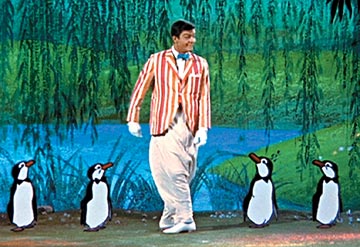
Somehow, she has a mended copy of the qualifications written by the children that Mr. Banks tore up and threw into the fireplace.  To the children’s astonishment, she slides up the banister.Out of her magically capacious carpetbag she takes out a tape measure to determine the measure of the children (“stubborn and suspicious” and “prone to giggling and not tidying up”) and her own (“practically perfect in every way”).  She directs them to clean up the nursery, and shows them how to make it into a game (“A Spoonful of Sugar Helps the Medicine Go Down”). Once it is clean, they go out for a walk, and they meet Mary Poppins’ friend Bert (Dick Van Dyke) drawing chalk pictures on the sidewalk. They hop into the picture and have a lovely time, or, rather, a “Jolly Holiday” in a mixture of live-action and animation that has Bert dancing with carousel horses and penguins.

Mary-Poppins-RooftopMary takes the children ato see her Uncle Arthur (Ed Wynn), who floats up to the ceiling when he laughs, and they find this delightfully buoyant condition is catching. Later, Mr. Banks takes the children to the bank where he works, and Michael embarasses him by refusing to deposit his tuppence because he wants to use it to buy crumbs to feed the birds. There is a misunderstanding, and this starts a run on the bank, with everyone taking out their money. Mr. Banks is fired.

Mr. Banks realizes that he has been too rigid and demanding. He invites the children to fly a kite with him. Mrs. Banks realizes that in working for the vote for women, she had neglected the children. Her work done, Mary Poppins says goodbye, and floats away.

This sumptuous production deserved its many awards (including Oscars for Andrews and for “Chim Chimeree” as best song) and its enormous box office. It is fresh and imaginative, and the performances are outstanding. (Watch the credits carefully to see that Van Dyke also plays the rubber-limbed Mr. Dawes.) The “jolly holiday” sequence, featuring the live-action characters interacting with animated ones, is superb, especially Van Dyke’s dance with the penguin waiters.

The resolution may grate a bit for today’s families with two working parents, but the real lesson is that parents should take time to enjoy their children, not that they should forego all other interests and responsibilities to spend all of their time with them.

Family discussion:  If you were writing a job notice for a nanny, what would it include?  Which of the children’s adventures did you most enjoy and why?

If you like this, try: books by P.L. Travers and the documentary about this film’s Oscar-winning song-writers, The Boys: The Sherman Brothers’ Story. And go fly a kite!

Related Tags:


Based on a book Classic Comedy DVD/Blu-Ray Pick of the Week Family Issues Fantasy For the Whole Family Musical Stories About Kids

Chariots of Fire

Posted on December 13, 2002 at 5:17 am

A+
Lowest Recommended Age: Kindergarten - 3rd Grade
MPAA Rating: Rated PG for adult situations and language
Profanity: None
Alcohol/ Drugs: Social drinking
Violence/ Scariness: Tense moments of competition
Diversity Issues: A theme of the movie
Date Released to Theaters: 1981
Date Released to DVD: July 9, 2012
Amazon.com ASIN: B00284AVN

In honor of the 2012 Olympics in London, this 1981 classic and winner of the Oscar for Best Picture has been reissued.

This is the true story of two athletes who raced in the 1924 Olympics, one a privileged Jewish student at Cambridge (Ben Cross as Harold Abrahams), the other a missionary from Scotland (Ian Charleson as Eric Liddell). Wonderfully evocative of the time and place, with superb performances, the movie shows us the source of the runners’ determination, for one a need to prove his worth to himself and the society that discriminates against him, for the other, a way of connecting to God.

The movie begins with the memorial service for Harold Abrahams, and then goes back to his first day at Cambridge, just after World War I. A speaker reminds the entering class that they must achieve for themselves and for those who were lost in the war. Abrahams is a bit arrogant, but finds friends and impresses the whole university by being the first to meet a long-term challenge and race all the way around the quad within the twelve strokes of the clock at noon.

Liddell is deeply committed to missionary work. But when his sister asks him to give up running so that he can go with her, he explains that “I believe God made me for a purpose. He also made me fast. And when I run, I feel his pleasure.”

Abrahams is devastated when he loses to Liddell, saying he won’t race unless he can win. But his girlfriend reminds him that he can’t win unless he races. Both Abrahams and Liddell make the Olympic team. There is a crisis when Liddell’s event is scheduled for a Sunday, because he will not run on the Sabbath. But Lord Lindsay (Nigel Havers) graciously allows Liddell his place in a different event, “just for the pleasure of seeing you run,” and both Liddell and Abrahams win.

Both of the athletes must make difficult choices with a great deal of opposition. One uses a coach (who isn’t even English), in defiance of tradition and expectations. The other resists the urging of his sister, the person he loves most, who wants him to quit racing and defies the Prince of Wales, who wants him to race on the Sabbath.

One of the themes of the movie is the problems that the Jewish athlete has dealing with the prejudice of society. The other athlete has to confront the conflict between the dictates of his religion and the requirements of the sport (including the entreaties of the heir to the throne) when he is asked to compete on the Sabbath.

Families who watch this movie should talk about these questions: Why was running so important to these men? Was it different for different athletes? Why does Harold Abrahams think of quitting when he loses to Liddell? Have you ever felt that way? What did you do? Why doesn’t Eric’s sister want him to race? Why does he race despite her objections? Why don’t the teachers at Harold Abraham’s school think it is appropriate to have a coach? Would anyone think that today?

This movie deservedly won the Oscars for best picture, screenplay, costume design, and music.

Families who enjoy this movie will also enjoy a two-part made for television miniseries called “The First Olympics — Athens 1896,” about the American team entering the first modern Olympics in 1896. It features Louis Jourdan (of “Gigi”), David Caruso (of the original cast of television’s “NYPD Blue”) and David Ogden Stiers (of Disney’s “Beauty and the Beast”). While it does not have the resonance and meaning (or the production values) of “Chariots of Fire,” it is heartwarming, funny, exciting, and a lovely period piece. Not currently available on video, it usually shows up on television around the time of Olympic competitions. An extremely silly movie about the first modern Olympics is “It Happened in Athens,” with Jayne Mansfield and real-life Olympic athlete Bob Mathias.

“Miracle on Ice,” another made for television movie, is the true story of the 1980 U.S. hockey team, which astonished the world at the Olympics in Lake Placid. Yet another Olympic made for television movie, “The Golden Moment,” is the story of a romance between a Soviet gymnast and an American athlete. Its primary charm is the fact that it takes place at an Olympics in which, in real life, the U.S. never competed — that was the year the U.S. protested the Soviet invasion of Afganistan by boycotting the Moscow Olympics.

See also “Cool Runnings” about the 1988 Jamaican bobsled team, “The Bob Mathias Story,” with the real-life decathalon champion playing himself, “The Jesse Owens Story,” with Dorian Harewood as the legendary athlete, and “Babe” with Susan Clark as Babe Deidrickson Zaharias.

On the silly side, try “Animalympics,” an animated spoof of the Olympics with some comical moments, and the very funny “Million Dollar Legs,” with W.C. Fields as the President of Klopstockia, a country entering the Olympics.

And of course Bud Greenspan’s documentaries about the Olympics are always worth watching, for the stories and the personalities as much as for the athletic achievements.

Related Tags:


Based on a true story Classic Drama DVD/Blu-Ray Pick of the Week For Your Netflix Queue Movie Mom’s Top Picks for Families Spiritual films Sports

Ice Age

Posted on December 13, 2002 at 5:17 am

B+
Lowest Recommended Age: Kindergarten - 3rd Grade
MPAA Rating: Rated PG for mild peril
Profanity: None
Alcohol/ Drugs: None
Violence/ Scariness: Some peril, off-screen deaths including family members of main characters
Diversity Issues: A theme of the movie
Date Released to Theaters: 2002

Ice Age” is a clever, funny, and touching story of an unlikely trio of animals who band together to return a human baby to his family.

The story is set when glaciers covered much of the earth, 20,000 years ago. As all of the other animals migrate south in search of food, three characters are moving in the opposite direction. They are a wooly mammoth named Manny (voice of Ray Romano), a sloth named Sid (John Leguizamo), and a saber tooth tiger named Diego (Denis Leary). In classic road movie fashion, they don’t like or trust each other very much at the beginning and the journey becomes a psychological one as they share experiences and confidences that make them see each other – and themselves – very differently.

This does not reach the level of Shrek for wit, there is no romance to keep the grown-ups happy, and the plot has no surprises. But it is told with terrific energy, imagination, visual invention, and humor and it moves along very quickly. Interestingly, the three lead voices are provided by performers who began as stand-up comics rather than actors. Their voices are edgy and distinctive, perfectly matched with their characters.

The computer animation is truly magnificent, from the majestic ice-covered mountains to the acorn treasure toted around by a hilarious squirrel who shows up over and over again in the travels of our heroes. The texture of the fur and feathers, the glint of the sun on ice, and soft sparkle of the snowflakes falling at night are perfectly rendered. The pristine settings convey a sense of vastness and promise that will make grown-up viewers pause to think about whether civilization has been all that civilized. All ages will enjoy the facial expressions, body language and — I have to say it — performances of the ice age mammals, so vivid and so true that you may forget that they are pixels, not people.

Parents should know that the characters face peril several times throughout the movie, and it may be upsetting for younger children. The mother of a young child is killed (off-screen) saving the child’s life. Another character recalls the death of his family. While it is fairly mild on the “Bambi” scale, the issues of human hunting of animals, animal predators, and extinction are raised. A character makes a skeptical comment about “mating for life.” There is some mild diaper humor.

Families who see this movie should talk about what Manny says about members of a herd being willing to risk their lives for each other. Why was it so important for Manny to return the baby, even though the humans had hunted his herd? How did that help to heal some of Manny’s sadness? Why did Diego change his mind about Manny? Why did Manny change his mind about Sid? Was it because of something Sid did or because of something Manny learned about himself, or both? What is different about the way that Diego and Manny react to human attacks?

Families who enjoy this movie will enjoy learning more about the real Ice Age, and should visit a local natural history museum or look at this virtual tour from the Smithsonian Institution’s museum in Washington. They should take a look at the real cave paintings from that era to see paintings of mammoths and saber tooth tigers by people who really saw them. Families with younger children will also enjoy the “Land Before Time” series of videos and Disney’s “Dinosaur.

Related Tags:


Animation Movies -- format Series/Sequel Talking animals

The Great Escape

Posted on December 13, 2002 at 5:17 am

A+
Lowest Recommended Age: Middle School
MPAA Rating: Not rated
Profanity: None
Alcohol/ Drugs: Some drinking, smoking
Violence/ Scariness: Very tense moments, characters in peril and many killed
Diversity Issues: People from a variety of backgrounds and countries work together toward a common goal
Date Released to Theaters: 1963
Date Released to DVD: May 7, 2013
Amazon.com ASIN: B00BN3DUVE

great escape

In honor of the Blu-Ray release of this classic film, it is the Pick of the Week – and I am delighted that I have one Blu-Ray to give away.  Send me an email at moviemom@moviemom.com with Escape in the subject line.  I will pick a winner at random on May 15.  Don’t forget your address!  (US addresses only.)

Towards the end of WWII, the Germans built a special high-security prison camp for Allied prisoners with a record of escape attempts. This is the true story of the extraordinary courage and ingenuity of the men imprisoned there, and of their plans for the greatest escape ever. As the British ranking officer explains, when the camp commandant urges him to relax and “sit out the war as comfortably as possible,” his duty is to escape, or, if escape is impossible, to force the enemy to use as many resources as possible to contain them.

Each man contributes his expertise. There are “tunnel kings” to dig the three tunnels, a “forger king” (Donald Pleasence) to forge the papers the soldiers will need when they escape, a “scrounger” (James Garner) to beg, borrow, steal, or obtain through blackmail the materials they need, and others who work as tailors and manufacturers. An American who is something of a loner, Hilts (Steve McQueen) becomes the “cooler king” for his long stints in solitary confinement, as a result of his independent escape attempts. When “Big X” (Richard Attenborough), the British officer who supervises the escape, asks Hilts to go through the tunnel to get information about the area surrounding the camp, and then allow himself to be recaptured, so he can let them know what he has found, he refuses. But when his friend is killed trying to escape, his spirit broken by the camp, Hilts changes his mind.

Seventy-five of the prisoners are able to escape before the tunnel is discovered. The Germans track almost all of them down, and fifty are killed, including Big X. It is to “the fifty” that the film is dedicated.

As in “Stalag 17” and many other films about prison camp, the prisoners in this story must adapt to the direst of circumstances, and they choose differing approaches. Hilts adapts by working on his own, or with one partner, while others work on a massive group escape. Ives and Danny begin to unravel under the stress, not so much a “choice” as an involuntary response.

Unlike other prison camp movies, this one does not dwell on disputes between prisoners or on the deprivations of the prison camp, which seems almost comfortable. It is about the professionalism, courage, resourcefulness, teamwork, and loyalty of every one of the prisoners.

As in a traditional “heist” film, the story focuses on defining a problem and then solving it. They examine the restrictions imposed by their conditions, change the ones they can, and adapt to the ones they cannot. They must also adapt quickly and calmly when the plan does not go as they expected.

The story gives us an exceptional example of teamwork and loyalty. Note the way that the prisoners protect each other. When Danny (Charles Bronson) cannot take it any more and wants to escape on his own, his friend talks him out of it. When the Forger goes blind, Big X wants to leave him behind, for his own protection. But the Scrounger promises to take care of him.

Point out to kids what factors do — and do not — go into the prisoners’ calculations and strategy. Big X is cautioned not to allow his personal wish for revenge determine their strategy. But pride (in the sense of morale) is permitted to be considered. When asked “Have you thought of what it might cost?” he answers, “I’ve thought of the humiliation if we just tamely submit — knuckle under and crawl.” They also consider the risk of failure, to the extent they can. At the end, when the Scrounger asks whether the escape was worth the price, the best the British Commander can do is answer truthfully, “It depends on your point of view.”

Note: The  screenplay was co-written by blockbuster novelist James Clavell (Tai-Pei, Shogun). His own experiences as a prisoner of war in a Japanese prison camp are the subject of “King Rat.” The outstanding musical score is by Elmer Bernstein (“The Magnificent Seven” and “To Kill a Mockingbird”). Richard Attenborough, who played Big X, became a director in the late 1960s of films such as “Gandhi” and “Shadowlands.” He continues to appear as a performer, and played Dr. Hammond in “Jurassic Park” and Kris Kringle in the 1994 version of “Miracle on 34th Street.”

Family discussion: Why are the experts called “kings”?  What makes Hilts change his mind about getting the information they want? Who was right about taking the Forger out through the tunnel, Big X or the Scrounger? Given the results of their action in this story, should officers who have been taken prisoner feel duty-bound to try to escape?

If you like this, try: “Stalag 17” and “King Rat”


Related Tags:


Based on a true story Classic Drama DVD/Blu-Ray Pick of the Week War
THE MOVIE MOM® is a registered trademark of Nell Minow. Use of the mark without express consent from Nell Minow constitutes trademark infringement and unfair competition in violation of federal and state laws. All material © Nell Minow 1995-2026, all rights reserved, and no use or republication is permitted without explicit permission. This site hosts Nell Minow’s Movie Mom® archive, with material that originally appeared on Yahoo! Movies, Beliefnet, and other sources. Much of her new material can be found at Rogerebert.com, Huffington Post, and WheretoWatch. Her books include The Movie Mom’s Guide to Family Movies and 101 Must-See Movie Moments, and she can be heard each week on radio stations across the country.

Website Designed by Max LaZebnik