The Four Previous Versions of “A Star Is Born”(Plus the Real Story)
Posted on September 27, 2018 at 3:31 pm
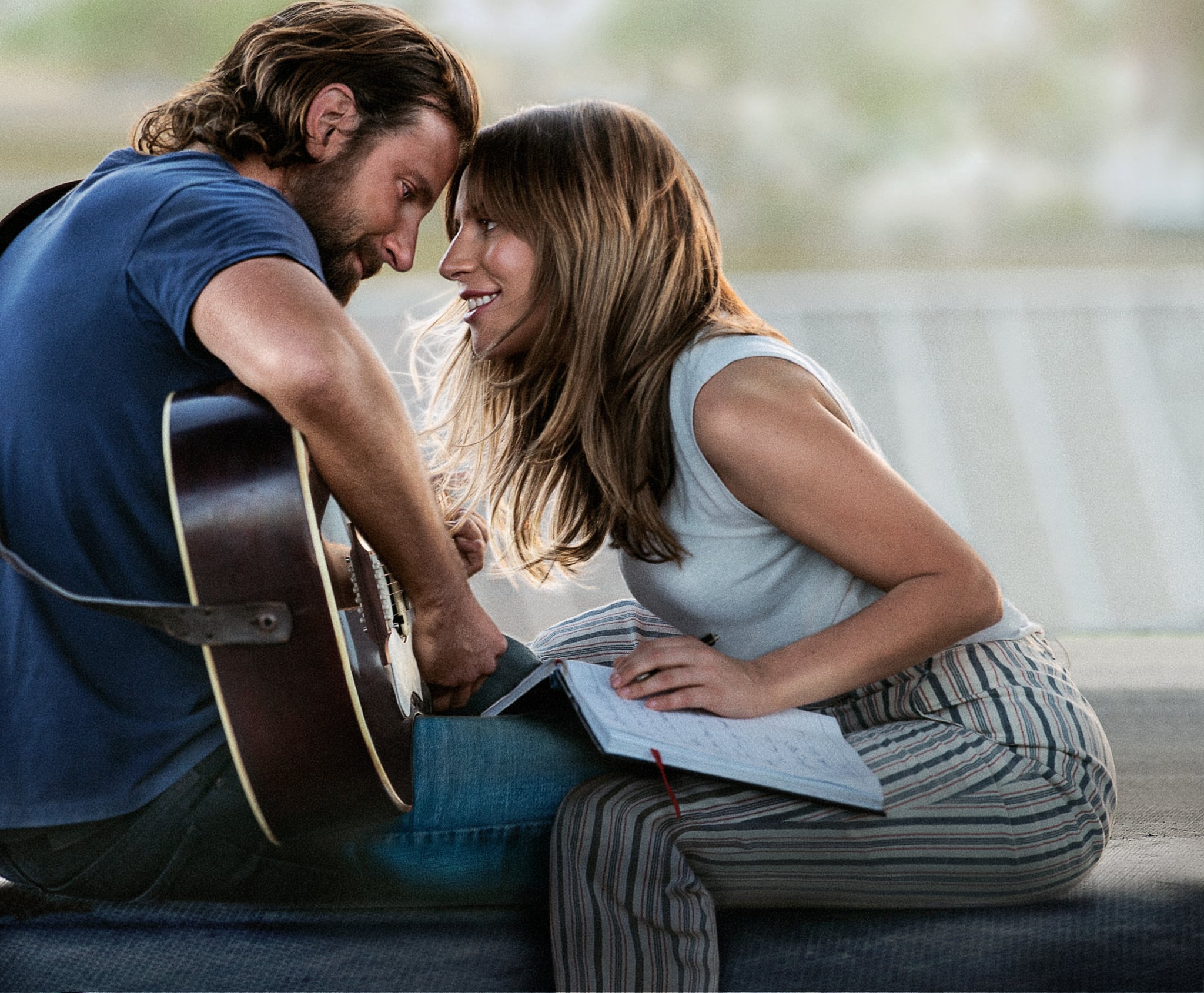
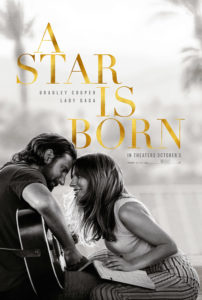
Copyright Warner Brothers 2018One of the biggest films of the year is the latest version of “A Star is Born,” written and directed by Bradley Cooper and co-starring Cooper and Lady Gaga. The story of the fading star with substance abuse problems who helps — and loves — a talented newcomer has been filmed under that title twice before, and once before that as “What Price Hollywood?” And it is inspired by the true story of two of the biggest names in show business in the 1920’s-30’s.
What Price Hollywood? George Cukor directed the version starring Constance Bennet as a Brown Derby waitress who meets director Lowell Sherman when she waits on him at the restaurant. While this is not explicitly the source of the following versions, and the waitress and director do not get married (because he is too noble), the essence of the story is all there, including (SPOILER ALERT) the suicide of the male character.
Dorothy Parker and her husband were two of the scriptwriters who worked on the glossy drama starring Frederic March and Janet Gaynor that has been the basis for three remakes (so far). She’s a waitress who catches the eye of a fading movie star. He gets her a screen test, the studio changes her name, he embarrasses her at an award ceremony, and when his drinking gets worse, she quits her job to care for him.
Broadway legend Moss Hart contributed to this musical update, again directed by George Cukor, starring Judy Garland and James Mason. It’s long and unwieldy (some excised scenes were partially added for re-release), but it has unforgettable moments like this one.
Barbra Streisand and Kris Kristofferson star in the 1976 version, which won an Oscar for Best Song. Reportedly, she tried to persuade Elvis Presley to take the role.
A Star is Born
Bradley Cooper says he was inspired to make the film by being backstage at a Metallica concert. He wrote, directed and stars opposite Lady Gaga. She may repeat her predecessor’s experience with a Best Song Oscar for this one.
Certainly there are many possible inspirations for the story, but most people think that one of the likeliest possibilities is the marriage of Al Jolson, one of the biggest stars in the country during the era of vaudeville and radio, and Ruby Keeler, who became a huge star in the early days of talkies.
Copyright 2018 Warner BrothersLady Gaga plays Ally, who becomes a star in what is the 4th or 5th version of this classic story, depending on whether you count “What Price Hollywood.” Lady Gaga herself becomes an instant movie star as already-star Bradley Cooper becomes an instant writing and directing and maybe even singing star in one of the year’s biggest releases.
Cooper said the moment that inspired the film was at a Metallica concert. “About seven years ago I was lucky enough to be backstage at a Metallica concert at Yankee Stadium. I had met Lars Ulrich, and I listened to Metallica when I was 14 years old. That’s why the character says, ‘Ride the lightning’ in Silver Linings Playbook. At the concert, I was behind the drum kit, and I could see the sweat on the back of Lars’ neck, and at the same time, I could see the scope of the audience in front of him. It was a beautiful proscenium, and that was the first moment where I thought, ‘Oh, I’ve never seen that on film, the subjective eye that could actually be epic and personal at the same time. And that was the beginning of the idea of how we were going to shoot all of the concert sequences that you just saw. It is all subjective. We never left the stage. But hopefully, you felt the scope of where they were.”
The concert scenes feel authentic because they are. Cooper filmed at real performance spaces, including the largest privately owned music festival in the world, Glastonbury, where they had just eight minutes to shoot before a performance by the star of the last version of A Star is Born, Kris Kristofferson.
Cooper said, “I had the luxury of having worked so often on camera and on stage, so I knew what I needed from a director as an actor in order to feel comfortable enough. As Al Pacino said, ‘We’re just trying to grab a few moments of authenticity.’ It’s important to create a space so that all the actors feel completely safe but also to know that it’s going to be hard. They’re going to have to go to places that scare them. They’re going to know that I’m right there with them. I’m not on the sidelines. It’s going to be okay to fail, but they have to risk. I have no desire for them to sit here and watch something that does not mean anything, that isn’t really personal to them and to me. Everybody wants to express the deepest part of themselves to another human being and feel safe about that. It’s very cathartic and healing.”
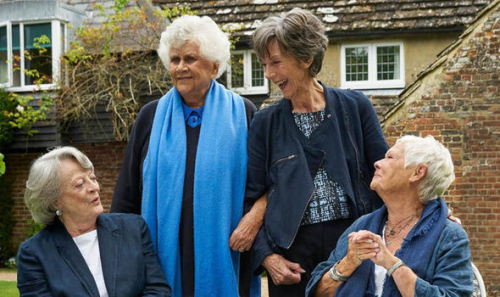
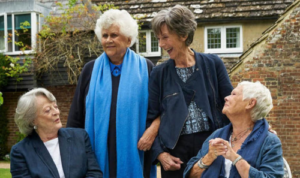
Copyright 2018 IFC FilmsFair warning. It was about ten seconds into this film when the first “Hello, darling” dissolved any critical distance I could muster, and by the time about five minutes later when we got to a “How ghastly,” as only Dame Maggie Smith can say it, I melted into a little puddle of pure happiness. So if seeing four of the greatest actresses in the world talk about their decades of experience and friendship is not for you, then ignore my gushing about how much I love them and how much I loved this film.
Dame Judi Dench, Dame Maggie Smith, Dame Joan Plowright, and Dame Eileen Atkins all came of age in the late 1950’s, beginning in theater and then movies and television. Director Roger Michell (“Notting Hill”) gives us a chance to eavesdrop on one of their get-togethers “to gossip, to remember, and to laugh.” They talk about acting, of course, but also about navigating show business and what they think of critics, and about husbands (everyone agrees that Dame Joan’s husband, Lord Oliver, was the most difficult), beauty, fear, competition, awards (we see each of them being Dame-d, by either Prince Charles or Queen Elizabeth II), Americans, Shakespeare, and aging, with the advice each of them would give their younger selves, though Dame Maggie (I would not dream of any other form of address, given the disdain they show for American clumsiness with titles) admits that her younger self would never have listened. And they do it all with such impeccable diction and classically trained technique in the exquisite timing of le mot plus juste.
In the early days, “you went to reps and you stayed in digs and things,” Dame Judi remembers. And if the landlady was unkind, “you nailed a kipper under the table.” Dame Joan Plowright talks about joining her first company, where another actor warned, “She can’t play queens, you know,” and the director replied, “I should think the last thing we want in a theater for contemporary writers is girls born to play queens.”
The Dames began acting as the “Kitchen Sink” era of postwar Britain was evolving into the swinging 60’s. There are some knowing looks and nostalgic smiles as they recall that era. There is a marvelous camaraderie and warm memories of working together that is unmarred by a continuing competition. Everyone remembers that Judi Dench was the first to be Dame-d. (When Dame Maggie got the word of her award, Dame Judi assured her that “It won’t change anything; you can still swear.) And the octogenarian Dame Maggie makes the kind of pointed comment that only the portrayer of the Dowager Duchess can master; her agent assures her that “We’ll look around for a nice little cameo that Judi does not have her paws on.”
Dame Eileen is less well known in the US, and I hope very much that this film and the marvelous archival clips will inspire American audiences to learn more about her. All of the Dames are exceptionally well represented with a remarkable range of clips, showing once again that one of the key differences between US and British actors is the British actors’ willingness to weigh in with equal enthusiasm to everything from classic dramas to avant garde to sitcoms. The glimpses of their work also provide a subtle but clear contrast between their delicious inability to take themselves seriously in real life and their obvious, visceral commitment to their performances, their characters, and the scripts and screenplays they bring to life.
None of them was willing to play Cleopatra (Shakespeare’s version), though all were asked repeatedly. Dame Judi challenged the director Peter Hall: “Do you really want a menopausal dwarf?” (But she did it.) Dame Maggie did it, but in Canada. But Cleopatra is a rare role that is the center of the play. Dame Joan describes “that rare exhilaration when you know you’re in charge.”
They talk about aging, and about fear, not of illness or death but, endearingly, enduringly, about the very thing they have devoted their lives to, acting. “Are first days still scary?” Michel asks, off camera. “All days,” Dame Maggie says immediately. But it is their relish for exactly that challenge that keeps them so vibrant. “Fear is petrol,” says Dame Judi. “It generates such an energy. If you can somehow handle it, it can be a help.”
As marvelous as they are playing other people, it is pure delight to see them as themselves.
Parents should know that the ladies use some frank and salty language and there are some sexual references.
Family discussion: What advice would you give to your younger self? Why didn’t they want to play Cleopatra?
If you like this, try: the films starring the Dames
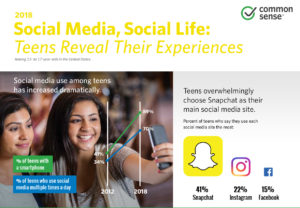
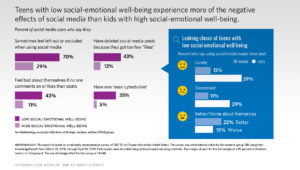
Common Sense Media has released a new study about teenagers and social media. The full report has suggested responses for parents to the findings to give teens support and guidance. Some of the highlights:
They can’t stop. They won’t stop. Seventy percent of teens use social media more than once a day (compared to 34 percent in 2012). Interestingly, most teens think technology companies manipulate users to spend more time on their devices. Many of them also think that social media distracts them and and their friends.
Managing devices is hit or miss. Many turn off, silence, or put away their phones at key times such as when going to sleep, having meals with people, visiting family, or doing homework. But many others do not: A significant number of teens say they “hardly ever” or “never” silence or put away their devices.
Snapchat and Instagram are where it’s at. In 2012 Facebook utterly dominated social networking use among teens. Today, only 15 percent say it’s their main site (when one 16-year-old girl was asked in a focus group who she communicates with on Facebook, she replied, “My grandparents”).
Less talking, more texting. In 2012, about half of all teens still said their favorite way to communicate with friends was in person; today less than a third say so. But more than half of all teens say that social media takes them away from personal relationships and distracts them from paying attention to the people they’re with.
Pick of the Litter Directors on Five Adorable Puppies Training to be Guide Dogs
Posted on September 12, 2018 at 9:31 am
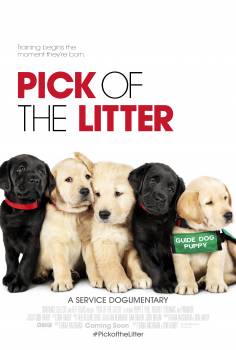
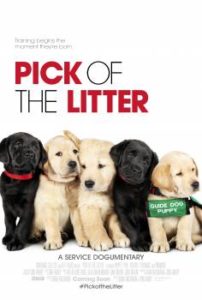
Pick of the Litter was one of the highlights of Washington DC’s AFIDocs documentary film festival. It follows five puppy siblings, all with names beginning with P, as they go through the extensive training and rigorous tests over two years to become guide dogs for the blind. Only a fraction of the dogs bred for the program have the temperament and skills for the job. We follow Patriot, Poppet, Primrose, Phil, and Potomac from birth to their ultimate place in a film that is exciting, funny, and always heartwarming.
Copyright IFC 2018
In an interview, directors Dana Nachman and Don Hardy, Jr. revealed their own favorites and described some of the behind the scenes choices and challenges.
Before we even meet the puppies, we get to hear from people whose lives have been saved by guide dogs. Why did you want to start with that?
DH: It’s really a life and death thing and what these dogs do is really extraordinary. So if you start there, then you can go back to the little bundles of fur and the people.
DN: It was very important to us to show what was at stake before we get to the cuteness of the puppies. It is essential to set that tone.
Your camera work was really impressive. At some points you had us at dog level. And for some essential conversations, you had us at both ends of the phone calls.
DH: It’s something we talked about from the very beginning, trying to tell it from that point of view of the dog. So we’re on the ground a lot. We’re trying to just stay in that world.
DN: Typically you see a lot of dog stuff just shooting down at the dog and we just didn’t want that. It really diminishes them if you’re coming from the upper angle whereas if you’re down low then you’re in their world and experiencing it like they do.
DH: We started with the big shoulder mount camera that is typical. It was fine when the dogs were small and didn’t move a lot but then once they got big they got faster. And they train the dogs really fast. There was no way to keep up. So we developed this little steadicam-like system, a small camera on a gimbal. And then I plug that into a monopod so then I could swing it down very low to get the dog’s eye level and then go up really high to to almost look like a drone.
And they’re inexpensive cameras so we ended up with a couple of them and so for a few key sequences Dana was shooting too. It just would all pair together well but it was a big undertaking to make this thing look like cohesive.
So much of the training of the dogs has to do with focusing their attention and not letting them get distracted. How did you get all the footage you needed without getting in their way?
DH: That was a big concern early on and we thought it would be maybe prevent Guide Dogs for the Blind from allowing us the access that we needed. We’re always going to be in the way. So that was another reason we had to develop this lightweight camera system to be able to not interrupt anything; there was no stopping to say, “Can you do that again?” We just had to keep up. But their response is interesting. They said that we’re just another distraction that these dogs have to deal with and it’s just part of life. We did a lot of the shooting ourselves so they just got to know us and I think we were just part of the training in a way.
DN: At one point one of the dogs was really tanking in some of his tasks like he wasn’t doing well and that particular dog liked Don a lot and so I think we even felt more nervous. We wanted to hang back because we didn’t want him to be out on our account. But they said, “If he can’t deal with Don being there then what’s he not going to be able to deal with if he’s with a visually impaired person?”
DH: It’s important in whatever story you’re telling to remember that the life the real events going on is more important than you.
How did you get started on this story?
DH: We worked together at the NBC station in San Francisco. We were both dog lovers and we did several pieces together on Guide Dogs for the Blind and so we always knew that they were just the tip of the iceberg. Pretty much coincidentally my mom was a newspaper reporter and she did a series in New York following a litter from birth until if they made it. We were like, “Oh well it’s great for a newspaper but so much better if it’s on camera.”
The dogs are wonderful, but the people are pretty wonderful, too, so dedicated and kind. I love their euphemism for the dogs who don’t make it all the way through the program: career changed.
DN: And some of the best parts in this film. They take it all very seriously. It’s almost a quasi Best in Show. It’s not even that you’re making fun of that. They own it. It is an earnestness that really resonates with me.
Did you each have a favorite? Were you sad for the dogs who were “career changed?”
DN: I’m #teampatriot.
Me, too!
DH: I’m #teamphil. They really say and it turns out to be true that the dogs choose. If you think of it that all of these dogs are doctors but only a few of them can be brain surgeons. They’re all like very incredible animals but only a few can do this job which is has life and death stakes.
DN: And I hope one of the things that people take away from the film too is that anybody who has a dog or has had a dog — it is a profound relationship. Even just for a regular person who has nothing wrong with them per se, it really is a life-changing relationship and we all know that.