Religion on ‘The Office’ — a Quiz

Posted on January 21, 2010 at 2:43 pm

How well do you know the characters on “The Office?” Try our Idol Chatter quiz about religion on the hit series about paper company Dunder Mifflin. Like most American workplaces, this one includes employees with an assortment of views about religion and the quiz is not just a lot of fun but a thoughtful reminder of how easy it is to be carelessly inconsiderate of others’ beliefs and how much we can draw from a broader understanding of faiths and traditions.

Related Tags:


Quiz Television

Kids and Media: Kaiser’s M2 Report

Posted on January 20, 2010 at 6:40 pm

The highly respected Kaiser Foundation has issued the third in its series of reports on children and media, Generation M2: Media in the Lives of 8-18-year-olds. They found that with technology allowing nearly 24-hour media access as children and teens go about their daily lives, the amount of time young people spend with entertainment media has risen dramatically, especially among minority youth.
Today, 8-18 year-olds devote an average of 7 hours and 38 minutes (7:38) to using entertainment media across a typical day (more than 53 hours a week). And because they spend so much of that time ‘media multitasking’ (using more than one medium at a time), they actually manage to pack a total of 10 hours and 45 minutes (10:45) worth of media content into those 7½ hours. The amount of time spent with media increased by an hour and seventeen minutes a day over the past five years, from 6:21 in 2004 to 7:38 today. And because of media multitasking, the total amount of media content consumed during that period has increased from 8:33 in 2004 to 10:45 today.
It will not come as a surprise to anyone that the increase in media use is driven in large part by ready access to mobile devices like cell phones and iPods. Over the past five years, there has been a huge increase in ownership among 8- to 18-year-olds: from 39% to 66% for cell phones, and from 18% to 76% for iPods and other MP3 players. During this period, cell phones and iPods have become true multi-media devices: in fact, young people now spend more time listening to music, playing games, and watching TV on their cell phones (a total of :49 daily) than they spend talking on them (:33). For the first time, however, actual TV use declined.
The study pointed out some racial differences. Black and Hispanic children consume nearly 4½ hours more media daily (13:00 of total media exposure for Hispanics, 12:59 for Blacks, and 8:36 for Whites). Some of the largest differences are in TV viewing: Black children spend nearly 6 hours and Hispanics just under 5½ hours, compared to roughly 3½ hours a day for White youth. And the racial disparity in media use has grown substantially over the past five years.
It is also not a surprise that the study found that the heaviest media use was associated with poor grades. But what I found particularly distressing was the failure of parents to exercise any oversight. According to the report, only about three in ten young people say they have rules about how much time they can spend watching TV (28%) or playing video games (30%), and 36% say the same about using the computer. But when parents do set limits, children spend less time with media: those with any media rules consume nearly 3 hours less media per day (2:52) than those with no rules.
Worst of all, about two-thirds (64%) of young people say the TV is usually on during meals, and just under half (45%) say the TV is left on “most of the time” in their home, even if no one is watching. Seven in ten (71%) have a TV in their bedroom, and half (50%) have a console video game player in their room. I strongly recommend that parents not allow televisions or other media except for music in bedrooms or at mealtime. Connections are nourished by silence and it is time to remind families that there is no connection via texting, ims, Facebook, phone, blogging, tweeting, or anything else requiring a charger that is as important as in-person, looking-at-each-other conversation. In law school, we learned about “demeanor evidence,” the things you can learn from watching and listening to the way someone says something. Teaching kids how to understand this is more important than all the LOLs and POSes ever typed.

Related Tags:


Commentary Elementary School Parenting Preschoolers Teenagers Tweens Understanding Media and Pop Culture

Veggie Tales: Silly Little Thing Called Love

Posted on January 20, 2010 at 7:39 am

The Veggie Tales gang give us three stories about love in this characteristically bright and tuneful treat, covering love for your family, love for your neighbors, and love of God. And of course it has time for the always-adorable silly songs, along with some thoughts from real kids about what love means.

I have one copy of this DVD to give away to the first person who sends me an email at moviemom@moviemom.com with the word Veggie in the subject line. Enjoy!

Related Tags:


Animation Early Readers Elementary School For the Whole Family Preschoolers Spiritual films
Tribute: Erich Segal

Tribute: Erich Segal

Posted on January 19, 2010 at 9:56 pm

Erich Segal, who died today at age 72, was a classics scholar who studied ancient literature. He also wrote a blockbuster movie script that became a blockbuster novel, Love Story. We know from the first sentence that its irrepressible heroine is going to die, leaving the narrator, her young husband, devastated. And her explanation to him that “Love means never having to say you’re sorry” became a cultural phenomenon. (Ryan O’Neal, to whom the line was delivered in the film, got to say it as a joke later on in “What’s Up, Doc?”) Segal also contributed to the deliciously witty script of “Yellow Submarine” and wrote several other novels, but he will always be best known for Love Story, corny, yes, but one of the all-time great tear-jerking romances.

Related Tags:


Tribute Writers
Interview: Dominic Cunningham-Reid and Taran Davies of ‘Journey to Mecca’

Interview: Dominic Cunningham-Reid and Taran Davies of ‘Journey to Mecca’

Posted on January 19, 2010 at 3:55 pm

In 1325 a 21-year-old man named Ibn Battuta set out from his native Tangier on pilgrimage to Mecca that would take him 18 months. And now the story of that journey has become an extraordinary IMAX film, stunningly beautiful, soul-stirring, and genuinely historic.
The Hajj, or obligation to visit Mecca, is one of the core requirements of Islam. Battuta found it to be so important that he would return five more times over the course of travels that would take him 75,000 miles over 29 years. He was the greatest explorer of the Old World, traveling three times further than Marco Polo before returning home to write down the story.
“Journey to Mecca” follows Battuta (played by Chems Eddine Zinoun) on his perilous journey in the context of a compelling picture of Islamic civilization during the 14th century. The story is book-ended by a close-up look at the contemporary Hajj, a pilgrimage to Mecca that draws three million Muslims from around the world every year who perform rituals that have taken place for over 1,400 years. JourneyToMeccaPoster01_250px.jpg
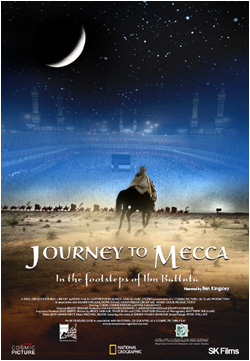
Dominic Cunningham-Reid and Taran Davies took time to speak to me on their recent visit to Washington about why the film was important to them and what was involved in getting it made.
It seemed to me that if you had made a list of every single obstacle to making a film, you not only covered them all, you added a few new ones. You had everything but a temperamental star — or maybe that was the camels.
TD: The camels might have been a little temperamental. It was really our personal Hajj in a sense. It just had to be done; I think that was the point. The IMAX challenges are enormous, particularly in this environment. There are millions of people there. Each roll of film lasts only three minutes and then you have to change your magazine. And each roll is incredibly expensive and you need several people to change the magazine. It is an incredibly daunting process in any environment but put that into one of the largest gatherings of people on earth and have them pull that off and it’s almost impossible.
The Hajj has been filmed before but only in low-quality video. It is so difficult to film logistically with the massive amount of people. And so we chose to really rise to that challenge and bring the greatest quality of production to this extraordinary cultural and spiritual event that deserves to be documented in such a fashion.
The images are stunning, exquisitely breathtaking. IMAX was really made for those vistas.
TD: There is some CGI in the film. We re-created Medina and Cairo in the 14th century. But the contemporary Mecca material with the Hajj, that is as it is. You see Mount Arafat on the Day of Standing, the holiest day of the Hajj from a helicopter we’re circling at dusk just a couple of hundred feet above the ground — totally unique, never been done before shot — with literally two million people in that frame. If you asked why would anyone do this, why would anyone make this film, that is the reason.
That is such a powerful image. Tell me about the historians. You worked with a wide variety of experts who did not always agree about some of the most sensitive issues.
TD: One of the crazy things we set out to do was really make the definitive film about the most sacred sanctuary of Islam and its rituals and we needed to get it right. We were working in a very sensitive environment where getting it wrong is not an option. We wanted to make sure that we brought on board as many experts on this subject as possible to make sure that we got it right. We had the leading experts on the Hajj, on Ibn Battuta, on Islamic architecture, on the architecture of Mecca, from all over the world, the United States, Morocco, Saudi Arabia, France, the UK, Kuwait, amongst other countries.
DC-R: The Grand Mosque of the year 1325, we had no visuals to go on. We had history books with verbal descriptions. We had to translate with all of the experts and research into a visual representations. One of the great moments we had is when we had actually sunk 18 pillars of the mosque and then the lead researcher calls up and says, “No, no, they weren’t square, they were round!”
Oh, no!
DC-R: So we had to pull them all out. And start again. Very, very challenging.
The biggest of challenges had to be your subject matter. It could not be more sensitive both from the perspective of believers and people who are ignorant of or hostile to Islam. How did you mediate differences between your experts?
TD: As I look back through time it is such a rosy picture of collaboration, I can’t really recall any disagreements! I think that would be too strong a word to describe what was a collaboration. We needed to receive as much information as we could on the subject of Islam and so we reached out to as many people as we could to provide it. We wanted to get things right from the way the ihram, the white cloth is worn. Do you have the shoulder uncovered or covered? Off-white? How off-white? What material is the cloth made of? Do the pilgrims in the 14th century wear sandals? When they perform the tawaf, what prayers do they say as they are circumambulating the ka’ba. If there were disagreements often among the Muslim community, they have different ways of doing things. It is a very daunting experience for them and many of them don’t know precisely how they are supposed to do it. It was as if we were doing the Hajj because we had to learn how do it right. We were approaching the ka’ba. We had to learn the proper way to perform the tawaf to be able to represent it.

(more…)

Related Tags:


Interview Spiritual films
THE MOVIE MOM® is a registered trademark of Nell Minow. Use of the mark without express consent from Nell Minow constitutes trademark infringement and unfair competition in violation of federal and state laws. All material © Nell Minow 1995-2026, all rights reserved, and no use or republication is permitted without explicit permission. This site hosts Nell Minow’s Movie Mom® archive, with material that originally appeared on Yahoo! Movies, Beliefnet, and other sources. Much of her new material can be found at Rogerebert.com, Huffington Post, and WheretoWatch. Her books include The Movie Mom’s Guide to Family Movies and 101 Must-See Movie Moments, and she can be heard each week on radio stations across the country.

Website Designed by Max LaZebnik