A Wrinkle in Time

A Wrinkle in Time

Posted on March 8, 2018 at 5:38 pm

B +
Lowest Recommended Age: 4th - 6th Grade
MPAA Rating: Rated PG for thematic elements and some peril
Profanity: None
Alcohol/ Drugs: None
Violence/ Scariness: Extended peril and some violence, some scary images
Diversity Issues: Diverse characters
Date Released to Theaters: March 9, 2018
Date Released to DVD: June 5, 2018
Copyright Disney 2018

Madeleine L’Engle’s A Wrinkle in Time is one of my all-time favorite books. I loved it when I was 11, read it aloud to our children, and went on to read all of the sequels and most of her other books as well. So it was with a lot of anticipation, excitement, and not a little trepidation that I looked forward to the film.

On the one had, the book had been dismissed over the decades as unfilmable due to its planet-hopping storyline, fantastical characters, and genre-straddling themes. On the other hand, I have the utmost respect for director Ava DuVernay (“Selma,” “13th”) and co-screenwriter Jennifer Lee (“Frozen,” “Zootopia”) and the all-star cast looked promising. I held my breath, crossed my fingers, and leaned forward and caught my breath as the iconic Disneyland castle in the opening logo suddenly…wrinkled.

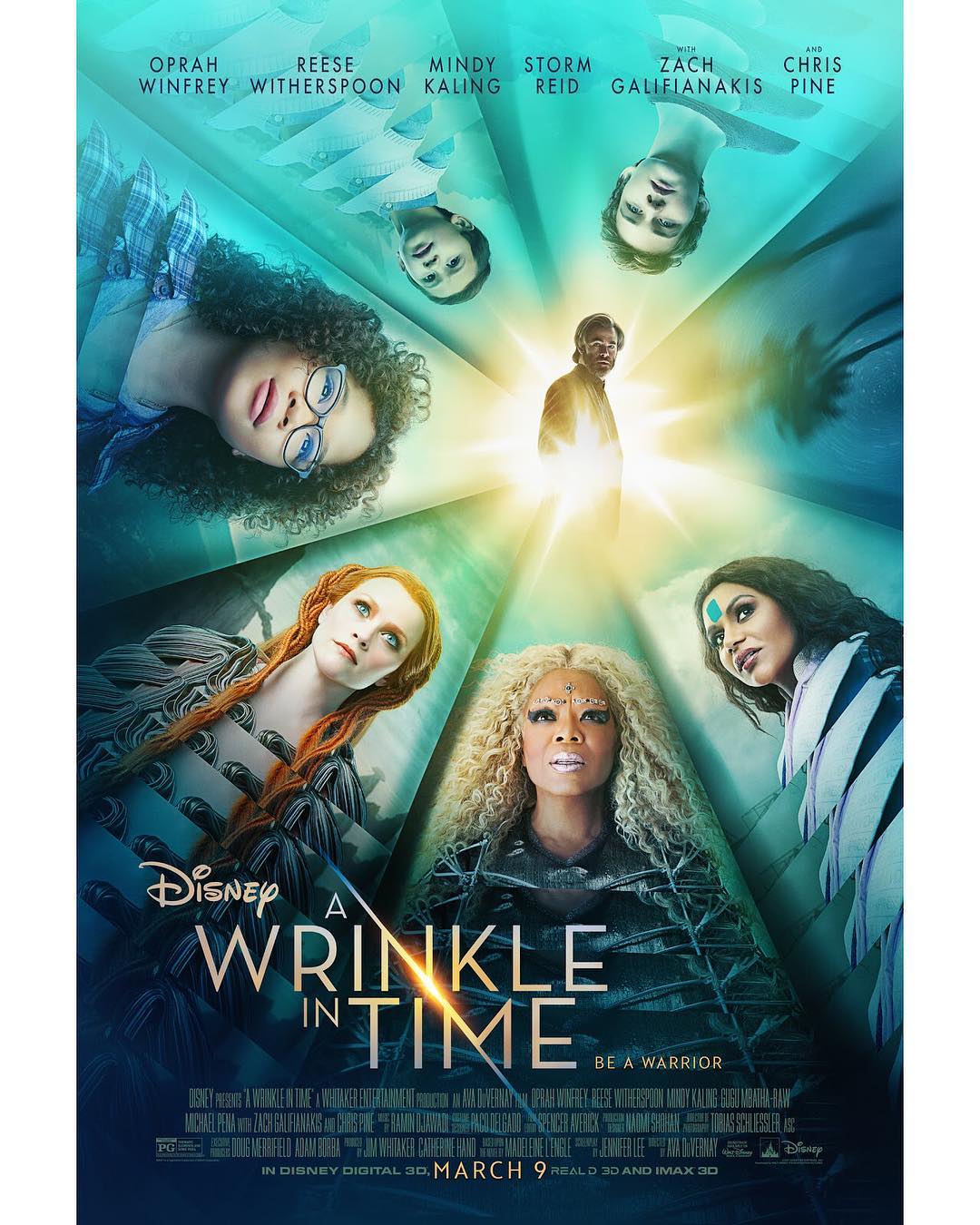
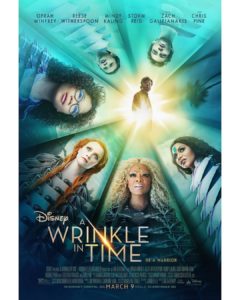
Most of what I love about the book was beautifully realized, and the movie is sure to be a middle school sleepover perennial and a family favorite for generations. It’s made straight from the heart of people who remember what it feels like to be 12 — and the way we all become 12 again in moments of uncertainty. If there’s a bit more Oprah-esque “you go girl” and “living your best life” than in the book, well, the movie features not just Oprah (who was also in “Selma”) but a house-sized Oprah with lips and eyebrows that look like someone went overboard on the Bedazzler.

Meg Murry (Storm Reid) is the daughter of two scientists (Gugu Mbatha-Raw and Chris Pine). She was once a gifted and attentive student, but since the disappearance of her father, four years before the movie begins, she has been sullen and uncooperative. Mean girls pick on her, and when she responds by throwing a ball at the ringleader, she gets in trouble. Nothing makes sense to her, and she wonders if her father left because she was not good enough.

Meg has an exceptionally precocious six-year-old brother named Charles Wallace (Deric McCabe). In the book, he is her bio-brother and they have two older brothers as well but in the movie it is just the two of them and Charles Wallace was adopted just before their father disappeared. Charles Wallace is one of the major challenges of adapting the book, because on the page he is endearingly hyper-aware and ultra hyper-articulate, but on screen it is difficult to make him believable and keep him from being annoying. It is one of the film’s most salient weaknesses that this critical character does not work.

Meg gradually learns that Charles Wallace has been befriended by three extraordinary and very strange women known as Mrs Whatsit (Reese Witherspoon), Mrs Who (Mindy Kaling), and Mrs Which (Oprah Winfrey). (NOTE: L’Engle insisted that there be no period after “Mrs” in the British style.) As disturbing as it is reassuring, they seem to know what the Murrys were working on, a form of “wrinkling” time and space to permit instantaneous travel to other planets that they call a tesseract. (For some reason, the explanation appears in the trailer, but not the film.)

Calvin O’Keefe (Levi Miller), is a well-liked, confident boy who seems to have nothing in common with the Murray children. But one day he impulsively visits them, and stays for dinner, appreciating the warmth and acceptance in their home. And then the three ladies explain why they are there. They have heard a call for help. It is the children’s father. And they are there to help Meg, Calvin, and Charles Wallace rescue him from “the darkness.”

And so, the rest of the film is candy-colored CGI, as the group visits first a paradisiacal planet for no particular reason other than a romp through a delightful garden of gossipy flying flowers who communicate via color and a soaring tour on a creature like a flying green manta ray with a rainbow Reese Witherspoon face. They visit a psychic called the Happy Medium (Zach Galifianakis) for more information about where Dr. Murry has gone, and finally they get to the planet where he is being held captive by an all-controlling force. The film brings to life one of the book’s most vivid scenes, with a pristine suburban street where every house has a child standing in the driveway bouncing a ball in perfect rhythm and all of the Stepford-style moms come out at the same moment to call them in to dinner. The book was written a a time of post-WWII concerns about conformity and “houses made of ticky-tacky that all look just the same.” But the image is just as compelling today. The 1950’s may have led to an explosion of “do your own thing” individuality in the mid-to late 1960’s and self-actualization in the me-decade 70’s, but the importance of intellectual courage, thinking for yourself, and challenging assumptions is even more important in the era of fake news and “both sides.”

The book’s most memorable message comes when Meg is told that what will help her to rescue her father is her faults. Though how those faults help is not as explicitly explained in the film, that idea retains its power here. That makes up for some faltering in the climax, some under-imagined images, and some distractions that seem to stem from a lack of trust in the audience. We don’t really need that extra back story on the mean girl or Calvin (an odd change from his home life in the books, which will be a problem if they decide to film the sequels) to understand what their insecurities are or the time spent cheering Meg on (and apologizing to her and deferring to her) without making it clear what her strengths are and how they are connected to her faults. It would be better to focus on the book’s rare combination of both faith and science and how important both are. In the book, the children visit the planets to learn about the darkness and to see that it can be overcome (Mrs Whatsit is the result of one such triumph). The movie leans more toward an Oprah-eque message of empowerment, so the focus is more on individual self-realization (and being appreciated by others, including Calvin, which seems to be his primary purpose in the story).

The three Mrses are not quite as fun as the movie thinks, though Mrs Who’s Bumblebee-like “post-language” use of quotations (always noting the nationality of the author, from Rumi and Shakespeare to Lin-Manuel Miranda and OutKast) is charming. But Reid is a heroine to root for, and the Murry family is one we are, like Calvin, glad to have a chance to visit.

Parents should know that this film includes extended sci-fi/fantasy peril with some violence and scary images, issues of an absent father, a school bully, and an abusive parent.

Family discussion: What are your most valuable faults? Why was Meg so important to IT?

If you like this, try: “The Neverending Story,” “The Wizard of Oz,” and the Narnia series

Related Tags:


Action/Adventure Awards Based on a book DVD/Blu-Ray Family Issues Fantasy movie review Movies -- Reviews Science-Fiction Stories About Kids
Annihilation

Annihilation

Posted on February 22, 2018 at 5:12 pm

B +
Lowest Recommended Age: Mature High Schooler
MPAA Rating: Rated R for violence, bloody images, language and some sexuality
Profanity: Some strong language
Alcohol/ Drugs: None
Violence/ Scariness: Extended peril and violence with many characters injured and killed, many grisly and disturbing images, animal attacks, guns, explosives, suicide
Diversity Issues: None
Date Released to Theaters: February 23, 2018
Date Released to DVD: May 28, 2018
Copyright Paramount 2018

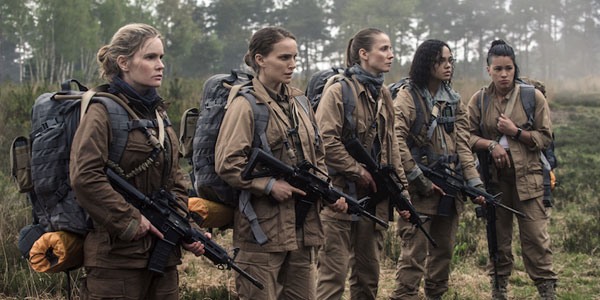
Annihilation” is based on the Nebula Award-winning first volume of Jeff VanderMeer’s Southern Reach Trilogy, adapted by director Alex Garland (“Ex Machina”). Natalie Portman plays Lena, a biologist and Army veteran, who joins a group of woman investigating an ominous anomaly the government is calling the shimmer. It looks like an rainbow prismed oil spill in the air. An area around a lighthouse is glowing and oscillating. Is it aliens? Is it God? Is it dangerous? Well, take a look at the title of the movie.

Whatever it is, it is expanding rapidly, posing a threat to pretty much everywhere. “The silence around it is louder than usual,” one observer notes. All missions, manned and unmanned, to investigate have produced no information and no human or drone sent inside has come back. Until one, an Army sergeant named Kane (Oscar Isaac), Lena’s husband. A year after he left, he shows up at their home, dazed and critically ill.

And so Lena joins the next group going inside, along with Dr. Ventress (Jennifer Jason Leigh), a psychologist leading the team, Anya (Gina Rodriguez), a paramedic, Sheppard (Tuva Novotny), an anthropologist, and Josie (Tessa Thompson), a shy physicist. The film is told in flashback, as Lena is being interrogated by a man in a hazmat suit, so we know that she will be the only one of the group to survive. We know what happened. We will see how.

The New Yorker calls VanderMeer “the King of Weird Fiction” and the Southern Reach trilogy “arresting, unsettling, and unforgettable” and “meditations on the theme of epistemic pessimism, in the tradition of Kafka.” I think what that means is that many science fiction and fantasy writers, even the most imaginative and compelling, base their stories on extrapolating what is already here, whether apocalyptic destruction of the planet due to environmental neglect or aliens who are a reflection of whatever geopolitical issues we are struggling with.

Generally, though, the fundamental rules, the ones we take for granted so much we are not even aware we are taking them for granted, apply, including the rules of dramatic fiction that go back thousands of years. Hubris invites catastrophe. Bad guys want to control everything. Courage and honor triumph. VanderMeer, let’s just say, goes another way. Instead of taking what we have and know and projecting it in a more extreme form, he takes what we have and know and bends reality — and our minds — to make us think about how much we do not know. Inter-species mutations are occuring, suggesting that the shimmer somehow dissolves what we think of as immutable barriers, the ones that define our sense of the world and our sense of ourselves. “It’s literally not possible,” a team member says. “It’s literally what’s happening,” another responds.

One of the first questions we hear at the beginning of the film, as Lena is being something between interrogated and debriefed, is “What did you eat?” Her group had rations for two weeks but survived for months. “I don’t remember eating,” she says. Later we will see the group, dazed, trying to remember what has happened and trying to figure out how much time has gone by based on how much food is gone. They do not know where they are or how long they have been there. Their communications technology does not work. Even the most basic technology, a compass directed only by the magnetism of the North Pole, does not work. They are literally disoriented. The women are there because of their expertise in science, but they cannot even manage some of the most fundamental cognitive tasks. They are not sure whether they cn trust each other. They are there to observe and report but they cannot trust their perceptions or analysis.

And we may not be able to trust our own. This movie puts its cards on the table with an opening that reveals the end. This will be an escape room/haunted house set in the wilds of the Florida swamp story with Lena as the “final girl,” the last woman standing. “It all goes back to the first cell,” we hear Lena tell her class of biology students. Cells do not die; they reproduce. Everything alive is a piece of the first cell. As the women on this mission have to decide whether they want to understand or fight the shimmer, another option presents itself.

Garland uses luscious, even seductive visuals in the verdant Florida swamp setting to beguile and horrify us, sometimes both at once. This is more than mind-bending; it is mind-expanding, something of an intellectual shimmer creating a cognitive distortion of its own.

Parents should know that this film includes extended peril and violence with many characters injured and killed and some very grisly and disturbing images, guns, grenade, fire, suicide, animal attacks, some strong language, and explicit sexual situations.

Family discussion: Why did Lena say she owed it to Kane to go on the mission? Why didn’t she tell the other women about her relationship to Kane? What would you do if you were in charge of containing the Shimmer? What is the relationship of this story to Lena’s lecture about cells?

If you like this, try: “Arrival,” “Invasion of the Body Snatchers,” “Solaris,” “2001: A Space Odyssey,” “Midnight Special,” and “Coherence”

Related Tags:


Action/Adventure Based on a book DVD/Blu-Ray movie review Science-Fiction Thriller
Samson

Samson

Posted on February 15, 2018 at 5:10 pm

B-
Lowest Recommended Age: Middle School
MPAA Rating: Rated PG-13 for violence and battle sequences
Profanity: None
Alcohol/ Drugs: Alcohol
Violence/ Scariness: Extended peril and violence, murder, torture, battle scenes
Diversity Issues: A theme of the movie
Date Released to Theaters: February 16, 2018

The Biblical story of the Jewish man who still stands as the exemplar of strength has been brought to the screen by Pure Flix, a sober, sincere retelling of the story that is intended for both religious and secular audiences. As Hollywood has recognized several times in the past, including a big-budget studio epic from Cecil B. De Mille, the story has all of the essentials for drama, a hero of extraordinary power who suffered loss and betrayal and ultimately sacrificed himself to defeat the Philistine leaders who were oppressing his people.

Copyright 2018 Pure Flix

Samson is played by Taylor James, a British actor who had a small part in the “Justice League” movie. In the beginning of the film he is confident and impetuous. He has pledged a life of piety, which means no drinking and never cutting his hair. In return, he has been gifted with great strength. He is not afraid to fight. But he does not consider that it may not be he who pays the consequences. King Balek (an icy Billy Zane) commands a powerful army and does not hesitate to murder the Jews who object, even in the mildest terms, to his brutal demands.

And then Samson falls in love with a Philistine woman. His parents (Lindsay Wagner as Zealphonis and Rutger Hauer as Manoah) know that a marriage would create great risk for the couple and for the Jewish community. But Samson is sure he can make it work. It is a tragic mistake.

The screenwriters made some good choices in expanding the story, creating parallels between the two fathers, Manoah and Balek, and their sons. Balek is as cruel and demanding with his son, Rallah (Jackson Rathbone, in one of the film’s strongest performances) as he is with the Jews. Rallah’s struggle to find his own way gives more texture to the story.

The ambitions of the filmmakers are admirable, but a bit beyond their capacity and it has an amateurish quality that makes this more like the movies you see in Sunday school than the movies you see in theaters. Pure Flix is not Cecil B. De Mille, and director Bruce MacDonald’s staging of the big fight scenes and the literally crashing climax lacks intensity. But it is a respectful and heartfelt portrayal of a story whose power is undimmed over the millennia.

Note: Other movie versions of this story include 2013’s Samson, 1984’s Samson and Delilah, Cecil B. De Mille’s 1948 Samson and Delilah with Victor Mature, and the animated Keep the Trust: The Story of Samson and Delilah

Parents should know that this film includes extended violence including murder and battle scenes with many characters injured and killed.

Family discussion: How does Samson change over the course of the film? Why does he change? Why does Delilah cut his hair?

If you like this, try: “The Ten Commandments” and “The Nativity Story”

Related Tags:


Action/Adventure Based on a book DVD/Blu-Ray Epic/Historical movie review Movies -- format Movies -- Reviews Reviews Spiritual films
Fifty Shades Freed

Fifty Shades Freed

Posted on February 8, 2018 at 6:36 pm

C
Lowest Recommended Age: Mature High Schooler
MPAA Rating: Rated R for strong sexual content, nudity, and language
Profanity: Some strong language
Alcohol/ Drugs: Alcohol
Violence/ Scariness: Peril and violence including kidnapping, punching, knife, gun, chase
Diversity Issues: None
Date Released to Theaters: February 9, 2018
Date Released to DVD: May 7, 2018

Copyright 2017 Universal
“The worse sin passion can commit is to be joyless,” wrote Dorothy Sayers. And Fifty Shades Freed is Exhibit A. It’s more of an endless perfume commercial than a story, with beautiful people smooching (and more) in a series of increasingly luxurious settings and modes of transportation. Viewers may more likely to find their breath taken away by the Birkin bag Ana carries than the licking-ice-cream-off-Christian’s-chest scene, the “You own this?” about the fancy private airplane response, “We own this” more than “meet me in the Red Room of pain.”

These are people who are supposed to be exceptionally successful at their jobs who are somehow not especially committed to them or particularly good at them. Anna is a college drop-out now elevated to editor at the publishing company that happens to be owned by her new husband, but entirely on her merits, but the job itself is one of those cutesy Hallmark Christmas movie-type careers where all she has to do is congratulate her hunky author on his success and ask him gently about the next book and tell an assistant to increase the font size on a cover. More important, these are people who share a deep kink connection who are pretty, to use their term, vanilla. Anything at all interesting about the issue of the power dynamics between Ana and Christian is so soft-focus that it barely registers.

It seems Ms. James ran out of ideas about a book and a half ago. All they’ve got left is sex in this and that ultra-luxurious location (more shelter porn than porn porn here) interspersed with some very random thriller moments as a figure from the past wants to destroy the perfect prettiness of the romance. This gives us an opportunity for a chase scene on a mountain road that turns out to be, like so much in the film, foreplay, plus some not at all tense would-be thriller moments and one pretty funny joke.* The tedium is occasionally lessened by some pop song montages. The music is not that great, but it is better than the dialogue. And then, the final whack of the cinematic riding crop, the utterly unnecessary remix montage featuring highlights of the films that we were hoping to have forgotten.

*New variation of the Gothika rule: I will give away the joke to anyone who sends me an email at moviemom@moviemom.com to save you the time and money of seeing the film.

Parents should know that this film includes extensive and explicit sexual references and situations with some BDSM activity, nudity, some strong language, alcohol, and peril and violence including kidnapping, a gun, knives, and punching.

Family discussion: Why did Ana object to Christian’s behavior in the red room on one occasion? What made each of them jealous?

If you like this, try: “9 1/2 Weeks”

Related Tags:


Based on a book Date movie DVD/Blu-Ray movie review Movies -- Reviews Romance Scene After the Credits Scene After the Credits Series/Sequel
Peter Rabbit

Peter Rabbit

Posted on February 8, 2018 at 11:11 am

C
Lowest Recommended Age: Kindergarten - 3rd Grade
MPAA Rating: Rated PG for some rude humor and action
Profanity: Some schoolyard language
Alcohol/ Drugs: None
Violence/ Scariness: Comic peril and violence, explosions, electrocutions, references to sad parental deaths and killing animals, human character collapses and dies
Diversity Issues: None
Date Released to Theaters: February 9, 2018
Date Released to DVD: April 30, 2018

Copyright 2017 Sony
We’re only six weeks in, and we’ve already had two live action/animation adaptations of beloved British classics of children’s literature, both starring members of the Gleeson family. One will go down in history as an example of how to do it right and the other, if it must remembered at all, will be the example of how to do it wrong. For the record, Paddington 2, starring Brendan Gleeson, captured the gentle charm of the stories because it trusted its source material and it trusted its audience. But “Peter Rabbit,” based on the books and paintings by Beatrix Potter, tries to make the classic story of a bunny who ignores his mother’s warning and almost gets caught by the farmer when he steals into the garden into a hyped-up, wink-at-the-crowd mess of slapstick, meta-narrative, and story of love and redemption. By trying to be contemporary, it loses the very qualities that have made it beloved in generations of nurseries.

As in the original book, before the story begins Peter’s father was captured by Mr. McGregor (Sam Neill) and eaten in a pie. Unlike the book, Peter’s mother is gone, too, and he is responsible for his sisters, Flopsy, Mopsy, and Cottontail and his cousin, Benjamin Bunny. Peter (voice of James Corden) is reckless and over-confident, leading Benjamin into the garden, which McGregor has covered with scary-looking steel traps. “There are other ways to get a meal,” he’s warned. “But not as fun!” Peter says, happy to risk not just his own life, but the others’ as well.

Peter deftly avoids the traps, but almost ends up in a pie himself, escaping by slipping out of his denim jacket, which McGregor uses on a (tiny) scarecrow. Aiding his rescue is McGregor’s neighbor, Bea (as in Beatrix Potter), a sweet-spirited artist who lives next door and is a friend to all of the local animals.

When Peter goes back to retrieve his jacket, McGregor catches him. It is almost too late for him to save himself when suddenly McGregor, like Don Corleone in “The Godfather,” has a sudden heart attack in the garden, collapses and dies. Though Peter takes credit for vanquishing his foe, the narrator (Margot Robbie) assures us that his death is attributable to “78 years of bad lifestyle choices,” with a merry little montage of McGregor inhaling asbestos and eating high-fat food. Really?

This, of course, is not in the book, is completely unnecessary to the storyline, and is likely to raise concerns in some of the young viewers, especially after Peter brags that he made it happen.

The property is inherited by another Mr. McGregor (Domhnall Gleeson), a persnickety control-freak of a great-nephew who barely knew he had a great-uncle with a farm and never met him. Thomas McGregor works for the famous Harrods department store, where he has a complete meltdown after being denied a promotion due to nepotism. If all of this seems superficial and unnecessary, that is because it is.

His arrival at the farm brings mayhem as he battles Peter and the rest of the local critters for the vegetable garden and the house, trying not to let his pretty neighbor know that he is not as much of an animal-lover as she is.

The movie opens with soaring birds singing an uplifting ballad — and then getting smushed, which becomes a repeated gag. So from the beginning, this film undercuts itself, winking at the audience and then trying to take it back. A joke about today’s parents’ oversensitivity to allergies is followed by “just kidding; don’t write letters!” “Don’t explain the joke,” Benjamin Bunny says. But that’s just what the movie does, constantly unsure of its focus and tone. Some sweet moments and lovely animation cannot make up for a film that is, to use a food metaphor, overstuffed and yet undernourished.

Parents should know that this movie includes some comic peril and violence, but a human character collapses and dies and there are references to the sad loss of Peter Rabbit’s parents, including his father’s being made into a pie, brief potty humor, some body shaming, and schoolyard language.

Family discussion: What did the characters learn about apologizing? Should farmers let animals eat their crops? What is your character flaw?

If you like this, try: “Babe,” “Paddington” and “Paddington 2,” and “Miss Potter,” with as Renee Zellweger as Beatrix Potter and Ewan McGregor as her publisher

Related Tags:


Based on a book Comedy DVD/Blu-Ray movie review Romance Scene After the Credits
THE MOVIE MOM® is a registered trademark of Nell Minow. Use of the mark without express consent from Nell Minow constitutes trademark infringement and unfair competition in violation of federal and state laws. All material © Nell Minow 1995-2025, all rights reserved, and no use or republication is permitted without explicit permission. This site hosts Nell Minow’s Movie Mom® archive, with material that originally appeared on Yahoo! Movies, Beliefnet, and other sources. Much of her new material can be found at Rogerebert.com, Huffington Post, and WheretoWatch. Her books include The Movie Mom’s Guide to Family Movies and 101 Must-See Movie Moments, and she can be heard each week on radio stations across the country.

Website Designed by Max LaZebnik