The Clapper

The Clapper

Posted on January 18, 2018 at 4:06 pm

B-
Lowest Recommended Age: High School
MPAA Rating: Rated R for language and some sexual references
Profanity: Strong language
Alcohol/ Drugs: Mild
Violence/ Scariness: Tense confrontations, reference to sad death
Diversity Issues: None
Date Released to Theaters: January 26, 2018
Copyright 2017 Momentum Pictures

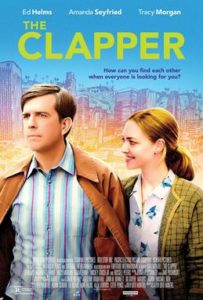
“The Clapper” is an unpretentious little indie from writer/director Dito Montiel, adapting his own novel. It has actors who are familiar from studio movies and television playing quirky characters with a bit of social satire some family dysfunction, and a love story. The screenplay is uneven, but the exceptionally strong cast makes it watchable.

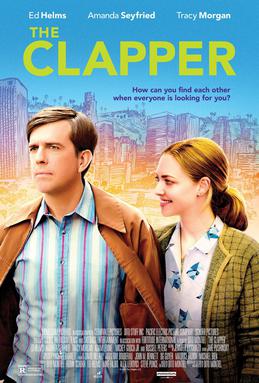
Ed Helms is a gifted actor/comedian who can play something other than a repressed, depressed but very nice guy (see, for example, “Jeff, Who Lives at Home,” and “We’re the Millers”), but that seems to be where he is most comfortable. Like the neglected gem “Cedar Rapids,” which he produced, as he did here, Helms plays a man who has shut down many of his emotions following a loss. He has what might be termed a micro-job. He and his best friend, Chris (Tracy Morgan) are “clappers.” They sit in the audience in infomercials and appear to be amazed and wildly enthusiastic about whatever is being pitched. Occasionally, they will get a line like, “There’s more?” for a couple of extra bucks. He has a hat and a fake moustache to try to look different for each show.

But a late-night host (Russell Peters) figures out that it is the same guy in all of the ads, and turns it into a bit, crowdsourcing a “Where’s the clapper?” search for the elusive audience member. It goes viral. In the world of this film, there is something existentially compelling about the sad sack who has nothing better to do than pretend to be in ecstasy over a bunch of cheesy junk and get rich quick schemes.

You might think that with a main character named Eddie Krumble, the movie is going to be harsher and more sharply satiric than it is. But there is a sweetness to it that is undeniably captivating. The talk show host and his producers (Adam Levine and the very funny P.J. Byrne) are out for ratings and not especially sensitive, but they are also not cartoonish villains, and they are not without heart. Eddie is horrified at the attention and knows it means he will lose his job, but he agrees to go on the show so he can find Judy (Amanda Seyfried), the shy, animal-loving gas station attendant he loves from afar. He does not think through the consequences of his appeal, because of course he turns on her the same kind of misery he has been subjected to as a result of the spotlight.

The script is uneven, with some awkward shifts in tone, as when Eddie’s mother appears as a caricature out of step with the rest of the film. But the movie’s biggest failure is in the character of Judy. Seyfried gives one of her best performances, but cannot save the character from the lack of agency or even personality that is the fault of the script. She is pretty much just there to for Eddie to respond to.

NOTE: I have a connection to this film. My daughter, Rachel Apatoff, was the assistant costume designer. So I make no pretense of objectivity in stating that the costumes were all superb and one of the highlights of the movie.


Related Tags:


Based on a book DVD/Blu-Ray movie review Movies -- format Movies -- Reviews Romance
Jumanji: Welcome to the Jungle

Jumanji: Welcome to the Jungle

Posted on December 21, 2017 at 5:38 pm

B +
Lowest Recommended Age: Middle School
MPAA Rating: Rated PG-13 for adventure action, suggestive content and some language
Profanity: Some schoolyard language, b-word
Alcohol/ Drugs: Alcohol, drunkenness
Violence/ Scariness: Extended action/fantasy-style peril and violence, characters injured, snakes, guns, fights, some disturbing images
Diversity Issues: Diverse characters
Date Released to Theaters: December 22, 2017

Copyright Columbia 2017
There has never been a more charming movie action hero than Dwayne “The Rock” Johnson, whose easy confidence is highlighted in a scene from the trailer for “Furious 7,” when his character gets out of a hospital bed, flexes his muscle to shatter the cast that covers his entire arm, and says meaningfully, “Daddy’s got to go to work.” The only thing more fun is seeing him subvert his own movie star magic, as he did with Kevin Hart in “Central Intelligence,” and as he does with Hart again in “Jumanji: Welcome to the Jungle,” where he plays the video game avatar of a shy, highly allergic high school nerd named Spencer (Alex Wolff). On the outside, he is Dr. Smolder Bravestone, a cross between Indiana Jones, Lara Croft, and, well, The Rock. On the inside, he is still Spencer. But this game goes way past virtual or augmented reality. Spencer and three other kids from his school are stuck in the game, and have to finish it before using up the three life bars each has been given.

Jumanji, the story of a jungle board game that becomes all too real, began as a 1981 book by author/illustrator Chris Van Allsburg, and then a 1995 movie with Robin Williams as a grown-up who has been trapped in the game since he was a boy. This movie pays tribute to the original in the opening scene, set in 1996, when the board game is found at the beach, buried in the sand. A boy in a Metallica t-shirt named Alex (Nick Jonas) has no interest. He likes video games. But somehow the beautifully carved board turns into a cartridge, he pops it in, and disappears.

And then we meet Spencer and three other students sent with him to detention: Fridge, a football star who has Spencer doing his homework, which gets them both in trouble; Bethany, a popular girl who only cares about her social media likes and takes a phone call in the middle of a quiz; and Martha, an anxious girl who puts herself under a lot of pressure to get good grades and mouths off to the gym teacher. Ordered to clean up the school basement as punishment, they find the game console and then disappear into the avatars they have selected: Dr. Bravestone, “weapons valet” Moose Finbar (Hart), scholar Dr. Shelly Oberon, and martial arts specialist Ruby Roundhouse (“Guardians of the Galaxy” series Nebula, Karen Gillan). They can’t get back home until they complete the game.

Director Jake Kasden balances the action, comedy, and heart and the four leads, especially Johnson and Black, have a lot of fun with the disconnect between what they look like and who they are inside. Bravestone quavers to an adversary, “I should warn you, I think I am a very strong puncher” before landing a roundhouse. And Bethany/Oberon can barely decide which is more upsetting, being in the body of an overweight middle-aged man (she needs some guidance on going to the bathroom) or not having her phone. There’s a nice twist when Bethany-as-Oberon tries to reach Martha-as-Ruby how to flirt so she can distract the bad guys, and Martha/Ruby learns that she has what she needs. Despite the best efforts of the jewel-thief villain (Bobby Cannavale) the strengths of the avatars and some unexplored strengths of the teenagers themselves help them get through the levels to finish the game. The original film was a success because of its concept, innovative special effects, and the always dazzling Williams, but this one has a smarter plot, better characters, more heart, and by the time we get to Game Over, we just might be ready to reboot and start it over again.

NOTE: The DVD/Blu-Ray release has some really terrific extras including behind-the-scenes features about the special effects and characters and a funny gag reel. Well worth a look!

Parents should know that this movie includes extended fantasy/comic peril and violence with characters injured and (temporarily) killed and some disturbing images and jump-out-at-you surprises, some crude humor about body parts and functions, some teen (adult avatar) drinking and drunkenness, kisses, and some schoolyard language (b-word). One girl (in a male body) teaches another girl how to flirt to distract the bad guys, but it is shown to be useless and she ends up using martial arts skills instead.

Family discussion: Which avatar would you pick? What strengths and weaknesses would you list for yourself? How did each of the characters use their game-assigned and real-life talents?

If you like this, try: the book and earlier movie and “Help! I Shrunk the Kids!”

Related Tags:


3D Action/Adventure Based on a book DVD/Blu-Ray Fantasy movie review Stories about Teens
Ferdinand

Ferdinand

Posted on December 14, 2017 at 9:22 pm

B-
Lowest Recommended Age: Kindergarten - 3rd Grade
MPAA Rating: Rated PG for rude humor, action and some thematic elements
Profanity: Some schoolyard language
Alcohol/ Drugs: None
Violence/ Scariness: Cartoon-style peril and violence including slaughterhouse and bullfights.
Diversity Issues: A theme of the movie
Date Released to Theaters: December 15, 2017
Date Released to DVD: March 12, 2018
Copyright BlueSky 2017

I warn you — a “however” is coming, maybe more than one.

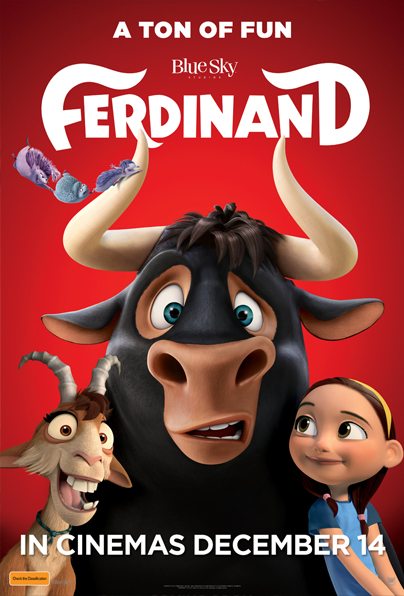
There’s a lot to like in “Ferdinand,” an affectionate version of the book by Munro Leaf about Ferdinand, the bull who did not want to fight; he just wanted to smell the flowers. WWE star John Cena provides a warm, inviting voice for the title character, and Kate McKinnon steals the show as his “calming goat.” The artwork is imaginative and colorful. However, the slight story of the book has been expanded to fill out a feature, and some of the choices are worse than just padding; they are misguided, distracting, even disturbing, especially for the youngest viewers.

Leaf’s original story and the lovely Oscar-winning 1938 Disney animated short are beautifully simple. While most bulls are ferocious and proud to fight matadors, Ferdinand is a gentle soul who just wants to sit under a cork tree and smell the flowers. The men who are looking for the fiercest bull of all arrive just as Ferdinand reacts to being stung by a bee. Mistakenly believing that he is a powerfully furious animal, they bring him to the bullring, where he refuses to fight.

The Disney film is eight minutes long and tells the entire story. This version, from Blue Sky, gives us a meandering tale about Ferdinand, bred in a facility that supplies bulls for bullfighters. As a young calf, he is bullied by the others, especially the alpha bull, Valiente, who suffers from what me might term bovine toxic masculinity.

Ferdinand adores his kind-hearted father (Jeremy Sisto), asking him, “Can I be a champ without fighting?” “I wish the world worked that way for you,” his father says before he leaves for the ring. He never returns home.

Ferdinand runs away and finds a perfect home, a flower farm.  He is adopted by Nina, who is so devoted to him that she has him cuddle on the sofa next to her and sleep in her bed, even after he grows to the size of an SUV.

After an adventure that includes a cleverly-constructed scene in yes, a china shop, Ferdinand ends up back at the ranch, where Lupe (McKinnon), his calming goat, declares that she will be his coach for outsmarting the matador.   Ferdinand learns that the only options for the bulls are the ring or the slaughterhouse. He must rescue two of the bulls who taunted him before they are turned into hamburger, and then find a way to survive the bullring.

McKinnon has the same lighting-fast fluidity of mood and character that made Robin Williams an ideal choice to provide the voice for the genie in “Aladdin.”  She is in constant conversation with her many selves, and it is hilarious.  However.  The palpable padding of the storyline would not be a serious problem except for the misjudgment about the presentation of the fatal options available to the bulls.  It is impossible, even for a child, to watch the rescue from the slaughterhouse without recognizing what all of those scary-awful machines are designed to do.  Parents who do not want to answer some tough questions about dinner — or reconcile themselves to a vegetarian menu — should stick with the Disney version.

Parents should know that this movie has peril and violence, including low-key depictions of a slaughterhouse and a bullfight, as well as some schoolyard language and potty humor.

Family discussion: Why were the other bulls mean to Ferdinand? Why were the horses mean? Why did Ferdinand want to rescue bulls who were mean to him?

If you like this, try: the book and the Disney animated version of this story and the “How to Train Your Dragon” series

Related Tags:


Animation Based on a book DVD/Blu-Ray movie review Remake
Darkest Hour

Darkest Hour

Posted on December 7, 2017 at 5:48 pm

A-
Lowest Recommended Age: High School
MPAA Rating: Rated PG-13 for some thematic material
Profanity: Some strong language
Alcohol/ Drugs: Drinking, smoking
Violence/ Scariness: Wartime violence
Diversity Issues: None
Date Released to Theaters: December 8, 2017
Date Released to DVD: February 26, 2018
Copyright 2017 Focus

A bitter debate is going on in Parliament. The Prime Minister, Neville Chamberlain (Ronald Pickup) has responded to Hitler’s invasion of other countries with appeasement and many of the politicians are with him. A combination of denial and sun-never-sets-on-the-British-Empire smugness of those who have colonized a quarter of the planet and are situated on the other side of the Channel makes them confident that they can work with Hitler. But it is increasingly clear to at least some of the politicians believe it is time to take a stronger stand. Is there someone they can call on to lead them in that direction?

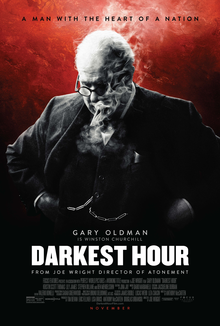
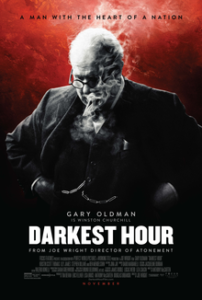
There is, and he is still in bed, “insuring his fingerprints are not on the murder weapon.” He is Winston Churchill (Gary Oldman, disappearing into the character and giving a dazzling performance worthy of the real-life man he portrays). The very inevitability of Churchill’s selection, no one’s first choice, a man who “has a knack for drawing out the very worst in those who are trying to help him,” according to his devoted but perceptive wife Clementine (Kristin Scott Thomas), increases the frustration of the elected officials around him, who continue to plot to undermine his determination to to go to war, if necessary, to fight Hitler’s takeover of Europe. “I’m getting the job only because the ship is sinking,” he says glumly but grimly. “It’s not a compliment. It’s revenge.”

Earlier this year, Christopher Nolan’s “Dunkirk” gave us a bracing look at the turning point that ends this film, when certain catastrophic defeat was turned into a victory just by escaping, rescued with the help of a citizens’ armada of boats. That film paid tribute to the ordinary men who retreated to come back stronger. This film gives us another side of the story in a more traditional “great man” portrayal of history and it could not have a better subject. Churchill was a master of language, grandiloquent at a time when people needed to be inspired by a leader of vision, a deep knowledge of history, and shining integrity. The benefit of having a central character in Churchill is that he pretty much spoke in movie dialogue, hyper-articulate, wryly witty, and with an underlying patriotism rooted in compassion, not jingoism.

Churchill knows that it is not enough for him to be right about Hitler. He has to get the support of the other politicians and he has to get the support of the population. He knows what he will be asking them to do will involve unimaginable sacrifice. And there is no time. “We are looking at the collapse of Western Europe in the next few days,” says a general. “Should the public be told?” There is no time. And, as yet, there is no plan for a counter-attack and Franklin Roosevelt, Churchill’s good friend in the United States, tells him that Congress has prevented him from being of help.

Churchill also knows what it is to fail, publicly and miserably. Will he make mistakes again? Clementine assures him that he is wise because he has doubts. Even if Hitler wins, Churchill knows it is better to give him as much of a fight as possible. “Countries that go down fighting come back.”

The compressed time period and the urgent conversations with Clementine, member of Parliament, and the king (superbly played by Ben Mendelsohn) are riveting, bolstered by an urgent score by
Dario Marianelli and masterfully sinuous camerawork by Bruno Delbonnel and editing by Valerio Bonelli. The camera maneuvers through Churchill’s legendary wartime cabinet rooms (a must-visit for London tourists), showing us the cramped quarters and the fierce energy of what is going on.

Oldman disappears into the role, a performance like the famous Karsh portrait come to life. His Churchill is crafty, sometimes impatient, sometimes uncertain, but compassionate, and always sure of what his values are. The Churchills had a famously devoted love match, and Kristin Scott Thomas is impeccable in showing us Clementine’s elegance, and resolve.

“He mobilized the English language and sent it into battle,” a character says. And with this film, director Joe Wright mobilized the language of film and presents us with an uplifting reminder of what the right person at the right time can do even under the direst circumstances.

Parents should know that this is a wartime story with tense peril and reference to violence and loss, some strong language, and smoking and drinking.

Family discussion: What should be factors in deciding when to intervene and when to negotiate? Why did the king change his mind? Read My Early Life, Churchill’s autobiography of his youth. Which self will you be today?

If you like this, try: “The King’s Speech,” “Dunkirk,” and some of the other movies about this towering figure of the 20th century, including the “First Churchills” miniseries about his ancestors.

Related Tags:


Based on a book Based on a true story Biography Drama DVD/Blu-Ray movie review Movies -- Reviews Politics War
The Disaster Artist

The Disaster Artist

Posted on November 30, 2017 at 5:13 pm

B +
Lowest Recommended Age: Mature High Schooler
MPAA Rating: Not rated
Profanity: Very strong language
Alcohol/ Drugs: Alcohol
Violence/ Scariness: Fictional depiction of suicide and violence, some scuffles
Diversity Issues: None
Date Released to Theaters: December 1, 2017

Copyright A24 2017Let’s face it. Failure is more fascinating than success. There are innumerable movies based on true stories about real people who overcame seemingly insurmountable obstacles with determination, vision, and talent to accomplish extraordinary achievements in sports, the arts, and shaping public policy. Movies like “Schindler’s List” and “The Big Short” help us to understand huge, complicated tragic failures through the prism of small victories. But there are also movies like “Florence Foster Jenkins,” with Meryl Streep as the legendarily awful singer and “Ed Wood,” with Johnny Depp as the legendarily awful movie director, that explore with some affection the stories of terrible failures, and they do it with vastly more skill than the people they depict could have imagined.

In fact, that is part of what led to the failures in the first place — Florence Foster Jenkins and Ed Wood were exemplars of the Dunning-Kruger effect, which shows that the less competent people are, the more likely they are to be unable to evaluate their own competence. It isn’t the terrible end product that enthralls us as much as the buoyant optimism and imperishable self-regard that keeps these people going while the rest of us are consumed with doubt and insecurity.

The Room,” from writer-director-star Tommy Wiseau, has been called “the ‘Citizen Kane’ of bad movies.” It is in that rare category of films that transcend “so bad it’s good” and “suitable for Mystery Science Theater commentary” into genuine hit, with well-attended midnight showings filled with fans who come to see it again and again. Like the midnight “Rocky Horror Show” screenings, fans come in costume and with props. An arty picture of a spoon in a frame that appears in many shots provokes a flurry of plastic spoons thrown at the screen. The crowd yells “focus” whenever someone should have reminded the cinematographer that the camera needed to produce a sharper image. And some people get happily tipsy taking a drink whenever any of the movie’s characters say “Hi.”

The film is based on a book co-written by Greg Sestero, who co-starred in “The Room.” For multi-degreed master of literary analysis James Franco, who directed and stars in the film, “Disaster Artist” is not an oxymoron. In his mind, Tommy Wiseau is an artist because he has a singular vision so urgent that he will realize it, no matter the cost, in the most literal terms. Wiseau is said to have spent six million dollars in making “The Room,” much of it as poorly decided as every other choice that went into making the film.

“The Room” tells the story (I use the term loosely, as the script is a mishmash of many unexplained developments and characters, with a plot even more out of focus than the camera) of Johnny (played by Wiseau, and Franco as Wiseau in this version), a successful banker who has a fiancee named Lisa (portrayed by Ari Graynor), a best friend named Mark (played by Dave Franco as Greg Sestero), and a teenage protegee of some kind named Danny (played by Josh Hutcherson). Lisa is bored with Johnny and begins an affair with Mark, though her mother pushes her to stay with Johnny because he is rich and treats her well. The film has extended soft-core-style sex scenes, a weird, inexplicable confrontation between Danny and a drug dealer, and another odd scene with guys in tuxedos tossing a football.

“The Disaster Artist” begins with Greg and Tommy meeting in acting class in Northern California, becoming friends in part because of their shared love for James Dean (coincidentally once played by Franco himself in a breakthrough performance) and dreams of being stars. They move to LA together, with Greg staying in Tommy’s apartment. Tommy is quite mysterious about his background (he has a strange eastern European accent), his age, and his source of income. He is supportive of Greg but also possessive. The decision to cast his own brother as Greg is Franco’s exploration of a mirrored duality in their relationship and there is more than a hint of some boundary issues that may reflect homoerotic feelings.

Frustrated by his lack of success in Hollywood and jealous that Greg is getting some work, Tommy decides to write and produce his own movie. And so we see how many bad decisions go into creating the “Citizen Kane” of terrible cinema. But we also see a very rare example of a film, usually the ultimate artistic reflection of teamwork, that is a genuinely singular vision. As muddled and incoherent as it is, it is exactly the movie he had in his head and exactly the movie he wanted to make. Franco clearly respects that, as Tim Burton did with “Ed Wood” (with Vincent D’Onofrio’s Orson Welles as his stand-in showing one director saluting another). The audiences in the midnight shows are there to jeer and feel superior. Franco, in his performance and direction, is sympathetic, giving Wiseau and his story the film he was not able to give himself.

NOTE: Be sure to stay through the credits for some uncanny side-by-side re-creations of scenes from “The Room” with the cast of this film.

Parents should know that this film includes nudity, sexual references and situations, depiction of suicide and violence, alcohol, and very strong language.

Family discussion: What does it mean that something is “so bad it’s good?” What does this movie tell us about the decisions that go into making a work of art?

If you like this, try: “The Room,” of course, and the book by Sestero, and the bonkers “Beaver Trilogy” documentary

Related Tags:


Based on a book Based on a true story Behind the Scenes DVD/Blu-Ray movie review Movies -- format Movies -- Reviews Scene After the Credits Understanding Media and Pop Culture
THE MOVIE MOM® is a registered trademark of Nell Minow. Use of the mark without express consent from Nell Minow constitutes trademark infringement and unfair competition in violation of federal and state laws. All material © Nell Minow 1995-2026, all rights reserved, and no use or republication is permitted without explicit permission. This site hosts Nell Minow’s Movie Mom® archive, with material that originally appeared on Yahoo! Movies, Beliefnet, and other sources. Much of her new material can be found at Rogerebert.com, Huffington Post, and WheretoWatch. Her books include The Movie Mom’s Guide to Family Movies and 101 Must-See Movie Moments, and she can be heard each week on radio stations across the country.

Website Designed by Max LaZebnik