
Where the Wild Things Are

Posted on March 1, 2010 at 8:00 am

A-
Lowest Recommended Age: 4th - 6th Grades
MPAA Rating: Rated PG for mild thematic elements, some adventure action and brief language
Profanity: Brief mild language
Alcohol/ Drugs: Adults drink wine
Violence/ Scariness: Fantasy peril and violence, references to being eaten, bones of victims, hurt feelings and family stress
Diversity Issues: None
Date Released to Theaters: October 16, 2009
Date Released to DVD: March 2, 2010
Amazon.com ASIN: B001HN699A

Maurice Sendak’s spare, poetic, and deeply wise book has been lovingly unfolded into a movie about the child who lives in all of us, brave and fearful, generous and needy, angry and peaceful, confident and insecure, adventuresome and very glad to come home. The movie may challenge children who are used to bright, shiny colors and having everything explained to them but if they allow it, Max and his story will bloom inside them as it will for anyone open to its profound pleasures.

The book’s opening line is as well-remembered as “Call me Ishmael” or “It was a dark and stormy night.” “The night Max wore his wolf suit and made mischief of one kind and another his mother called him ‘WILD THING.'” Those who wondered what prompted Max’s mischief will accompany him as he experiences the jubilation of creating his own cozy space, a snowball-stocked igloo, and as he joyously takes on his sister’s friends in a snowball fight, only to be inconsolably crushed when they carelessly smash his icy lair and then leave without him.

There has never been a more evocative portrayal on film of the purity, the intensity, the transcendence of childhood emotions. The hallmark of maturity is the way we temper our feelings; it is not a compliment when we call someone “childish” for not being able to do so. Our experiences — and our parents — teach us that life is complex, that sorrow and joy are always mixed, and that we can find the patience to respond to frustration without breaking anything. But one reason that we mis-remember childhood as idyllic is the longing for the ferocity of childhood pleasures. Jonze and his Max (Max Records) bring us straight into the immediacy and open-heartedness of a child’s emotions.

We know we are in a child’s world even before the movie begins, with scrawled-on opening credits and then a breathtaking, child’s eye opening bursting with sensation, all the feelings rushing together. The film brilliantly evokes the feeling of childhood with the same freshness and intimacy director Spike Jonze showed in the influential videos he made when he was barely out of his teens. Max’s mother is beautifully played by Catherine Keener who makes clear to us, if not to Max, her devotion and sensitivity in the midst of concerns about work and a budding romance. His incoherent fury at her being distracted, including a kiss from a date who seems to think he has the right to tell Max how to behave almost hurtles him from the house, into the night, where he runs and runs, and then to a boat, where he sails and sails, until he comes to the land of the Wild Things.

They begin to attack him, but Max tames them with his bravado and imagination and he becomes the king, promising to do away with loneliness and make everyone happy. The book’s brief story blooms here as Max interacts with the Wild Things (voices of James Gandolfini, Lauren Ambrose, Catherine O’Hara, Paul Dano, Forest Whitaker, and Chris Cooper). Each of them represents or reflects Max’s emotions or experiences. They love sleeping in a big pile and are thrilled with Max’s plans for a fort. But Max learns how difficult it is to be responsible for the happiness of others, and before long, like other children in stories who have traveled to lands filled with magic and wonder, he longs for home.

The movie’s look is steeped in the natural world, with forests and beaches, and intricate Waldorf-school-style constructions that evoke a sense of wonder. The screenplay by Dave Eggers and Jonze locates the heart of Sendak’s story. They have not turned it into a movie; they have made their own movie as a tribute to Sendak, to childhood, to parenthood, to the Wild Things we all are at times, and to the home that waits for us when those times are over.

Related Tags:


Action/Adventure Based on a book DVD/Blu-Ray Pick of the Week Family Issues Fantasy For the Whole Family Talking animals
Cirque Du Freak: The Vampire’s Assistant

Cirque Du Freak: The Vampire’s Assistant

Posted on February 23, 2010 at 6:00 pm

Vampires are everywhere these days. There are the Romeo and Juliet-style stories of Twilight and the steamier True Blood as well as the love triangle of the CW’s Vampire Diaries. And now there is “Cirque Du Freak,” based on the best-selling series of YA novels by Darren Shan, who shares his name with the title character.

I think it is because in this open-minded and permissive era it is hard to find a reason to keep an ordinary romantic couple apart. In the old days, parental disapproval, not having enough money, or societies’ strictures could fuel an entire movie until the happily-ever after ending. But these days it is difficult to create narrative tension to keep a couple separate for 10 minutes, much less two hours. That may be great for society, but it is tough on story-tellers. And so in order to get transgressive, a bit of cross-species romance seasoned with the risk of death and the prospect of an unleashed id can make a story very captivating.

Teenager Darren Shan (Chris Massoglia) feels that his life is just fine. He gets good grades. Kids at school like him. His parents are proud of him. He has a life-long best friend named Steve (Josh Hutcherson of “Bridge to Terabithia”), who is restless and unhappy.

Darren does not want to admit that he also has his restless moments and is not always comfortable being what Steve calls “perfect boy.” Darren wants to make sure we understand that he is no longer close to a former friend who has become “a freak,” meaning that he does not dress like an ad for a soft drink. He is not sure that he will be satisfied with what his parents tell him is “the path to a happy, productive life: College! Job! Family! And one day, if you’re lucky, you’ll be yelling at a teenager of your own.”

And there’s Darren’s lifelong fascination with spiders, not studying them, more communing with them. Steve is obsessed with vampires and dreams of becoming one himself. They pick up a mysterious flier about a freak show and sneak out to see it. When Darren steals a poisonous spider and it bites Steve, Darren agrees to give up his life as a human to become the vampire’s assistant in exchange for the antidote.

It makes some changes to the story in the book series but it is true to the tone — a nice combination of teenage angst and outrageous grotesquery, with the implicit recognition that sometimes it can be hard to tell the difference. Massoglia and Hutcherson come across as bland at times, but then they are sharing the screen with a snake-boy and a lady who not only has a beard but is the mesmerizing Salma Hayek. The story can be exposition-heavy as it lays the foundation for the next episodes in the series by starting up a war between two vampire factions. But it benefits from small details around the edges that attest to the fully-realized world of the novels. It balances the scary moments with humor. And it has good guy and bad guy vampires, a rock music-loving snake boy (Patrick Fugit, one of the film’s highlights), a woman whose limbs regenerate, a super-tall guy who kind of looks like Edgar Allen Poe, and a world of freaks that knows how to make the Cirque feel like home.

Related Tags:


Based on a book Fantasy Horror
The Time Traveler’s Wife

The Time Traveler’s Wife

Posted on February 9, 2010 at 8:00 am

Books and movies are two very different modes of expression. Books tend to be more subjective and internal, focusing on what the author or characters think and feel. Movies are usually better at showing what happens. Even a hugely popular book about a deeply passionate romance like The Time Traveler’s Wife made with diligence and respect and starring beautiful people who are good actors, does not always produce a movie that lives up to the vision of the author and the readers.
Henry (Eric Bana) has become an involuntary time traveler following a traumatic accident that killed his mother when he was a child. He has no control over when or where he goes, but a force he describes as being like gravity pulls him back over and over to places and interactions that are most meaningful to him. When a beautiful young woman named Clare (Rachel McAdams) asks him for help at the Newberry Library, he can tell from her expression that she knows his future self and he knows her past self, but at the moment he has no clue who she is, much less that they are in love with one another. The special challenges (disappearing and re-appearing) are painful, often life-threatening, and even the benefits (it can be very helpful to know what is going to happen) can be stressful. But like all great love affairs, the connection between Henry and Clare transcends time.
Like the book, the movie gets weaker as it becomes more convoluted and far-fetched in the last third of the story. Unlike the book, it does not have the evocative and graceful prose written by Audrey Niffenegger. The novel is very internal, and no matter how able Bana and McAdams are, the script gives them little to do to convey the book’s power other than gaze lovingly at each other. The movie eliminates many secondary characters and much of the conversation and interaction that makes us care whether Henry and Clare figure out a way to literally stay together. They seem to have no personality, no substance beyond those longing glances. By far the most interesting character in the movie does not even arrive until the last 20 minutes. As the storyline gets more preposterous (and, in the screening I attended, provoked some unintended laughter), a new character arrives to give the film more weight and honesty than anything that has gone before, making us wish we could go back in time to start the film with that story instead.

(more…)

Related Tags:


Based on a book Date movie Drama Fantasy Romance
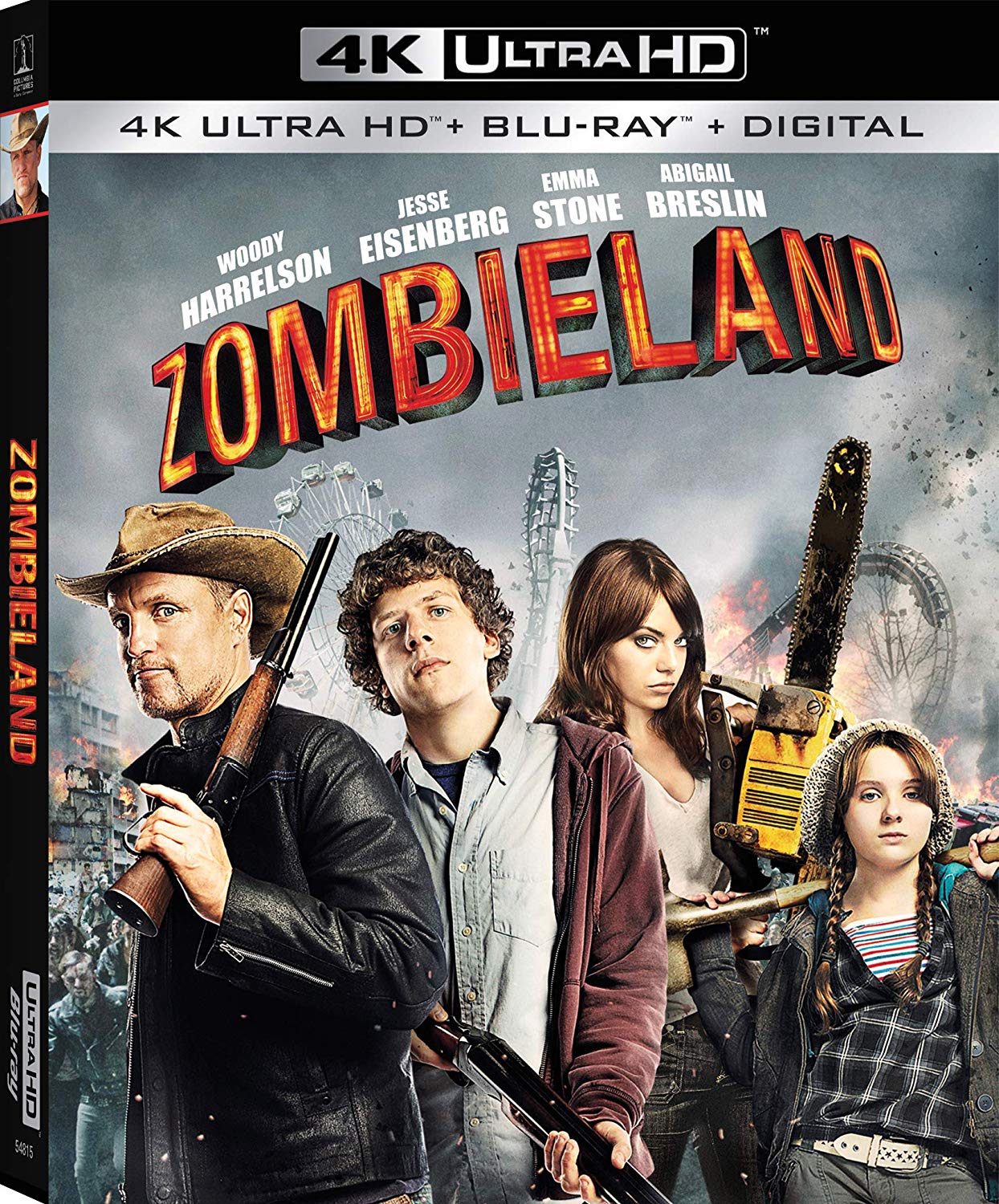
Zombieland

Zombieland

Posted on February 2, 2010 at 8:00 am

B +
Lowest Recommended Age: Mature High Schooler
MPAA Rating: Rated R for horror violence/gore and language
Profanity: Constant very bad language, some crude
Alcohol/ Drugs: Drinking
Violence/ Scariness: Constant peril and violence, characters injured, killed, and eaten, zombies and other graphic and grisly images
Diversity Issues: None
Date Released to Theaters: October 2, 2009
Date Released to DVD: February 2, 2010

What is it about zombies?

Dating back to 1932’s “White Zombie,” the stories of the relentless, omnivorous undead and the humans who try to escape them have been one of film’s most popular genres, with sub-genres including the flourishing category of zombie comedies, best described as gallows humor, gasps of horror alternating with gasps of laughter. Zombie films turn out to provide many opportunities for some core elements of humor, especially the juxtaposition of dire circumstances with trivial detail and the deconstruction of our assumptions about what we need and the norms of lifestyle and behavior. As its title suggests, “Zombieland‘s” take is darkly comic, with zombie encounters as theme park or video game. It even ends up in a real theme park, the few remaining humans battling the hordes from rides and concession stands.

Copyright 2019 SPHE

One thing about zombies is that they thin out the herd. In this story, only four non-zombie humans seem to be left, which gives them an opportunity to try to band together with people with whom they would otherwise have nothing in common and show each other and themselves that they are capable of more in both physical courage and relationships than they ever thought possible.

The mixed bag, all known only by the names of cities, includes shy college student (Jesse Eisenberg) who tries to maintain some sense of control by compulsively making lists of rules for survival. He meets up with a modern-day cowboy (Woody Harrelson) in search of his favorite Hostess treat and a pair of sisters (Emma Stone and Abigail Breslin) who have their own methods for taking care of themselves. And even though they have not much idea where they are going or why they should go there, they hit the road.

Funny zombie movies can be just as scary as straight zombie movies, but they leaven the terror with humor that comes as the characters try to find some element of normalcy in between double-tapping zombies (one of the rules), grabbing whatever they want among the abandoned cars and grocery stores. It also includes checking out the home of a major movie star who shows up for an hilariously deadpan cameo before one last zombie attack in the actual amusement park — that juxtaposition element again.

The actors, including the movie star, are all superb. Eisenberg and Stone are two of the most talented young performers in movies and they hit just the right notes here. The usual getting-to-know-and-trust-you road trip developments play out in a manner that is both endearing and funny, as when Eisenberg asks Breslin if her sister has a boyfriend as though there are any other possible candidates for dating who would have a very different idea of having her for dinner. It goes on a little too long and does not match the inspired lunacy of “Shaun of the Dead,” but it will keep zombie-philic audiences as happy as finding the very last Twinkie.

Parents should know that this film has extreme and graphic violence involving zombies, guns, characters in peril, injured, killed, and eaten, drinking, smoking, and very strong language including crude sexual references.

Family discussion: Why didn’t the characters use their real names? What do you think of Columbus’ list of rules? What makes zombie movies so popular?

If you like this, try: “Dawn of the Dead,” “Shaun of the Dead,” “I am Legend,” and “28 Days Later”

Related Tags:


DVD/Blu-Ray Fantasy Horror movie review Movies -- format

The Invention of Lying

Posted on January 19, 2010 at 8:00 am

Ricky Gervais has come up with a fresh and enticing premise but — I have to be honest — it is imperfectly executed. It has the gloss of a romantic comedy because it gives us the fun of knowing that the couple will end up together long before they figure it out for themselves. But it also takes on some very big issues and has some surprising insights.

Gervais has imagined a world that looks exactly like ours, except that the people can only tell the concrete, literal truth. That means that they always say exactly what is on their minds, most of which is, to be brutally frank, brutally frank. This is not a crowd you want to ask whether these pants make you look fat.

And so when Mark (Gervais, who also co-wrote and co-directed) goes out on a date with a woman he has had a crush on named Anna (Jennifer Garner), she tells him up front that he is not in her league. He is repeatedly told that he is fat, dull, and unappealing. And then he is fired from his job as a screenwriter. But since fiction is a form of lying, all of this world’s movies are merely footage of people sitting in chairs reading aloud text about historical events. Mark, assigned to the 13th century, is fired because the only thing he can write “movies” about is the black plague.

About to be evicted because he cannot pay the rent, Mark goes to the bank to close out his account and the movie’s title event occurs. He informs the teller that he has more money than the bank’s computers show. And since no lie has ever occurred in this world, the teller believes him. Mark is thrilled with this new power, especially when he discovers he can ease his mother’s passing at what our world would politely call a nursing home but in no-lie world is identified with a sign that reads “A Sad Place for Hopeless Old People.” She is upset because she does not know what happens after death, so he tells her that she will be in a place where everything is loving and plentiful and she will be reunited with everyone she has loved. She dies in peace and the doctor and nurses who overheard want to know more. And soon Mark’s new ability to imagine gets him his job back and everyone wants to hear all about heaven and the “Man in the Sky.”

Gervais is not as imaginative as a director as he is as a writer but we get to see what a subtle and even moving actor he has become. The flatness of delivery of the no-lie world is a challenge for the cast, including comedian Louis C.K., Jason Bateman, Rob Lowe (looking unnecessarily seedy), Tina Fey, the inescapable Jonah Hill, and John Hodgman, and the talented Nathan Corddry and Christopher Guest are on screen too briefly to make much of an impression. Jennifer Garner is a great pleasure, as always, giving us a chance to see the wistful longing for something she cannot define because it is beyond her ability to conceive.

Amid the jokes (just imagine what soda ads look like in a world without exaggeration and implication) there are some provocative and meaningful insights. Lies are impossible without abstraction and the ability to imagine. And so is fiction. And so is faith. And even love. Without the ability to conceive abstraction, marriage is only about genetic superiority. There is no kindness, no compassion, no real understanding.

Some audience members will be uncomfortable at the suggestion that God is portrayed as a lie but this underestimates the film. While Gervais is an acknowledged atheist, the movie does not have to be seen that way. The emptiness of the lives of the people in a world devoid of anything but the literal truth and the way they are enthralled with the concepts of faith and meaning argue just the opposite. Just because someone lies about something does not change the underlying reality. Watch Gervais’ face as Mark uses his new ability to depart from concrete truth to provide encouragement and inspiration, and enjoy a comedy that may be about the invention of lying but knows how to tell the truth.

Related Tags:


Comedy Fantasy Romance
THE MOVIE MOM® is a registered trademark of Nell Minow. Use of the mark without express consent from Nell Minow constitutes trademark infringement and unfair competition in violation of federal and state laws. All material © Nell Minow 1995-2026, all rights reserved, and no use or republication is permitted without explicit permission. This site hosts Nell Minow’s Movie Mom® archive, with material that originally appeared on Yahoo! Movies, Beliefnet, and other sources. Much of her new material can be found at Rogerebert.com, Huffington Post, and WheretoWatch. Her books include The Movie Mom’s Guide to Family Movies and 101 Must-See Movie Moments, and she can be heard each week on radio stations across the country.

Website Designed by Max LaZebnik