Get Ready for “First Man” With These Moon Shot Movies
Posted on October 5, 2018 at 1:09 pm
Copyright 2018 Amblin Entertainment
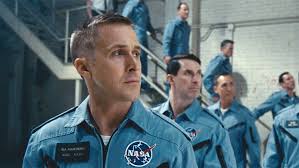
“La La Land” director Damien Chazelle and star Ryan Gosling have teamed up again for “First Man,” the story of Neil Amstrong and the 1969 Apollo 11 voyage to the moon. Get ready for space travel with these outstanding fact-based films — they are not only true stories; they are some of my very favorites:
Hidden Figures One group of braniacs figured out how to build the rocket, another figured out how to create the fuel necessary to make the almost half a million mile round trip. And a whole other group had to figure out how to hit the target, so that fully fueled rocket ship would not bypass the moon and go hurtling off into the universe. The remarkable story of the math people, including brilliant black women, is told in this warm-hearted and inspiring film.
The Dish Another story of the unsung heroes of the space race is this utterly charming film about the Australian crew who ran the satellite dish that allowed the footage of the moon landing to be shown around the world.
The Right Stuff Tom Wolfe’s ground-breaking book about the earliest days of the space program, including the selection of the first group of astronauts is the source for this film, written and directed by Philip Kaufman and starring Scott Glenn, Ed Harris, Barbara Hershey, Dennis Quaid, Pamela Reed, and Sam Shepard.
Apollo 13 Tom Hanks, Bill Paxton, Kevin Bacon, and Ed Harris star in the gripping story of a flight to the moon that went terribly wrong. “Failure is not an option,” said Flight Director Gene Kranz. Even though we know they came home safely, the film will keep you on the edge of your seat.
In the Shadow of the Moon This British documentary about the history of the Apollo program with archival footage and interviews with people who made it happen.
From the Earth to the Moon This brilliant miniseries from “Apollo 13” star and space geek Tom Hanks looks at the space program from many different angles, including the press, the government contractors, and the wives of the astronauts. The last episode is a poignant parallel story that includes the making of Georges Melies’ classic of the same name.
Rated PG-13 for mature thematic elements, some violent content, drug material and language
Profanity:
Some strong language
Alcohol/ Drugs:
Teen drinking, drug and drug dealing references
Violence/ Scariness:
Intense peril and violence, teenager killed by a police officer
Diversity Issues:
A theme of the movie
Date Released to Theaters:
October 5, 2018
Date Released to DVD:
January 21, 2019
Copyright 2018 20th Century Fox
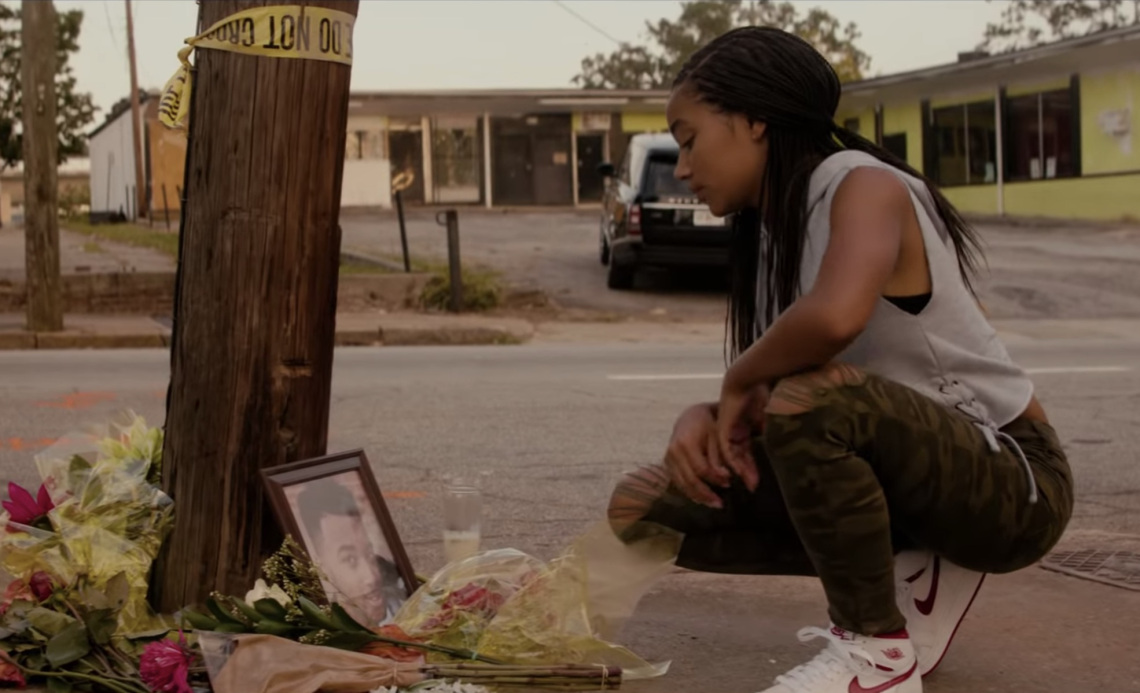
“The Hate U Give” is one of the best and most important films of the year. Angie Thomas’ best-selling novel about a girl named Starr has become a profound and profoundly moving film. It is an of-this-moment, vitally urgent story about race, culture, and America in 2018, but it is also a deeply human, deeply moving exploration of the most universal themes: family, identity, growing up, forgiveness, and finding your voice.
The incandescent young actor/activist Amandla Stenberg (Rue in “The Hunger Games”) plays Starr, the middle child and only daughter in a loving family. She is completely at home in their neighborhood of Garden Heights. But you can get “jumped, high, pregnant, or killed” at the local high school, and so she and her older brother attend a private school called Williamson, where most of the students are white and wealthy. She calls the version of herself they see “Starr version 2.” When the white kids sing along to hip hop or use black slang, she smiles politely but knows that if she does the same thing she will appear too “ghetto.” But she has a nice (white) boyfriend named Chris (K.J. Apa), and some nice white girl friends she can complain to when Chris tried to push her into having sex.
At a party in Garden Heights, she feels more at home, but some of the people there are suspicious of her for possibly “acting white.” She runs into an old friend, Khalil (Algee Smith) and he offers to drive her home. As children, they played Harry Potter together with a third friend, but they have fallen out of touch. Starr can tell from his very expensive, mint-condition shoes that he may be in trouble. Khalil has begun to deal drugs because it is the only way he can support his ailing grandmother.
They are stopped by a white policeman who thinks that Khalil is reaching for a weapon and shoots him. Starr sees it all. Starr is devastated. And she begins to see herself and her world differently. The Williamson students walk out of school to protest in support of Black Lives Matter — or to get out of school. Starr’s friend stops following her on Instagram because Starr connects the killing of her friend to tragic injustices like the murder of Emmett Till.
As we see in the opening scene, Starr has been told since she was a child how to respond to law enforcement. As we will learn later, this is not the first time she has lost someone close to her to violence. As she has to decide whether she will tell the truth about what she saw, putting her Williamson persona at risk and, because of Khalil’s involvement with a powerful neighborhood drug dealer, putting her family and her community at risk as well.
Every performance in the film is a gem, especially Regina Hall (“Support the Girls”) and Russell Hornsby (“Fences”) as Starr’s parents and Stenberg herself, who has extraordinary screen charisma and a remarkable control of detail to show us how Starr begins to integrate the separate versions of herself. The film brings in a remarkably nuanced range of perspectives, especially in two standout scenes: Starr talking to her police officer uncle (Common) about the ways he sees black and white suspects, and Starr talking to her mother about forgiveness. Every element of the story is handled with sensitivity, respect, and a deep humanity, from the specifics of Starr’s relationships to the big themes of how we interact with the world and how we work for change. This is a rare film that does justice to the characters and the themes as it reminds us that we can all do more to bring justice to the world.
Parents should know that this film includes an unarmed character shot by a police officer, peril and violence, protests, guns, vandalism, arson, some teen partying, drug dealing, and some strong language
Family discussion: Should Starr speak out? What are the risks and how can she best make a difference? How can you?
If you like this, try: “Boyz n the Hood,” “Do the Right Thing,” “Fruitvale Station,” “Blindspotting,” and the book by Angie Thomas
Rated R for language throughout, some sexuality/nudity and substance abuse
Profanity:
Very strong language
Alcohol/ Drugs:
Alcohol and drug abuse
Violence/ Scariness:
Some fights, medical issues, suicide
Diversity Issues:
None
Date Released to Theaters:
October 5, 2018
Date Released to DVD:
February 18, 2019
Copyright 2018 Warner Brothers
There are movies like “Invasion of the Body Snatchers” that are periodically remade to reflect changing times. And then there is “A Star is Born,” with its fifth version in just under 90 years, where the difference is in the details of the characters and performances but the theme remains the same. Going back to 1932, with “What Price Hollywood,” and then the Janet Gaynor/Judy Garland/Barbra Streisand versions of this same name, it remains the story of a fading male performer with substance abuse problems who falls in love with a young, talented female, helps her become a star, and then realizes he is in her way.
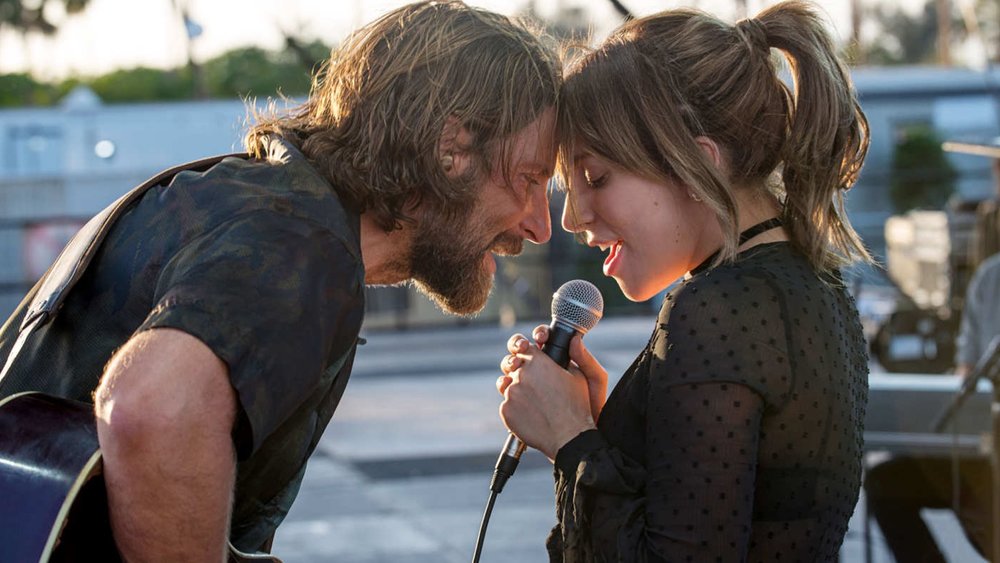
It is perhaps surprising that this story still carries so much power to move us. It could be corny and dated. After all, stars these days go to rehab and then come out to tell their stories of redemption and healthy habits on the cover of People Magazine. The credit for this latest version’s compelling power goes to its director/co-writer/star, Bradley Cooper, who has told the story with verve, specificity, and conviction, and who wisely selected pop superstar Lady Gaga to play the part of the young singer. Life imitates art for the performer originally as famous for her transgressive videos and wild attire (who can forget the meat dress, now at the Rock and Roll Hall of Fame museum?) as for her music. Reportedly, when Cooper met the artist originally known as Stefani Joanne Angelina Germanotta, he wiped the makeup off her face and told her that was how he wanted her to be seen in the film. Her character, Ally, would not be the highly burnished, defiantly confident, even brazen pop performer in grotesque haute couture, but the real girl underneath. That girl is a revelation. The emotions we see on her face as he tries to pull her onstage for the first time, and then her resolve as she steps out from the wings are achingly honest.
Writer/director/co-star Bradley Cooper shows as much evident pride and pleasure in showing her to us as his character, Jackson Maine, does in pulling Ally onstage to introduce her to the audience by making her sing, for the first time, her own songs. His careful attention to every detail is evident in every moment and he has a true musician’s sense of pace and timing. The songs are not just lovely; each of them is meaningful in revealing character and helps to tell the story. The two most recent “Star is Born” movies had their songs nominated for Oscars. One was a winner; the other should have been. This follows in that tradition and I hereby predict that “Shallow” will win this year’s Best Song and that Lady Gaga will be nominated as well.
Cooper’s script reflects the intensive textual analysis he learned in his studies at the Actors Studio and his direction reflects his deep understanding of the importance of creating a safe space for actors to take risks and be completely vulnerable on screen. His own performance is meticulously considered. We see his struggle, his pain, and his passion for music. But like his character, it is very much in service to Lady Gaga as Ally. Cooper says that the idea for the film came to him when he was backstage at a Metallica concert, where he could see the intimacy of the experience of the musicians working together on stage at the same time he saw the immensity of the crowd caught up in the experience. He creates that for us here, and one of the movie’s best images is the small, private smile we see when Jackson begins his signature song. For a moment, the agony of his world disappears and all that is left is the music and the connection it makes to the audience.
Ally gives him that feeling, too. Helping her pulls him out of himself, at least for a while. But his past and dark thoughts about his future are too much to bear.
Cooper also has some small but lovely tributes to the earlier versions of the story, to James Mason wiping off Judy Garland’s garish make-up and to the bathtub scene with Streisand and Kristofferson. But this is very much a stand-alone, a timeless story of love and loss, and a stunning debut from a director who arrives fully present, utterly committed, and astonishingly in control of a vision that is a work of art and completely heartfelt.
SPOILER ALERT: All of the other versions of this story end with a suicide that is portrayed as tragic but also noble, a sacrifice to make it possible for another person to succeed. I was very concerned going into this film that it would perpetuate this toxic romanticized notion. Cooper finds a way to mitigate that to some extent, but viewers should know that it remains a very troubling issue and is the reason I did not give the film a higher grade.
Parents should know that this film has very strong language, alcohol and drug abuse, some fighting, sexual references and situations, some nudity, and suicide.
Family discussion: Why didn’t Jackson tell Ally the truth about what was happening to him? What will Ally do next? How is this version of the story different from the previous films?
Rated PG-13 for crude and sexual content throughout, language, some drug references and violence
Profanity:
Very strong language for a PG-13
Alcohol/ Drugs:
Drug references
Violence/ Scariness:
Comic peril and violence
Diversity Issues:
Diverse characters
Date Released to Theaters:
September 28, 2018
Date Released to DVD:
January 7, 2019
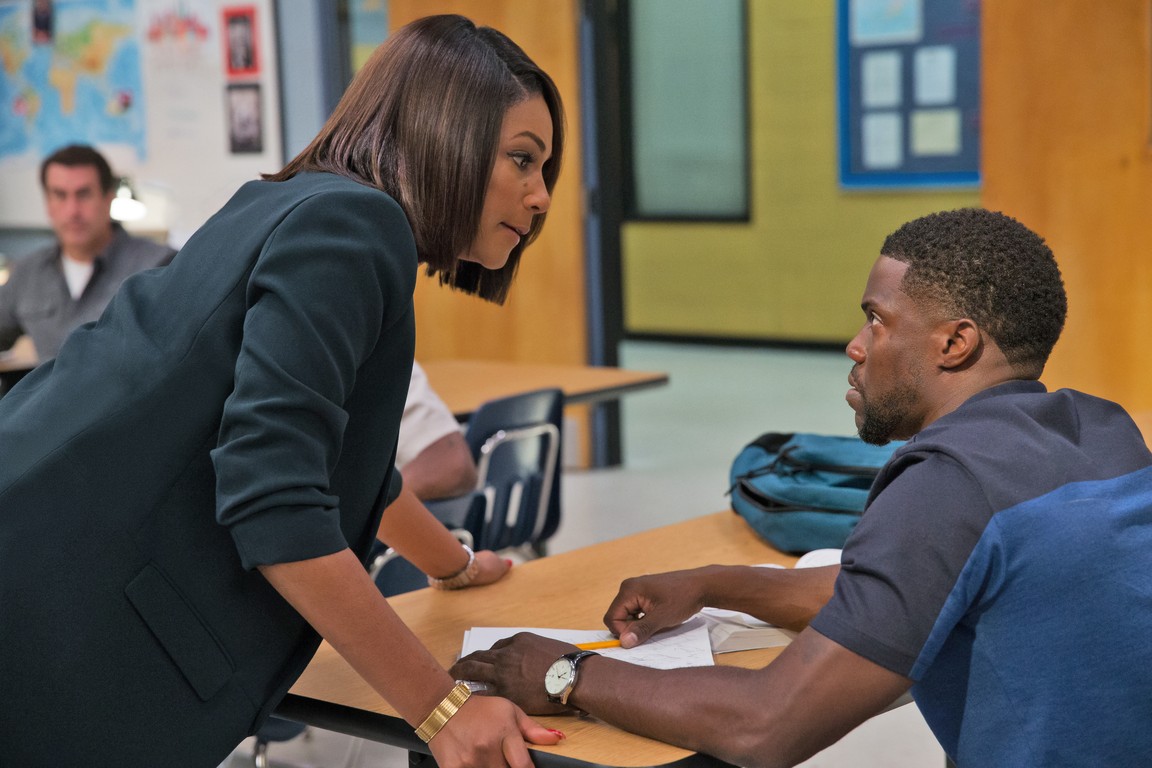
Copyright Universal 2018Maybe Night School might slide past more easily in the summer, when audiences are more susceptible to silly comedies. But it is possible even summer audiences would find this a disappointingly lesser work from two of the most unquenchably funny people in movies, Kevin Hart and Tiffany Haddish. It’s a warning sign when the opening credits show six different writers in a tangle of “ands” and “&s,.” The seams between the obvious rewrites trip over each other, interrupting the flow of the storyline and the build-up of the comedy.
The premise is in the title and the best jokes are all in the trailer. Kevin Hart plays Teddy, a high school dropout who is happy and successful, happy because he has a beautiful, accomplished, loving girlfriend (the exquisitely lovely Megalyn Echikunwoke as Lisa), but not as successful as she thinks he is because he does not want her to know that he never finished high school and is living paycheck to paycheck. His best friend Marv (Ben Schwartz) warns him that he cannot afford his duplex, Porsche, or the engagement ring he wants to give Lisa, but Teddy’s boss has promised to give him the store when he retires, and so he thinks it will all work out.
Of course, all of that has to fall apart for the story to happen, but it takes too long to get to the reason we are there — night school, so Teddy can get his GED and go to work for Marv as a financial analyst(!). And so we can see the scenes with Hart and Haddish, playing his teacher, Carrie. The early scenes drag, especially when Teddy tries to get out of paying an expensive restaurant bill by sticking his hand down his pants so he can put some hair into the food and claim it came that way from the kitchen. And then Teddy has to accidentally burn down the store, another pointless, overlong digression.
And then we get to the GED program, at the very high school that was so traumatic for Teddy, now run by his high school nemesis, Stewart (a woefully underused Taran Killam), who has a poster of “Lean on Me” behind his desk and carries a Joe Clark-style baseball bat to terrorize the students.
The night school instructor is Carrie (Haddish), a straight-talking, hard-working teacher who demands the best from students. She has no patience for the work-arounds Teddy has come up with to hide what she recognizes as learning disabilities. But she has all the patience it takes to find a way for him to succeed.
The night school classmates are lazily sketched out, relying on our familiarity with the types we have seen in so many movie classrooms and the talent of the supporting cast, including Rob Riggle playing the blustery part he usually plays, Mary Lynn Rajskub in another mousy role, and Al Madrigal as the waiter Teddy got fired in the restaurant incident. The movie heaves from one set-up to the next, and we get the sense that “Kevin does something funny” is pretty much all they had in mind for most of them. Ultimately, even that fails and they have to resort to the desperation go-to, a dance sequence. To Outkast’s “Hey-Ya.” Come on. Okay, that part made me smile, but I was not proud of myself for it.
We don’t need the movie to make sense or ring true, but we do need it not to fight with us. In other words, the events and the comedy have to bring the movie forward. It may be funny to see Haddish deliver a powerhouse punch to Hart in full boxing gear (followed by further punches as he gets more and more protective covering), but it undermines everything we have been told about her character’s dedication and decency and come on, this is how you “cure” ADD and dyslexia? Scenes like the whole class getting together to steal the answers to a test go on much too long for too little payoff. I’m a fan of director Malcolm Lee, whose films generally have an expert balance of heart and humor. This one, sorry to say, does not make the grade.
Parents should know that this film includes near-R-level language and crude humor, sexual references, comic peril and violence, and drug references.
Family discussion: How did understanding that he had learning disabilities change Teddy’s outlook? Why didn’t he tell Lisa the truth sooner?
If you like this, try: “Central Intelligence” and “Girls Trip”
Rated PG for some action, rude humor, and thematic elements
Profanity:
Some schoolyard language
Alcohol/ Drugs:
None
Violence/ Scariness:
Some peril, no one hurt
Diversity Issues:
A metaphorical theme of the movie
Date Released to Theaters:
September 28, 2018
Date Released to DVD:
December 10, 2018
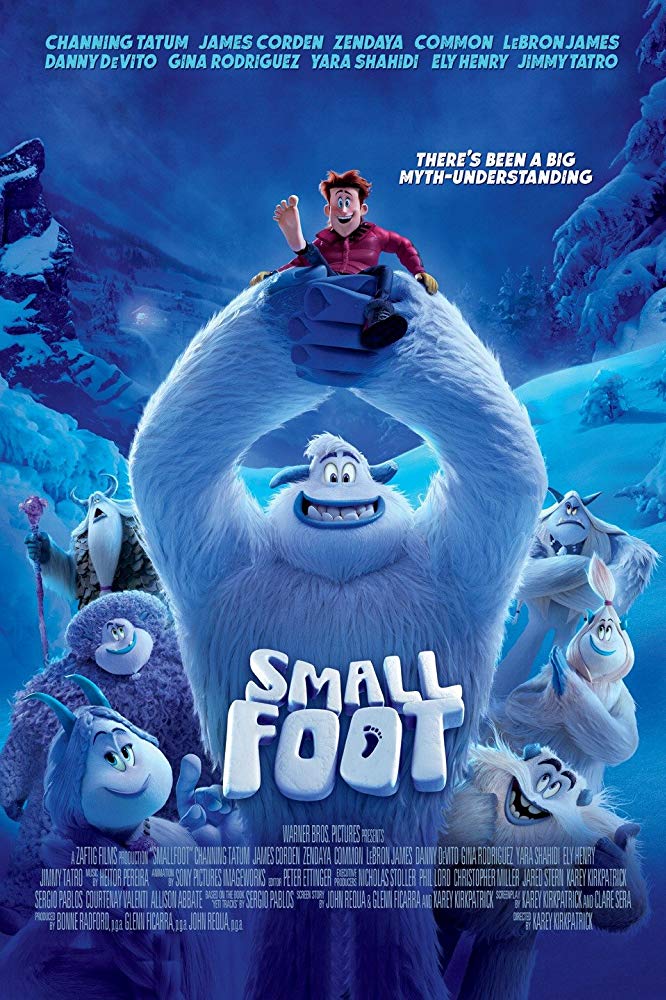
Copyright Warner Brothers 2018The Yeti, sometimes known as Bigfoot or the Abominable Snowman and akin to Sasquatch, is a mythical, or, shall we say, so far unproven creature of enormous size, something like an ape. “Smallfoot” takes a charming switch-up — here it’s the Yeti who don’t believe there is such a thing as humans — and turns it into a surprisingly thoughtful film. In between its colorful musical numbers, silly jokes, and action scenes, somehow manages to address some pretty big and complex issues like fake news, xenophobia, and personal integrity, and to do so in a manner that is accessible and nuanced.
Our hero in this movie is Migo (voiced by Channing Tatum), who is perfectly happy and wants everything to stay exactly the same. His home is “harsh, jagged, freezing, and awesome.” “It’s a day like any other,” he sings, “and I don’t want to change a thing.”
We can understand why. The gorgeously imagined tundra of the Himalayas is wonderfully enticing here, with a color palette of blue and white with sparkling snow and Prussian shadows, and the community has an inviting design of homes made from stone and ice. It is a close and cooperative neighborhood, led by the Stonekeeper (Common), whose robes made of stone lay out the immutable laws. The gong must be rung each morning to raise the sun. The mammoths that hold up the mountain must be fed. And, very important, no one may question the laws or traditions. “If there’s a question causing you to go astray, just stuff it down inside.” As Migo’s father, Dorgle (Danny DeVito) says, “Do what you’re told. Blend in.”
Migo and Dorgle have the very important responsibility of ringing the morning gong. With Dorgle’s head (explaining why it is so flat and he is so short). Each day, Migo launches his father like an arrow through a sort of giant bow. He dreams of someday having the honor of getting launched at the gong himself. He finally gets his first try, but misses the target and ends up out in the snow, where he witnesses a plane crash and sees a human, what the Yeti call “Smallfoot.” The pilot sees Migo, too, and is equally surprised and a lot more scared.
No one believes Migo, and when he insists that he is not lying about what he saw, he is banished by the Stonekeeper. That is when he discovers a kind of Yeti Resistance movement, led by the Stonekeeper’s spirited daughter, Meechee (Zendaya). She believes in curiosity, exploration, challenging assumptions, and testing hypotheses: “Questions lead to knowledge, and knowledge is power.” Migo sets off to go beneath the clouds in search of Smallfoot.
Below the tree line, a British television personality named Percy (James Corden) is “under pressure” (he performs a Karaoke version of the song) because his once-popular television programs about animals have been eclipsed by amateur cute animal videos on YouTube and Facebook (the musical number features floating Facebook “likes”). He tells his colleague, Brenda (Yara Shahidi) that he plans to fake a Yeti sighting, and then go back to having integrity afterward. But then Migo, a real Yeti, shows up. Migo wants to take Percy back to his community to show that he was telling the truth. And Percy wants to film Migo so he can make a lot of money.
Amusingly, they have no way of understanding each other’s form of communication. We hear what each of them sounds like to the other, Percy’s little squeaks and Migo’s growls. Migo wraps Percy in a sleeping bag, wears him on his huge hairy chest like a Baby Bjorn, and begins to climb back up to the peak of the mountain.
This is where most movies for children start to move toward the themes of friendship, home, and believing in yourself. But “Smallfoot” goes in a different direction, somewhere between “The Matrix’s” blue pill/red pill choice between being safe and knowing the truth and “Black Panther’s” choice between isolationism and, despite the risks, finding a way to help and learn from others. Migo learns the reason for the Stonekeeper’s insistence on perpetuating the myths of the Yeti world, and he has to consider carefully whether it is worth putting his friends and family at risk in order to learn the truth.
This is some pretty existential stuff. “If I’m not the gong ringer, who am I?” Migo asks. It is heartening in this era of fake news, when it is tempting to outsource our knowledge base to our devices, to have a movie about curiosity, critical thinking, and challenging the status quo.
Parents should know that this movie has some schoolyard language, brief potty humor, action/cartoon-style peril (no one hurt), and discussions of past violence.
Family discussion: When did you find that curiosity led you to something you would never have expected? Why didn’t the Stonekeeper want anyone to know the truth? Who should decide what knowledge is available?
If you like this, try: “Cloudy With a Chance of Meatballs” and “Surf’s Up!”