Rampage

Rampage

Posted on April 11, 2018 at 4:00 pm

B
Lowest Recommended Age: Middle School
MPAA Rating: Rated PG-13 for sequences of violence, action and destruction, brief language, and crude gestures
Profanity: About a dozen bad words
Alcohol/ Drugs: None
Violence/ Scariness: Extended peril and action-style violence with chases, explosions, guns, bombs, monsters, many human and animal characters injured and killed, some graphic and disturbing images
Diversity Issues: Diverse characters
Date Released to Theaters: April 13, 2018
Date Released to DVD: July 16, 2018
Copyright New Line Cinema 2018

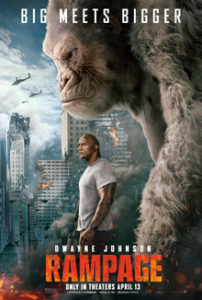
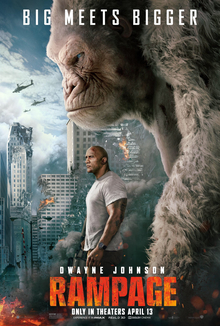
Pay attention, my friends, this one is a little bit tricky. In his last movie, Dwayne “The Rock” Johnson played an avatar in a movie about a video game. In Rampage, he plays a human in a movie based on a video game, though in the video game, big in arcades in the 1980’s, it was the animals who were the avatars, and your task as player was to help them destroy the city while Johnson’s human character in the film is there to protect it.

Still with me?

Well, maybe “human” does not adequately describe Johnson’s character, the primatologist/Special Forces veteran Davis Okoye, the essence of movie hero, always ready with his fists or a quip or both at the same time. And, you know, he looks like The Rock.

Okoye works at a San Diego animal preserve, where he is especially close to an albino gorilla named George. They communicate via sign language. And it’s all downright Edenic until George is hit with spray from one of three canisters of gene-altering material that “edit” his DNA to make him grow to King Kong size and make him furious, aggressive, and destructive.

With the help of the beautiful scientist who developed the gene-editing juice, hoping to help humanity and not in any way aware that the evil corporation she was working for was planning to weaponize it. Naomie Harris plays Dr. Kate Caldwell, and Jake Lacy and Malin Akerman are the oh-so-evil brother and sister who run the corporation. Well, she’s evil; he’s way over his head. Then there’s Joe Manganiello as a mercenary hired by the evil sister, Jeffrey Dean Morgan as a FBI official with a Southern accent, and a walloping lot of CGI as the three monsters — those two other canisters — Okoye has to find a way to stop.

If they ever give out an Oscar for efficiency of set-up, this movie is a contender. It quickly assigns an attribute to each character and lets us know immediately what the stakes are in every scene. Director Brad Peyton (“San Andreas,” also starring Johnson) knows we’re here for the action, and spends just enough time between scenes of shootouts, explosions, and chases to remind us why we should care what happens to the characters. Manganiello’s character has a big scar on his face, so we know he’s tough. The evil sister says, “There’s a reason we were doing these experiments in space and it wasn’t for the betterment of humanity,” just to make it clear that she is the bad guy. In case we missed it the first time, when her hapless brother says, “You can’t liquidate all your problems,” she snaps back, “Agree to disagree.”

And Dr. Kate lies to her boss on the phone, so we know that she is not a rule follower. Plus, we glimpse a photo in her apartment showing her hugging a cancer patient, so we know she is nice and probably bereaved. Morgan’s FBI character has a seen-it-all, heard-it-all look but a bit of a twinkle in his eye. And a homing device has the three giant, hungry, and very hostile animals going full-speed to Chicago.

Does any of it make sense? Not really. Do we care? Not really. Just don’t think too hard about how long it would take for debris to fall from space, what condition it might be in, or how long it would take an antidote to work. This is a movie based on an arcade game, and it is much better than most game-based films.

In part that is because the game was from the 80’s and didn’t really have a storyline, so there was no risk of being too faithful or not faithful enough, and in part because it never takes itself too seriously. It takes the stunts and action seriously, though. There’s a wow of a plane crash and some good moments in the midst of a massive destruction of Chicago’s Loop. And George (motion capture actor Jason Liles) is, if not realistic, believable. Johnson is right in his sweet spot here, and so are we, with a popcorn treat to kick off the summer season.

Parents should know that this film includes extended peril and action-style violence with chases, explosions, guns, bombs, monsters, many human and animal characters injured and killed, some graphic and disturbing images, some strong language, and some crude humor.

Family discussion: Who should make the rules about genetic experimentation? Who in this film follows orders and who does not? Why did Davis say he was not a “people person?”

If you like this, try: “Jumanji: Welcome to the Jungle” and “Transformers”
Related Tags:


Action/Adventure Based on a video game DVD/Blu-Ray

25 Great Musicals

Posted on April 9, 2018 at 9:08 am

I love movie musicals and I especially love the movie musicals of the studio era, with stars like Fred Astaire, Ginger Rogers, Gene Kelly, Judy Garland, Rita Hayworth, Debbie Reynolds, and Bob Fosse.

 has put together a terrific list of 25 of the all-time best movie musicals, all highly recommended.  I’d also add: “Bells are Ringing,” “The Music Man,” “Kiss Me Kate,” “Let’s Make Love,” “The King and I,” and so many more.

Some of my favorites include:

Related Tags:


Film History For Your Netflix Queue Movie History Movie Mom’s Top Picks for Families Musical

Trailer: Kodachrome

Posted on April 9, 2018 at 8:04 am

Coming April 20, 2018 in theaters and on Netflix: “Kodachrome”

An estranged father and son make a pilgrimage to the last place that can develop rolls of Kodachrome film on this movie starring Ed Harris, Elizabeth Olson, and Jason Sudeikis, inspired by a true story.

Related Tags:


Based on a true story Trailers, Previews, and Clips
Interview: Drew Fellman and Jake Owens on the new IMAX Film “Pandas”

Interview: Drew Fellman and Jake Owens on the new IMAX Film “Pandas”

Posted on April 1, 2018 at 10:15 pm

Copyright Warner Brothers 2018

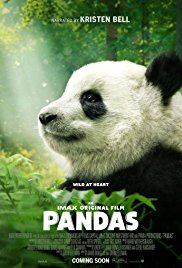
Pandas are, as someone notes in the adorable new IMAX documentary simply called “Pandas,” “the King Kong of cuteness.” Kristen Bell narrates the story of an ambitious and daunting Chinese project, to take panda babies bred in captivity and release them into the wild, to repopulate the endangered species. The Chinese panda specialists consult with an American from New Hampshire who has a similar program for bears. And we get to watch as a panda named Qian Qian leaves the only home she has ever known. I spoke to director Drew Fellman and American panda expert Jacob Owens, who worked with Qian Qian and appears in the film.

Why are humans so drawn to pandas?

Fellman: I know, it’s a mystery, isn’t it? There is so much about that that really is so unknown, part of it I think is that pandas are still so new to us. Pandas were unknown to the West until about the 1860’s and the first panda showed up in the U.S. in 1920. Once people were introduced to pandas there has been a panda mania of some sort. From the very beginning they just captured the public imagination and I think part of that was because they seemingly came out of nowhere and they’re so big and so adorable and they look so unlike any other animal. The physical answer as to why they’re so adorable is because they have the strongest jaws you can imagine so they can bite through solid bamboo and that gives them these huge jaw muscles which give them a big round head like a giant baby.

Owens: Yes, babies are cute because they have big eyes and they have round heads, they’ve got disproportionate ears; and so you look at the pandas and it’s got big black spots that look like big eyes and big ears and a big round head, also they roll around more than any other animal I’ve ever seen. They love rolling. So not only do they do look really cute, they’re also really silly goofy animals.

In the film you say that the three qualities you were looking for in finding the right panda for the release program were courage, curiosity, and climbing ability. Why were those were the key skills and how do you look for them?

Owens: There is a lot of research that goes into this that we can draw from. It starts off with genetics and health; we want healthy individuals who have the right genetics for the places that we’re looking to release them. The next thing is looking at the behavior. We introduce novel stimuli to see how they respond. If an individual panda sees something new and instantly runs towards it that’s not necessarily the quality we need because we want them to be curious but also careful but you also don’t them to be so wary of everything that they won’t explore. They’ll need to explore their habitat, being able to find food on their own; things like this, so having in moderation being exploratory but also being cautious, being really vigilant; vigilance is a big thing always looking out for new dangers, those are the key features. And they have to climb well because they have to spend a lot of time in trees. They flee predators up trees and so being able to walk around and climb and do that well at a young age is a good indicator.

Did it feel like leaving a child at school to say goodbye that way?

Owens: Yeah, worse. As scientists you try not to get attached to the animals that you’re studying but this is very different than just strict science; this is reintroduction and release of individual animals and so we are doing all this research but then you’re also dealing with an individual and their own personality that’s unique and so you can’t help but personify and you can’t help but get very attached. You really care about them as an individual and also what they represent for the species. As a conservation biologist, I’m focused on making sure that there are individuals of species in the future. But at the same time just like anybody else, just like if you have a human child you want them to go off on their own and be able to be successful. It’s just that how you prepare them is a bit different. I don’t ever refer to it as training because I can’t train a panda to be a panda because I’m not one. So I call it conditioning or preparing, letting their natural instincts come out progressively through increasingly wild conditions and eventually to the point when they are ready to go out. We open the gate and she can make that decision when she wants to go out and when she wants to come back and, when she’s ready, just to be out fully.

What was the most important thing that the project learned from Ben Kilham, the man who has been raising bear cubs and releasing them successfully in New Hampshire?

Owens: Ben has been doing black bear rehabilitation for more than 20 years and so he’s just got a huge amount of knowledge about bears in general and pandas are bears. They are very different bears but they’re still bears. He also knows so much about rehabilitating and releasing animals. I’ve worked on reintroduction programs before with different species. People think that you should avoid all human interactions. Ben takes the opposite approach. He says there’s no real way to do that because these black bears don’t have a mom so you have to hand raise these cubs and you have to give them a safe environment to progress into the wild. Our pandas are born in captive care. Their mothers are also captive-born individuals so they don’t have the wild skills to teach their cubs. So for Ben the biggest thing is that human interaction has a real advantage, because once they trust you that provides us the access to keep on learning more about their biology, to keep on learning more about their conservation and also monitor them. I can change Qian Qian’s GPS collar just as Ben can with Squirty as you see in the film, and that’s a huge advantage because we can monitor her, we can follow her, we can see where she’s at, see how she’s doing. As technology increases we can do a lot more with that technology but if you don’t have access to them and they don’t trust you, then you’ll have to take other measures. You have to capture them in some kind of trap or use sedation and so because they know and trust us it’s a lot easier for us to do those things. Using those human interactions for those advantages is the biggest thing that I have learned from Ben in terms of our project.

Fellman: Also from the panda’s point of view is the positive interaction with the humans as opposed to being trapped or tranquilized which can be dangerous and can frighten them.

Owens: There is also the misconception that I had coming into this that if a panda or black bear gets used to one individual or a handful of individuals then they’re used to people and then they’re going to be a nuisance animal then there’s going to be a real problem and they’re not going to do well when they go out. But pandas and black bears are really smart and they can identify individual people very easily by the sound of their voice, by the smell and also by vision somewhat when you get close. It was a big learning thing for me to learn that we were wrong in thinking that this risk of them trusting a few human individuals is going to lead to touching every human. My dogs don’t do that in the States and most people’s dogs don’t do that in the States. Most animals just don’t do that.

What’s the most important thing that you want families to learn about pandas when they watch this movie?

Owens: I want people, especially families with young kids, that people around the world can work together really successfully and use their own combined strengths to work on an endeavor that’s really challenging. We’re really dedicated and I think that’s the big point — all of us globally working together to achieve a difficult goal.

Fellman: And another important message is that pandas are much more than just adorable animals; they are very smart, occasionally fierce, a bear with a mind of their own and they’re all individuals. It’s going to take a lot to create a better future for them and it’s something that’s really worth fighting for.

Related Tags:


Animals and Nature Directors Directors IMAX Interview
Interview: Andre Borschberg of “Planet Power” and Solar Impulse

Interview: Andre Borschberg of “Planet Power” and Solar Impulse

Posted on March 29, 2018 at 2:54 pm

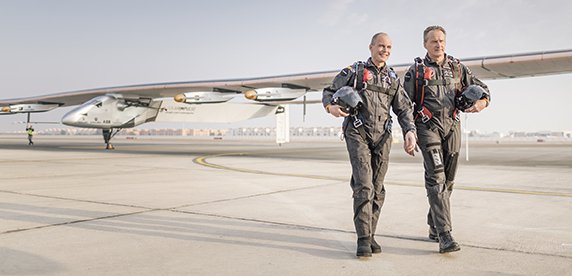
“Planet Power,” is a stunning documentary about the round-the-world flight of the Solar Impulse, the first-ever plane completely powered by sunlight to circle the globe. It is now in IMAX theaters across the country. It was developed and piloted by two Frenchmen, Andre Borschberg and Bertrand Piccard.

What did you learn about the world by flying over it that way that you didn’t know before?

Lots of things! But first of all it’s an incredible experience when you look about the airplane and you see the sun and you see the sun rays and then you start thinking that these rays and this radiation is sufficient to make the airplane fly, to climb and fly through the night. It’s absolutely incredible. Normally you always have an eye on the fuel gauge and then you know you only have a few minutes to go and then you have to land. So to think that you have an indefinite unlimited endurance, it’s a totally different world. Of course the entire project was incredible in the sense that we were told by the aviation industry that to build such an airplane was not possible. We were convinced on our side that there was a solution so we decided to do it ourselves. These fifteen years were a sequence of hurdles, of success, of difficulties and all this done with a fantastic team; so it’s a life experience.

I imagine that it was very quiet there because you didn’t have the humming of the engines. Is that right?

It is. If you have a chance to fly in an electric airplane, you will see how quiet it is because you don’t hear much, there’s no vibration. It’s like being in a glider which suddenly can climb like a normal plane. And in this plane I was alone. We will have a two-seater flying this summer in Switzerland and my goal is really to take lots of people in this airplane just to see the difference. The experience is something else.

One of the things that really captured my attention in the movie was that while a passenger plane can tip to a degree of 30 degrees this plane because of the size of its wings was much more limited. Did that make it difficult to maneuver?

What was tricky was the sensitivity of the airplane towards turbulence and this is why we also always try to take off very early and land late at night so we’re away from the turbulences created by the sun during the day. So that is certainly one characteristic of the airplane. On the other side, as I said, we have this freedom to be away from the clock and having the possibility if necessary to be one more day in the air when I flew across the Pacific from Japan to Hawaii, we thought it would take 5 days than have taken 6; I would say even so much the better because of the incredible experience but to have this feeling of no limit on the energy, of course, it’s a major plus.

The movie explains that you come from a family with a history of innovation. What did they do to influence you to become an innovator yourself?

When I was a really young kid I was taken by the books I read about the aviation pioneers, about what they did, about their lives, about the way they went about trying, exploring, building something that nobody did and then flying without having been coached by a flight instructor on how to do that. For me this created a strong dream and appeal in fact to be part of this world as well; so when I met in fact Bertrand a few years later, it was like getting into this world I’ve been dreaming about when I was a young boy.

Tell me a little bit about more about the partnership with Mr. Piccard, what is it that each of you contribute to that partnership?

Bertrand and I basically had different educations; we have different backgrounds and skills and at the end we were extremely complementary as a partnership through these differences. It’s one plus one equals three; one for each and one when we’re together. In that sense we are truly different but we understood that this difference was a source of creativity so very early we gave up basically the tendency to argue and to try to defend own ideas and we were more interested when we were not having basically the same understanding of a situation. I think we were always interested to understand what the other was thinking, knowing that at the end the solutions would be neither his solution nor mine. So regularly once every two weeks, once every month we would sit down and expose our feelings to the other one to try to find a common ground. We had a clear understanding that it’s only by sticking together that we could have a chance to succeed.

What of the innovations in the plane do you think will be most useful to consumers?

I think very simply electric propulsion. It is not just that solar energy is renewable. It is also much more efficient than a combustion engine. If you take your car, two liters or two gallons out of three that you put in the tank are lost for heat so it’s a totally inefficient technology. With electric propulsion we’ve changed the world of aviation for a lot of reasons but it will make aviation quieter, cleaner, safer and more affordable and you can use it not only for propulsion but also to stabilize the airplane. There are few moving parts, it’s only software, it’s only electronics, which are (things we know how to produce very cheaply and very safe today, so you can start imagining that you will have new ways to transport people, for example from one side of Los Angeles to the other side. There are many projects aiming in fact to provide this added value that will all use electric propulsion. I didn’t want basically to do a commercial project after flying around the world but I couldn’t resist to continue and develop this technology because I think it will be a game changer.

Related Tags:


Documentary Interview
THE MOVIE MOM® is a registered trademark of Nell Minow. Use of the mark without express consent from Nell Minow constitutes trademark infringement and unfair competition in violation of federal and state laws. All material © Nell Minow 1995-2026, all rights reserved, and no use or republication is permitted without explicit permission. This site hosts Nell Minow’s Movie Mom® archive, with material that originally appeared on Yahoo! Movies, Beliefnet, and other sources. Much of her new material can be found at Rogerebert.com, Huffington Post, and WheretoWatch. Her books include The Movie Mom’s Guide to Family Movies and 101 Must-See Movie Moments, and she can be heard each week on radio stations across the country.

Website Designed by Max LaZebnik