Thunderbolts*

Thunderbolts*

Posted on May 1, 2025 at 2:06 pm

B +
Lowest Recommended Age: Middle School
MPAA Rating: Rated PG-13 for strong violence, language, thematic elements, and some suggestive and drug references
Profanity: Some strong language
Alcohol/ Drugs: Drug references
Violence/ Scariness: Non-stop action-style peril and violence, child is killed, automatic weapons, military weapons, chases, explosions, characters injured and killed
Diversity Issues: Diverse characters, mental illness sympathetically portrayed
Date Released to Theaters: May 2, 2025
Copyright 2025 Marvel Studios

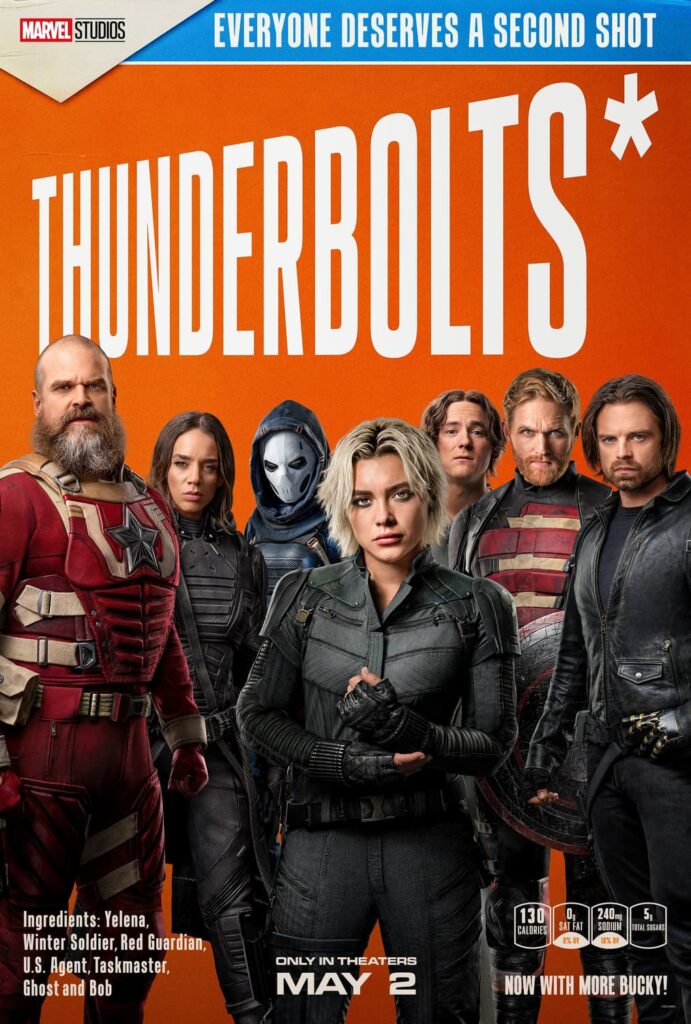
I liked “Thunderbolts* (note the asterisk) a lot, but it will be divisive. Some people don’t want to delve into the mental health struggles of anyone, including a superhero or supervillain. They’re just there for the punches, powers, explosions, and special effects. But as I watched the film, I thought about how many superheroes experienced devastating trauma before gaining their powers and/or dedication to saving the world. Bruce Wayne saw his parents killed by a mugger when he was a child. Superman lost his family and his whole planet. Spidey was living with his aunt and uncle, so had already lost his parents before Uncle Ben was killed. Tony Stark had dad issues. Black Widow was trained to be a child assassin.

“Thunderbolts*” is a “Suicide Squad”/”Guardians of the Galaxy”-style superhero story about a group of damaged, distrustful loners with superpowers who have to do more than just band together for all the punching and explosions. They have to begin to heal themselves. And I am completely here for it, plus for finding out the meaning of the asterisk, which I enjoyed very much. And yes, you do need to stay all the way through the credits for a final scene that teases what’s coming next.

Before I get to the superheroes, I want to talk about the villain(s). I always say that it is the villains more than the heroes that matter most in a comic book movie (and in some other places as well, as Milton showed us in Paradise Lost). Julia Louis-Dreyfus is one of the all-time great villains as Valentina, the ultra-wealthy corporate CEO turned Director of the CIA (though with current Director of National Intelligence Tulsi Gabbard’s streak of silver hair, just a coincidence, I’m sure). Some villains have great evil smiles. Louis-Dreyfus has a great social smile exuding the supreme confidence and power of the .001% while all-but-hiding the voracious all-consuming drive for power and utter disregard of the rights or value of anyone in her way.

We first see Yelena (Florence Pugh), still in mourning for her sister, Natasha (The Black Widow) and almost by rote working as an operative for Valentina. She is numb and lonely and lacks purpose. She tells Valentina she wants out, but agrees to one last job, in a remote lab where Valentina’s company once performed experiments, trying to find a formula to give superpowers to her subjects.

She ends up fighting Captain America (Wyatt Russell as John Walker), Ava Starr/Ghost (Hannah John-Kamen), and another super-character who doesn’t last long, before they figure out that they are all there for the same reason, to die, because they have become problems for Valentina. At this point, a guy who seems to be the opposite of super in any way wanders in wearing pajamas, with no memory of pretty much anything except his name. He is Bob (Lewis Pullman, in his second “just Bob” role after “Top Gun: Maverick”).

Yelena, John, and Ava do not trust each other, but the only way to stay alive is to work together. The escape works well in moving the plot and character development forward as well as being fun to watch. And that’s pretty much the vibe for the rest of the film.

Valentina thought her program to turn humans into supers failed, meaning they all died. But somehow Bob survived and that changes her plan. And the people she describes as “defective losers, anti-social tragedy in human form” may not have the cool powers and (mostly) good manners of the Avengers, but they are all struggling toward being something better. That means dealing with sad and scary feelings like loss and trauma, with the characters catapulted into immersive re-creations of their most painful moments. Will they finally find a way to become, a, what’s the word, team? The good news is that by the end of the film, we hope so.

NOTE: Stay through the credits for a mid-credit scene and a teaser at the end for what’s coming next.

Parents should know that this is a superhero movie with non-stop peril and action-style violence including automatic weapons and fantasy powers. Characters are injured and killed, including a child. Mental health and trauma are themes of the film. Characters use some strong language and there are drug references and alcohol.

Family discussion: What is the best way to discover your purpose? How did the childhood experiences of Yelena and Bob affect the way they saw themselves? How is Valentina different from other villains in superhero movies?

If you like this, try: “Guardians of the Galaxy” and the Avengers movies

Related Tags:


Action/Adventure Comic book/Comic Strip/Graphic Novel IMAX movie review Movies -- format Movies -- Reviews Scene After the Credits Science-Fiction Series/Sequel Superhero
Paddington in Peru

Paddington in Peru

Posted on February 13, 2025 at 12:17 pm

B +
Lowest Recommended Age: 4th - 6th Grade
MPAA Rating: Rated PG for action, mild rude humor and some thematic elements
Profanity: None
Alcohol/ Drugs: None
Violence/ Scariness: Peril and violence, gun, machete, tarantula, no one badly hurt
Diversity Issues: None
Date Released to Theaters: February 14, 2025

Paddington is entertaining because of his naivety, which sometimes results in amusing slapstick. But he is beloved because he is true-hearted and kind, and because he knows that a hard stare is called for when people forget their manners. Following the second Paddington film, famously the highest rated movie in the history of Rotten Tomatoes, above expectations for this next in the series were high. It just about meets them with a heartwarming and delightful film, filled with adventure, family, a lost city, singing and tap-dancing nuns, and, when called for, orange marmalade and a hard stare.

Copyright 2025 Sony/Columbia

One highlight of the series has been its A-list villains, and I strongly urge audiences to stay through the credits for an update on the best so far, Hugh Grant as Phoenix Buchanan.

We get a reminder of Paddington’s origin stories here, both his being separated from his family and being taken in by his beloved Aunt Lucy (warmly voiced by Imelda Staunton), to reassures the little cub that if he ever gets lost again, he should roar and she will roar back. We also see him arrive at the train station that give him a name humans can pronounce, and then we are up to date with Paddington (Ben Wishaw) not only a beloved part of the Brown family but a naturalized British citizen with a passport to prove it.

The timing is very good, because Paddington receives a concerning letter from the Reverend Mother (Olivia Colman) at the home for retired bears in Peru. She says Aunt Lucy is doing poorly. The Browns like the idea of a trip with some adventure included. Henry (Hugh Bonneville), whose job is assessing risk, with thick notebooks of triple-laminated documentation of every possible peril, is therefore inclined to be very risk-averse. His new American boss has encouraged him to take some risks, and Peru, even with its scary purple-kneed tarantulas, looks like a good opportunity. Mary Brown (Emily Mortimer charmingly taking over from Sally Hawkins) thinks a trip will bring the family together, something she’d been missing with her children getting older. Judy Brown (Madeleine Harris) is getting ready to leave for college and Jonathan Brown (Samuel Joslin) spends all day in his room working on inventions to help him “put a lot of effort into doing as little as possible.”

Paddington and the Browns go to Peru, but when they get to the home for retired bears, Aunt Lucy is gone and no one knows where she is. The clues she left behind seem to suggest she has gone in search of the legendary lost city of El Dorado. And so what they thought was going to be a quiet visit in a nun-run assisted living facility turns into an adventure on the Amazon, in a boat captained by Hunter Cabot, played by Antonio Banderas.

Banderas also plays Cabot’s ancestors, who were all obsessed with finding the legendary lost city of El Dorado, filled with gold. The ancestors are in pictures on the wall and also appear to Cabot to urge him on.

Like the others, this latest entry in the Paddington saga is visually enchanting, charmingly funny, surprisingly wise, and genuinely heartwarming. I admit I teared up near the end. While there is nothing as enthralling as the second film’s gently animated pop-up book or as hilarious as the prison scene, there is plenty to enjoy. This is a story about the power of being kind, empathetic, and gentle, about learning to challenge ourselves, about where we come from and where we are going. It is funny, smart, and endearing, a true gift.

NOTE: Stay for some very funny mid-credit scenes.

Parents should know that there is some fantasy/cartoon-style peril and violence including a tarantula, a gun, a machete, quicksand, and various mildly scary situations. We see the “comic” deaths of the ancestor characters. There are themes of family separation and adoption. Some in the audience may be bothered by the comic and disconnected from faith portrayal of nuns and the “sentencing” of a villain to a convent.

Family discussion: Were you surprised by Paddington’s choice at the end of the film? Why did he make that decision? How should you decide what risks are worth taking?

If you like this, try: the other Paddington movies and the books

Related Tags:


Based on a book Family Issues Fantasy For the Whole Family movie review Movies -- format Scene After the Credits Series/Sequel Talking animals
Mufasa: The Lion King

Mufasa: The Lion King

Posted on December 19, 2024 at 1:35 pm

B
Lowest Recommended Age: 4th - 6th Grade
MPAA Rating: Rated PG for action/violence, peril and some thematic elements
Profanity: None
Alcohol/ Drugs: None
Violence/ Scariness: Characters in peril, flood, animal fights, references to predators, some injured and killed, attacks by predators, some disturbing images
Diversity Issues: A metaphorical theme of the movie
Date Released to Theaters: December 20, 2024
Copyright 2024 Disney

On the 30th anniversary of “The Lion King,” Disney tells the story of Simba’s father and uncle, how they met and grew up together, considering themselves brothers, and the betrayals that tore them apart. This version is “live action,” meaning not traditional animation but realistic CGI so that we can see every detail of fur and landscape. The action and drama is punctuated with songs (Lin-Manuel Miranda taking over from Elton John) and some silly humor to sweeten the tension.

The frame story is set as an adult Simba (Donald Glover) and Nala (Beyoncé Knowles-Carter) have a daughter Kiara (Ivy Blue Carter). As a storm comes up, Kiara is scared. Her mother is away and her father leaves her with old friends the warthog Pumbaa and the meerkat Timon (Seth Rogen and Billy Eichner repeating their roles from the 2019 “live action” “Lion King”). Rafiki (John Kani, also returning from the 2019 version) tries to comfort Kiara by telling her the story of the grandfather she never got to meet, Mufasa. (The movie is dedicated to the original voice of Mufasa, the late James Earl Jones.)

Like Kiara, Mufasa was once a young cub afraid of storms. And like Kiara, he had loving parents, Masego (Keith David) and Afia (Anika Noni Rose, already Disney royalty as the voice of Tiana in “The Princess and the Frog). The area they live in has not had rain in many months and the land is parched. They decide to go in search of Milele, a land they believe is filled with lush growth and peaceful animals. On the way there, a storm creates a flood and the young cub is separated from his parents.

He is spotted by Taka, a cub his age with an English accent (remember, in the original film, Scar was played by Jeremy Irons, “brother” to American-accented Mufasa). Taka fishes Mufasa out of the water and brings him home. Taka’s father, Obasi (Lennie James) wants to eat Mufasa. He has a firm rule against outsiders. But Taka’s mother, Eshe (Thandiwe Newton) is a warm, loving, generous soul and Taka wants a “brother.” Obasi gives Mufasa a chance. If he can beat Taka in a race, he can stay. Taka allows him to win, knowing that Obasi will judge him harshly for losing. Obasi grudgingly allows Mufasa to stay, but treats him as “other” and less than by ordering him to stay away from the male lions. This allows Eshe to teach him to hunt the way the lionesses do. They become very close. Mufasa (as an near-adult lion voiced by Aaron Pierre ) has an exceptional sense of smell that allows him to identify animals and their environments even if they are far away.

Obasi’s lions are attacked by a group of pale, ghost-like lions led by Kiros (Mads Mikkelsen). Knowing they cannot survive, Obasi and Eshe send Taka (now voiced by Kelvin Harrison, Jr.) and Mufasa away, making Mufasa promise that he will protect his friend.

The two young lions have many adventures along the way. They are joined by Sarabi (Tiffany Boone), an independent female lion with a lookout bird named Zazu (Preston Nyman) and Rafiki, a wise mandrill (frequently mistaken by the other characters for a baboon). The group learns to trust and rely on each other. But Taka begins to develop feelings of resentment and jealousy.

The movie looks beautiful and the CGI allows more expressiveness than the 2019 “Lion King” remake. The songs by Lin-Manuel Miranda are not his best. They are placed at points that evoke comparisons to Elton John’s music at similar moments in the original film and the remake. The framing story, with an elderly Rafiki telling Kiara about her grandfather, is sometimes jarringly different in tone, with Timon and Pumbaa making meta jokes. I mean, a joke about getting a call from legal for using too much from a song in the earlier film? Who is that for? And since Disney owns both properties, who is going to argue about intellectual property rights being violated? At least this time they acknowledge that predators are better off than prey. That jump from the cliff moment is awfully similar to “Butch Cassidy and the Sundance Kid.” There are touching moments, but a lot of loss (even with much of it delicately off-screen) for young children.

I’m losing count of how many prequel/sequel/origin stories I’ve seen this year: “Furiosa,” “Wicked,” “Lord of the Rings: War of the Rohirrim,” “Gladiator 2,” “Transformers One.” It is hard to think of these films as anything more than fan service and brand extension. “Mufasa” is fine and most families will be satisfied. But the jubilant imagination that went into the original, make this one look as pale as Kiros.

Parents should know that this film has a lot of peril and many animals are injured and killed, mostly off-screen. Characters are caught in a flood, and a young cub is separated from his parents, who are assumed to have died. A lion speaks of eating outsiders and is bigoted of those who are not of his blood. A male cub is punished by being forced to stay with the females.

Family discussion: How were Taka and Mufasa different? Why did Taka want to change his name?

If you like this, try: the earlier “Lion King” movies and the very cute “Lion King 1 1/2”

Related Tags:


Fantasy movie review Movies -- format Movies -- Reviews Musical Series/Sequel Talking animals
The Lord of the Rings: The War of the Rohirrim

The Lord of the Rings: The War of the Rohirrim

Posted on December 12, 2024 at 5:43 pm

B-
Lowest Recommended Age: Middle School
MPAA Rating: Rated PG-13 for strong violence
Profanity: None
Alcohol/ Drugs: None
Violence/ Scariness: Extended fantasy and action violence, scary animals, swords, fire, characters injured and killed
Diversity Issues: Strong, fierce female characters
Date Released to Theaters: December 13, 2024
Copyright 2024 New Line Cinema and Warner Brothers Animation

“The Lord of the Rings: The War of the Rohirrim” takes us back to Middle Earth, nearly 200 years before the adventures of the Bagginses and the Fellowship of the Ring. For those whose reaction to this IP brand extension is, “Great! I can’t wait to learn more about the stories behind the story and feel satisfaction when familiar places and characters are name-checked,” this animated story, produced by LOTR director Peter Jackson, will be welcome.

Fans of animation with a taste for anime style, are likely to find this a disappointment. While our heroine, Hèra (Gaia Wise) has big, sometimes expressive anime eyes, the overall style of the animation here is, in a year that included “The Wild Robot,” “Flow,” and “Inside Out 2,” disappointing. Many of the backgrounds are detailed and dimensional, some almost photographic, while the characters and animals are flat and minimalist. Their interactions with the environment seem weightless, any sense of heaviness or the impact of a punch or a fall coming more from the sound effects than the visuals.

Ancillary stories that spring like tree branches from beloved sources have to succeed as independent, stand-alone stories, and this one does not. The Lord of the Rings sagas, books and movies are memorable because of the compelling characters and storylines. The details of the world of hobbits, elves, orcs, ents, and a dragon, not to mention a complete language, are imaginative, but it is the themes of honor, purpose, and loyalty that make them beloved by generations. The characters and storylines here are close to generic.

King Helm Hammerhand of Rohan (Brian Cox of “Succession” and “Manhunter”) is a warrior by nature, physically and politically powerful ruler, generally fair-minded, though he underestimates his “wild, headstrong” daughter, Hèra in favor of his two sons. At a gathering of the noblemen, Freca (Shaun Dooley) barges in, demanding that Hèra marries his son Wulf (Luca Pasqualino) so they can take over the kingdom. Wulf and Hèra played together as children and she still feels warmly toward him. But she insists that she has no interest in marrying anyone. Helm and Freca get into a fistfight, and with one mighty punch Helm knocks Freca down, killing him. Helm banishes Wulf.

Wulf all but disappears and they hear nothing more from him for a few years until he returns, with an army, to capture Hèra and attack Rohan. This means a lot of battles, with just-passable animation and discussions of battle strategy with mostly passable dialogue. This movie never convinces us that there is a reason to make it, and that means there is only reason to watch it for those who will perk up at the mention of familiar places and characters.

Parents should know that this is a very violent film with many battle scenes and a few graphic and disturbing images including dead animals and a severed arm. A young man sees his father killed in a fight and a young woman sees her brother murdered. Characters are killed sacrificing themselves for others.

Family discussion: Why didn’t Helm listen to Hèra? Why were Wulf and Freca so angry and resentful? What was the scariest part?

If you like this, try: the “Lord of the Rings” books and movies

Related Tags:


Action/Adventure Animation Based on a book Fantasy movie review Movies -- format Movies -- Reviews Series/Sequel
Moana 2

Moana 2

Posted on November 26, 2024 at 6:37 pm

B
Lowest Recommended Age: Kindergarten - 3rd Grade
MPAA Rating: Rated PG for action/peril
Profanity: None
Alcohol/ Drugs: Toxic darts
Violence/ Scariness: Extended fantasy peril and violence, scary monsters
Diversity Issues: A theme of the movie
Date Released to Theaters: November 27, 2024
MOANA 2 – © 2024 Disney Enterprises, Inc. All Rights Reserved.

“Moana 2” is colorful and exciting, often beautiful to watch, with some catchy songs. But the storyline is overcomplicated and it does not have the heart (or the Lin-Manuel Miranda bangers) of the first film. It is episodic, with a complicated array of different places, characters, and stakes, evidence of its original version as a series for Disney+. The mid-credit scene is a cliffhanger that makes the entire film seem like a teaser for what comes next, most likely a series that keeps the story going.

At the end of the first film, Moana (Auli’i Cravalho) came home in triumph having — with the help of demigod Maui (Dwayne Johnson) — restored the balance of the universe by returning the heart of Te Fiti and removing the curse that was blighting her island. You don’t need to worry about whether you’ve seen the first one or not; there’s a recap.

Three years later, Moana has grown up a lot. She has the same adventuresome spirit and is proud of being a “way finder,” but has more confidence and skill, as we see her maneuver her boat, handling the ropes and sails like a seasoned salt. She adores her little sister, Simea (Khaleesi Lambert-Tsuda) and her loving parents are very proud of her vision and leadership.

As in the first film, Moana sets off on a journey. The first journey was to reconnect with the history of her people and remove the curse on her people. This time, she is in search of other people from other places and cultures. She assembles a crew. Moni (Hualalai Chung) is a Maui fanboy, a storyteller tied to the legends of the community, and very enthusiastic. Loto (Rose Matafeo) is the gear-head everyone needs on a voyage, filled with ideas about how to make everything work more smoothly. But her most valuable assets are her unquenchable enthusiasm, quick problem-solving, and her ability to turn disastrous damage into something that will still get the group where they need to go. The most unexpected addition to the crew is Kele (David Fane), a grumpy elder whose speciality — farming — and lack of enthusiasm seem like impediments, at least at first.

Of course no Moana journey would be complete without her animal sidekicks, the scrawny rooster Heihei (Alan Tudyk) and the little pig Pua (left behind in the first film but along for the ride this time).

Moana and the crew land on an island of the Kakamora, cute but fierce coconut creatures (think the Ewoks except they are either wearing or made of coconuts). They have paralyzing darts (children will enjoy where the toxic gel comes from) but they also have the antidote, a large, green, jello-like creature. One of them joins the voyage.

They also have an encounter with a mysterious woman whose song has an unusual message for a wayfarer. Her name is Matangi (Awhimai Fraser) and her advice is to “get lost, cut loose, and lose your way.” She is friends with bats. She captured Maui. And she seems to be a captive herself, all of which should make Moana (and us) a suspicious. Is Matangi trying to help Moana and her crew or is she trying to help herself? Moana takes it as permission to worry less about finding the right way and allow herself to enjoy the freedom of not knowing exactly where she is going. And once Maui is on board (literally), giving him a chance to spit some rhymes in the lickity-split fast “Can I Get A Chee Hoo” you can expect to hear children rapping non-stop.

The visuals are as Disney-sublime. Water wishes it could be as water-ish as the water in this movie. Songwriters Abigail Barlow and Emily Bear created good, singable songs that help tell the story. The mechanics and rigging are superbly imagined in the musical numbers and the action sequences with characters and pieces of the boat flying in every direction. The new characters are welcome additions, especially Loto, but they are thinly imagined and we do not get enough time with them to form a connection. So much was happening and the mythology underlying it was so complicated, I kept wishing for a better balance between story and action. Also, it takes much too long to reunite Maui and Moana. Johnson, who also produced, should have made sure his energy was boosting the first third of the film.

So, this is not top-level Disney, but Moana remains an appealing character and if she gets a bit lost in this chapter, we will wait for her to find her way.

Note: stay for a mid-credit sequence that sets the stage for the next chapter

Parents should know that this movie has some scary monsters and some gross-out humor. Characters are in peril. Moana has contact with her ancestors, including her late grandmother.

Family discussion: How do you learn who you’re meant to be? What do you think Matangi will do next? What would you like to ask your ancestors?

If you like this, try: “Moana” and “Lilo and Stitch”

Related Tags:


Action/Adventure Animation Fantasy IMAX movie review Movies -- format Movies -- Reviews Scene After the Credits Series/Sequel Stories about Teens Talking animals
THE MOVIE MOM® is a registered trademark of Nell Minow. Use of the mark without express consent from Nell Minow constitutes trademark infringement and unfair competition in violation of federal and state laws. All material © Nell Minow 1995-2026, all rights reserved, and no use or republication is permitted without explicit permission. This site hosts Nell Minow’s Movie Mom® archive, with material that originally appeared on Yahoo! Movies, Beliefnet, and other sources. Much of her new material can be found at Rogerebert.com, Huffington Post, and WheretoWatch. Her books include The Movie Mom’s Guide to Family Movies and 101 Must-See Movie Moments, and she can be heard each week on radio stations across the country.

Website Designed by Max LaZebnik