The Post

The Post

Posted on December 25, 2017 at 11:01 pm

A-
Lowest Recommended Age: Middle School
MPAA Rating: Rated PG-13 for language and brief war violence
Profanity: Some strong language
Alcohol/ Drugs: Smoking and drinking
Violence/ Scariness: Some wartime violence
Diversity Issues: Some sexist treatment
Date Released to Theaters: December 25, 2017
Date Released to DVD: April 16, 2018
Copyright 2017 20th Century Fox

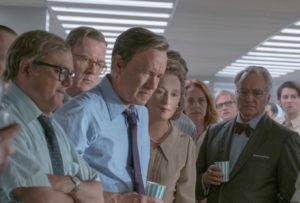
Katherine Graham (Meryl Streep), publisher of The Washington Post, is going over a list of financial and legal documents once again, rehearsing her answers to the questions she will be getting from bankers about selling shares in the company to the public for the first time. This job is one she never anticipated and never wanted. Her father had handed the business over to her husband and she had been perfectly content to be a mother and a socialite, hosting gracious parties and enjoying friendships with people who were important but never being important herself. But her husband has died — no, she reminds a colleague, he committed suicide. And so this is the job she has, even though the men around her are not sure she can do it and she is far from sure herself.

Daniel Ellsberg (“The Americans'” Matthew Rhys), a top aide to Defense Secretary Robert McNamara (Bruce Greenwood), watches his boss tell reporters that the military was making progress in Vietnam, exactly the opposite of what Ellsberg had told him moments before. Later, working for the RAND Corporation think tank, he would take 47 volumes of reports on the government’s lies about the military efforts in Vietnam and send them to the New York Times. When the Nixon administration got a court order to stop further publication, it was shy, inexperienced Mrs. Graham who would have to decide whether she would risk her reputation, her family business, and even her freedom to continue to print the story.

And that, my friends in journalism, is why The Post, about the real-life publication of the Pentagon Papers, is not about the New York Times, which published them first, but about the then-considerably second-tier Washington Post and Mrs. Graham, who risked the collapse of the crucial deal to secure their finances, published second. This is about a woman who did not have greatness thrust upon her; she became great when greatness beckoned. And in playing Graham, we see a woman who began great and is still getting greater.

I know, I know, we’re all kind of over how great Meryl Streep is. She has given us so many decades of impeccable performances and inevitable awards nominations that we just take her for granted. But Streep’s performance in “The Post” is worthy of special attention because it shows us exactly what makes her the best actor of her generation. There’s nothing especially flashy about it. She did not have to learn a new language or transform herself as she has done in the past. Yet she is, as always, astonishingly precise in this film as Katharine Graham, a very private 1970’s socialite who is not yet aware of how fundamentally she is changing to become the leader of a major media outlet.

The very best actors convey a mixture of emotions. In “The Post,” the play of thoughts and feelings in Streep’s face as she seeks the courage to stand up to the men who are telling her what to do is like a master class in acting. She is nervous but resolute, insecure about her ability, unsure of her role, but certain about her commitment to the paper. We see how devoted she is to her family and her friends, the tribute she pays to the guest of honor at a cocktail party in the garden of her Georgetown mansion, her concern for her good friend Robert McNamara as he cares for his ailing wife, the way she softens in the middle of a tense conversation when a grandchild chases a ball into the room. But we also see her growing in the realization of the power of The Post and her own power as well.

Streep is not just superb at creating characters. She is a true ensemble player, never showboating but always seamlessly matching the rest of the cast, whether she is playing a notoriously awful singer in “Florence Foster Jenkins,” a house band front woman in “Rikki and the Flash,” or a British Prime Minister in “The Iron Lady,” to mention just a few of her most recent roles.

In “The Post” she once again blends into the ensemble and she plays a character who is used to deferring to men. So it is easy to overlook how specific and layered she is in showing us a woman who was quiet, unsure, and, frequently condescended to by the men she worked with. As the shy heiress who unexpectedly became the publisher of The Washington Post when her husband committed suicide, Streep shows us the struggle, the spirit, and ultimately the determination of the woman who took the paper from a small local publication to fearless coverage of Watergate that brought down the Nixon administration.

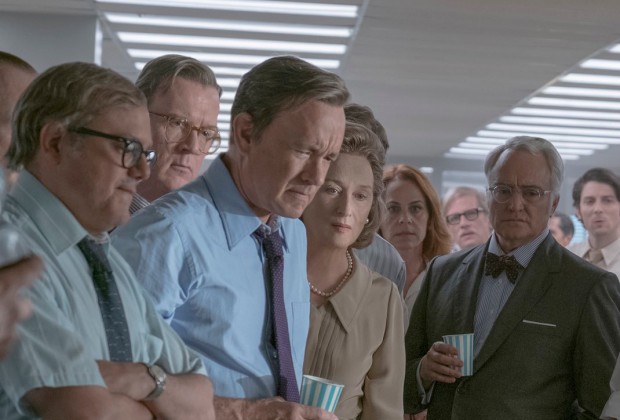
As the movie begins, Graham is practicing for the biggest challenge she has had since taking over the paper that her father had given to her husband. The company is going to go public and she will have to persuade the bankers that even with the family maintaining control it is going to be a good investment. She is hyper-diligent; as one of the men points out, she is the only one who has read through all of the technical financial and legal documents, and she has made extensive notes for herself. We see her rehearsing her answers and when the time comes and she cannot get the words out, we see how hard she is trying and how much she wants to be the business executive the company needs. Watch Streep as Graham becomes in each scene less of the shy socialite who was unfailingly gracious to the paper’s sources, subjects, and rivals. Watch her become not just an executive but a journalist and a passionate defender of freedom of the press as she spars, first tentatively and then hitting her stride with Ben Bradlee (Tom Hanks) over his own blind spots in putting friendship before reporting the story. Watch her as her close friend, whose reputation she is about to help destroy, shocks her by showing her his own fundamental integrity, and just try to look anywhere else as she reads aloud a note from her daughter and as she quietly but firmly and authoritatively does at the end of the film what she could not do at the beginning – thinks for herself and makes a decision based on her own sure sense of what is right for the paper and the country.

This movie brings us back to a time when trust in government and media was high. The Pentagon Papers was the first major leak of the modern era, followed by the Cointelpro documents revealed which revealed abuses by the FBI and led to major reforms and increased oversight. The discovery that three Presidents and their administrations had lied about the prospects of success in Vietnam was the political equivalent of “the call is coming from inside the house.” It had a seismic effect on Americans already in the midst of one of the country’s most tumultuous periods of protest and upheaval.

This movie makes it clear that the press had its own credibility issue at the time. Mrs. Graham points out to Bradlee that his close friendship with President Kennedy compromised his integrity as a journalist, as he asks her not to let her close friendship with McNamara compromise hers.

On top of all that, and its uncanny timeliness, it is whalloping good story about secrets and honor and Bob Odenkirk all but steals the film from two of the biggest stars in Hollywood history with his performance as Ben Bagdikian, the reporter with a hunch and a Rolodex who tracked down the papers for the Post. The last scene cheekily sets it up as a prequel to “All the President’s Men.” We can hope both are a prequel to future films about reporters dedicated to telling the story.

Parents should know that this film includes brief footage of the war in Vietnam, reference to suicide, and some strong language.

Family discussion: How did Mrs. Graham change and why? What did Ben Bagdikian mean about being part of a revolution?

If you like this, try: “All the President’s Men” and Mrs. Graham’s superb autobiography

Related Tags:


Based on a true story Drama DVD/Blu-Ray Journalism movie review Politics Politics Reviews
Jumanji: Welcome to the Jungle

Jumanji: Welcome to the Jungle

Posted on December 21, 2017 at 5:38 pm

B +
Lowest Recommended Age: Middle School
MPAA Rating: Rated PG-13 for adventure action, suggestive content and some language
Profanity: Some schoolyard language, b-word
Alcohol/ Drugs: Alcohol, drunkenness
Violence/ Scariness: Extended action/fantasy-style peril and violence, characters injured, snakes, guns, fights, some disturbing images
Diversity Issues: Diverse characters
Date Released to Theaters: December 22, 2017

Copyright Columbia 2017
There has never been a more charming movie action hero than Dwayne “The Rock” Johnson, whose easy confidence is highlighted in a scene from the trailer for “Furious 7,” when his character gets out of a hospital bed, flexes his muscle to shatter the cast that covers his entire arm, and says meaningfully, “Daddy’s got to go to work.” The only thing more fun is seeing him subvert his own movie star magic, as he did with Kevin Hart in “Central Intelligence,” and as he does with Hart again in “Jumanji: Welcome to the Jungle,” where he plays the video game avatar of a shy, highly allergic high school nerd named Spencer (Alex Wolff). On the outside, he is Dr. Smolder Bravestone, a cross between Indiana Jones, Lara Croft, and, well, The Rock. On the inside, he is still Spencer. But this game goes way past virtual or augmented reality. Spencer and three other kids from his school are stuck in the game, and have to finish it before using up the three life bars each has been given.

Jumanji, the story of a jungle board game that becomes all too real, began as a 1981 book by author/illustrator Chris Van Allsburg, and then a 1995 movie with Robin Williams as a grown-up who has been trapped in the game since he was a boy. This movie pays tribute to the original in the opening scene, set in 1996, when the board game is found at the beach, buried in the sand. A boy in a Metallica t-shirt named Alex (Nick Jonas) has no interest. He likes video games. But somehow the beautifully carved board turns into a cartridge, he pops it in, and disappears.

And then we meet Spencer and three other students sent with him to detention: Fridge, a football star who has Spencer doing his homework, which gets them both in trouble; Bethany, a popular girl who only cares about her social media likes and takes a phone call in the middle of a quiz; and Martha, an anxious girl who puts herself under a lot of pressure to get good grades and mouths off to the gym teacher. Ordered to clean up the school basement as punishment, they find the game console and then disappear into the avatars they have selected: Dr. Bravestone, “weapons valet” Moose Finbar (Hart), scholar Dr. Shelly Oberon, and martial arts specialist Ruby Roundhouse (“Guardians of the Galaxy” series Nebula, Karen Gillan). They can’t get back home until they complete the game.

Director Jake Kasden balances the action, comedy, and heart and the four leads, especially Johnson and Black, have a lot of fun with the disconnect between what they look like and who they are inside. Bravestone quavers to an adversary, “I should warn you, I think I am a very strong puncher” before landing a roundhouse. And Bethany/Oberon can barely decide which is more upsetting, being in the body of an overweight middle-aged man (she needs some guidance on going to the bathroom) or not having her phone. There’s a nice twist when Bethany-as-Oberon tries to reach Martha-as-Ruby how to flirt so she can distract the bad guys, and Martha/Ruby learns that she has what she needs. Despite the best efforts of the jewel-thief villain (Bobby Cannavale) the strengths of the avatars and some unexplored strengths of the teenagers themselves help them get through the levels to finish the game. The original film was a success because of its concept, innovative special effects, and the always dazzling Williams, but this one has a smarter plot, better characters, more heart, and by the time we get to Game Over, we just might be ready to reboot and start it over again.

NOTE: The DVD/Blu-Ray release has some really terrific extras including behind-the-scenes features about the special effects and characters and a funny gag reel. Well worth a look!

Parents should know that this movie includes extended fantasy/comic peril and violence with characters injured and (temporarily) killed and some disturbing images and jump-out-at-you surprises, some crude humor about body parts and functions, some teen (adult avatar) drinking and drunkenness, kisses, and some schoolyard language (b-word). One girl (in a male body) teaches another girl how to flirt to distract the bad guys, but it is shown to be useless and she ends up using martial arts skills instead.

Family discussion: Which avatar would you pick? What strengths and weaknesses would you list for yourself? How did each of the characters use their game-assigned and real-life talents?

If you like this, try: the book and earlier movie and “Help! I Shrunk the Kids!”

Related Tags:


3D Action/Adventure Based on a book DVD/Blu-Ray Fantasy movie review Stories about Teens
Pitch Perfect 3

Pitch Perfect 3

Posted on December 21, 2017 at 5:32 pm

B-
Lowest Recommended Age: High School
MPAA Rating: Rated PG-13 for crude and sexual content, language and some action
Profanity: Some strong and crude language
Alcohol/ Drugs: Alcohol
Violence/ Scariness: Comic/action violence, peril, explosions, fire
Diversity Issues: None
Date Released to Theaters: December 22, 2017
Date Released to DVD: March 19, 2018
Copyright Universal 2017

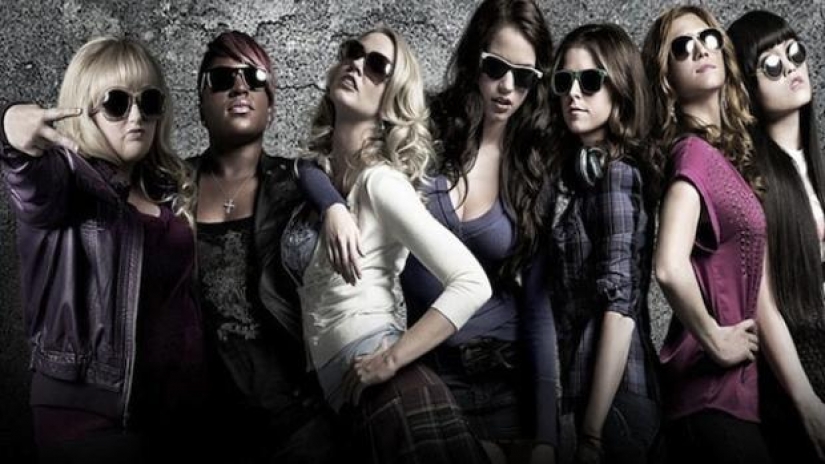
When a franchise runs out of ideas, it’s time to stop, even if the characters and music are still delightful. When a franchise descends to having its own characters wink at the audience with jokes about how it’s run out of ideas, and resorts to just (literally) setting things on fire, not once but twice in it’s 90ish minute runtime, it’s one movie past time to stop. Not that the previous two films had much of a storyline, but compared to this one, they were the Iliad and the Odyssey. It wasn’t fun to hear Fat Amy (Rebel Wilson) tell Emily (Hailee Steinfeld) that she’s stupid one time. It borders on agonizing by the third time.

The music is still delightful, exquisitely harmonized and choreographed covers of songs that it is surprising and fun to hear performed that way, especially in the obligatory riff-off, where this edition’s twist is that the other groups don’t care and use — gasp! — instruments!

The original Bellas are all out in the working world and not very happy about it. When Emily, who is still in college and performing with a new group of Bellas, invites them to a “reunion,” they think they are being invited to sing but learn they are just there to cheer on the new group. They decide that finding a way to sing together again is the most important thing in the world, and Aubrey (Anna Camp) suggests they contact her dad in the military to perform for the USO. Chloe (Brittany Snow) points out that there doesn’t seem to be much point if there isn’t a competition. Wink!

And so the Bellas go to Europe to perform for the troops, along with a country group called Saddle Up and a very sophisticated female rock group led by Calamity (Ruby Rose). And DJ Khaled (playing himself) is going to pick one of them to be his opening act because, oh, who cares that it makes no sense; at least Chloe gets to feel that she’s in a competition. Continuing to scrape the bottom of the storyline barrel, the movie then gives us not one but two distant daddy issues, neither of which matters at all, though it’s always good to see John Lithgow.  And there is barely a flicker of love interest with a couple of guys who are so generic they seem to have wandered in from a Hallmark Christmas movie.

By the time we get to the end more than one character has made a choice that is completely inconsistent and/or nonsensical because no one seems to be paying attention to anything but the musical numbers, which continue to be delightful. Skylar Astin, Ben Platt, and Adam Devine escaped this mess, and anyone who is not a major fan of the franchise would do well to do the same.

Parents should know that this film includes some very crude sexual references and language, some comic peril and action including martial arts and explosions.

Family discussion: Why did the Bellas want to compete so badly?  Were you surprised by Beca’s decision?

If you like this, try: the first two movies in the series and listen to a capella groups like Pentatonix and Home Free

Related Tags:


DVD/Blu-Ray movie review Movies -- format Musical Series/Sequel
The Greatest Showman

The Greatest Showman

Posted on December 20, 2017 at 8:00 am

B +
Lowest Recommended Age: Middle School
MPAA Rating: Rated PG for thematic elements including a brawl
Profanity: Some mild language
Alcohol/ Drugs: Drinking and drunkenness
Violence/ Scariness: Peril and violence including fights and mob threats, fire
Diversity Issues: A theme of the movie
Date Released to Theaters: December 20, 2017
Date Released to DVD: April 9, 2018
Amazon.com ASIN: B077R32LVQ
Copyright 2017 20th Century Fox

I am in no way dissing “The Greatest Showman” by saying that when it is available on DVD and streaming it is destined, even designed to be popular for sing-alongs at middle school slumber parties. Or that it is a good old-fashioned movie musical to take the whole family to, including grandparents and grandchildren, over the holidays. “The Greatest Showman” is differences-make-us-great personal empowerment tuneful fantasy inspired by impresario P.T. Barnum, who revolutionized entertainment flavored with unabashed hucksterism in the 19th century.

This highly romanticized and simplified version of PT Barnum’s life has the young Phineas (Ellis Rubin) the son of a poor tailor, very much in love with the daughter of his father’s wealthy customer. She is sent away to boarding school and he is left an orphan and has to survive on the streets, but they write to each other (an “I wish” musical number, of course) and when they grow up, he returns to her family’s mansion so they can get married. Her father warns that she will be back.

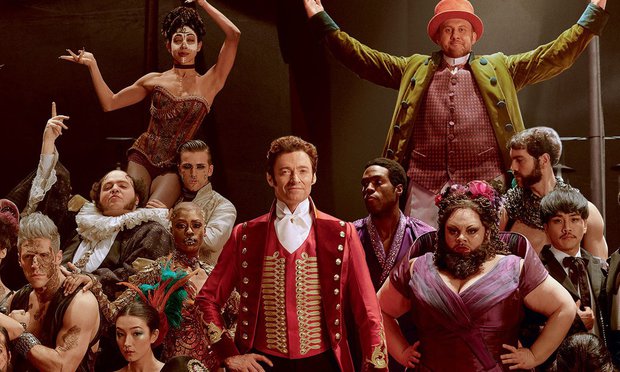
At first, Barnum (Hugh Jackman) and his wife, Charity (Michelle Williams) are poor but very happy and devoted to their two daughters. But Barnum loses his desk job and has to come up with some new way to support his family. To get a loan from the bank he presents documentation that falls somewhere between exaggeration and outright fraud, then uses the money to rent a warehouse and sets up a series of exhibits.

No one comes to see it.

And so, inspired by his daughter, he decides to add “unusual” people to the displays. Attitudes toward disabilities and differences were very different almost 200 years ago, and many people who were unusual — little people, women with facial hair, people with albinism, conjoined twins — had no opportunities for school or jobs and were abandoned or hidden by their families. In the world of this movie, handled with as much delicacy as is possible in the context of a big, brassy musical, Barnum tells them they were beautiful and promises to make them stars. If there are echoes here of the unforgettably eerie “we accept her, one of us” in “Freaks,” consider this a refutation, not repetition. At one point, when Barnum is successful, he wavers, not wanting his circus “family” to mingle with the society patrons. But he rejects Charity’s society family as well. And the circus performers remind him that once they recognized their beauty, he cannot take that away from them with the stirring anthem, “This is Me.”

And really, and appropriately given the subject matter, it’s the stirring anthems and the pageantry that this movie is about, not the melodrama of its thin storyline. Barnum tours with his star, Jenny Lind (Rebecca Ferguson), straining his marriage. Barnum has a partner (Zac Efron), who falls for an African-American performer (a radiant Zendaya–can’t wait to see more from her in the next “Spider-Man” movie), straining his relationship with his family. And there are those in the community who are offended by Barnum’s performers.

But it’s just part of the show, there to give everyone a chance to sing and dance, with songs from the young Oscar and Tony Award-winning team from “La La Land” and “Dear Evan Hanson.” There’s no attempt to be true to the period; another reminder we’re just here to have some fun, the closest most of us will ever get to running away to the circus.

Parents should know that this film includes some mild language, family tension and drama, sad loss of a father, bullies, a scary fire, a brawl, and a racist remark.

Family discussion: Would you buy a ticket to see a Barnum show? What would you want to see? How would his show be different today?

If you like this, try: “The Great Houdini” and “Moulin Rouge”

Related Tags:


DVD/Blu-Ray Pick of the Week
Ferdinand

Ferdinand

Posted on December 14, 2017 at 9:22 pm

B-
Lowest Recommended Age: Kindergarten - 3rd Grade
MPAA Rating: Rated PG for rude humor, action and some thematic elements
Profanity: Some schoolyard language
Alcohol/ Drugs: None
Violence/ Scariness: Cartoon-style peril and violence including slaughterhouse and bullfights.
Diversity Issues: A theme of the movie
Date Released to Theaters: December 15, 2017
Date Released to DVD: March 12, 2018
Copyright BlueSky 2017

I warn you — a “however” is coming, maybe more than one.

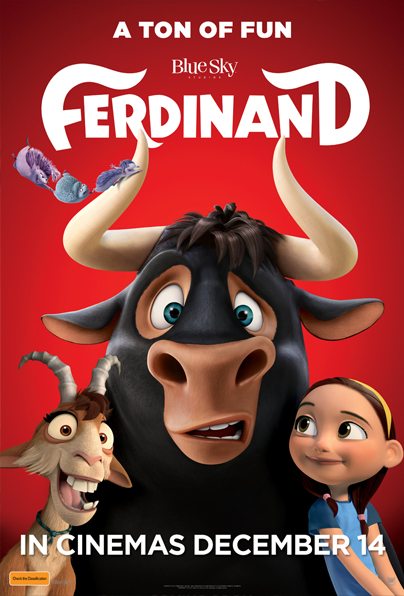
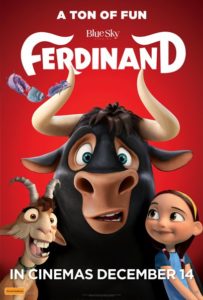
There’s a lot to like in “Ferdinand,” an affectionate version of the book by Munro Leaf about Ferdinand, the bull who did not want to fight; he just wanted to smell the flowers. WWE star John Cena provides a warm, inviting voice for the title character, and Kate McKinnon steals the show as his “calming goat.” The artwork is imaginative and colorful. However, the slight story of the book has been expanded to fill out a feature, and some of the choices are worse than just padding; they are misguided, distracting, even disturbing, especially for the youngest viewers.

Leaf’s original story and the lovely Oscar-winning 1938 Disney animated short are beautifully simple. While most bulls are ferocious and proud to fight matadors, Ferdinand is a gentle soul who just wants to sit under a cork tree and smell the flowers. The men who are looking for the fiercest bull of all arrive just as Ferdinand reacts to being stung by a bee. Mistakenly believing that he is a powerfully furious animal, they bring him to the bullring, where he refuses to fight.

The Disney film is eight minutes long and tells the entire story. This version, from Blue Sky, gives us a meandering tale about Ferdinand, bred in a facility that supplies bulls for bullfighters. As a young calf, he is bullied by the others, especially the alpha bull, Valiente, who suffers from what me might term bovine toxic masculinity.

Ferdinand adores his kind-hearted father (Jeremy Sisto), asking him, “Can I be a champ without fighting?” “I wish the world worked that way for you,” his father says before he leaves for the ring. He never returns home.

Ferdinand runs away and finds a perfect home, a flower farm.  He is adopted by Nina, who is so devoted to him that she has him cuddle on the sofa next to her and sleep in her bed, even after he grows to the size of an SUV.

After an adventure that includes a cleverly-constructed scene in yes, a china shop, Ferdinand ends up back at the ranch, where Lupe (McKinnon), his calming goat, declares that she will be his coach for outsmarting the matador.   Ferdinand learns that the only options for the bulls are the ring or the slaughterhouse. He must rescue two of the bulls who taunted him before they are turned into hamburger, and then find a way to survive the bullring.

McKinnon has the same lighting-fast fluidity of mood and character that made Robin Williams an ideal choice to provide the voice for the genie in “Aladdin.”  She is in constant conversation with her many selves, and it is hilarious.  However.  The palpable padding of the storyline would not be a serious problem except for the misjudgment about the presentation of the fatal options available to the bulls.  It is impossible, even for a child, to watch the rescue from the slaughterhouse without recognizing what all of those scary-awful machines are designed to do.  Parents who do not want to answer some tough questions about dinner — or reconcile themselves to a vegetarian menu — should stick with the Disney version.

Parents should know that this movie has peril and violence, including low-key depictions of a slaughterhouse and a bullfight, as well as some schoolyard language and potty humor.

Family discussion: Why were the other bulls mean to Ferdinand? Why were the horses mean? Why did Ferdinand want to rescue bulls who were mean to him?

If you like this, try: the book and the Disney animated version of this story and the “How to Train Your Dragon” series

Related Tags:


Animation Based on a book DVD/Blu-Ray movie review Remake
THE MOVIE MOM® is a registered trademark of Nell Minow. Use of the mark without express consent from Nell Minow constitutes trademark infringement and unfair competition in violation of federal and state laws. All material © Nell Minow 1995-2026, all rights reserved, and no use or republication is permitted without explicit permission. This site hosts Nell Minow’s Movie Mom® archive, with material that originally appeared on Yahoo! Movies, Beliefnet, and other sources. Much of her new material can be found at Rogerebert.com, Huffington Post, and WheretoWatch. Her books include The Movie Mom’s Guide to Family Movies and 101 Must-See Movie Moments, and she can be heard each week on radio stations across the country.

Website Designed by Max LaZebnik