Maudie

Maudie

Posted on June 22, 2017 at 5:29 pm

B +
Lowest Recommended Age: High School
MPAA Rating: Rated PG-13 for some thematic content and brief sexuality
Profanity: Mild language
Alcohol/ Drugs: Alcohol, smoking
Violence/ Scariness: Tense family confrontations, domestic abuse, illness, sad death
Date Released to Theaters: June 24, 2017
Date Released to DVD: October 10, 2017
Copyright Sony Pictures Classics 2017

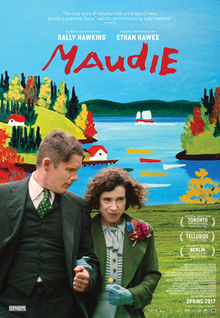
Maudie Lewis was severely disabled and abused. She lived in a tiny house with no electricity or running water in the unforgiving climate of Nova Scotia. And she decorated her tiny world with vibrant, joyful images that captivated the people who came to her door to buy them, usually for as little as $5. Her home, the walls covered with bright flowers and birds and cats painted over 35 years, is now seen by art lovers in the museum where it has been lovingly preserved, and she is recognized as one of the foremost “outsider” (untrained) artists of the mid-20th century.

In “Maudie,” the infinitely gifted Sally Hawkins gives an incandescent performance as the woman whose indomitable spirit shines through her art.

After her parents died, Maudie lived with an aunt who treated her with contempt. She left to take a job as a live-in housekeeper for Everett Lewis (Ethan Hawke), a fisherman taciturn to the point of being a recluse. “You walk funny. Are you a cripple?” he asks bluntly. And he tells her that she comes after the dogs and the chickens in importance. And that he expects her to sleep in his bed as a part of the job. When he wants more, she tells him that he must marry her, and he does.

With some leftover house paint, holding the brush in her arthritic fingers, she paints a flower on the wall. And surprisingly, Everett does not disapprove; he only tells her to leave one section of the wall alone. A summer visitor from the US spots one of her paintings and brings it back to New York. Vice President Richard Nixon buys one, too. Everett is glad for the income and worried that Maudie will become independent and leave him.

Director Aisling Walsh insisted on filming on location and created a meticulous replica of the tiny Lewis home, and the setting itself, bleak and beautiful, with minimal musical score becomes a character in the film. So do Maudie’s pure, simple paintings, expressing her unquenchable joy in observing the world around her and in expressing what she sees. Hawkins is a marvel in every scene; like Maudie herself, she commits herself completely to the creative spirit.

Parents should know that this film includes sexual references and situations, references to out of wedlock child, mistreatment of disabled character, and a sad death. Characters drink and smoke.

Family discussion: Why did Everett tell Maudie not to paint one part of the wall? Why did he change his mind about selling the painting she said was not finished? What was happiness to Maudie?

If you like this, try: “The Straight Story”
Related Tags:


Based on a true story Drama DVD/Blu-Ray Pick of the Week Romance
The Beguiled

The Beguiled

Posted on June 22, 2017 at 5:22 pm

B
Lowest Recommended Age: Mature High Schooler
MPAA Rating: Rated R for some sexuality
Profanity: Mild language
Alcohol/ Drugs: Some alcohol
Violence/ Scariness: War (off-screen), injuries, murder
Diversity Issues: Gender issues
Date Released to Theaters: June 23, 2017
Copyright 2017 Parmount

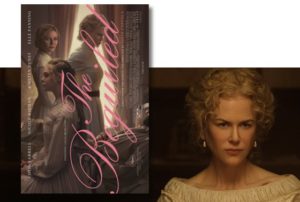
Writer/director Sofia Coppola has taken a 1971 Clint Eastwood movie about a wounded but manipulative Civil War soldier cared for and disruptive of the staff and students of a small girls’ school and reframed it as a story about the staff and students of a small girls’ school who care for and are disrupted by a wounded Civil War soldier. It is not so much telling the story of the spider and the fly from the perspective of the fly; it is more like telling the story with the women as the spider.

From her first film, “The Virgin Suicides,” through “Marie Antoinette,” “The Bling Ring,” “Lost in Translation,” and “Somewhere,” Sofia Coppola has been transfixed by stories of slender, ethereal young women who are a bit lost in a world created by powerful but inadequate men, and she has done her best to transfix the audience as well. Her next project, “La Traviata,” the story of a consumptive courtesan who turns out to be more noble than the man she loves, is certain to fit this pattern as well.

It is impossible to consider this latest work, a remake of a film directed by and starring two of the most testosteronic filmmakers in movie history, without that context. And that context is increasingly repetitive, with each iteration revealing not only the limits of the individual film but also the lacunae of the previous ones as well. What once seemed intriguing, mysterious, and thoughtful now appears, when the work is viewed as a whole, as superficial. It turns out that what was omitted was not because it was subtle and deep but because she had nothing more to say. While this film touches on issues of war (and warring emotions), it eliminates the slave character played in the first film by Mae Mercer, because there is really no way to do that relationship justice and any attempt to do so would throw the rest of the story off balance.

It is a pity, because she is just so good with the externals. The settings, costumes, music, and performances in her films are always superb, which makes the dispiriting emptiness even more disappointing.

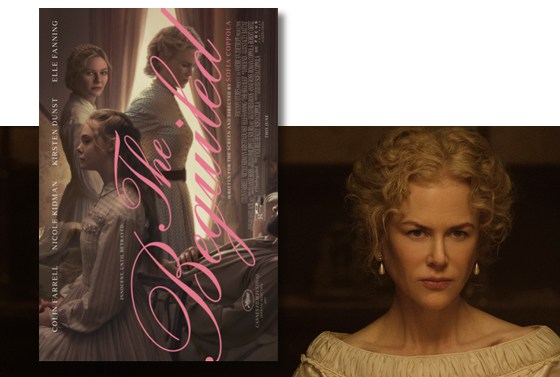
Martha Farnsworth (Nicole Kidman) runs a small boarding school for girls, a retreat precariously close to Civil War battles being fought nearby. When one of the girls is out gathering mushrooms in the woods, she discovers a wounded Union soldier, John McBurney (Colin Farrell) and she brings him back to the school for treatment. Miss Farnsworth is not pleased, but she cannot turn him away. She treats him and tries to keep his presence as a male and an enemy combatant from disrupting the students and her co-teacher, Edwina Dabney (Kirsten Dunst). But he is a novelty and a distraction especially for those who long, perhaps unaware how much, for male attention.

McBurney has a gift for making each female in the house feel that he is what they most want him to be, from the teenager (Elle Fanning) to the widow (Dunst). “I’m grateful to be your prisoner,” he says. At first, he is gracious, unassuming, and charming. But he becomes a more ominous presence, dividing and disrupting the women until they take drastic action.

Kidman and Dunst are outstanding, representing two very different reactions to the intruder. It is precisely presented, even beguiling, but Coppola needs to move on or go deeper.

Parents should know that this film contains peril and violence including war (mostly offscreen), a wounded soldier, an accident, amateur surgery, mutilation, and murder, as well as sexual references and a situation, alcohol, and some strong language.

Family discussion: How did McBurney assess the vulnerabilities of each of the women and girls? How does this version reflect our era in differing from the original?

If you like this, try: the original version with Clint Eastwood

Related Tags:


Based on a book Drama Horror Movies -- format Movies -- Reviews Remake War
Transformers: The Last Knight

Transformers: The Last Knight

Posted on June 20, 2017 at 5:37 pm

D
Lowest Recommended Age: Middle School
MPAA Rating: Rated PG-13 for violence and intense sequences of sci-fi action, language, and some innuendo
Profanity: Strong language, many s-words and crude insults
Alcohol/ Drugs: None
Violence/ Scariness: Extended sci-fi/fantasy violence, fire, guns, explosions, chases, characters injured and killed, reference to suicide
Date Released to Theaters: June 21, 2017
Date Released to DVD: September 25, 2017
Copyright 2017 Paramount

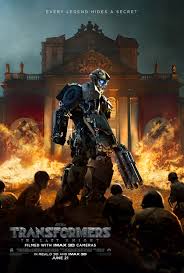
It is time to stop the madness. I only wish this was called “Knight: The Last Transformers Movie.” I am as happy as anyone to see robots transforming into cars and cars transforming into robots and I freely admit to tearing up once when it appeared that Bumblebee might have been mortally wounded. I’m very fond of Sir Anthony Hopkins, and I’m also very fond of Mark Wahlberg. But this big, loud, dumb, dull, nonsensical dud of a movie is two and a half excruciating hours long.

Wahlberg returns as inventor-turned-renegade Autobots protector Cade Yeager. The government has set up a special branch of the military to get rid of all of the transformers, making no distinction between the honorable Autobots led by Optimus Prime and the evil Decepticons led by Megatron. We see in a prologue set in the time of King Arthur that the Transformers go back more than 1000 years, when Merlin, who turns out to have had no magical skills at all, was given the “weapon of ultimate power,” a staff that enabled Arthur and the Knights of the Round Table to win some battle with the help of a pretty impressive three-headed dragon. The staff and an amulet that is somehow connected to it will be the McGuffins that everyone will be looking for despite the fact that we never really find out what they can do.

Sure, the stunts are fun, and I especially enjoyed seeing Wahlberg leap from drone to drone like he was a stone skipping on a pond. But without a clear idea of the stakes there is no heft to them; it’s just pixels.

And the dialog — I can’t say which is worse, the painful attempts at banter (there’s an intended-to-be cute but isn’t at all riff on the homonyms “chaste” and “chased”), the exposition-heavy portentousness (“Where in Hell is your so-called magician?” “He will be here, Lancelot.” “Why do we tell ourselves these stories? We want to believe we can be heroes in our own lives.” “Do you seek redemption?” “Only a direct descendant of Merlin can wield this instrument of immense power!”), or the faux meaningful (“You are more important than you can possibly imagine”). If someone has to be spouting off idiotic explanations, though, at least most of it is in the beautifully husky Welsh voice of Sir Anthony (though his character’s ripping a page out of an antique library book is the most disturbingly violent act in the film).

Not much makes sense in “Transformers: The Last Night.” I’m not talking about why a robot would smoke a robot cigar-type sense. We expect that going in. But why would a robot want to eat a car?
And I’m talking about the basic elements that are necessary to connect to what is going on. How do you kill a Decepticon? Sometimes robots blow apart and sometimes they just come back together like in “Terminator 2.” How do we know how we are supposed to feel if we don’t know what the impact/import of a hit is? That all-powerful weapon? We never understand what it can do and it doesn’t seem very powerful after all. What is the point of Tony Hale spouting off about physics? I will note that one completely deranged moment was actually quite fun, when a C-3PO rip-off (acknowledged as such!) turns out to be the source of the dramatic organ music in one scene: “I was making the moment more epic.” A bit more deliriously loopy stuff like that would have been a step in the right direction.

What is the point of all the jokes about how a professor at Oxford should be looking for a husband? (Or a wife?) What is the deal with way too many daddy issues? Everyone in this movie seems to be a daughter looking for a daddy or a daddy looking for a daughter. As for this daughter, I’m just looking for a good summer stunts and explosions movie. Still looking.

Parents should know that this film includes extended sci-fi/fantasy peril and violence with chases, explosions, swords, guns, and monsters. Human and robot characters are injured and killed. Characters use strong and crude language and there is some dumb sexual humor.

Family discussion: Does it matter that Cade is “chosen?” Which Transformer is your favorite and why?

If you like this, try: the other “Transformers” movies and the television series

Related Tags:


3D Action/Adventure Based on a television show DVD/Blu-Ray IMAX movie review Movies -- format Series/Sequel
The Book of Henry

The Book of Henry

Posted on June 15, 2017 at 5:37 pm

D
Lowest Recommended Age: High School
MPAA Rating: Rated PG-13 for thematic elements and brief strong language
Profanity: Brief strong language
Alcohol/ Drugs: Drinking and drunkenness, drug reference
Violence/ Scariness: Theme of child sexual abuse, attempted murder, suicide, medical issues, sad death, peril
Diversity Issues: None
Date Released to Theaters: June 17, 2017
Date Released to DVD: October 2, 2017
Copyright 2017 Focus Features

I’ve got a pretty high tolerance for movies, even syrupy ones, about super-gifted kids and am generally willing to give them some leeway as metaphor or fairy tale.  So I’m okay with “August Rush,” “Pay it Forward,” “A Monster Calls,” etc.  But “The Book of Henry” crosses the line from syrupy to smarmy, and where it wanted to be endearing, it was annoying, and then infuriating.

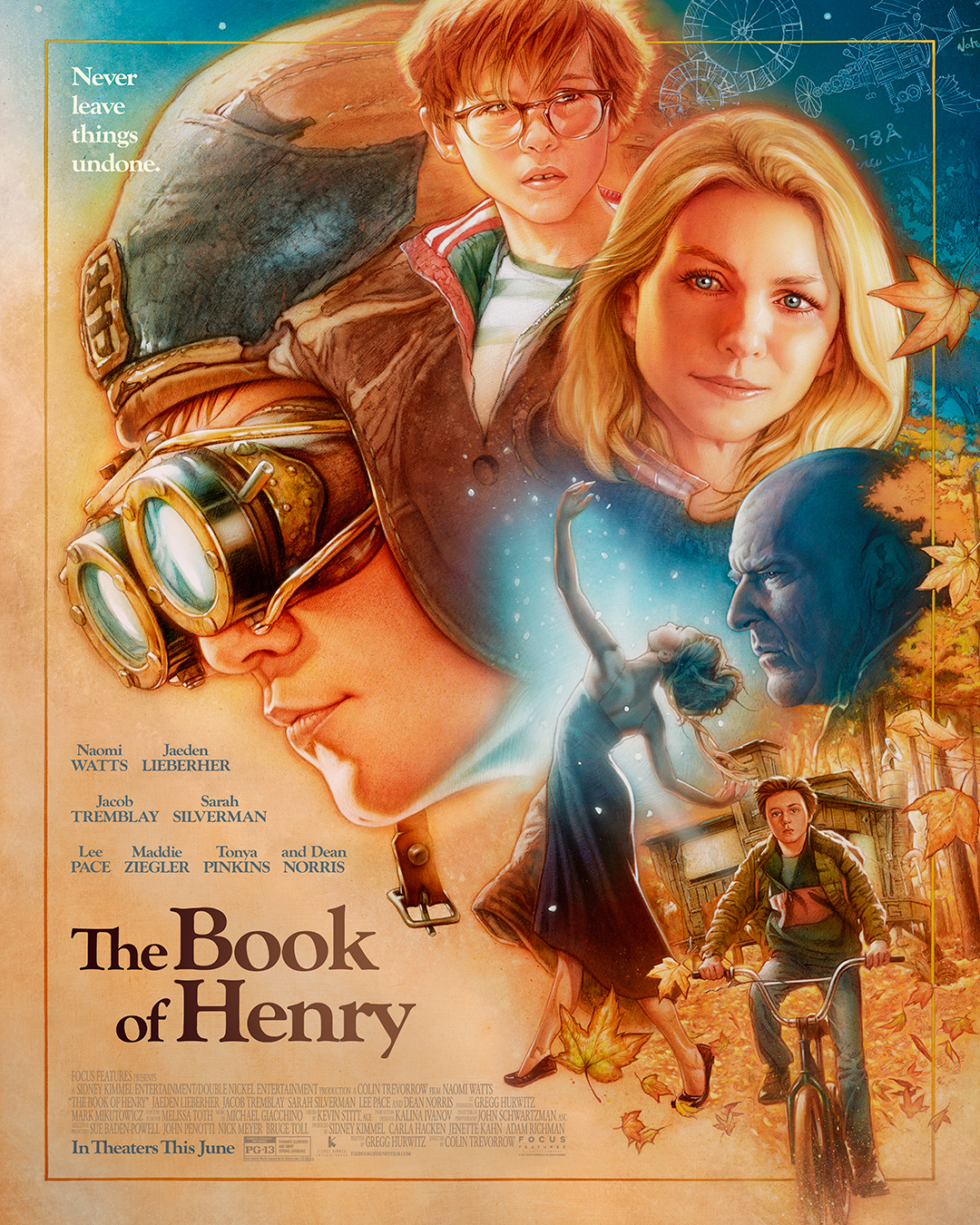
Jaeden Lieberher, who is making a career out of playing preternaturally wise and powerful children, has the title role as Henry, an 11-year old who is the kind of genius only found in movies. Not only is he a total braniac who understands architecture, finance, electronics, existential conundrums, weapons, and engineering, he has a rapier wit and knows the difference between different kinds of tumors and can read an MRI. Furthermore, he is a near-empath who instantly understands the people he cares about. In other words, he is not a character; he is a symbol and his purpose in the story is to give other characters important life lessons.

Henry has a younger brother, Pete (Jacob Tremblay of “Room”), who is in the movie to play the role of Normal Kid. And they have a mother, Susan (Naomi Watts), who is loving and devoted but irresponsible. Henry is the grown-up in the family, stopping at a phone booth after school to place complicated brokerage orders.

Let’s pause for a moment on that last point. Yes, I said phone booth. Even though the movie takes place sort of now (there are cell phones, a coffeemaker, video games, and a super-duper weapon), it has a deliberately retro feel. Henry and Pete use old walkie-talkies, barely a glimpse of a laptop (who needs one; Henry’s a walking Wikipedia). Susan is a waitress at a diner that could be out of the 1950’s, though her boss (“SNL’s” Bobby Moynihan) offers to pay her by direct deposit. You do not need to be Henry to figure out that this is supposed to lull us into cutesy-ness.

Henry has a crush on the girl next door, a classmate named Christina (Sia muse Maddie Ziegler), who lives with her stepfather, Glenn (Dean Norris), the town’s police commissioner. Henry senses that Glenn is abusing Christina. When Glenn’s position of power makes it impossible to protect her through official channels, he comes up with a dangerous plan to keep her safe.

To say more would be to risk spoilers, so I will just note that pretty much everything that happens after that is intended to be touching and poignant but  none of it is .   Lee Pace does his best with the thankless role of Doctor Perfect, who would make Prince Charming look like the guy who gets eliminated in the first episode of “The Bachelorette.” And Sarah Silverman adds some sass as Susan’s best pal, who joins her in wisecracks about how they aren’t rich and in getting drunk.  Christina has a lovely dance number in the school talent show.  And Watts is marvelous as always.  But the story’s preposterousness and manipulation thwarts their best efforts to provide some grounding.

Parents should know that the movie’s themes include child sexual abuse, attempted vigilante murder, and a very sad death of a child, and suicide. There is some strong language, a drug reference, and drinking and drunkenness.

Family discussion: What should Susan have done about the couple in the store? What made Susan change her mind?

If you like this, try: “Phenomenon” and “Disturbia”

Related Tags:


DVD/Blu-Ray Family Issues Stories About Kids
Cars 3

Cars 3

Posted on June 15, 2017 at 5:23 pm

B
Lowest Recommended Age: Kindergarten - 3rd Grade
MPAA Rating: G
Profanity: None
Alcohol/ Drugs: None
Violence/ Scariness: Peril and some violence including fiery car crashes, references to sad death
Diversity Issues: Diverse characters
Date Released to Theaters: June 17, 2017
Date Released to DVD: November 6, 2017
Copyright Disney/Pixar 2017

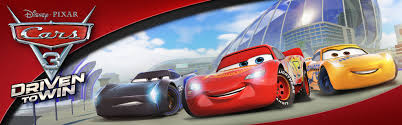
It’s better than “Cars 2,” but not as good as the first “Cars,” so it continues the saga of the second tier of Pixar movies.  Second-tier Pixar is pretty good. But this time the storyline is unlikely to be of much interest to children.  They’ll enjoy the race scenes (except for the ones that are too scary) and the silly humor.  But the theme of this film is the existential dilemma of an aging athlete.  While “Inside Out” and “Toy Story 3” addressed issues of growing older/up with infinite tenderness and sensitivity, “Cars 3,” with the help of generous samples of Paul Newman’s Doc Hudson character from the first film, has appropriated the plots of many of the “Rocky” movies, with now-champion Lightning McQueen (Owen Wilson) confronted with his own mortality.  I know; they’re machines, but apparently they have parents and childhoods and lifespans.

Lightning is beaten by a super-slick competitor dashingly named Jackson Storm (Armie Hammer), who looks like he is visiting from another Disney movie, “Tron.”  And there’s another blow.  Lightning has loved being sponsored by his friends at Rust-Eze, but the company has been sold and his new sponsor is the smooth, corporate Sinclair (Nathan Fillion), who tells him that if he does not win his next race, he has to stop racing all together.

But racing is all Lightning knows or cares about.  If he can’t race, who is he?

Sinclair has a very high-tech training facility that’s all about cybermetrics. Lighting is assigned a new trainer, Cruz (Cristela Alonzo), who is essentially a stopwatch on wheels.  Everything is about readouts and algorithms.  Lightning takes her out on the beach to show her what real racing is.  And he decides that his mentor, Obi-Wan Kenobi, I mean Doc Hudson, may be gone, but perhaps he can find Doc’s mentor, and gain some wisdom.

Lighting and Cruz end up competing in what they think is a race but what turns out to be a demolition derby (pretty scary for G).  They squabble and make up and Cruz confides that she once dreamed of racing.  They do find Doc’s old friends, led by Smokey (Chris Cooper) and his adorable sidekicks.

It has talking cars, and kids will like that. And it doesn’t have the bombast and over-complexity of “Cars 2.”  But it also does not have the heart we have come to rely on from Pixar, and if we feel disappointed, it is only because they have set the bar so high.

Parents should know that despite the G rating, this film has characters in peril including scary 3D car crashes and fire, many references to a sad death and to the challenges of aging, and a reference to unsupportive parents.

Family discussion: Why did Lou take other children’s toys? Who is your mentor and who can you help as Doc Hudson helped Lightning?

If you like this, try: the other “Cars” movies and “A Bug’s Life”

Related Tags:


3D Animation DVD/Blu-Ray Pick of the Week Fantasy Movies -- format Scene After the Credits Series/Sequel
THE MOVIE MOM® is a registered trademark of Nell Minow. Use of the mark without express consent from Nell Minow constitutes trademark infringement and unfair competition in violation of federal and state laws. All material © Nell Minow 1995-2026, all rights reserved, and no use or republication is permitted without explicit permission. This site hosts Nell Minow’s Movie Mom® archive, with material that originally appeared on Yahoo! Movies, Beliefnet, and other sources. Much of her new material can be found at Rogerebert.com, Huffington Post, and WheretoWatch. Her books include The Movie Mom’s Guide to Family Movies and 101 Must-See Movie Moments, and she can be heard each week on radio stations across the country.

Website Designed by Max LaZebnik