Cats

Cats

Posted on December 19, 2019 at 5:09 pm

C
Lowest Recommended Age: Middle School
MPAA Rating: Rated PG for some rude and suggestive humor
Profanity: Some mild language
Alcohol/ Drugs: None
Violence/ Scariness: Threats, dusting-style disappearances, portrayal of afterlife/reincarnation
Diversity Issues: None
Date Released to Theaters: December 20, 2019
Date Released to DVD: April 6, 2020
Copyright 2019 Universal

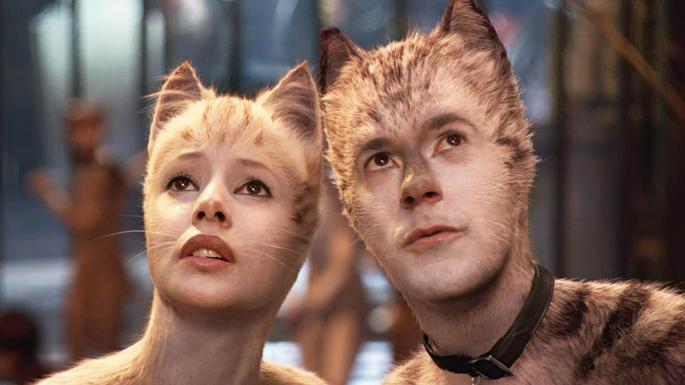
I was not hoping for much from “Cats.” I knew that the record-breaking, popular-for-decades Broadway musical did not have much of a plot, just songs with lyrics from the poetry of T.S. Eliot and music by Andrew Lloyd Webber and spectacular dancing. So that’s all I hoped for — an all-star cast singing and dancing. Some of the singing is fine, and the dancing is great, when you can see it, but the whole thing is so badly misbegotten that it does its best to keep its most entertaining elements out of sight.

I mean that literally. There’s one simple rule, going back to the days of Fred Astaire, for dance in movies: get the camera out of the way and let the audience see the dance as fully as possible. We want to see the shapes the bodies make, we want to feel the way they interact with the rhythm and with each other, and we want to see their feet. There are dance numbers in “Cats” where the camera moves away from the feet or out of beat with the rhythm. Why? They also give “Memory,” one of the most iconic songs of the last 30 years to Jennifer Hudson, one of the greatest singers of the last 30 years and have her put most of her energy into emotion instead of singing.

The movie’s credits highlight ballerina Francesca Hayward in her first film appearance, playing the young ingenue cat, Victoria. She is thrown into the garbage inside a sack at the beginning of the film, and we learn about the world of the cats as it is explained to her. The various felines introduce themselves, including Jennyanydots (Rebel Wilson) the house cat, who teaches mice and even cockroaches to sing and dance, the magician Mr. Mistoffelees (Laurie Davidson), the down-at-the-paws Grizabella (Jennifer Hudson), filled with regret and self-doubt, “the tap-dancing railroad yard cat Skimbleshanks (Steven McRae), and the wicked Macavity (Idris Elba) “the Napoleon of crime.”

Presiding over everyone is the magisterial Old Deuteronomy (Dame Judi Dench), who has the power to select one “jellicle” cat (a term Eliot made up) for a second chance at life. As cats comes forward to introduce themselves, it’s like a feline “Chorus Line,” everyone auditioning for that one big chance.

All of that would be fine if there was some joyful energy behind it, but it is mostly just dreary. Some of the musical numbers, especially McRae’s tap dance, could could have provided that lift if the camera would have stopped long enough to let us see what he was doing. Taylor Swift brings all of her considerable Swiftian panache (though an uncertain hold on an English accent) as Bombalurina, but the movie then sinks back into its trudgey tempo, leaving us to wonder at the furry costumes with ears and tails constantly twitching, so skin-tight it only emphasizes the human and decidedly un-feline forms and movements. It’s a close call what we get more of, silly “cat got your tongue”-style references, the word “jellicle” or Hayward’s lovely face, even in fur and whiskers, which director Tom Hooper keeps cutting back to. Not to sound catty, but it just reminds us how much less enthralled we are than she is.

Here’s a tip. “Cats” is a purely theatrical experience. You want to make a movie about it? Try making it about a theater troop putting it on, and try not have it turn unto “Noises Off.” Even if it did, it would be more entertaining than this version.

Parents should know that this film includes some mild sexual references, nuzzling, some disturbing dusting-style disappearances and death references, and sad songs.

Family discussion: What do you think “jellicle” means? Do you agree with Deuteronomy’s choice? Which was your favorite cat and why?

If you like this, try: “The Fantastcks” and “Nine”
Related Tags:


Based on a book Based on a play DVD/Blu-Ray Fantasy movie review Movies -- format Musical Talking animals
Star Wars: The Rise of Skywalker

Star Wars: The Rise of Skywalker

Posted on December 18, 2019 at 6:23 am

B +
Lowest Recommended Age: Middle School
MPAA Rating: Rated PG-13 for sci-fi violence and action
Profanity: Mild language
Alcohol/ Drugs: None
Violence/ Scariness: Extended sci-fi/action-style peril and violence, sad death, characters injured and killed, some disturbing images
Diversity Issues: None
Date Released to Theaters: December 19, 2019

Copyright 2019 20th Century Fox
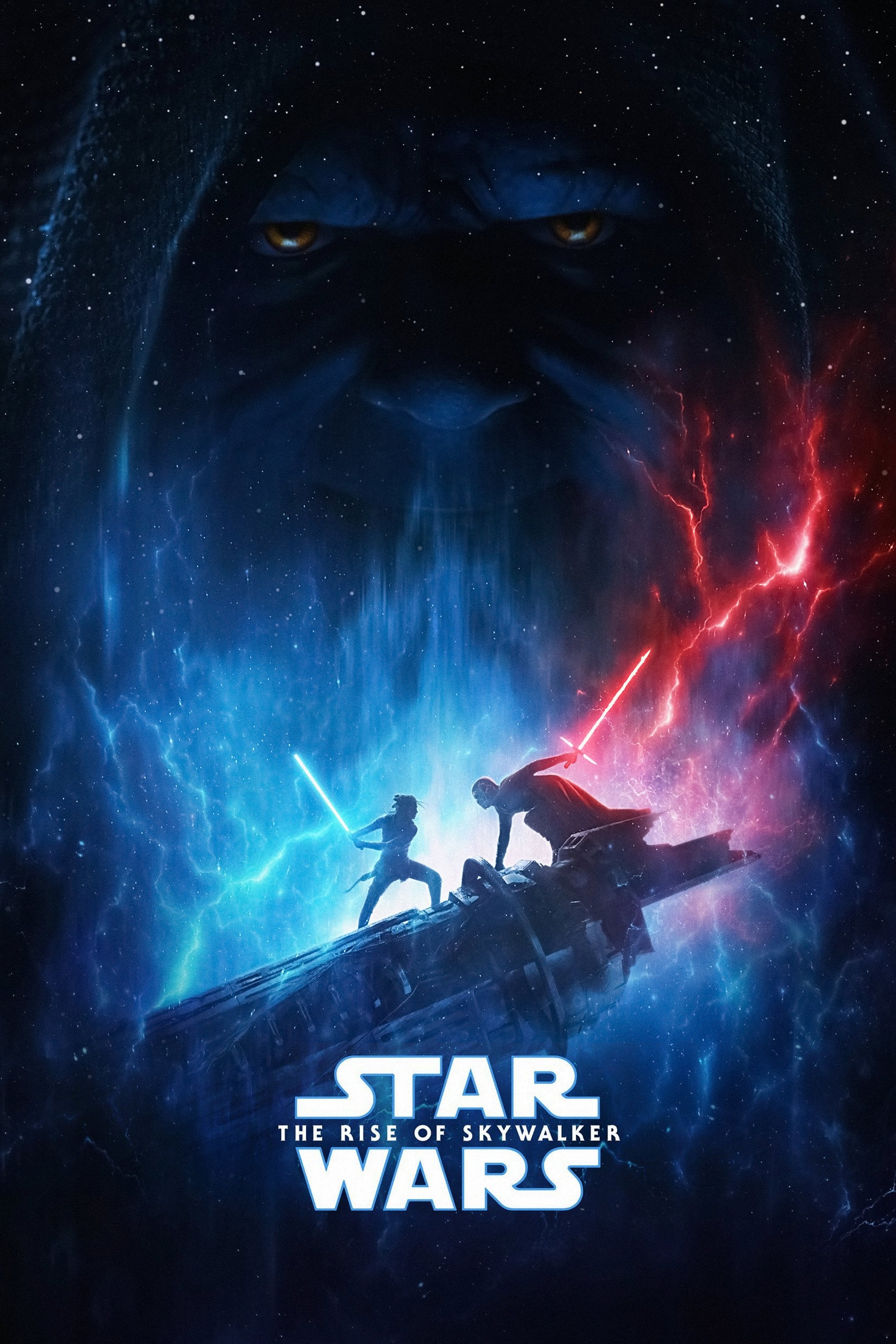
Nine episodes in, not counting the countless auxiliary expansions and storylines, “Star Wars” is still a place I love to go. But nine episodes and more than four decades since the original film, now called “Episode IV: A New Hope,” the franchise faces some daunting challenges, including balancing the weight of precedent with the need for something new and the expectations, and in many cases encyclopedic knowledge of the fans. I liked this last in the original storyline, despite some problematic elements I will do my best not to spoil — and alert to any possible spoilers before I even get close, I promise. Here’s the non-spoiler headline: I predict that this episode will divide the fans into two camps. Those who liked the last two films, “The Last Jedi” and “The Force Awakens” will not like this one as much. Those who were disappointed by those will like this one better.

Now, go see the movie if you do not want to hear more, and come back afterwards to see what else I have to say so you can argue with me.

Once again, the heart of the story is Rey (Daisy Ridley), the former scavenger turned student of the force and Jedi trainee with Luke Skywalker (Mark Hamill), and her friends and colleagues, former Storm Trooper Finn (John Boyega) and hotshot, hothead pilot Poe Dameron (Oscar Isaac). Let’s take a moment to honor their superb performances, which have given so much to the series. In the midst of all of the action and hardware and locations and just-in-time rescues, all three of them have created vital, vibrant characters who give us a reason to care about all of the action. We also get to see the characters from Episode IV, including Carrie Fisher as Princess (now General) Leia, Hamill as Skywalker, Harrison Ford as Han Solo, and Billy Dee Williams as Lando Calrissian, along with droids C-3PO and R2D2 and the Wookiee, Chewbacca. And the conflicted nemesis Kylo Ren (Adam Driver) is back, along with General Hux (Domhnall Gleeson). There’s a brief surprise appearance that had people in the theater cheering, and a return to an iconic location.

So, much is familiar. At the end of “The Last Jedi” the rebel forces were almost entirely wiped out, with no response to their distress signals. And the bad guys who are ruthless fascists, want to take over that galaxy far, far, away. You might think there are only so many times someone can say “If this mission fails, it’s all been for nothing,” but I admit freely, for me, at least a couple more.

Remember how “New Hope” kicked off by sending a secret spy message to Obi-Wan Kenobi? Well, here we are again, with a message from a mole — perhaps we might call him/her a whistleblower — inside the bad guy organization. I do not want to give too much away by saying what they are calling themselves now or who is behind it. I will only say that the message shows they are planning some very bad stuff and the Death Star looks like a slingshot by comparison with what they have now.

So It is time to get Rey back from Luke’s remote island retreat, something between a spa and boot camp. One question is whether Kylo Ren will be on board. He is literally offered “everything” if he will just prove himself by killing Rey, and the glints of red reflecting in his eyes suggest that rage is still his primary motivation. His connection to Rey, including a sort of psychic Skype communication they have with each other across the galaxy, could make him waver. Or, it could make her waver. He offers her the same “everything” he is tempted by.

This is not about the set-up, though; it is about the adventure, and J.J. Abrams takes us from one planet to another, with chases, escapes, explosions, and new characters. I was disappointed that this movie did not pick up on some of the most intriguing elements of “The Last Jedi” and even more disappointed that it countermanded one I considered among the most significant, SPOILER ALERTS tilting some of the series’ most fundamental existential premises away from individual determination toward a less appealing notion of destiny pre-ordained. I did not care for some new Force powers, which also undermine the original trilogy’s premises, or for some of the developments of the last half hour. I did enjoy some new characters, including one from Poe’s past played by Keri Russell and a rebel alliance-friendly group who ride horse-like creatures and even use a bow and arrow, a nice break from all the laser beams and spaceships. There’s a kind of nutty detour to a sort of Ren Faire that was a hoot. One of my favorite characters continues to be the Millennium Falcon (pronounced both FALL-kin and FAAL-kin here!), and I loved every minute it was on screen. I got a kick out of the callbacks, including an “I’ve got a bad feeling about this.”

Abrams was given thousands of threads to tie together, and if what he wove is uneven it is heartfelt and mostly a lot of fun to watch. That is all the force I need.

Parents should know that this film includes extended sci-fi/action peril and violence with some graphic and disturbing images, sad deaths, and characters who are injured and killed.

Family discussion: How did what she learned change Rey’s ideas about herself? Why did Leia pick Poe?

If you like this, try: the other “Star Wars” films and the work of Joseph Campbell, who was one of George Lucas’ inspirations in creation the series

Related Tags:


Action/Adventure Fantasy movie review Movies -- format Movies -- Reviews Science-Fiction Series/Sequel
Jumanji: The Next Level

Jumanji: The Next Level

Posted on December 14, 2019 at 9:24 pm

B +
Lowest Recommended Age: Middle School
MPAA Rating: Rated PG-13 for adventure action, suggestive content and some language
Profanity: Some schoolyard language, brief strong language
Alcohol/ Drugs: None
Violence/ Scariness: Extended video game action style peril and violence, issue of terminal illness
Diversity Issues: Diverse characters and issues of diversity
Date Released to Theaters: December 13, 2019
Date Released to DVD: March 16, 2020

Copyright 2019 Columbia
My review of Jumanji; The Next Level is on rogerebert.com — an excerpt:

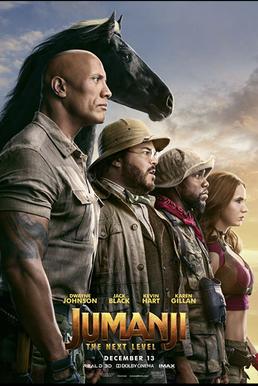
Like its predecessor, this latest “Jumanji” movie combines fantasy action and adventure with some comedy, a touch of romance, and real-life lessons about courage, friendship, and empathy—all with the help of some low-key race and gender fluidity….Johnson was terrific as Spencer in the first film, a humorously exaggerated version of an adolescent discovering the power of adulthood. But as the outer version of Spencer’s cranky grandfather, he’s clearly having more fun. He barely notices the surreal concept of being trapped inside a video game (he does not appear to be entirely sure what a video game is), and is much too busy swiveling hips that for the first time in years have a full range of motion. Johnson/Bravestone as Spencer was something to aspire to, in a future that still seemed filled with infinite potential, but Johnson/Bravestone as Eddie is filled with the bucket list delight of someone who sees nothing but loss ahead. Hart is especially good at toning down his usual peppery energy as the avatar for the slow-talking Milo, whose avatar’s strength is languages but who retains his discursive style. Black and Awkwafina both have a chance to represent more than one of the human characters, making each one distinct and clever.

The fantasy of the avatars, with their assigned strengths and weaknesses, make it possible for the characters to become more honest with themselves and each other. As with the first film, the humor and excitement are nimbly balanced so it never gets too scary or silly, and the focus is more on friendship than romance. This time, there is a light touch of poignance as well that makes the message about friendship more meaningful. And like all good video games, there’s a hint of yet another level at the end for those, like me, who are not yet ready to say Game Over.

Parents should know that this film icludes video game-style peril, action, and adventure, some strong language, brief crude humor (references to eunuch character), and issues of aging and terminal illness.

Family discussion: If you were a game avatar, what would your strengths and weaknesses be? What did the characters learn from being different races and genders?

If you like this, try: “Jumanji: Welcome to the Jungle” and “Journey to the Center of the Earth”

Related Tags:


Based on a book DVD/Blu-Ray Fantasy movie review Movies -- format Series/Sequel
Richard Jewell

Richard Jewell

Posted on December 12, 2019 at 5:42 pm

B-
Lowest Recommended Age: High School
MPAA Rating: Rated R for language including some sexual references, and brief bloody images
Profanity: Very strong language
Alcohol/ Drugs: Alcohol
Violence/ Scariness: Bombing, explosions, characters injured and killed, brief disturbing images
Diversity Issues: Portrayal of female professional using sex to manipulate men
Date Released to Theaters: December 14, 2019
Date Released to DVD: March 16, 2020
Copyright Warner Brothers 2019

Erik Erikson said that at each stage of life we have a choice between growth, learning, and compassion and fear, immaturity, and self-absorption. The final choice he posed was for old age, when people have to choose between ego integrity (satisfaction and completeness at the end of life, a sense of having made a difference) or despair (being lost, lacking a sense of purpose). (I highly recommend “Everybody Rides the Carousel,” an animated film from John and Faith Hubley, illustrating Erikson’s theories.) Two big end-of-the-year releases by two men, one in his 70’s, the other almost 90, seem to come down on different sides.

Martin Scorsese’s “The Irishman” is a movie by old men about what it is to be old, to be looking back on the choices you’ve made and the consequences they have had. The characters in the film, based on real people and their sometimes questionable stories, committed brutal crimes. The movie never excuses their behavior, but it portrays them in a complex, humane, elegiac manner.

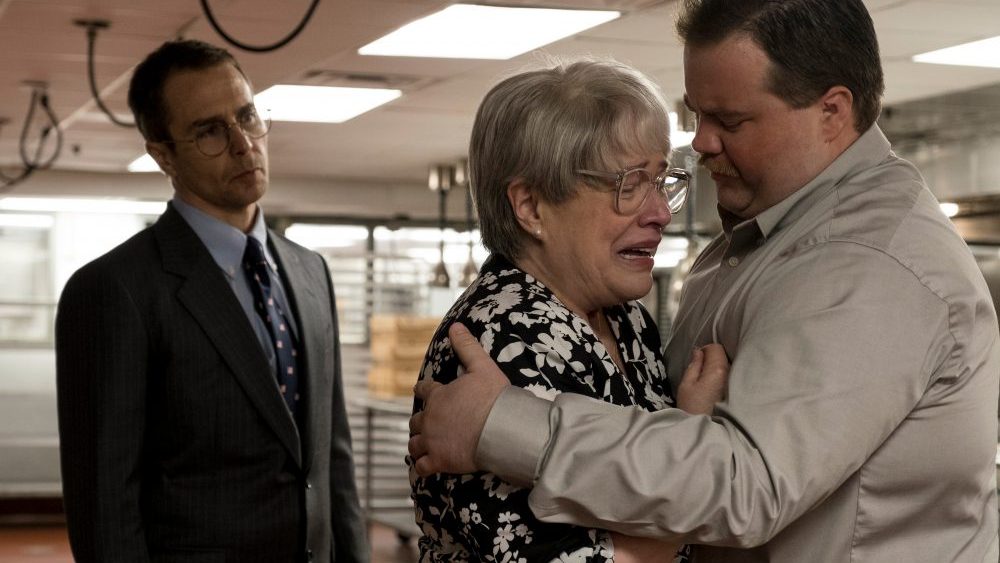
89-year-old Clint Eastwood has made “Richard Jewell,” also based on a true story, this one about a man who was accused of a crime he did not commit. Richard Jewell (Paul Walter Hauser) was pudgy and his social skills were uneven. He was fascinated with order and authority and wanted very much to be a police officer. He lived with his mother and he had a lot of guns (“This is Georgia,” he shrugs.) He fit the profile and was an easy target in a city desperate to keep the international athletes, IOC officials, and media confident that everything was under control.

One of three films this month about real-life heroic lawyers who fought near-insurmountable odds to bring justice (the other two are “Dark Waters” and “Just Mercy”), this could have been a heartwarming story, but Eastwood’s cranky “get off my lawn” perspective cannot resist overdoing it as though he was talking to an empty chair. Instead of a movie about a guy who was the victim of the FBI under pressure to find a culprit and the media frantic to find a story. Eastwood is so sure we will not be able to figure out who the bad guys are that he all but has them wear signs.

It isn’t just this FBI agent who is wrong; it’s the government. And it isn’t this reporter or this newspaper that is wrong; it’s the media. It is not enough that the reporter’s first reaction on hearing that there has been a bombing is to hope that the bomber is story-worthy. Eastwood has to make her trade sex for information. (She is dead now, but her newspaper has demanded that the movie make clear it is not an accurate representation.) Our hero, meaning the lawyer, played by the always-great Sam Rockwell, has a bumper sticker in his office that says, “I fear government more than I fear terrorism.” JUST IN CASE WE DON’T GET THE POINT.

It’s a shame because the story has an even more important lesson in this era of social media, citizen “journalists” and milkshake ducks. But the shrill tone of the film gets in the way, especially in its portrayal of the reporter as not just irresponsible about the facts but willing to trade sex for a story. Pro tip: if you are going to make a movie about how terrible it is that the media exaggerates and lies, try not to do that in the movie itself.

Parents should know that this movie includes very strong language and a bombing with some brief disturbing images. Characters drink alcohol and a woman use sex to get information.

Family discussion: Why was Richard Jewell a suspect? Why did Watson believe him?

If you like this, try: “Sully” and “American Sniper” from the same director

Related Tags:


Based on a true story Drama DVD/Blu-Ray movie review Movies -- format
Bombshell

Bombshell

Posted on December 12, 2019 at 5:38 pm

B +
Lowest Recommended Age: Mature High Schooler
MPAA Rating: Rated R for sexual material and language throughout
Profanity: Very strong and crude language
Alcohol/ Drugs: None
Violence/ Scariness: Sexual pressure and harassment
Diversity Issues: A theme of the movie
Date Released to Theaters: December 13, 2019
Date Released to DVD: March 9, 2020

Copyright 2019 Lionsgate
The word “bombshell” works both ways as the title of this film based on the true story of the #metoo moment that rocked the powerful leadership of Fox News and brought down its visionary founder Roger Ailes. “Bombshell” means a very attractive woman (check out the Jean Harlow movie of the same name, about a gorgeous movie star, and the documentary of the same name, about Hedy Lamar). And “bombshell” also means a shocking piece of news. Both are equally apt.

Those who watched “The Loudest Voice in the Room” on Showtime know that Ailes transformed the news media by creating a network that had two important innovations: gorgeous women in revealing clothes delivering news stories slanted toward white people who think their victimhood has been overlooked. As an executive puts it in this film, “You have to adopt the mentality of an Irish street cop. The world is a bad place. People are lazy morons. Minorities are criminals. Sex is sick, but interesting. Ask yourself, ‘What would scare my grandmother, or p— off my grandfather?’ And that’s a Fox story.”

The story is almost operatic in scope and drama and director Jay Roach and screenwriter Charles Randolph (“The Big Short”) hit the tone just right, the heightened urgency of the newsroom, the millions of small and devastatingly large compromises at the top of the media food chain.

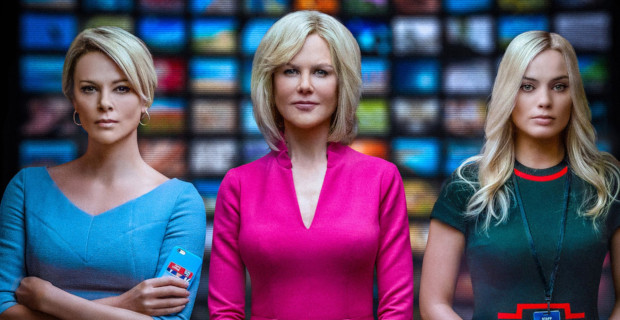
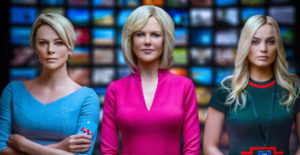
The performances are sizzling. Gretchen Carlson (Nicole Kidman) is a fading star at FOX, relegated to off-peak programs. (I could not help thinking of this performance as a bookend with Kidman’s “To Die For,” with Kidman as a woman who was willing to do anything, including sexual favors and murder, to get a job on TV news.) Megyn Kelly (Charlize Theron) is a rising star, and as this movie begins, she is horrified to find herself in the middle of a story as then-candidate Donald Trump makes ugly and crude accusations because she surprised him by asking him to comment on some of his insults to women (“You’ve called women you don’t like fat pigs, dogs, slobs and disgusting animals”) in an on-air interview. Margot Robbie plays Kayla, a fictional character based on the ambitious lower-level staff and what those who asked Ailes for on-camera opportunities were expected to do to show their “loyalty.”

Some early critics of the film object to the women being portrayed as feminist heroines. But they are not portrayed as feminist heroines; on the contrary. They’re not fighting courageously for justice like Norma Rae or Erin Brockovich. They are carefully calibrating how much abuse, how many humiliations, how much indignity they are willing to trade for the professional opportunities they want, even when it means ignoring abuse of other women. Answer: a lot. Ultimately, there is a limit, though, and watching each character locate that line is what makes this movie smart and engrossing. For Carlson, it is being fired. For Kayla, it is a painful realization after the fact, and after someone else has taken the almost unthinkably daunting step of going first. And the stakes are clear. “Once you go public, no one will hire you,” Carlson is told. Her post-lawsuit career has focused on sexual harassment issues either because she now recognizes the importance of the issue or because she cannot get any other job. The week of the film’s release she wrote an op-ed in The New York Times calling on Fox to withdraw the non-disclosure agreement she had to sign in order to settle her case. It’s unlikely, but if they do, maybe we’ll get another movie out of it.

The focus here is on Kelly. It is one thing to burn your bridges after you have been fired and have nothing to lose, but it is entirely another for a woman near the top of her profession who says, “I’m not a feminist; I’m a lawyer,” who does not want to be the story, who is in cutthroat competition with the other beautiful blondes and not one to raise a fist and proclaim that sisterhood is powerful. What will it take to get her to speak out and what price will she pay for saying something? Kelly is a complicated character and the way her dilemma is presented here is complicated and nuanced, more directed toward nods of recognition than standing ovations. Her career has been rocky (except for financially) since her decision to acknowledge the abuse, which makes this a cautionary tale that does not make the prospect of feminist heroine-ing look very appealing.

What is even more fascinating here is the setting. Is Fox a news organization as it has traditionally been understood? We get glimpses of other Fox personalities, including Bill O’Reilly, who left Fox following his own #metoo abuses. The way the organization responds to Carlson’s claims — handing out “Team Roger” t-shirts before any investigation even though it is generally known why there’s a lock on his door and a separate entrance to his office — says something about whether “loyalty” is more important than the truth, to them and to us.

Parents should know that this film is based on the real life #metoo upheavals at FOX News, with explicit discussions and some depiction of sexual harassment, abuse, and predation, and very strong language.

Family discussion: Why did the three women respond differently? How has coming forward affected their careers? What is the best way to prevent abuse by people in power?

If you like this, try: “The Loudest Voice” miniseries and “The Hunting Ground”

Related Tags:


Based on a true story Drama DVD/Blu-Ray Gender and Diversity Journalism movie review Movies -- Reviews
THE MOVIE MOM® is a registered trademark of Nell Minow. Use of the mark without express consent from Nell Minow constitutes trademark infringement and unfair competition in violation of federal and state laws. All material © Nell Minow 1995-2026, all rights reserved, and no use or republication is permitted without explicit permission. This site hosts Nell Minow’s Movie Mom® archive, with material that originally appeared on Yahoo! Movies, Beliefnet, and other sources. Much of her new material can be found at Rogerebert.com, Huffington Post, and WheretoWatch. Her books include The Movie Mom’s Guide to Family Movies and 101 Must-See Movie Moments, and she can be heard each week on radio stations across the country.

Website Designed by Max LaZebnik