Harriet

Harriet

Posted on October 31, 2019 at 5:29 pm

B +
Lowest Recommended Age: Middle School
MPAA Rating: Rated PG-13 for thematic content throughout, violent material and language including racial epithets
Profanity: Strong and racist language
Alcohol/ Drugs: Drinking, smoking, drug use
Violence/ Scariness: Intense violence including brutal abuse of enslaved and free people, references to rape, guns, wartime violence
Diversity Issues: A theme of the movie
Date Released to Theaters: November 1, 2019
Date Released to DVD: January 27, 2020
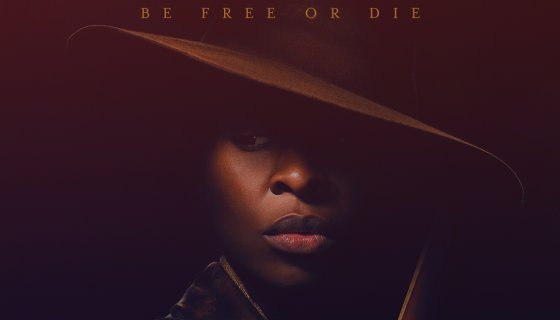
Cynthia Erivo stars as Harriet Tubman in HARRIET, a Focus Features release.
Credit: Glen Wilson / Focus Features

There should have been a movie about Harriet Tubman decades ago. And yet, this moment for “Harriet” is just right, because the story of the woman who led more than 70 enslaved people to freedom and was the first woman to lead an armed expedition for the U.S. Army was made at a time when it could be written and directed by Kasi Lemmons and star Cynthia Erivo, who is nothing less than electrifying in the role.

Harriet Tubman was a name she chose. Born to enslaved parents on a plantation in Maryland, she was called Minty, short for Araminta. Although her family was supposed to have been freed by the terms of the plantation owner’s will, his widow (Jennifer Nettles as Eliza) and son (Joe Alwyn as Gideon) refuse to acknowledge their right to freedom. Minty marries a free man she dearly loves. But when Gideon plans to “sell her down the river” to the Deep South, as he had sold her siblings, Minty decides she has to run away, no matter what the risk. She has no map, and if she did have one she could not read it. What she had was determination, the ability to run fast, the North Star, and an innate sense that helped her to elude her would-be captors.

That innate sense is part of Tubman’s legend. She had some kind of seizure disorder, probably the result of a horrific beating from the plantation owner. She thought it was a connection to God. Whatever it was, she was able to make it to safety in Philadelphia, where she met free black people of culture and accomplishment, including William Still, and Marie (the exquisitely gracious Janelle Monáe), a fictional character inspired by Tubman’s real-life friend. Her choice of a new name and her introduction to the possibilities of freedom are movingly portrayed.

But she cannot rest until her husband can join her. And so, she makes the treacherous trip back. That trip does not turn out as she intended, but it gives her a new purpose; giving other enslaved people a chance to be free.

Erivo is incandescent in the role, one of the great performances of the year in a story that is as vital as history as it is timely.

Parents should know that this is a film about slavery and escape and war, so there is extended peril and violence, including beatings, attacks, and abuse with references to rape. There is a Civil War battle scene. Characters drink and use strong language.

Family discussion: Why did Harriet Tubman choose that name? What name would you choose? Who is most like her today?

If you like this, try: “Glory” and Nate Parker’s “Birth of a Nation”
Related Tags:


Based on a true story DVD/Blu-Ray movie review Movies -- format
Terminator: Dark Fate

Terminator: Dark Fate

Posted on October 31, 2019 at 5:15 pm

B
Lowest Recommended Age: Mature High Schooler
MPAA Rating: Rated R for violence throughout, language and brief nudity
Profanity: Strong language
Alcohol/ Drugs: Pharmaceutical drugs
Violence/ Scariness: Extended very strong violence, many characters injured and killed, graphic and disturbing images
Diversity Issues: None
Date Released to Theaters: November 1, 2019
Date Released to DVD: January 27, 2020

Copyright 20th Century Fox 2019
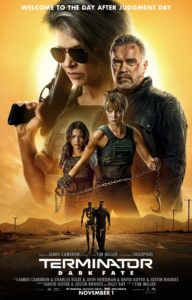
Can we please send someone back from the future to suggest that we really do not need any more Terminator movies?

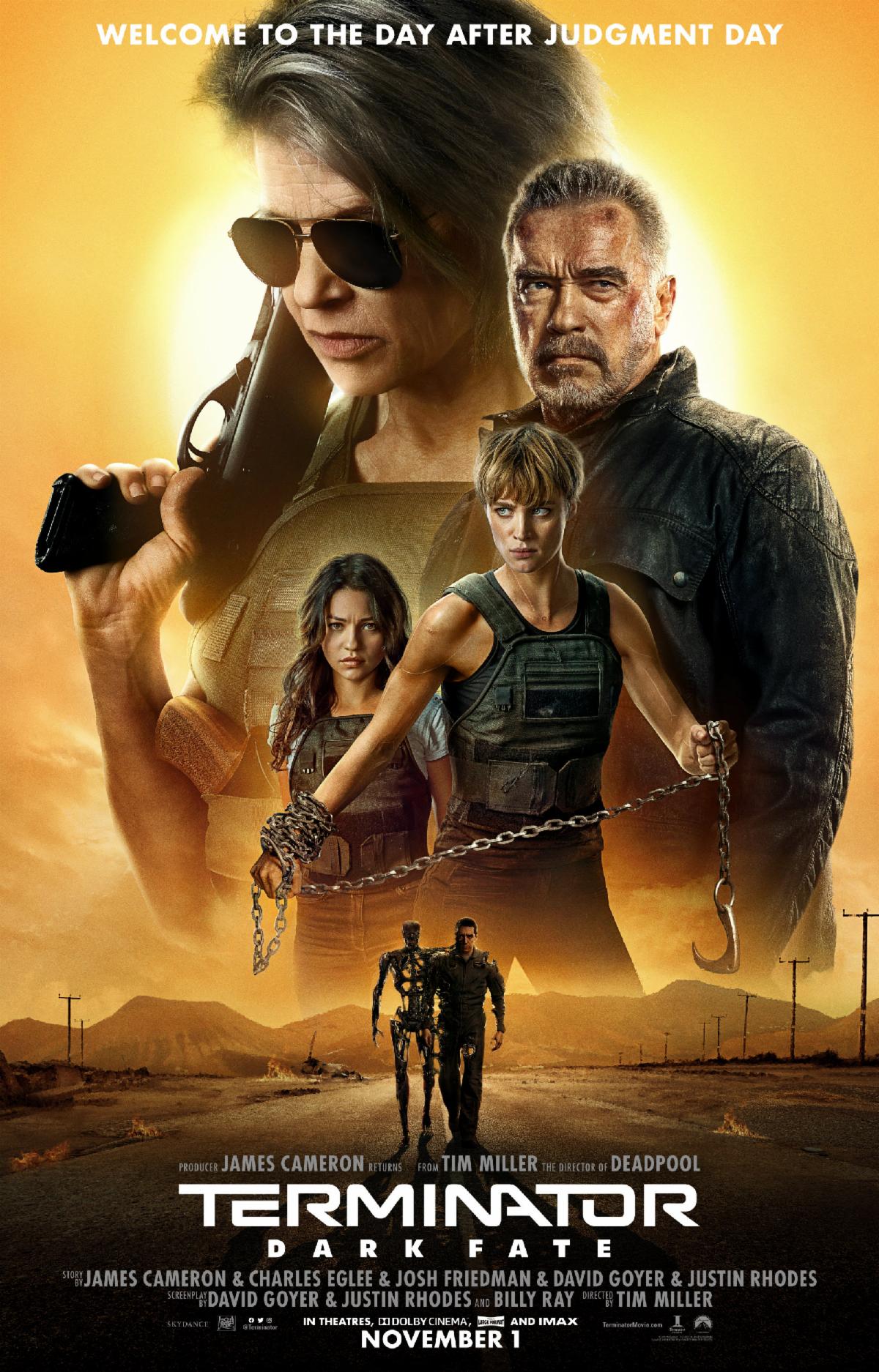
Okay, I have to admit Dark Fate is pretty entertaining. The action scenes are fun and there are some good characters. It’s nice to have the original Sarah Connor (Linda Hamilton) back. It’s not bad; it’s just unnecessary. And its very unnecessariness makes it ordinary and that retroactively diminishes the quality of the ground-breaking original and the first sequel.

It’s like they ran the first film through a slightly broken copier machine (not a scanner) and what came out was fuzzy and off-kilter. So, from the first movie: a terminator comes back to the present day from the future with immeasurable powers of strength, speed, and strategy, and, most important, total tunnel vision, complete, implacable, single-mindedness. There is no plea, no bribe, no argument possible. The only hope, and it is a slim one, is escape.

From the second movie: someone else comes back from the future to protect the vulnerable target of the new Terminator. This time, though, it is an enhanced or augmented human, a kind of souped-up cyborg. What makes this interesting is that we do not exactly know what her powers are (also interesting that she is a female), but we quickly learn that she has some significant vulnerabilities. Her name is Grace (a terrific Mackenzie Davis, outstanding both in the action and the acting departments). She is enhanced for a sprint, not a marathon; she is very powerful in short, intense spurts, but if the fighting or running away is too prolonged she will urgently need a collection of powerful pharmaceuticals.

And Grace will not tell us (until a crucial plot point) why the young woman she is protecting is so important. That young woman is Dani (Natalia Reyes). And, this chapter’s smartest and strongest element, our old friend from the first film is back, Linda Hamilton as Sarah Connor, and if there is ever an Oscar for being amazingly fit, they should give it to her and retire the trophy. Hamilton is the star of the show here, clearly enjoying being an action hero who is more than a little deranged (see “Terminator 2: Judgement Day” for this part of the origin story). She even gets to say, wait for it, “I’ll be back.”

On the other hand, you-know-who is also back, Arnold Schwarzenegger as our old friend the T-800 (I will not dwell on why a robot ages), and when he says, wait for it, “I won’t be back,” it is too much of a wink at the audience.

We do not really have time to object, though, because there’s another chase, another battle, another what-are-we-trying-to-be-Fast-and-Furious-umpteen-here set piece to enjoy. Davis is great. Hamilton is awesome. There are some thrill-ride moments. But if you go, you might wish someone came back from the future to tell you to rent the first one again instead.

Parents should know that this film includes extended very strong violence, many characters injured and killed, graphic and disturbing images, strong language, pharmaceutical drugs, and brief non-sexual nudity.

Family discussion: Why didn’t Grace tell the truth about Dani earlier? How do Sarah Connor’s actions change the future and what does not change? How are Sarah and Dani different?

If you like this, try: the other Terminator movies

Related Tags:


Action/Adventure Drama DVD/Blu-Ray movie review Movies -- format Science-Fiction Series/Sequel
JoJo Rabbit

JoJo Rabbit

Posted on October 24, 2019 at 5:46 pm

B +
Lowest Recommended Age: Mature High Schooler
MPAA Rating: Rated PG-13 for mature thematic content, some disturbing images, violence, and language
Profanity: Strong and offensive language including anti-Semitic insults
Alcohol/ Drugs: Alcohol
Violence/ Scariness: Intense and disturbing peril and violence including a child injured in an explosion, wartime violence, bombs. guns, tragic deaths
Diversity Issues: A theme of the movie
Date Released to Theaters: October 25, 2019
Date Released to DVD: February 17, 2020
Copyright Fox Searchlight 2019

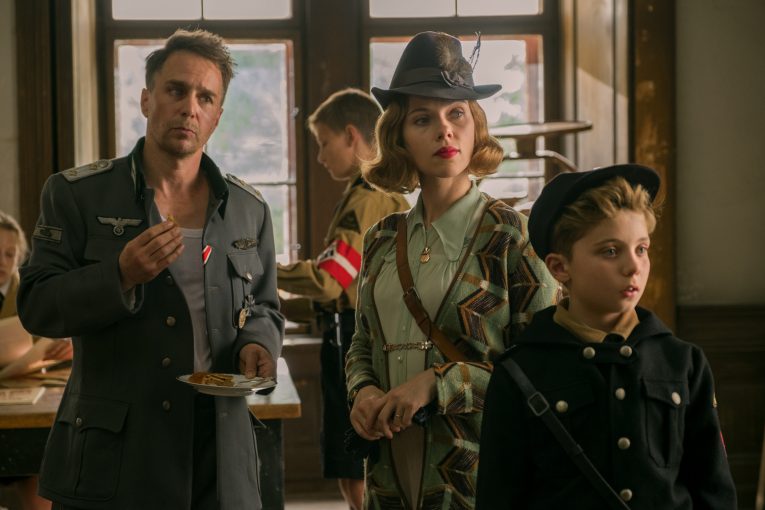
The first thing you need to know is that writer/director Taika Waititi does not play HItler in “JoJo Rabbit,” and it does not portray the real Adolf Hitler as a comic figure. Waititi plays a child’s imaginary version of Hitler. He has more in common with Chris O’Dowd’s imaginary friend character in his very funny and endearing Moone Boy. In both, the adult male figure is a child’s idea of what a man is, or what he would like to be when he grows up. In the case of Jojo Rabbit, the nickname for the 10-year-old Austrian boy at the center of the film, he is especially in need of a role model because of the uncertainty in his own life and the upheavals that are all around him. So it makes sense that he would respond by clinging to something that seems strong and structured and certain. And that is why when we first see him, he is looking in the mirror to admire himself in his Hitler Youth uniform, very excited to learn all about becoming an active member of the Nazi party. His imaginary friend represents what he would like to be, but JoJo is a child, so to us, his version of Hitler is ten-year-old’s fantasy. Which means he is very silly.

I tell you all this because for the first half hour or so of “JoJo Rabbit” you might think you’re watching some sort of “Springtime for Hitler,” from “The Producers.” But it turns out that while “JoJo Rabbit” does portray the Nazis in a heightened, satiric, silly manner, this is not an insensitive or superficial film. But by the end, it wants to pack a wallop, as it should, and it does.

JoJo (Roman Griffin Davis, in a knockout of a performance) lives with his mother, Rosie (a career-best Scarlett Johansson, warm and witty). His father is off in the war but has not been heard from for a long while. JoJo and his best friend Yorki (Archie Yates) go off to Hitler Youth camp, led by Captain Klenzendorf (Sam Rockwell), assisted by Fraulein Rahm (Rebel Wilson). The other boys laugh at him when he cannot bring himself to kill a rabbit (prompting his derisive nickname), and so to prove his courage, urged on by the imaginary Hitler, he takes a risk that leads to his being injured in an explosion, leaving scars on his face. He cannot return to school, so Rosie takes him to the Hitler Youth office and insists that Klenzdorf give him a job.

And then something happens that turns JoJo’s ideas about strength, courage, and power upside down. His ideas about Jews, too, though that takes a while. Waititi handles the tonal shift with great skill, and by the end of the film, the heightened tone blends seamlessly with the surreal absurdity of war, making the conclusion as meaningful to us as it is to the characters.

Parents should know that this movie is set in the last months of WWII and has wartime violence including guns and bombs, portrayal of virulent and systemic anti-Semitism. A child is injured in an explosion and a parent is murdered. Characters use strong language, drink alcohol, and smoke.

Family discussion: Why did JoJo imagine Hitler as an imaginary friend? What made him change his mind about Elsa? Why didn’t Elsa tell him what she knew about the letters?

If you like this, try: Hunt for the Wilderpeople and What We Do in the Shadows from the same writer/director. You may also enjoy satiric takes on war like “Oh, What a Lovely War,” “M*A*S*H,” and “King of Hearts.”

Related Tags:


DVD/Blu-Ray Epic/Historical Family Issues Fantasy movie review Movies -- format Stories About Kids War
THE MOVIE MOM® is a registered trademark of Nell Minow. Use of the mark without express consent from Nell Minow constitutes trademark infringement and unfair competition in violation of federal and state laws. All material © Nell Minow 1995-2026, all rights reserved, and no use or republication is permitted without explicit permission. This site hosts Nell Minow’s Movie Mom® archive, with material that originally appeared on Yahoo! Movies, Beliefnet, and other sources. Much of her new material can be found at Rogerebert.com, Huffington Post, and WheretoWatch. Her books include The Movie Mom’s Guide to Family Movies and 101 Must-See Movie Moments, and she can be heard each week on radio stations across the country.

Website Designed by Max LaZebnik