Maudie

Maudie

Posted on June 22, 2017 at 5:29 pm

B +
Lowest Recommended Age: High School
MPAA Rating: Rated PG-13 for some thematic content and brief sexuality
Profanity: Mild language
Alcohol/ Drugs: Alcohol, smoking
Violence/ Scariness: Tense family confrontations, domestic abuse, illness, sad death
Date Released to Theaters: June 24, 2017
Date Released to DVD: October 10, 2017
Copyright Sony Pictures Classics 2017

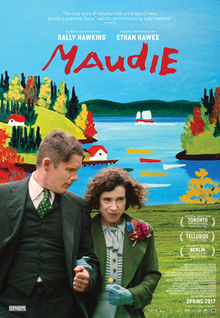
Maudie Lewis was severely disabled and abused. She lived in a tiny house with no electricity or running water in the unforgiving climate of Nova Scotia. And she decorated her tiny world with vibrant, joyful images that captivated the people who came to her door to buy them, usually for as little as $5. Her home, the walls covered with bright flowers and birds and cats painted over 35 years, is now seen by art lovers in the museum where it has been lovingly preserved, and she is recognized as one of the foremost “outsider” (untrained) artists of the mid-20th century.

In “Maudie,” the infinitely gifted Sally Hawkins gives an incandescent performance as the woman whose indomitable spirit shines through her art.

After her parents died, Maudie lived with an aunt who treated her with contempt. She left to take a job as a live-in housekeeper for Everett Lewis (Ethan Hawke), a fisherman taciturn to the point of being a recluse. “You walk funny. Are you a cripple?” he asks bluntly. And he tells her that she comes after the dogs and the chickens in importance. And that he expects her to sleep in his bed as a part of the job. When he wants more, she tells him that he must marry her, and he does.

With some leftover house paint, holding the brush in her arthritic fingers, she paints a flower on the wall. And surprisingly, Everett does not disapprove; he only tells her to leave one section of the wall alone. A summer visitor from the US spots one of her paintings and brings it back to New York. Vice President Richard Nixon buys one, too. Everett is glad for the income and worried that Maudie will become independent and leave him.

Director Aisling Walsh insisted on filming on location and created a meticulous replica of the tiny Lewis home, and the setting itself, bleak and beautiful, with minimal musical score becomes a character in the film. So do Maudie’s pure, simple paintings, expressing her unquenchable joy in observing the world around her and in expressing what she sees. Hawkins is a marvel in every scene; like Maudie herself, she commits herself completely to the creative spirit.

Parents should know that this film includes sexual references and situations, references to out of wedlock child, mistreatment of disabled character, and a sad death. Characters drink and smoke.

Family discussion: Why did Everett tell Maudie not to paint one part of the wall? Why did he change his mind about selling the painting she said was not finished? What was happiness to Maudie?

If you like this, try: “The Straight Story”

Related Tags:


Based on a true story Drama DVD/Blu-Ray Pick of the Week Romance

Interview: Kumail Nanjiani and Emily V. Gordon on “The Big Sick”

Posted on June 18, 2017 at 3:45 pm

Emily V. Gordon wants you to know that her father did not cheat on her mother. You might think that he did because in the movie Gordon wrote with her husband, Kumail Nanjiani, about their romance, movie Emily’s father, played by Ray Romano, confesses that he had an affair. But Gordon and Nanjiani explained in an interview that the overall story is true, and Nanjiani plays himself, but some elements were compressed or heightened for dramatic purposes.

This part is true: Gordon met Nanjiani when she was in grad school studying psychology and he was a stand-up comic. Very early in their relationship, she suddenly became critically ill. This is probably the only romantic comedy in history to have its female lead spend half the movie in a medically induced coma. And that’s not even the couple’s biggest obstacle. Nanjiani’s Pakistani immigrant family wants him to marry a girl from their religion and culture. Gordon’s character, Emily Gardiner in the movie, is neither. He hasn’t told her about the parade of eligible girls his mother has “dropping by” the house when he is visiting his parents. Movie Emily, played by Zoe Kazan, breaks up with Nanjiani just before she gets sick, and then he meets her parents (Romano and Holly Hunter) for the first time at the hospital. The second half of the film is a different love story, between Nanjiani and Emily’s parents. “And then we get to really, really play and create these really fun people,” she said. “My parents are lovely but it would have been a more boring movie.”

“This is obviously very, very autobiographical,” Nanjiani continued. “I would say my character is probably closer to how I was then than Emily is.” “I would say your character is pretty clueless, and you’re not as clueless,” Gordon added. “We had a lot of fun arguments like: character Kumail is a lying asshole, but the real Kumail is just a liar.” “Yes, just a liar. And clueless. Judd would ask me what I thought was going to happen, what the plan was when I was dating Emily. And I was like, ‘I don’t know. I haven’t thought about it.’” Gordon, whose terrifically funny and wise book Super You: Release Your Inner Superhero reflects her training as a therapist and her insight as a writer, said, clearly not for the first time, “Not deciding is a decision. People don’t realize that not making a decision is a decision in itself.”

Nanjiani and Gordon worked on the script for three years, sending drafts to Apatow, who guided them on tempo and character. “We would write down the truth of things and then he would advise us: ‘You could really turn up the drama here, you can change the situation here and kind of make this resonate more.’ So we would show him what the truth was and then he would help us figure out ways to make it more cinematic, ways to make it more dramatic, more funny,” Nanjiani said. The biggest departure was in the portrayal of Gordon’s parents. Apatow was especially helpful in providing feedback on the story’s structure. “He was like: ‘this much will be Emily and Kumail, this much should be them separated, this much should be the hospital, this much should be the surgery.’ He just drew these lines separating each section and we took a picture of it. And then when Michael Showalter came on as director, he said, ‘Kumail in Emily’s room, that’s the center of the movie so everything has to come before come after it.’ So we moved everything around that point because that’s the point of no return. That’s when I realize that I’m in love with her and that I had made a huge mistake.”

Gordon described working with Showalter. “He’s all heart, that’s what’s great. And he wears all his emotions on his sleeve. That’s his strength in a way. He is so amazing to watch because he’s passionate and invested in the story. And he was always very open to collaboration. It wasn’t like he was ruling with an iron fist, ever. Everything felt like a collaboration. He had no ego about collaborating. That made me feel so safe and confident in giving him our story.” Nanjiani said that Showalter showed them how he was subtly using different color palettes for the different characters, even different camera movements. “And Mike is very good at guiding you between movements of the movie, with silence or just following a character for a little bit or whatever it, is he’s very, very adept at switching gears for the movie in a seamless way.” Showalter is especially gifted in casting even the smallest roles and because they shot in New York they were able to find superb performers from theater whose faces were not familiar to movie audiences.

Nanjiani said that writing the film helped him to appreciate and understand his parents’ reaction to his wanting to marry Gordon. “When people from a different culture come here you want to hold on to your own culture but you also want to be your own person. It’s a complicated thing and you do lose something going against the wishes of your parents and your culture. But ultimately it has to be a personal decision.”

Nanjiani is an experienced performer, including three seasons as Dinesh on “Silicon Valley.” But this role presented some new challenges for him, with some dramatic moments and with the difficulty of reliving some of his most painful experiences on camera.

“I hadn’t ever taken any acting classes so I started taking acting classes to sort of prepare for this. I just knew that there was this big thing coming up and it was going to be very difficult and challenging. I wanted to take some of the guesswork out of it because what I knew was comedy acting, where you can go on instinct and as long as it feels funny it works. I knew this was going to be different, especially separating the reality from the movie character and also dealing with some very painful memories. I wanted to get the tools to be able to go into different emotions because I knew that this was a very low budget movie and we had to learn work really fast. If I had to be sad in the scene knew I knew that I had to figure out how to do that like quickly.”

“And if may say,” added Gordon, “Old Kumail from the movie would not have done that. He just would have been like, ‘I’ll figure it out.’”

Originally published on Huffington Post.

Related Tags:


Actors Based on a true story Interview Romance Writers
The Journey

The Journey

Posted on June 16, 2017 at 2:56 am

B +
Lowest Recommended Age: Middle School
MPAA Rating: Rated PG-13 for thematic elements including violent images and language
Profanity: Some strong and bigoted language
Alcohol/ Drugs: Drinking
Violence/ Scariness: References to and depictions of historical civil unrest, violence, and murder
Diversity Issues: A theme of the movie
Date Released to Theaters: June 17, 2017
Copyright 2016 IFC

First thing, I’m going to ask you to overlook two obvious problems with this film.  The first is the awful title, pretentious and overused.  The second is the film’s complete distortion of the real-life facts and details in favor of a condensed and heightened portrayal that puts decades of delicate negotiations into one car ride.  Let’s just agree to get past both of those for a moment and we will return to them later, I promise.

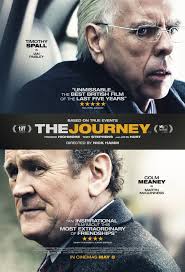
Here is the truth.  Two men who were the bitterest of enemies at the center of The Troubles, one of the worst, longest, and most intractable conflicts in modern history, found a way to create an enduring peace.  One was Ian Paisley (played by Timothy Spall), an evangelical Protestant minister.  The other was Martin McGuinness (played by Colm Meany)  a leader of the Catholics.  Although they despised each other, and blamed each other for the violent attacks that led to thousands of deaths, they were statesmen enough to realize that no one would ever win if they kept fighting each other.  In  2007, when the two men visited the White House to see President George W. Bush, McGuinness said, “Up until the 26 March this year, Ian Paisley and I never had a conversation about anything — not even about the weather — and now we have worked very closely together over the last seven months and there’s been no angry words between us. … This shows we are set for a new course.”

This movie imagines what the first conversation between the two men might have been, placing them in a streamlined, highly artificial, and very heightened dramatic context to have it.  This is not a documentary.  It is not history.  It is intended to be seen by people who have very little notion of the story.  So, the good news is that it is very accessible.  The less good news is that it will confuse the audience into thinking that this is how it happened, so be warned.

But it is a touching, inspiring, beautifully performed and very timely story about finding common ground even under the most bitter partisan circumstances.  And it is a powerful reminder that at the end of the day policy and statecraft and clashing ideologies may give rise to briefing books filled with charts and footnotes, but at the end of the day sometimes it just comes down to two people who agree to acknowledge their common humanity. “These men are anarchy,” one of the government officials says. “They are The Troubles.” But he might just as well say, “They are the answer.”

Parents should know that the theme of this film includes decades of civil unrest and murder during “The Troubles” in Northern Ireland, some graphic and disturbing images and references to sad deaths, and some strong language.

Family discussion: What was the turning point on the journey and why did it make a difference?  Read up on the real relationship between Martin and Ian, which evolved over decades, not one car trip.

If you like this, try: “In the Name of the Father” and “Maeve”

Related Tags:


Based on a true story Movies -- format Politics
Megan Leavey

Megan Leavey

Posted on June 9, 2017 at 10:26 am

B +
Lowest Recommended Age: Middle School
MPAA Rating: Rated PG-13 for war violence, language, suggestive material, and thematic elements
Profanity: Some strong language
Alcohol/ Drugs: Drinking and drunkenness, drug references
Violence/ Scariness: Wartime violence
Diversity Issues: Diverse characters
Date Released to Theaters: June 9, 2017
Date Released to DVD: September 11, 2017
Copyright 2017 Bleeker Street

Devastated by the loss of a close friend, fired from a dead-end job, without any sense of worth or meaning, a young rural New Yorker enlists in the Marines and learns about honor, loyalty, and purpose, and finds unconditional love, too.

What makes that familiar story less familiar in this fact-based retelling is that the Marine in question is a woman and the love story is with her partner, a German Shepard.

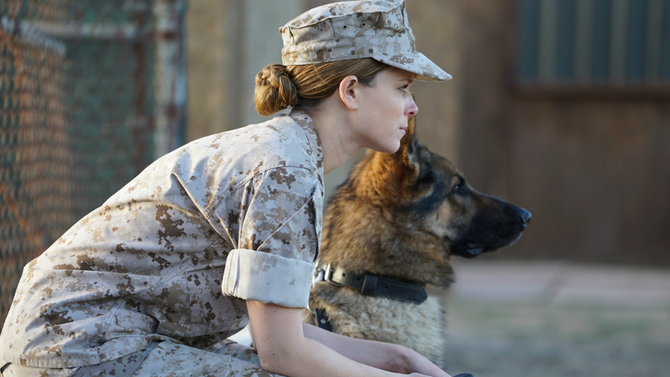
Kate Mara is both vulnerable and determined as Megan Leavey, who was lost until she joined the Marines and got assigned to the K-9 division of military dogs trained to sniff out bombs and guns. Leavey had two tours of duty alongside Rex until they were blown up together by a bomb. The most significant part of her recovery came from a renewed sense of purpose in fighting for the chance to give Rex a home when he could no longer work.

The film, which has some dramatic (and romantic) heightening, shows Leavey being fired by a supervisor who tells her, “You don’t connect with people very well.” Her mother (Edie Falco, terrific as always) does not want her to go into the military but has nothing else to offer. After basic training, she gets drunk with friends and is sentenced to clean up the dog kennels. That is the moment when a part of her wakes up. Instead of resisting what she does not want, for the first time there is something she does want.

The Leavey equivalent in the K-9 corps is Rex, a handsome German shepherd described by the veterinarian as “the most aggressive dog I’ve ever treated.” The woman who does not connect with people very well is a perfect match for the dog who does not connect with people very well, either.

Leavey wants to become a part of the K-9 program, but in order to qualify she has to meet some very tough standards for her skills and behavior. She makes it in and the training includes learning how to bandage a wounded dog, a powerful reminder of the risks ahead.

The story has four distinct chapters: Leavey before the Marines, her training and getting to know Rex, their deployment, and her efforts to bring him home so she can care for him in his last months. Director Gabriela Cowperthwaite and star Mara wisely keep the focus on Leavey’s spirit-enlarging journey. Cowperthwaite is a documentarian (“Blackfish”) and brings a low-key naturalism to the storytelling, and Mara is excellent in revealing Leavey’s growing sense of confidence and purpose. “We were injured in Iraq,” she says, simply, compellingly. They are both wounded warriors and their best path to healing is to be together.

Parents should know that this film includes wartime violence with guns, bombs, explosions, characters injured and killed, drinking and drunkenness, strong language, sexual references and a non-explicit situation.

Family discussion: What was it about the dog corps that made Megan want to qualify to be a part of it?  Why did Gunny give her a chance?

If you like this, try: “Max”

Related Tags:


Based on a true story DVD/Blu-Ray Pick of the Week Get Your Handkerchiefs Ready War
The Lost City of Z

The Lost City of Z

Posted on April 20, 2017 at 5:34 pm

B +
Lowest Recommended Age: Middle School
MPAA Rating: Rated PG-13 for violence, disturbing images, brief strong language and some nudity
Profanity: Brief strong language
Alcohol/ Drugs: Alcohol, smoking
Violence/ Scariness: Peril and violence including WWI battles and attacks by indigenous people
Diversity Issues: Class, race, and culture issues a theme of the movie
Date Released to Theaters: April 21, 2017
Date Released to DVD: July 10, 2017
Copyright Amazon Studios 2017

From the early 19th to the early 20th century, the British Empire exemplified a spirit of adventure, devotion to duty, and confidence bordering on hubris that led to extraordinary achievements like the Oxford English Dictionary and the arrogant imposition of colonialism around the world. All of that is in this true story of Percy Fawcett, an officer in the British Army whose eight trips to South America in search of ancient ruins inspired characters in books by H. Rider Haggard and Arthur Conan-Doyle (The Lost World) (both friends of Fawcett’s) and in movies like “Raiders of the Lost Ark.” Basically, if the hero wears khakis as he slashes through the jungle, he owes something to Percy Fawcett.

Writer/director James Gray based the screenplay on the book by David Gann and the letters of Fawcett and his wife, and shaped the story to make it more accessible, turning eight trips into three and reflecting a more contemporary understanding of race and gender. That is notable in Nina Fawcett’s attempt to insist that she should accompany her husband on an expedition and in the treatment of the natives, who are portrayed with dignity and agency, and treated as such by Fawcett.

He also helps us understand the pressures of the era that helped to motivate Fawcett’s journeys. The unlimited opportunities of the uncharted jungle were especially compelling. In addition to giving him the chance to earn money for his family, a major discovery would allow him to return to England in triumph and overcome the disgrace his father had brought to the family name. We first see him outracing his fellow officers, showing us his skill and determination. When he has the opportunity to go to Bolivia to map the country’s boundaries — to protect the British business interests in South America — he does not want to leave his family but he is eager to escape the restrictions of Edwardian social class. “He’s rather unfortunate in his choice of ancestors,” one character sneers.

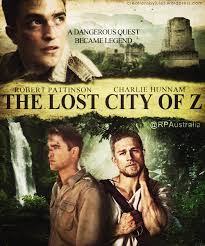
On the mapping expedition he hears about a place where there are artifacts of a prehistoric civilization and he is determined to find it and come home in triumph. He teams up with the loyal and capable Henry Costin (Robert Pattinson, unrecognizable behind a thick beard).

On his second visit, he brings along a veteran explorer, James Murray (Angus Macfadyen), who had been with Shackleton on his expedition to Antarctica, which turns out to be a very bad decision. But it is also the final proof for Fawcett that class and reputation are not determinative. On the third trip, after Fawcett’s return to military service in WWI, he brings his once-estranged son (Spider-Man Tom Holland) and reaches a new understanding and reconciliation.

Gray ably conveys the curiosity and wonder of the journeys and the passions that impel the adventurers. Pattinson’s performance is especially thoughtful and Hunnam does well, especially in an impassioned speech to the skeptics at the Royal Geographical Society and in showing us how his journeys change his views of himself and his world, perhaps inspiring us to imagine our own.

Parents should know that this film includes extended peril and violence including wartime battle scenes, sad deaths, some graphic and disturbing images, native nudity, brief strong language.

Family discussion: Why did Percy keep returning to his search? What did he learn from his experience with Murray?

If you like this, try: “The Man Who Would be King,” “The Lost World,” “Mountains of the Moon,” and the books by H. Rider Haggard and Arthur Conan-Doyle inspired by Fawcett’s adventures

Related Tags:


Action/Adventure Based on a book Based on a true story Drama DVD/Blu-Ray Pick of the Week Epic/Historical
THE MOVIE MOM® is a registered trademark of Nell Minow. Use of the mark without express consent from Nell Minow constitutes trademark infringement and unfair competition in violation of federal and state laws. All material © Nell Minow 1995-2026, all rights reserved, and no use or republication is permitted without explicit permission. This site hosts Nell Minow’s Movie Mom® archive, with material that originally appeared on Yahoo! Movies, Beliefnet, and other sources. Much of her new material can be found at Rogerebert.com, Huffington Post, and WheretoWatch. Her books include The Movie Mom’s Guide to Family Movies and 101 Must-See Movie Moments, and she can be heard each week on radio stations across the country.

Website Designed by Max LaZebnik