The Current War: Director’s Cut

The Current War: Director’s Cut

Posted on October 24, 2019 at 5:35 pm

B +
Lowest Recommended Age: High School
MPAA Rating: Rated PG-13 for some violent content and thematic elements
Profanity: Brief strong language
Alcohol/ Drugs: Alcohol, smoking
Violence/ Scariness: Flashback to Civil War scene with guns, animals and humans electrocuted, discussion of "humane" executions, sad death of wife and mother, tense confrontations
Diversity Issues: Anti-immigrant prejudice
Date Released to Theaters: October 25, 2019
Date Released to DVD: March 30, 2020
Copyright 101 Studios 2019

There’a a saying usually attributed to Balzac: “Behind every fortune is a crime.” There is a fairy tale quality to stories of people who have exciting new ideas that change our lives and are rewarded with unimaginable fortunes, from the grad students who created Google to the garage tinkerers who founded Hewlett-Packard and the college dropouts who created Microsoft and Facebook.

But as any business school student knows, it takes more than a brilliant or even a monumentally disruptive idea to create a business. That requires the ability to execute. It is one set of skills to jot down great thoughts in a notebook but another set entirely to bring it all to life. It takes courage, because ordinary people are afraid of anything new and people who are invested in the old ways will try to stop you. And it takes a singular purpose that looks a lot like ruthlessness. That is the story “The Current War,” which is not as much about the inventions that transformed America from being lit by gas lamps and candles to being lit and powered by electricity as it is about the control of those inventions and the fortunes they made.

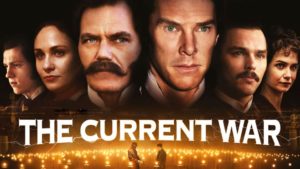
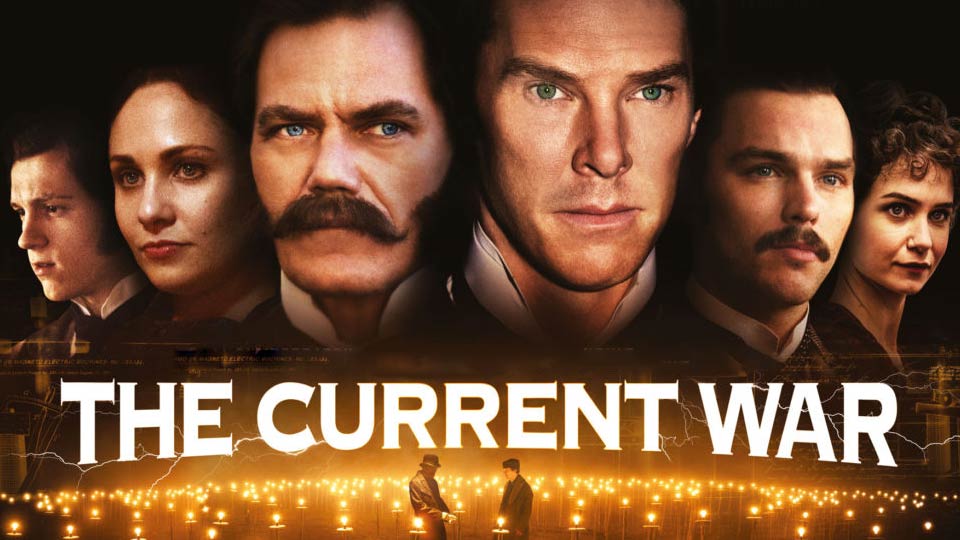
The three major players are America’s greatest inventor, Thomas Alva Edison (Benedict Cumberbatch), entrepreneur and engineer George Westinghouse (Michael Shannon), and visionary Serbian immigrant Nikola Tesla (Nicholas Hoult). Also in the mix is one of the wealthiest men in the world, J.P. Morgan (Matthew McFayden) and the current Spider-Man, Tom Holland, as Edison’s aide Samuel Insull.

At the center of their battle is the fight over what kind of electricity will be used, Edison’s lower voltage direct current, which was safer but more limited in range, and the Tesla/Westinghouse alternating current, which travelled over longer distances, was powerful enough to fuel machinery as well as light bulbs, but was also more dangerous, potentially fatal. (Now you know what AC/DC means and how the Australian rock group got its name and why their first album was named High Voltage.)

Director Alfonso Gomez-Rejon avoids the too-often stuffy quality of prestige historical dramas with refreshingly dynamic camerawork from DP Chung-hoon Chung (“The Handmaiden,” “Stoker”) and editing by Justin Krohn and David Trachtenberg. The opening shots are as striking as any you’d find in an art-house or superhero movie, blowing the dust off of the idea that movies set in the past have to be stodgy to be taken seriously. The script by Michael Mitnick packs a lot of developments and details into the story, from the illness of Edison’s wife to the conflicts (and jealousy) between the talent and the money to the shifting loyalties and various strategic maneuvers (legal and illegal), some as complex as the engineering specs for the various contraptions. One fascinating detour reminds us that as soon as new technology is invented, someone will try to figure out a way to use it to kill people (it was still so new there was no word for electrocution). Another reminds us of the connection between the characters on screen and the very technology we use to tell their story.

“The Current War: Director’s Cut” places the human drama in the midst of cultural and technological shifts and shows us how they affect and are affected by each other. Vivid, compelling characters, smart, witty dialogue, and a cherry-on-the-top ending making this film not just enjoyable, but, yes, illuminating.

NOTE: The official title of this film includes the words “Director’s Cut” because after it premiered at the Toronto Film Festival its release was put on hold because Harvey Weinstein (the distributor) was caught up in the #metoo accusations. The version shown at the festival was re-cut by Weinstein and director Alfonso Gomez-Rejon was not happy with that version. Martin Scorsese came on as a producer to make sure he was able to release the version he wanted.

Parents should know that this film include the sad illness and death of wife and mother, offscreen murder and execution, electrocutions of people and animals, Civil War scenes with shooting, and some strong language.

Family discussion: What is a bigger factor in success — having the best idea or being able to put it into practice — or wanting to win above all? What is Edison’s most important invention? Why did Elon Musk name his company Tesla?

If you like this, try: two biopics about Edison, “Young Tom Edison” with Mickey Rooney and “Edison the Man” with Spencer Tracy
Related Tags:


Based on a true story Drama DVD/Blu-Ray Epic/Historical Movies -- format
Downton Abbey

Downton Abbey

Posted on September 19, 2019 at 5:11 pm

B +
Lowest Recommended Age: Middle School
MPAA Rating: Rated PG for thematic elements, some suggestive material, and language
Profanity: Brief strong language
Alcohol/ Drugs: Social drinking
Violence/ Scariness: Assassination attempt, scuffle
Diversity Issues: Class issues
Date Released to Theaters: September 20, 2019
Date Released to DVD: December 16, 2019
Copyright 2019 Focus Features

There’s a reason the hugely popular “Downton Abbey” television series and this first theatrical release are named for the property, not the characters. The part of Downton Abbey the building, or, I should say, the estate, is played by real-life historic Highclere Castle. It is over a thousand acres and has 200 rooms. And (which you can stay in via Airbnb). The story began in 2010 (1912 in Downton years) with the vital question of the future of the estate, which like most British great homes, was entailed. That means that it would always be inherited by the eldest male of each generation. (For more on this issue, see Sense and Sensibility and Moving Midway and let me just have a brief aside here to say that one completely revolutionary decision of our founding fathers that does not get enough credit for deciding that in the United States people could leave their property and land as they wished.).

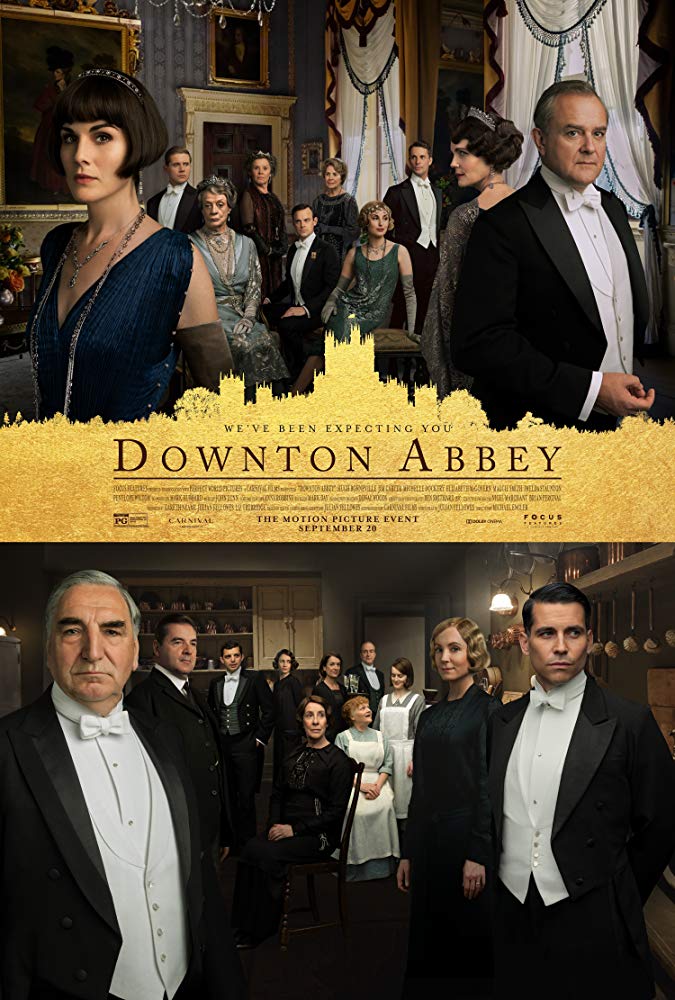
The noble family occupying Downton Abbey are the Crawleys, headed by Lord Grantham (Hugh Bonneville of “Paddington”), who with his American wife Cora (Elizabeth McGovern) has three beautiful daughters and no sons. The property will thus go to to a cousin, who conveniently has become engaged to the oldest daughter, Lady Mary (Michelle Dockery). Unfortunately, as the first episode begins, he had been traveling to the United States on the Titanic, and he has been killed. Lady Mary is very sorry to lose her fiancé, but the family is in a complete upheaval because the next male relative is someone they don’t even know. Meanwhile, one of the great strengths and points of interest in the show is that it devotes equal attention and respect to the extensive staff below stairs, the servants, who all have complicated characters and conflicts and lives. They include Mrs. Patmore, the cook (Lesley Nicol), Carson, the head butler (Jim Carter), Tom Branson, and the chauffeur (Allen Leech), who crosses the uncrossable line by marrying one of the Crawley daughters. And there’s everyone’s favorite character, the acid-tongued Dowager Duchess exquisitely played by Dame Maggie Smith.

There is a ton of drama and romance over the run of the series, plus World War I and other seismic historical events.

And so now, here we are with the first Downton Abbey feature film, picking up the story in 1927, and once again the issue of property and inheritance is at issue. Writer Julian Fellowes had a daunting challenge. He had to take two dozen characters the fans were deeply invested in and were used to being able to watch through long-form storylines over the course of months. It’s kind of like “The Avengers” for the PBS/Anglophile crowd (I consider myself happily and proudly in both camps).

And, you know what? He pulls it off, with a brilliant mechanism for bringing everyone together in a high-pressure situation that gives even the most devoted fan many sigh-worthy and highly satisfying developments. As the movie begins, we follow a very important letter from its creation to its receipt. They are to receive a visit from the King and Queen of England (that would be King George and Queen Mary, the parents of future abdicator Edward VIII and “The King’s Speech” younger brother who became George VI, father of the present Queen Elizabeth II, the longest-reigning monarch in British history). This is an honor that no one can turn down. And so Downton is made ready, every tiara and silver serving piece polished, every piece of furniture in every one of the 200 rooms shined, and every arcane protocol meticulously followed.

There are ups and downs, none of the downs too terrible, all of the ups reassuring and satisfying. If we think about it for a moment, we will remember why we do not want to return to that world. It will take less than a moment if we consider the possibility we would be returning as the servants, not the nobility; the Crawleys may worry about money, but they get to worry in some beautiful clothes and settings while they are nicely cared for. We are aware that both the upstairs and downstairs characters struggle with the restrictions of their positions but somehow it all seems like a fairy tale to escape to in this lush and beautiful version, where we can all imagine ourselves dressing for dinner and receiving a visit from the royal family.

Parents should know that this film includes references to terminal illness, family conflicts, assassination attempt, scuffle, an out of wedlock child, and some mild language.

Family discussion: Why did the servants rebel? Why did Violet change her mind about the property? Do you agree with what Thomas told the princess?

If you like this, try: “Gosford Park” and the “Downton Abbey’ television series

Related Tags:


Based on a television show Drama DVD/Blu-Ray Epic/Historical Family Issues movie review Movies -- format
Aladdin

Aladdin

Posted on May 23, 2019 at 5:17 pm

B-
Lowest Recommended Age: Kindergarten - 3rd Grade
MPAA Rating: Rated PG for some action/peril
Profanity: Mild language
Alcohol/ Drugs: Brief alcohol
Violence/ Scariness: Extended fantasy/action peril and violence, attempted murder, near-drowning, discussion of sad deaths of parents
Diversity Issues: Issue of female autonomy and power
Date Released to Theaters: May 24, 2019
Date Released to DVD: September 16, 2019

Copyright Disney 2019
It is a bit of a puzzle that a director known for dynamic action doing a live action remake of a musical animated film that was exceptionally lively has somehow produced a movie that seems bogged down, even static. The new “Aladdin” from co-writer/director Guy Ritchie (“Lock, Stock, and Two Smoking Barrels,” “Sherlock Holmes”) is colorful and tuneful, but for much of its just over two hours running time it lumbers along, despite its best efforts to entertain.

The original Disney animated version of “Aladdin” is one of the studio’s all-time best thanks to a wonderfully melodic score, with songs by Alan Mencken and Howard Ashman and possibly the all-time greatest animated movie voice performance in history, Robin Williams as the Genie. The mercurial Williams found his ultimate mode of presentation with the help of Disney’s top animators as the magical, infinitely malleable, cartoon character, instantly creating characters ranging from Ed Sullivan, William F. Buckley, and Jack Nicholson to Peter Lorre and a bunch of zombies, always retaining the essential heart and humor that made a fantasy come alive. (The closest Williams ever came to replicating avalanche of portrayals might be his innumerable improvisations with a shawl on “Inside the Actor’s Studio.”) No live action version, even with the help of the latest CGI technology and the powerhouse charisma of Will Smith, can match the kaleidoscopic imagination of the 1992 Genie.

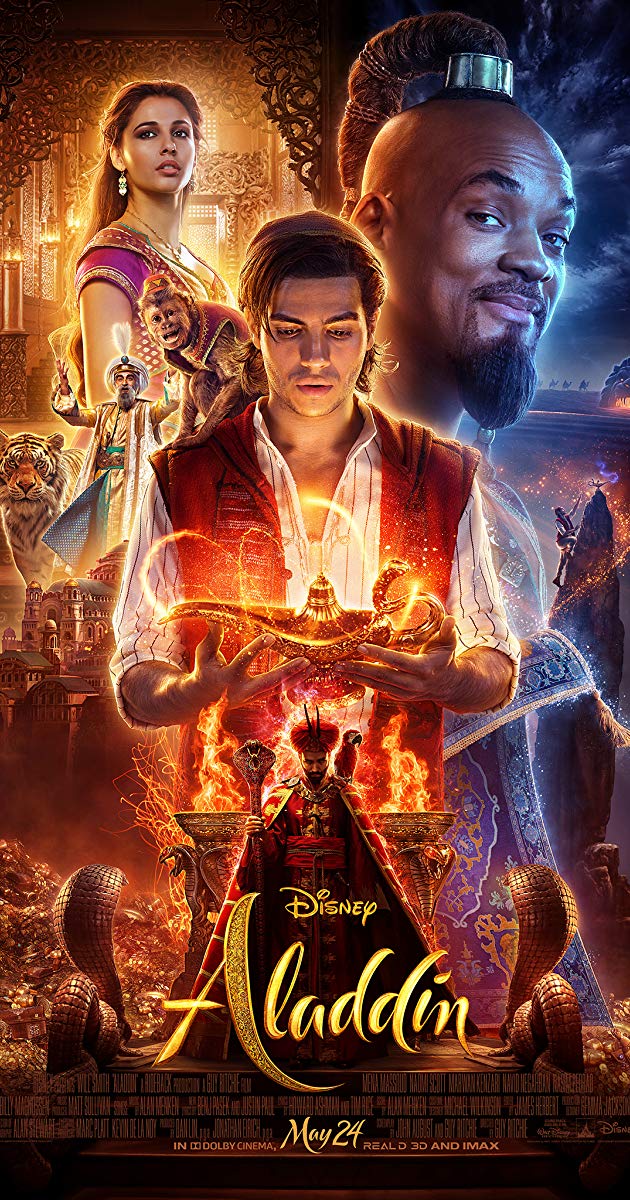
This version does make some substantial improvements in the story of the “street rat” who loves a princess and then, with the help of the genie in a magical lamp, pretends to be a prince so he can court her. Disney says it has the most diverse cast in the studio’s history, and it is great to see all of the lead roles performed by people whose ethnicity matches their characters, with Egyptian-born Mena Massoud as Aladdin and Naomi Scott, of British and Indian heritage, as Jasmine. The locations are authentic as well. Filmed in Jordan, and with the always-outstanding work of the Disney production designers, the settings are splendid, and the classic songs still sound fresh and hummable, especially “Prince Ali” and “A Whole New World.” The film should really be called “Aladdin and Jasmine” because it gives the princess a full, meaningful role in the story, respecting her agency, ability, and dedication to her people. It gives her father, the Sultan (Navid Negahban) more agency, as well, unlike the animated character, who spends much of the story in an enchanted fog. And it’s nice to see Genie get a bit more of a story, too, thanks to the handmaiden to the princess, played by “SNL’s” Nasim Pedrad.

But the story-telling itself is foggy in this version. Jafar (Marwan Kenzari), the story’s villain, does not have the menace of the original. He seems young and angry, more petulant than ominous. There is a hint of an intriguing backstory for him that gets lost in the busy, “look at me”-ness of the film. A storyline about whether the Sultan should approve invasion of another country does not work well and a dance number with the Genie controlling Aladdin has too many cuts to deliver on the humor of the situation. The “Step Up” movies do these moments much better, and Jasmine’s new song from “La La Land’s” Benj Pasek and Justin Paul is outshone by the originals. A wink at the map of Disneyland as Jasmine does the ancient equivalent of Googling “Prince Ali” is out of place.

If there had been no animated version, this one would have served as an entertaining family movie. But as has happened too often with Disney’s live action remakes of its best animated films, it is just an unnecessary reminder of how much we loved the original.

Parents should know that this film includes fantasy peril and violence including near-drowning, attempted murder and references to killing and to sad death of parents, action, brief alcohol, and a kiss.

Family discussion: What would your three wishes be? Remember to be careful with your words! Why was Aladdin so awkward when he becomes Ali? Why was Jafar so angry? What does it mean to be a diamond in the rough, and what made Aladdin one?

If you like this, try: the original Disney animated version and the stories of the 1001 Nights

Related Tags:


Action/Adventure Based on a book DVD/Blu-Ray Epic/Historical Fantasy Movies -- Reviews Musical Remake Romance
Mary Queen of Scots

Mary Queen of Scots

Posted on December 6, 2018 at 5:31 pm

B
Lowest Recommended Age: High School
MPAA Rating: Rated R for some violence and sexuality
Profanity: Some language
Alcohol/ Drugs: Drinking and drunkenness
Violence/ Scariness: Peril and violence including armed battles and beheading
Diversity Issues: A theme of the movie
Date Released to Theaters: December 7, 2018
Date Released to DVD: February 25, 2019

Copyright 2018 Focus Pictures
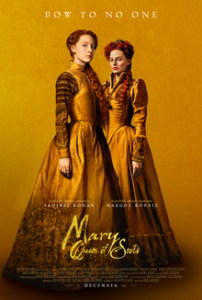
Gorgeous production values, magnificent costumes, a gripping historical rivalry that lasted a quarter century and ended with a beheading, and two fierce, beautiful, endlessly talented actresses giving it everything they’ve got — that takes us pretty far, but it cannot make up for a script that reduces the story of the class between two of the most powerful rules in history to a spat between mean girls over who has the cutest boyfriend.

Okay, not that bad. But it is a real shame for Mary Queen of Scots to take the story of these two women and limit the focus to their rivalry. Queen Elizabeth gave her name to an age that included innovative and very successful economic policies, resolved irreconcilable religious divisions that began when her father, Henry VIII, left the Catholic church and established the Church of England and led to decades of bloody conflict, defeated the Spanish Armada, oversaw historical world exploration (and colonization), and presided over a golden age of culture that included the greatest author in the history of the English language. Mary, Queen of Scots was able to maintain her throne for a remarkable time given the constant attacks and efforts to undermine and betray her. But too much of this film is focused on their rivalry even though (or maybe because) they were facing very similar challenges.

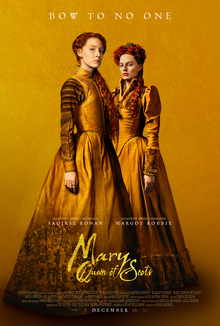
Saoirse Ronan is superbly regal as Mary, fire to Elizabeth’s ice. She is fierce and fearless, leading her troops into battle and confronting those who would question her fitness or her right to serve as a matter of law, divine and mortal. Having been married off to another ruler, the king of France, who died, leaving her with no place in the French court, she makes a triumphant return to Scotland, kissing the ground as she arrives to take the throne that had been occupied by her half-brother.

Margot Robbie plays Elizabeth, canny, decisive, often imperious, but also afraid — of the threats within her own court and of her cousin Mary, whose legal claim, ties to the Catholic church, and personal appeal made her jealous and uncharacteristically insecure. Co-screenwriter Beau Willimon (“House of Cards”) has a feel for the ruthlessness of courtiers jousting for power and director Josie Rourke, with a background in theater, is well suited to the pomp and, well, theatricality of the courts. Mary’s looks like a castle version of the Scottish countryside, spare and craggy, while Elizabeth’s is luxurious and draped with tapestries. In real life, the two women never met, but that isn’t very cinematic, so there is a strikingly choreographed meeting here, the two queens separated by a maze of fluttering linens. If the substance of the story matched the look of it, this movie could have done justice to two of history’s most fascinating and transformative characters.

Parents should know that this film has peril and violence including armed battles and beheading, sexual references and explicit situations, and medical issues.

Family discussion: Who was the better leader? How did being women affect the way Mary and Elizabeth saw themselves? Why couldn’t Elizabeth trust Mary?

If you like this, try: “Anne of the Thousand Days,” “Elizabeth,” and “The Young Victoria”

Related Tags:


Based on a true story Biography DVD/Blu-Ray Epic/Historical movie review Movies -- format Politics
THE MOVIE MOM® is a registered trademark of Nell Minow. Use of the mark without express consent from Nell Minow constitutes trademark infringement and unfair competition in violation of federal and state laws. All material © Nell Minow 1995-2026, all rights reserved, and no use or republication is permitted without explicit permission. This site hosts Nell Minow’s Movie Mom® archive, with material that originally appeared on Yahoo! Movies, Beliefnet, and other sources. Much of her new material can be found at Rogerebert.com, Huffington Post, and WheretoWatch. Her books include The Movie Mom’s Guide to Family Movies and 101 Must-See Movie Moments, and she can be heard each week on radio stations across the country.

Website Designed by Max LaZebnik