Being Flynn

Being Flynn

Posted on March 8, 2012 at 6:05 pm

B
Lowest Recommended Age: Mature High Schooler
MPAA Rating: Rated R for adult situations, language, nudity, and sex
Profanity: Constant very strong and explicit language
Alcohol/ Drugs: Drinking, smoking, drugs, substance abuse
Diversity Issues: A theme of the movie, character makes bigoted remarks
Date Released to Theaters: March 9, 2012
Amazon.com ASIN: B00772HR6O

Nick Flynn was working at a Boston homeless shelter when his father, Jonathan Flynn, came in looking for a place to stay. Nick was raised by his mother and had little contact with his father except for some letters explaining that he would soon be recognized as one of the three greatest writers in American history. Nick Flynn’s memoir, Another Bullshit Night in Suck City, has been adapted for the screen by director Paul Weitz, whose films often explore the relationships between fathers and sons (“About a Boy,” “In Good Company,” “American Pie”).

Paul Dano plays Nick, a young man who has some good instincts and some talent.  He is worse than directionless — he is stuck.  His mother (Julianne Moore) has died and he has no place to go.  He moves into a strip club-turned apartment that is barely more than a squat, selected over the other candidates because he has no family who might come in for an extended stay.  He takes the job at the homeless shelter because it is the first opportunity he hears of.  He is not unsympathetic but he is distant and untrained.  When a resident needs a new pair of pants Nick turns to one of the more experienced aides to ask what size.  The aide says simply, “Ask him.”  Nick begins to see — as we do — the artificiality of the denial-based distance we maintain from people we think might ask more from us than we can give or might make us think about how fragile our support system can be.  When his father (Robert De Niro) shows up in the line of people needing a bed, Nick has so many conflicting feelings he has to go numb — on his own and with some chemical assistance.  He wants to love his father and he wants his father to love him.  He wants to care for him but is afraid of not being able to — we learn more about why later in the story.  He is not prepared to acknowledge how much he wants to be like his father (in following his dream of being a writer) and does not want to be like him (unable to finish his story).  We hear their competing versions of the story but we know, as Nick does, that both are coming from him.

De Niro has one of his best roles as a man wavering between fierce pride and grandiosity.  Jonathan is a man of large gestures and unspeakably selfish behavior. De Niro keeps him human without compromising by trying to make him more sympathetic.  Ultimately, it is Jonathan’s lack of empathy that allows him to finally if briefly provide fatherly support and guidance in telling Nick an important truth that frees him from the past and provides direction for the future.

(more…)

Related Tags:


Based on a book Based on a true story Family Issues Movies -- format
Undefeated

Undefeated

Posted on March 1, 2012 at 6:30 pm

B+
Lowest Recommended Age: Middle School
MPAA Rating: Rated PG-13 for some language
Profanity: Some strong language
Alcohol/ Drugs: References to substance abuse
Violence/ Scariness: Sports injuries, references to violence
Diversity Issues: A theme of the movie
Date Released to Theaters: March 2, 2012
Amazon.com ASIN: B005S9EITC

Bill Courtney, a successful white businessman, coaches an underdog football team at an inner city high school in an Oscar-winning documentary that quickly transcends the risks of sports cliché and racially treacherous noblesse oblige.  Like the wonderful “The Heart of the Game” it is a powerful reminder of the difference one person can make — and of the consequences when no one is willing to make that difference.

Manassas High School in North Memphis has never made the play-offs since it was founded in 1899.  Neither the school nor its students have the resources of their opposing teams.  Courtney sums up his situation to his players: Two have been shot and are no longer in school.  Two others were fighting and another was arrested for shooting someone. “For most coaches, that would be a career’s worth of crap,” he says.  “I think that sums up the last two weeks for me.”

http://www.youtube.com/watch?v=ckku5qEt-vA

Courtney volunteers his time and an even more precious gift — he truly gives his heart to his players.  He has a lot to teach them about practice and plays and teamwork, but the most important lessons come from his own example of indefatigable dedication to his team.  He is fully present for them in a way that is infinitely touching.  They can never give less than their best because they see him giving his every day.

The movie focuses on three players.  One is returning to the team after some time in juvie for problems caused because he cannot control his rage and seems to have no inclination to try.  Another is a strong player who will need to get his grades up if he wants to qualify for a college scholarship.  And the third is an honor student who wants a football scholarship but is sidelined with an injury just as he needs to show the scouts he can play. Courtney’s passionate commitment makes the difference, sometimes by just being there, sometimes by bringing in some extra help.  When he has some good news for one of his players, there is not a dry eye on the field — or in the audience.

“You think football builds character,” he tells the team.  “It does not.  It reveals character.” That is true of the players and the coach as well.

Parents should know that this film has some strong language and some sad situations including the loss of a parent and a sports injury, as well as references to substance abuse and violence.

Family discussion:  Do you agree with Courtney’s decision at the end of the season?  What was the most important lesson his team learned from him and what is the most important lesson he learned from them?  What can Courtney’s example inspire you to do?

If you like this, try: The Heart of the Game


Related Tags:


Documentary Movies -- format School Sports
Joyful Noise

Joyful Noise

Posted on January 12, 2012 at 7:00 pm

B +
Lowest Recommended Age: Middle School
MPAA Rating: Rated PG-13 for language including a sexual reference
Profanity: Some strong language
Alcohol/ Drugs: Drinking
Violence/ Scariness: Tense family confrontations, bullies, brief fight, gun, sad deaths
Diversity Issues: Diverse characters including disabled character
Date Released to Theaters: January 13, 2012
Date Released to DVD: April 30, 2012
Amazon.com ASIN: https://amzn.to/4xxi2xm

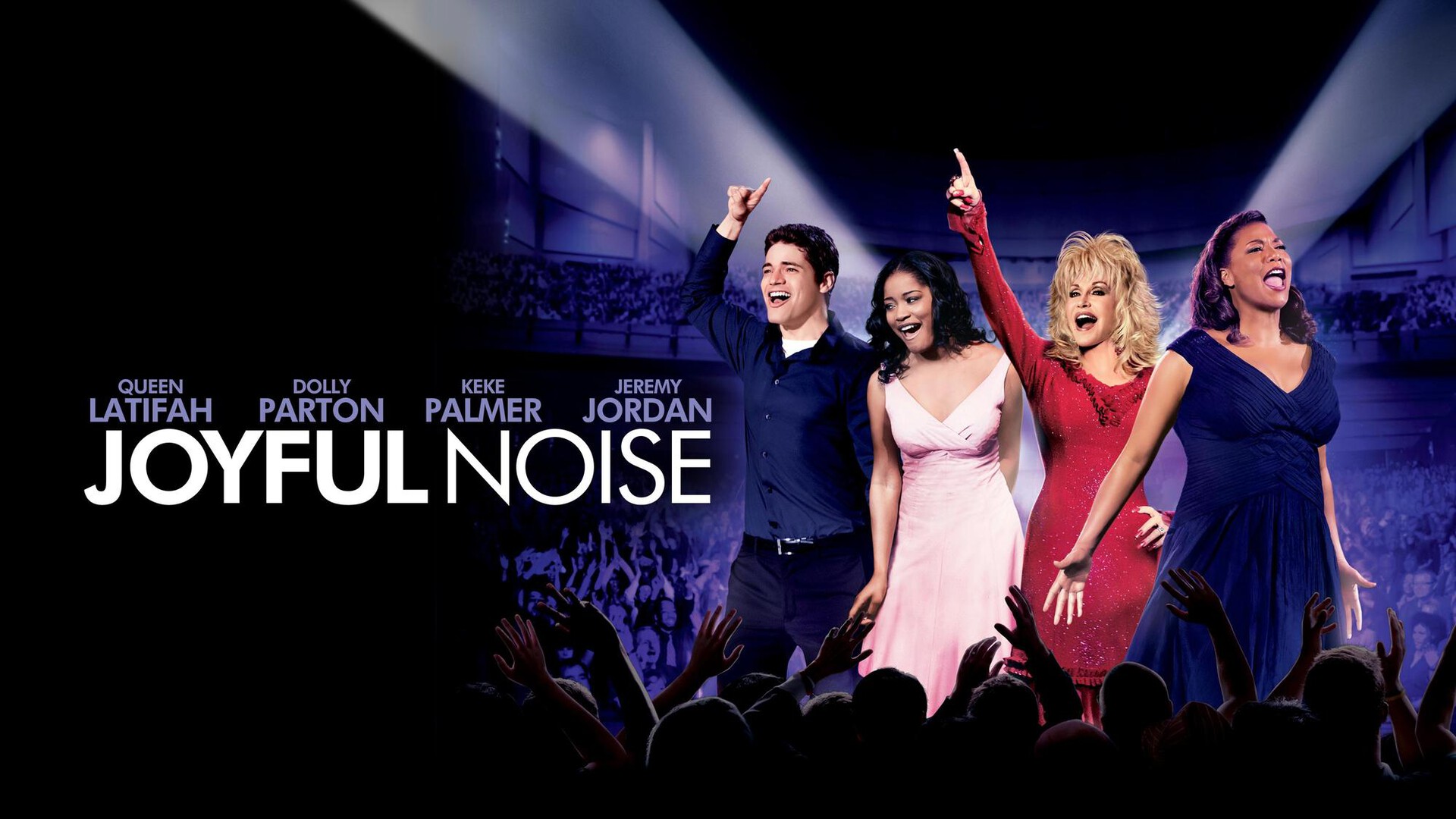
Joyful indeed — this movie is pure cinematic sunshine, guaranteed to brighten the heart and gladden the spirit.  Super-divas Dolly Parton and Queen Latifah play rival gospel choir leaders in an inspiring and heart-warming story filled with love, laughter, music, and praise.

Joyful Noise
Copyright 2012 Warner Brothers

G.G. (Parton) is still mourning the loss of her husband Bernard (Kris Kristofferson) when she receives another blow.  She expected to take over his duties as choir leader but the church council picks Vi Rose (Queen Latifah) and her more traditional approach instead.  Vi Rose’s husband is in the military and out of contact.  She has to take on extra work to support Olivia and her son Walter (Dexter Darden), who has Asperger’s syndrome that makes social interaction difficult.  She is devoted to the choir, a source of stability and connection for her.  She wants it to be competitive but it is more important to her that it be clear that the focus is on the music as worship, not performance.  When they get a chance at the national title — and a budding romance between G.G.’s grandson Randy (Broadway star Jeremy Jordan)  and Vi Rose’s daughter Olivia (Keke Palmer of Akeelah and the Bee) — G.G. and Vi Rose will have to find a way to work together harmoniously.  And that, after all, is what a choir is about.


Writer/director Todd Graff demonstrated in the underrated Camp and Bandslam that he understands teenagers as characters and works well with them as performers.  His sincere and sympathetic appreciation for their stage of life is a pleasure to experience.   Graff also understands the passion of those who love to perform before a live audience and the challenges they face.  As an experienced theater nerd himself he knows how to stage musical numbers.  And he is remarkably adept at managing a lot of characters and story lines gracefully, giving each element of the story its own dignity and spirit and sensitively evoking a touching sense of a small-town Georgia community hit hard by the economic upheavals of the past five years.  I would have excised a not-very-comic sub-plot about one choir member’s difficulty finding a date after a man dies following their first night together.  But the rest is skillfully blended with some sharp dialog.  “You’re so country you’ve been married three times and have the same in-laws,” one character teases another.  “Your train of thought makes all local stops,” says another.

Queen Latifah gives her best performance to date because Vi Rose is the most complex character she has played to date, giving her a chance to show her confidence, her humor, and her warmth.  She shines in a terrific speech about what incandescent beauty really means and sings a moving “Fix Me, Jesus.”

Parton makes a welcome return to feature films after nearly two decades in a role as tailor-made for her as her fitted choir robes.  G.G. is flashy and outspoken.  But she, too, is trying to hold on in difficult times.  She is estranged from her daughter and trying to care for her grandson.  In a scene of piercing sweetness, she remembers her life with her husband in a tender duet that gently evolves into a trio.

Jordan and Palmer are enormously appealing, with a quiet chemistry that lights up the screen.

Parton’s three tuneful new songs are mixed with raise-the-roof adaptations of gospelized classics Paul McCartney’s “Maybe I’m Amazed” and Michael Jackson’s “The Man in the Mirror.”  On stage and off, Graff shows us the characters’ kindness and sense of connection even when they frustrate each other and it feels very genuine.  There is a lot of heart in the musical numbers that deepens our pleasure in seeing the characters find what the harmony they are looking for.

Parents should know that this film includes tense and unhappy family situations, sad deaths, bullies and a brief fight, a gun, sexual references, earthy humor and a non-explicit situation, jokes about character who can’t get anyone to sleep with her because someone died after they had sex, and some strong language (b-word, s-word).

Family discussion: What was the biggest difference between Vi Rose and G.G.?  Who was right?  Find out which members of your family have participated in choirs and go to see some of the choirs in your neighborhood.

If you like this, try: “The Fighting Temptations” and “Bandslam” as well as real-life gospel performers in Soul of the Church and Rejoice and Shout and the glorious Aretha Franklin in Amazing Grace.

Related Tags:


Drama DVD/Blu-Ray Pick of the Week Family Issues Movies -- format Musical Romance Stories about Teens VOD and Streaming

The Iron Lady

Posted on January 12, 2012 at 6:43 pm

B
Lowest Recommended Age: High School
MPAA Rating: Rated PG-13 for some violent images and brief nudity
Profanity: Some strong language
Alcohol/ Drugs: Drinking, smoking
Violence/ Scariness: Some violent images including war and terrorism
Diversity Issues: A theme of the film
Date Released to Theaters: January 13, 2012
Amazon.com ASIN: B0059XTUVI

A performance by Meryl Streep of endless intelligence, skill, and sensitivity cannot keep this impressionistic portrait of Baroness Margaret Thatcher from being exactly the sort of sentimental nonsense she spent her career trying to avoid. “People don’t think anymore; they feel,” she says in this movie, with infinite disdain. “It used to be about trying to do something,” she says in an earlier scene. “Now it is about trying to be someone.” This film recognizes her point of view but then comes down on the side of feelings and of being rather than doing.

Margaret Thatcher was one of the most influential and polarizing figures of the last half-century. She was the first woman to serve as the British Prime Minister and she held the position for an extraordinary and transformational decade that included highly controversial privatization initiatives, major reductions in the power of unions, and a brief war with Argentina over the Falkland Islands.

Based on this film, however, one would conclude that she is a dotty old lady who was once fierce, peremptory, and ambitious, but now cannot quite remember what it was all about.  It is always a relief to be spared the usual biopic structure of highlighted anecdotes as a shorthand explanation for the person’s motives and fears, followed by assorted personal and professional high and low points, all conveniently assembled to create the illusion that lives can be neatly dissected.  But, as with “J. Edgar” a few months ago, this film goes too far in the other direction, leaving us with an unreliable, subjective approach.  A movie about a real life should not pretend to be definitive, but it should be illuminating.

Streep is truly magnificent, creating a vibrant character of passion and strength and her scenes with Jim Broadbent as Thatcher’s supportive husband are touching.  But without some sense of what made her so passionate and how she formed her ideas about economics and foreign policy it’s just a less glamorous version of “My Fair Lady.”  A young woman is literally groomed for success, her hair shellacked into an intimidatingly immobile helmet, her voice lowered, her accent raised.  Without a “why,” though, it’s just a trip to the ball.  It is a shame that a film produced and directed by women takes such a diminished view of Thatcher, reducing the scope of any doubts or regrets she might have at the end of her life to house and home and overlooking the fierce engagement with ideas that was truly her core.

(more…)

Related Tags:


Based on a true story Biography Drama Movies -- format

Beauty and the Beast

Posted on January 12, 2012 at 6:00 pm

A+
Lowest Recommended Age: Kindergarten - 3rd Grade
MPAA Rating: G
Profanity: None
Alcohol/ Drugs: Beer, scenes in bar
Violence/ Scariness: Some scary moments with wolves, fighting
Diversity Issues: Theme of not judging by appearances
Date Released to Theaters: January 13, 2012
Date Released to DVD: September 20, 2016
Amazon.com ASIN: B004WE01YA

“Beauty and the Beast” is one of Disney’s most beloved fairy tales and the first animated film to be nominated for a Best Picture Oscar.  This week Disney celebrates its 25th anniversary with a splendid new DVD release that includes some special extras. 

Ultimately, what makes “Beauty and the Beast” so winning, though, is its story, characters, and songs, which need no restoration.  They are as fresh as ever.  Clever lyrics by the late Howard Ashman are a delight, with a brute singing about how he decorates with antlers or the stirring Oscar-winning theme song played as the couple dances alone in an enormous ballroom.  And it is a joy to revisit the timeless pleasures of traditional Disney storytelling, with no attempts to add sizzle from celebrity voice talent or radio-friendly pop songs.  The movie’s roots are in Broadway, with performances from Tony-winners Angela Lansbury and Jerry Orbach and tuneful ballads from composer Alan Menken, including the rousing “Be Our Guest” and the joyous introductory “Belle.” Notice the way that only Belle wears blue in the opening scenes, helping to set her apart from the people in her village.  We know before she does that she and the Beast have something in common when we see that he also wears blue.

Belle (voice of Broadway star Paige O’Hara)  is the book-loving daughter of an absent-minded inventor. She wants “more than this provincial life” and the boorish hunter Gaston, who hopes to marry her.

Lost in the woods, Belle’s father stumbles into what appears to be a deserted castle. But the castle is inhabited by the angry Beast, once a prince, now under a spell that will last forever unless he finds love before he turns 21. The same spell turned all of the human staff of the castle into objects — a clock, a candelabra, a teapot, a mop.

The Beast, furious at being seen by an intruder, locks Belle’s father in the dungeon. Belle comes after her father and offers to take his place. The Beast accepts, lets her father go, and tells Belle she must stay with him forever.

At first antagonistic, she begins to find the Beast appealingly gentle and kind, wounded in spirit, rather than cruel.  He shares her love of books.  Back in Belle’s village, Gaston tries to get Belle’s father committed, saying that his talk of the Beast shows he is delusional.  Belle, home on a visit to care for her father, proves that the Beast exists to show that her father is telling the truth.  The townspeople are terrified and form a mob to kill the Beast.

In a fight with Gaston, the Beast is badly wounded. Belle tells him she loves him, which ends the spell. He becomes once again the handsome prince, and they live happily ever after.

Parents should know that this movie has some scary moments when Belle is chased by wolves and when Gaston and the townspeople storm the Beast’s castle.  It appears briefly that the Beast has been killed.  Characters drink beer and there are scenes in a bar.

Family discussion: Gaston and the Beast both wanted to marry Belle — how were their reasons different?  Why did the prince became the beast and what did he have to learn before he could return to his handsome exterior? What did Belle have to learn? What made her decide she liked the Beast?

If you like this, try: Some of the other movie adaptations of this story. One of the most lyrically beautiful of all films ever made is Jean Cocteau’s version of this story, “Belle et Bete.” The Faerie Tale Theatre version stars Susan Sarandon and Klaus Kinski, and is very well done.

Related Tags:


3D Animation Based on a book Classic Comedy DVD/Blu-Ray Pick of the Week For the Whole Family Movies -- format Musical Romance
THE MOVIE MOM® is a registered trademark of Nell Minow. Use of the mark without express consent from Nell Minow constitutes trademark infringement and unfair competition in violation of federal and state laws. All material © Nell Minow 1995-2026, all rights reserved, and no use or republication is permitted without explicit permission. This site hosts Nell Minow’s Movie Mom® archive, with material that originally appeared on Yahoo! Movies, Beliefnet, and other sources. Much of her new material can be found at Rogerebert.com, Huffington Post, and WheretoWatch. Her books include The Movie Mom’s Guide to Family Movies and 101 Must-See Movie Moments, and she can be heard each week on radio stations across the country.

Website Designed by Max LaZebnik